I sell mobile phones in Africa
If you flip the world open, on every page, there is someone starting over.
As more and more Chinese enterprises go global, a growing number of young Chinese people are relocating their lives to a whole new map.
They go to Africa to sell mobile phones, to the Middle East to develop infrastructure, to Latin America to conduct cross-border e-commerce, and to Southeast Asia to work on AI.
What they see is not just another country, but a completely different set of business logic, cultural rules, and a global landscape of opportunities being redistributed.
Today, let's follow the perspective of Zhiyuan, a post-95s young man, to step into Africa. Through a single country, we will understand the local industries and opportunities, as well as this changing world.
Interview/Writing: Banjun, Huahua
Interviewee: Zhiyuan, a post-95s generation, mobile phone supply chain practitioner, has worked in Africa for a year
I. The "Taste" of the DRC
On Tuesday night, while scrolling through X (formerly Twitter), Zhiyuan saw a notice: The Democratic Republic of the Congo would hold a nationwide temporary event on Wednesday and Friday, which locals call the "Day of Silence."
The next morning, the Chinese Embassy in the DRC also issued a safety reminder to Chinese citizens in the country: Try to stay in your residence as much as possible.
So Zhiyuan had breakfast in his bedroom, making a video call with friends on his phone. Outside the window, Kinshasa, the capital city of the DRC with a population of 20 million, instantly became both noisy and eerily quiet.
This kind of sudden shutdown is not at all strange in Africa.
Zhiyuan has been in Africa for a year. A year ago, he resigned from a leading Chinese internet company. It was a decent job with a stable income and a clear promotion path. But he increasingly felt that the domestic development environment was changing: the tracks were overcrowded, incremental growth had disappeared, and what young people could do was increasingly like involution within a stagnant stock of resources.
He wanted to find a real blue ocean market.
Later, Zhiyuan chose to join a Chinese mobile phone supply chain enterprise, and was soon dispatched to the Democratic Republic of the Congo to conduct brand promotion and localized research. This country has an extremely high proportion of young people, and the smartphone penetration rate is still on the rise. The demographic dividend is the biggest reason he came here.
The full name of the DRC is the Democratic Republic of the Congo, with a land area of 2.3449 million square kilometers, roughly equivalent to the total area of the narrow-sense Western European countries; its population in 2025 is about 112.8 million, ranking fourth in Africa; in terms of land area, it is the second largest country in Africa.
Beneath the ground of the DRC lies more than 50% of the world's cobalt reserves. Cobalt is the core raw material for the cathode of lithium batteries in smartphones, and high-purity cobalt thin films are also used in small amounts in advanced memory chips. In a sense, the smartphones in our hands are more or less related to this country.
But this connection has not made the country a better place. On the contrary, mineral resources are a curse. The eastern part of the DRC is still at war, and gunfire never ceases in those mining areas.
In the game between major powers, no one truly wants the DRC to become stable. It was colonized by Belgium for a hundred years, and the colonists only plundered resources without teaching the locals how to govern. Several generations of leaders after independence, from grassroots revolutionaries to power-hungry dictators, have failed to put the country on the right track.
The first time Zhiyuan got off the plane, a distinct smell hit him.
At first he thought it was just his psychological effect, a mental projection of a strange country. Later, all his colleagues confirmed the same thing to him: the DRC really has a unique smell. It is the smell of burning garbage.
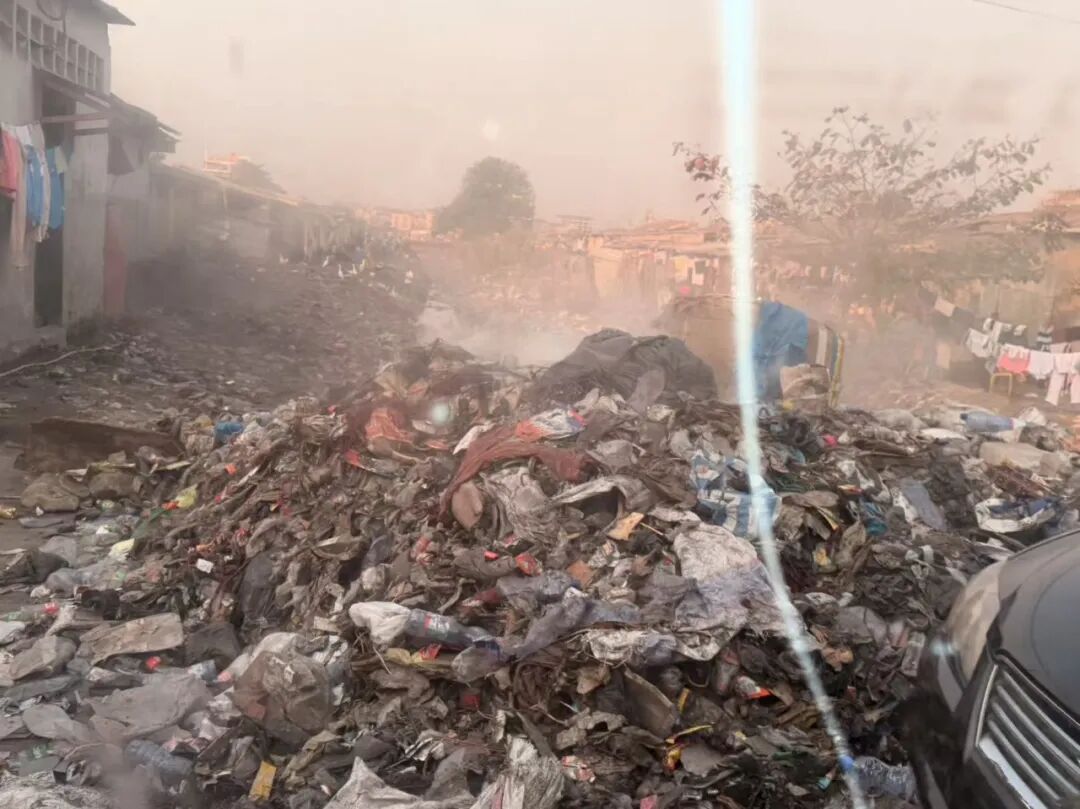
(Garbage burning sites that can be seen everywhere on the streets)
In this capital city with a population of 17 million, people usually dispose of garbage by burning it on the spot. When you drive through the streets at night, the outside is pitch black, and the only light comes from piles of burning garbage. Looking around, you can count ten bonfires along a single road. The firelight reflects the darkness, and the air is filled with the acrid smell of burning plastic.
Looking at the flickering sparks outside the window, one can't help but think of a few words: Magic Realism.
The traffic in the DRC is another kind of surreal scene. The country has imported a large number of scrapped cars eliminated from Japan, some with the steering wheel on the left and some on the right, all mixed on the same road. The road conditions are extremely poor, full of potholes. The 20-minute straight-line journey from Zhiyuan's company to his residence can take two hours when there is a traffic jam. This can even rank among the world's worst traffic jams.
Fortunately, he lives in a community with good conditions. Looking out from the window, the outside is often pitch black, and only his community is lit up. That feeling is very complicated: he knows he is enjoying a privilege that very few people have, while those people in the dark outside don't even have access to stable electricity.
In some parts of Africa, power outages are the norm. Once Zhiyuan went on a business trip to the Republic of the Congo, where there was no electricity at all for 12 hours during the day, from 7 a.m. to 7 p.m., and air conditioning could only be used with power supply at night. In more severe countries, such as Zambia, even the base stations lose power during blackouts, and mobile phone signals disappear completely. The ability to provide a stable power supply in a region has even become a bargaining chip for local election votes.
But what shocked Zhiyuan the most was not power outages and traffic jams, but prices.
He once picked up a Chinese cabbage in a supermarket, glanced at the price at the checkout counter, and it was 20 US dollars. He put the cabbage back.
In a Chinese restaurant in Kinshasa catering to foreigners, a small skewer of grilled lamb costs 3 US dollars. He made a rough calculation: if you want to maintain the same quality of life as in China's first- and second-tier cities (with complete imported goods, housing, and foreign-related services), the overall cost is about six to seven times that of China.
The global standardized cost of living rankings are always topped by Zurich and Geneva; although imported goods in Kinshasa have extremely high premiums, the overall cost of living is far lower than that of Switzerland. However, the local residents' income is extremely low, so the pressure brought by prices feels far more intense than in Switzerland.
A country with a monthly per capita income of two or three hundred US dollars has a higher cost of living and greater pressure than the richest cities in the world. This in itself is a structural disaster: there are no ports, no local agricultural systems for growing vegetables, no logistics infrastructure, everything relies on imports, and every link in the import chain is marking up prices.
This is the DRC. This is where Zhiyuan works.
II. The Channel War
As a brand representative of a mobile phone supply chain enterprise, one thing Zhiyuan thinks about every day is: What does it really mean to sell mobile phones in Africa?
First of all, it means that many of your consumers cannot afford a 100-dollar smartphone. Most of them have never owned a computer. People here jumped directly from the feature phone era to the smartphone era, skipping PCs, the internet, e-commerce, and social media accounts.
Africa is also one of the most competitive emerging markets for smartphones in the world. Chinese brands play a core role here: Transsion, Xiaomi, OPPO, vivo, plus South Korea's Samsung, constitute the main players in the African mobile phone market. They use different models, different price ranges, and different channel strategies to compete for every consumer on this continent with a population of more than one billion.
The African mobile phone market is divided into two models: the open market and the carrier market.
The open market means opening physical stores, building distribution channels, setting up storefront signs, and letting consumers walk into a dense mobile phone mall similar to Huaqiang North to pick up a mobile phone from the glass counter.
Why are dense malls the norm?
This is very similar to the early model in China. Before smartphones became popular, people had no Google Maps or food delivery apps. If they wanted to buy something, they had to go to a landmark place. Mobile phone markets naturally gather together to form dense commercial districts, similar to China's Huaqiang North, but on a much smaller scale.
The carrier market means cooperating with giant operators such as Orange and Vodacom to launch installment plans and bundled sales. African carriers are absolute monopolists: France's Orange dominates French-speaking colonial countries, and the UK's Vodafone (called Vodacom in Africa) rules English-speaking colonial countries.
These carriers are not just communication service providers. They have also developed mobile wallets similar to Alipay. On a continent without bank cards, credit cards, or a credit system, the carriers' mobile wallets are the only digital financial infrastructure.
Every player in this market is solving the same problem in different ways: How to sell a mobile phone to someone who earns two or three hundred US dollars a month?
Samsung once used a very down-to-earth approach. It reached a strategic cooperation with a financial company called Watu. Founded in Kenya, this company's services cover 8 African countries, focusing on installment loans for physical equipment such as motorcycles and mobile phones, serving ordinary entrepreneurs without credit records.
The strategy of Samsung and Watu is extremely simple: a car pulls a large bag of the lowest-end Samsung A-series mobile phones, and drives to remote villages and towns at the T4 and T5 levels. When they arrive, they set up a shed, hang the logos of Samsung and Watu, and handle installment plans on-site.
A large number of people in Africa cannot afford to pay a lump sum of 40 US dollars for a smartphone. But if you can split the payment into 6 or 12 installments, automatically deduct the money from their mobile wallet every month, and remotely lock the phone if they don't pay, those who could only use feature phones will be converted into smartphone users.
Using this ground promotion model, Samsung has forcibly expanded the smartphone market capacity in countries such as Tanzania. It is not competing for share in a stock market, but creating incremental growth, making the entire cake bigger.
Huawei Honor and ZTE took another path: carriers.
These two enterprises have To B genes themselves and have deep relationships with giant operators such as Orange and Vodacom. In carrier-dominated markets like South Africa, Honor has grabbed a considerable market share through bundled installment plans, with impressive growth rates. But outside the carrier system, it has almost no presence in the open market.
Transsion, Xiaomi, OPPO, and vivo are targeting the open retail market. But even on the same track, their strategies are vastly different.
At present, most brands still adopt a model where the headquarters uniformly outputs content and strategies, and the local team only does translation and promotion execution. This model is efficient and low-cost, but the problem is also obvious: they are always half a beat slow in responding to local consumer needs, channel changes, and unexpected situations.
All companies have realized this problem and are looking for more in-depth localized solutions.
For example, they usually find a large agent, provide funds, glass counters, and storefront signs, and let the agent purchase and distribute goods. The profit margin of mobile phones is extremely low, and they rely on high sales volume. But the problem is that almost no one is willing to be stationed locally.
What does it mean to send people to the local area? It means that Chinese employees who have received a good education, enjoyed a privileged life and environment in China, suddenly have to go to a place where the air is filled with the smell of burning garbage to work, visit stores every month, chat with consumers face to face, and understand what they really want.
It means you have people on the ground monitoring every layer of the agent's distribution, from the port to the primary warehouse, to the secondary agent, and then to the glass counter on the street.
It also means that when unexpected situations occur, such as the sudden ban on US dollars, the flash collapse of the exchange rate, or the interruption of transportation lines, you have people on the spot to respond immediately, instead of panicking at the headquarters in Shenzhen thousands of miles away.
Judging from the current overall market size in Africa, Transsion dominates the open market with its long-accumulated channel network; Samsung sinks to the bottom of the market with its brand power and installment plans; Honor and ZTE carve out a share through carrier relationships; Xiaomi, OPPO, and vivo rely on low prices to drive sales in the cracks, but they have no foundation and are unstable.
But what do consumers really want? The answer to this question is beyond the expectations of all Chinese people.
III. Sociology of African Marketing
Selling mobile phones in Africa is actually a branch of sociology.
In China, consumers discuss chips, running scores, imaging systems, and AI large models. In Africa, consumers discuss: Gold or blue? Which one is brighter? Which one looks better?
This is not because they don't care about performance, but when a person's entire income is only enough to buy a mobile phone, this mobile phone is not just a tool, it is the only luxury item. It represents your taste and your image in the crowd.
So the importance of color, texture, and appearance design far exceeds the imagination of the Chinese people.
When selling consumer goods in Africa, people naturally like gaudy and bright-colored things. Which model you promote and which color you focus on will directly affect product sales. For the same mobile phone, the sales volume of the black version and the gold version may differ by double.
Of course, it's not just about color.
Africans want large-capacity batteries, because power outages are frequent. In many cases, mobile phones are their only light source, the only entertainment device, and the only communication tool. Once the power runs out, life comes to a standstill.
They also want loud speakers, which stems from their music culture. African life is deeply tied to music, and music is played during gatherings, dances, and even when doing business. Whether the external speaker of the mobile phone is loud enough is a hard indicator.
In addition, Africans also require good photo quality, but the definition of "good" here is different from that in China. It means that the photos of black skin are clear, natural, and glossy. This requires separate algorithm tuning, and the local team specially trains models for the African market.
All these insights, including color preferences, battery capacity, speaker volume, and camera algorithms, are not thought up by the headquarters, but are developed by market managers who walk the streets to visit stores and chat with consumers one by one.
Zhiyuan has to visit dozens of stores every month. From the glass counters in Kinshasa to the street shops in Angola, from the warehouses of secondary agents to retail outlets in remote villages and towns. Every time he arrives at a store, he squats down to watch how consumers choose mobile phones, bargain, and compare different models. He chats with the shop assistants and the customers who enter the store, asking them what they want most and what they are most dissatisfied with.
"Our boss's favorite thing is to let us visit stores, get close to consumers, and gain insights," Zhiyuan said. This sounds like a clumsy method, but looking at the entire African market, few Chinese manufacturers are willing to do this.
Visiting stores is not just about looking at sales. The expression of a store manager, the length of time a customer stays, the worn position of a demo phone, and which models are piled up next to the cashier—these details cannot be provided by any backend data.
This also forms a globalization difference: Chinese mobile phone manufacturers compete on brand in Europe, on ecosystem in the United States, and on the depth of understanding of local people's lives in Africa.
On a continent where post-colonial mentality is still strong, you cannot do business with the attitude of an outsider. You have to sink in and become part of their lives.
IV. The Market with Extreme Price Sensitivity
All localization efforts and all brand building ultimately cannot avoid the most brutal variable: price.
How much direct impact can a war in the Middle East have on the consumer market far away in Africa? The