An old debt from the era of rapid expansion: Ping An Real Estate's $300 million bond maturity and the long path of transition
The countdown for debt repayment is ticking again.
Viewpoint New Media has found that Ping An Real Estate's only remaining $300 million US dollar bond is just 23 days away from maturity. The bond, numbered XS2368566829, has a size of $300 million, a coupon rate of 3.45%, was issued in July 2021, and has a five-year term.
Looking back at its price trajectory, it is strikingly similar to a rollercoaster drama.
During the industry downturn in 2023, the aforementioned bond once hit a low of 56.8 cents on the dollar, rebounded to 96.75 cents in July 2025, and now has climbed to 99.594 cents, trading almost at par value.
The recovery close to par value not only implies strong market expectations of Ping An Group's implicit support, but also reflects collective market confidence in Ping An Real Estate's asset realization efficiency, foreign exchange operation pathways, and short-term liquidity management capabilities.
However, the repayment of this bond is far more than a simple final step.
This $300 million bond, which originated during the rapid expansion era, acts like a prism, reflecting the profound transformation of Ping An Real Estate.
From 2021 to 2026, Ping An Real Estate's old high-leverage development model is gradually coming to an end, while the new holding-type asset management model is slowly taking center stage. During this transition period, all the challenges of debt restructuring, cash flow reallocation, and business rhythm alignment are converging at this critical juncture.
The maturity of the bond is both a full stop and a question mark, both an ending and a new beginning.
A Debt From the Era of Frenzied Expansion
The story traces back to 2021, the peak of Ping An Real Estate's aggressive expansion.
In June of that year, it acquired core equity stakes in six CapitaLand Raffles City complexes for 33 billion yuan, covering key cities including Beijing, Shanghai, Hangzhou, and Ningbo, making it the largest single real estate acquisition in China that year with unstoppable momentum.
However, Raffles City was just the tip of the iceberg. Before that, Ping An Real Estate had already heavily invested in leading private and state-owned real estate enterprises such as China Fortune Land, Country Garden, CIFI, Sunac, and China Jinmao through both equity and debt channels.
By simultaneously deploying capital through equity, debt, and property rights, Ping An Real Estate penetrated every link of the real estate development chain, expanding its territory wider and wider.
According to Ping An of China's 2021 annual report, the total balance of the group's insurance funds invested in real estate reached 216.138 billion yuan at that time. Among this, property rights investments (self-held properties for rental income, mainly commercial and office properties with stable returns) stood at 100.647 billion yuan, accounting for 46.57% of the total. Meanwhile, real estate equity investments (including listed company shares and project development equity) amounted to 56.863 billion yuan, and real estate debt investments (including debt plans, development financing, and non-standard debt) hit 58.628 billion yuan, with equity and debt combined making up 53.43% of the total.
On one hand, looking back at that time, the real estate market was still in the late stage of its boom, and the market did not generally anticipate the arrival of a large-scale real estate enterprise debt crisis. Ping An Real Estate followed the market trend by increasing investments across commercial office, residential, and cultural tourism sectors, attempting to leverage capital to build a larger footprint.
On the other hand, domestic real estate financing was subject to dual controls of the "Three Red Lines" and loan concentration regulations, with stock exchanges and the National Association of Financial Market Institutional Investors imposing strict quota approval and usage restrictions on domestic corporate bonds and medium-term notes for real estate entities.
In the same year, Ping An Real Estate successfully issued several domestic bonds, with the net raised funds strictly limited to "fully repaying maturing domestic bank loans and existing bonds", and was prohibited from being invested in any new projects.
In contrast, the offshore market presented a completely different picture — the financing window was lenient, low-cost US dollar funds were easily accessible, and there were fewer restrictions on the use of raised funds.
Against this backdrop, US dollar bonds almost became a "customized" channel for Ping An Real Estate's overseas expansion.
Consequently, on July 29, 2021, Ping An Real Estate simultaneously issued two senior unsecured green bonds of $300 million each. The first bond (XS2368566746) has a 2.75% coupon, matured on July 29, 2024, and was fully repaid on schedule; the second bond (XS2368566829) has a 3.45% coupon and will mature on July 29, 2026 — the one about to come due now.
These two bonds are to be repaid over two separate years. Clearly, Ping An Real Estate intended to use this staggered repayment schedule to disperse the pressure of concentrated redemption, exchanging time for operational space.
Regardless of how the repayment schedule was structured, based on Ping An Real Estate's business model and development pace back then, its core repayment logic relied heavily on the upward cycle of the real estate market, generating cash flow through rapid residential sales turnover to cover principal and interest, forming a closed loop.
However, plans never catch up with changes. Less than three months after the bonds were issued, alarms suddenly went off in the real estate industry. As giants like Evergrande and Sunac successively faced debt crises, the entire industry took a sharp downturn, and the downward cycle arrived at a speed no one had anticipated.
The two US dollar bonds that were carefully designed for staggered repayment have thus become the final two countdown bells of Ping An Real Estate's old high-leverage era. One of them ended quietly in 2024, and the other will sound its final echo in 23 days.
From Expansion Tool to Repayment Burden
The shockwaves from the real estate industry inevitably spread to Ping An. After all, as the once largest "backer" of the sector, it was impossible to stay unaffected.
A landmark case is reflected in China Fortune Land.
In 2021, the debt default of this enterprise brought tens of billions of yuan in impairment losses to Ping An; in the same year, Ping An of China recorded 43.2 billion yuan in impairment provisions related to its China Fortune Land investments, directly dragging down the group's annual profits significantly. During the same period, Ping An Real Estate's net profit also dropped from 5.645 billion yuan in 2020 to 4.989 billion yuan.
In the following years, disposing of non-performing assets and making impairment provisions almost became an annual routine. By the end of 2025, Ping An's risk exposure to China Fortune Land had reached 54 billion yuan, with remaining related exposure still standing at 10.8 billion yuan. The market value of its equity holdings has shrunk by over 90% compared to the cost, and disputes between the two parties are still ongoing.
From CIFI and China Fortune Land to China Jinmao... These names that were once "strategically invested" in by Ping An Real Estate with fanfare later appeared on the impairment list year after year.
Looking at physical projects, the old renovation project of Hedong Village in Liwan District, Guangzhou, was a typical residential reserve asset during Ping An Real Estate's expansion period. However, residential property prices in the area have continued to decline, the sales cycle has lengthened, and the funds spent on demolition and construction have been continuously draining cash flow, resulting in investment returns far below expectations.
In 2024, Ping An Real Estate listed its full 30% equity stake in this project on the property rights exchange for transfer.
The financing side also faced difficulties. In October 2023, Moody's downgraded Ping An Real Estate's issuer rating from "Baa2" to "Ba1", and Ping An Real Estate Capital's issuer rating from "Baa3" to "Ba2", with both ratings carrying a "negative" outlook.
Moody's stated that the main reasons for the downgrade were: first, the sluggish residential market would affect future investment returns; second, troubled legacy real estate projects would lead to increased impairment losses; third, although Ping An Real Estate has shifted its business focus to long-term investment properties and reduced the scale of residential properties, this will extend the investment period and cash conversion cycle.
In response, Ping An Real Estate issued a statement claiming that "overall risks are under control". However, it is undeniable that with the effective closure of the offshore US dollar bond market for Chinese real estate enterprises, the once smooth path of "borrowing new funds to repay old debts" has been blocked.
As a result, the perfectly structured chain of "using leverage to expand scale and relying on turnover to cover principal and interest" that Ping An Real Estate carefully built back then is no longer feasible. Only two channels remain for debt repayment: asset disposal and shareholder support.
Therefore, in 2024, a string of projects including the Hedong Village old renovation project in Liwan (Guangzhou), Gemdale Songzhuang project in Tongzhou District (Beijing), Xinshitou project in Haizhu (Guangzhou), and the Huadu TOD project (Guangzhou) were all put up for transaction.
At the beginning of the same year, Ping An Bank urgently added a comprehensive credit line of 8 billion yuan for Ping An Real Estate, with a 1-year term, specially used to supplement liquidity and cover maturing domestic and overseas debt repayments.
The market generally believes that this 8 billion yuan credit line was the core liquidity tool "tailor-made" for the $300 million US dollar bond maturing in July 2024. The credit line was launched exactly five months before the maturity date of that US dollar bond, and its timeline fully aligned with the fundraising cycle for overseas debt.
Amid the shift of market cycles, the leverage tool that was once used for rapid expansion has become a heavy burden on its shoulders. In 2024, Ping An Real Estate survived the crisis relying on credit lines and asset sales.
Two years later, the same $300 million overseas bond has once again entered its countdown phase, and the second round of large-scale debt repayment pressure has arrived as scheduled.
How Robust Is the New Model?
In June 2022, a key personnel reshuffle took place quietly within Ping An Real Estate: Jiang Daqiang took over as Chairman, Tang Bensheng was appointed as General Manager, and former Chairman Lu Guiqing stepped down from his position.
The arrival of the new leadership coincided with the intersection of the implementation of new insurance regulations and the in-depth adjustment of the real estate industry, sending a clear signal.
What followed was a brand new business policy: "Focus on investment, ensure orderly exit from non-performing assets, strengthen asset management, reduce costs and improve efficiency". Simply put, this means no longer blindly expanding, but focusing on revitalizing existing assets, digesting legacy risks, and solidifying asset management capabilities.
In addition, at Ping An's 2022 and 2023 performance conferences, Chief Investment Officer Deng Bin repeatedly conveyed the same signal to the public: the group will no longer make new residential development investments or add new credit-related equity and debt investments in real estate enterprises, and will only allocate self-held property assets that generate stable and continuous rental cash flow.
This means that within Ping An Real Estate's system, residential development will be closed out once legacy issues are resolved, and new funds will only be invested in income-generating assets.
Several years have passed, the slogan has been put into practice, and the practice has been translated into data. What is the current situation of Ping An Real Estate?
Viewpoint New Media's research shows that Ping An Real Estate has largely exited residential development and equity/debt investments in real estate enterprises.
The most intuitive change can be seen on its official website, where the original sections of "residential cooperative development, equity and debt investment in real estate enterprises" have been completely removed, replaced by four self-held business tracks: urban commercial office, industrial logistics, indemnificatory rental housing, and senior care communities.
Data source: Corporate financial reports, Viewpoint Index compilation
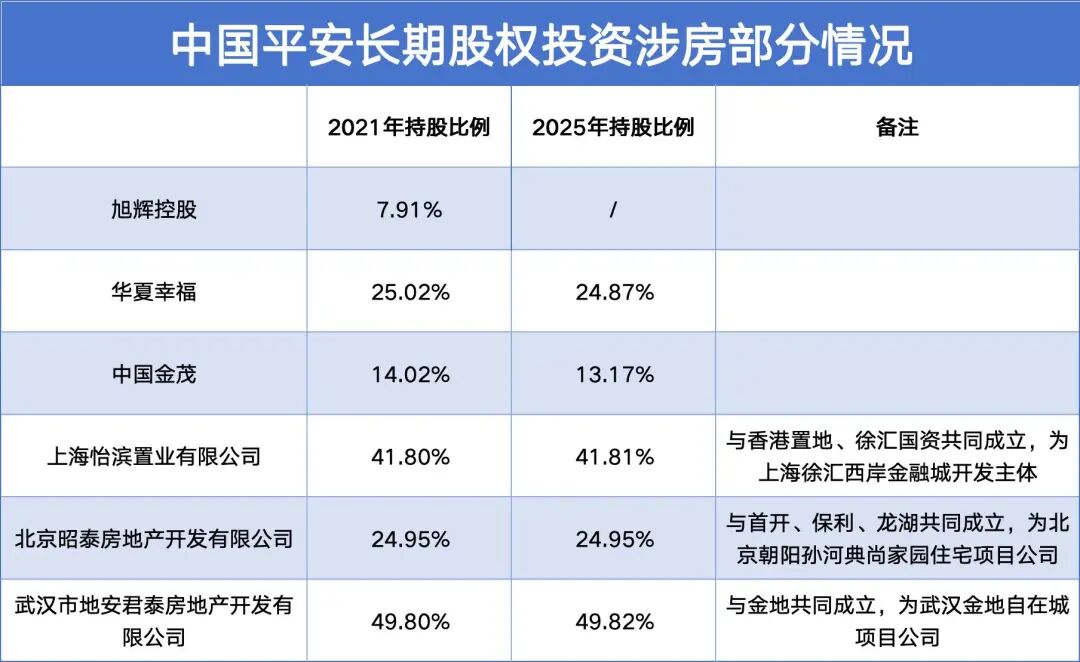
However, the transformation did not happen overnight. According to Ping An of China's 2025 financial report, among its long-term equity investments, Ping An still holds a 24.87% equity stake in China Fortune Land and a 13.17% stake in China Jinmao. Legacy risks have not been fully cleared, and old accounts are still being settled.
In terms of core commercial assets, Ping An's asset base remains solid. It currently holds core properties including the Shenzhen Ping An Finance Center (PAFC), Chengdu and Wuhan Ping An Finance Centers, six Raffles City complexes, and the Shenzhen iN City Mall.
In addition, Ping An Real Estate has reached a long-term strategic cooperation with China Resources Mixc Lifestyle. The commercial complex of Foshan Ping An Center is in the final stage of construction, scheduled to open in September 2026, and will be operated by the Mixc brand team.
In the industrial logistics sector, Ping An acquired four industrial parks in Beijing and Shanghai for 7.333 billion yuan in 2023; in 2025, it acquired three high-standard logistics warehouses of Blackstone in Dongguan and Foshan for 1.8 billion yuan. It also simultaneously developed and self-operated the Tongxiang Ping An New Economic City and Chengdu Airport Logistics Park.
Some analysts believe that logistics is the only incremental sector that Ping An Real Estate has continuously increased its investment in from 2022 to 2026, with no plans to scale back operations.
The indemnificatory rental housing sector has also begun to take shape. By the end of 2023, Ping An Real Estate had launched 18 projects, with a total of over 20,000 units and an asset management scale of 16 billion yuan. In 2024, it expanded new benchmark projects such as the Jiading Lingfeng project in Shanghai, entrusting operation to the Home Inn Group's Cjia Apartment to strengthen its light-asset model.
The senior care sector has evolved from initial pilot exploration to upgraded development: in the early stage, it adopted a "lease + sale" model to test the market, and in 2025, the "Yiniancheng" senior care project in Shanghai was launched in the core area of Jing'an District. Targeting high-net-worth customers with a premium threshold of 18.88 million yuan, it integrates resources from Huashan Hospital and Japanese-style refined nursing services, attempting to form a closed-loop ecosystem of "insurance + medical care + senior care".
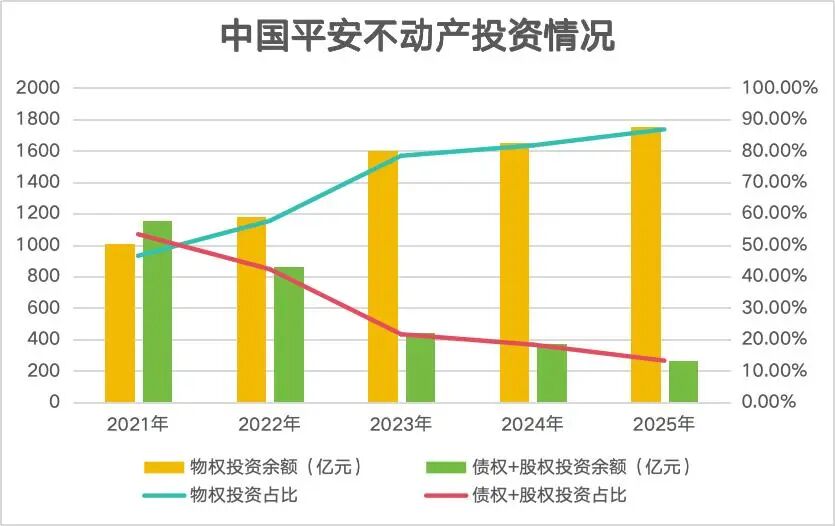
From a data perspective, by the end of 2025, the total balance of Ping An of China Group's insurance funds invested in real estate reached 202.187 billion yuan. Among this, the proportion of property rights investments has increased significantly from 46.57% in 2021 to 86.8%, while equity and debt investments have been reduced to 13.2%. Residential-related equity and debt investments have been almost completely cleared out, and the "overhaul" of the asset structure has been largely completed.
Data source: Corporate financial reports, Viewpoint Index compilation
Nevertheless, the cost of transformation is equally clear. Ping An Real Estate's bond financial reports have only been updated to the mid-2024 period, with no new disclosures since then. According to this latest financial report, in the first half of 2024, the company's total operating revenue was only 365 million yuan, down 32.77% year-on-year; total profit was 60.41 million yuan, plummeting 92.4% year-on-year, almost a tiny fraction of its peak performance.
In other words, the rental income generated by new assets remains meager, and the endogenous cash flow gap is significant. The repayment of this $300 million debt still cannot avoid the old path of "group implicit support".
However, the market has fully anticipated this, as the recovery