In this city, the price of luxury properties has surged by over 14 times
In the first half of 2026, the luxury residential market remained stable.
According to statistics from "Ding Zuyu's Property Market Review", a total of 17,910 high-end residential units with a total value of over 10 million yuan were transacted across 35 key cities in the first half of the year.
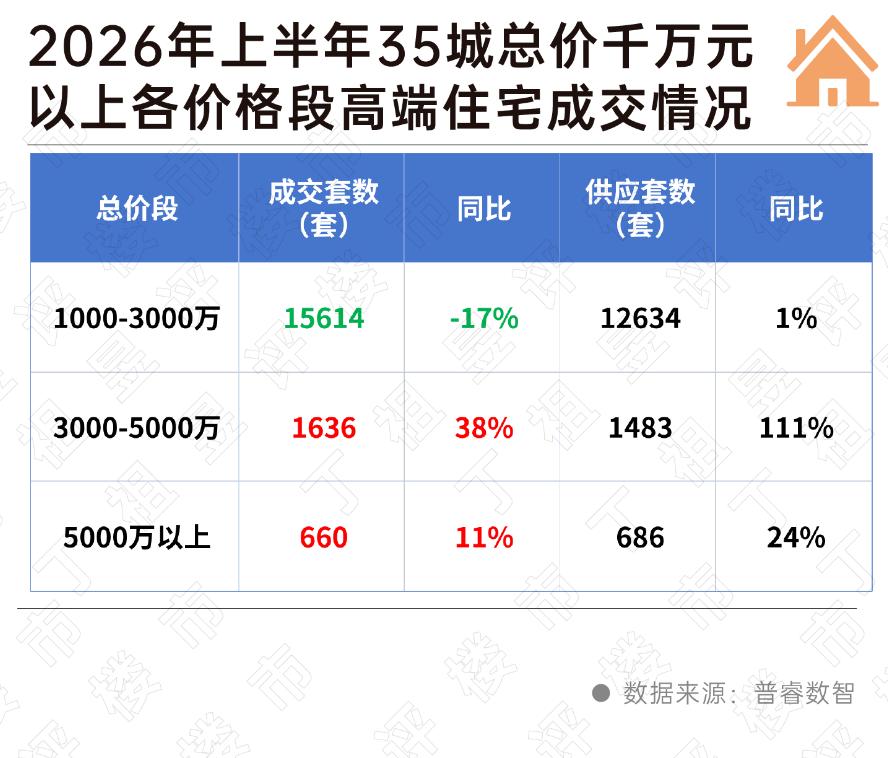
Among them, 15,614 high-end residential units in the 10-30 million yuan price range were sold, accounting for 87% of total transactions of 10-million-yuan-level luxury homes, but representing a 17% year-on-year decline.
In contrast, transactions in the 30-50 million yuan and above 50 million yuan price ranges both increased. The former saw 1,636 units sold in the six-month period, up 38% year-on-year; the latter recorded 660 units sold, a 11% year-on-year growth.
From a supply perspective, in the first half of the year, the 35 key cities saw 12,634 units supplied in the 10-30 million yuan price range, a slight 1% year-on-year increase; the 30-50 million yuan segment had 1,483 units supplied, surging 111% year-on-year, demonstrating a scenario of "prosperous supply and demand"; the above-50 million yuan segment recorded 686 units supplied, up 24% year-on-year, with an overall basically balanced supply and demand.
At the individual city level, the high purchasing power capable of supporting luxury residential products remains highly concentrated in a small number of core first- and second-tier cities.
For example, in the four first-tier cities of Beijing, Shanghai, Guangzhou and Shenzhen, a total of 11,749 high-end residential units priced above 10 million yuan were transacted in the first half of the year, accounting for 65.6% of the national total. Among them, Shanghai took the lead, leading the country with 4,922 units sold, though marking a 29.3% year-on-year decline.
Beijing, Shenzhen and Guangzhou recorded 3,046, 2,211 and 1,570 units transacted respectively, with year-on-year changes of -29.6%, 25.48% and -1.80%.
Among second-tier cities, Hangzhou delivered a standout performance, with 2,516 high-end residential units priced above 10 million yuan sold in the first half of the year, representing a 40% year-on-year growth. Its transaction volume ranked third among the 35 key cities, second only to Shanghai and Beijing.
Other cities that made it into the top 10 include Chengdu, Xiamen, Nanjing, Ningbo and Qingdao. These five cities recorded 791, 435, 391, 367 and 354 units transacted respectively in the first half of the year, with year-on-year changes of 7.62%, 39.87%, -3.93%, -54.96% and 12.38%.
It is worth noting that in the first half of the year, Shenzhen saw 619 high-end residential units priced above 30 million yuan transacted, a staggering 247% year-on-year surge. This growth was mainly driven by three projects: Yun Xi in Shenzhen Bay, Guan Chao Fu and CITIC City Development Xin Yue Wan, which together contributed 495 units in total transactions.
Hangzhou also demonstrated remarkable momentum in its luxury residential market, with 203 high-end residential units priced above 30 million yuan transacted — a figure 14.5 times that of the same period last year.
It is understood that from the fourth quarter of last year to the first half of this year, a number of high-priced land plots were auctioned in core first- and second-tier cities, such as the Xuhui Riverside plot in Shanghai, the Ma Chang plot in Zhujiang New Town of Guangzhou, the Olympic Sports plot in Hangzhou, as well as the Yuehai plot, Guiwan plot and North Bao'an New Neighborhood plot in Shenzhen.
It is not difficult to foresee that the level of intense competition in the high-end residential sector across major cities will only become increasingly fierce going forward.
"Ding Zuyu's Property Market Review" points out that the concentrated boom in the high-end market segment above 30 million yuan in this round is not simply driven by increased purchasing power. More importantly, the substantial expansion of supply has filled the gap in high-end product supply in the market, enabling the long-pent-up demand for high-net-worth asset allocation to be released in a concentrated manner.
However, this growth window for the high-end market may not last long. On one hand, the high-end housing units entering the market in a concentrated manner are depleting the existing pool of targeted customers. On the other hand, a large number of high-priced land plots will continue to be converted into new high-end supply. Under the combined effect of these two factors, competition in the future high-end residential market will become white-hot. Only projects that occupy scarce urban locations, boast outstanding product quality, and have pricing aligned with market expectations can gain a firm foothold in the fierce competition.
This article is from the WeChat Official Account "Leju Finance", written by Zhao Panpan, and published by 36Kr with authorization.