The "Saidei Moutai" That Cannot Thrive Beyond Xinjiang, Losing Its Throne as the "Wine King of Northwest China"
On one hand, Xinjiang's local market continues to shrink, and on the other hand, the market outside Xinjiang is stagnating. Since 2020, Yilite has failed to meet its annual business goals for six consecutive years.
1
Stock Price Falls Back to Levels of a Decade Ago
"Could you tell us about your company's plans to grow stronger in the future, and how do you view the shareholders' reaction to today's sharp plunge in Yilite's stock price?"
"The company has announced share increase and repurchase plans, why has there been no action taken yet? Are there any measures in place to stabilize the stock price?"
Even after rolling out a series of initiatives such as a leadership reshuffle and major shareholder share increases, Yilite, known as the "Moutai Beyond the Great Wall," still failed to stop the continuous sharp decline in its stock price. As of the latest trading day, Yilite's stock closed at 9.88 yuan, with a market capitalization of 4.684 billion RMB, marking a decline of over 30% in 2026. Looking at a longer time horizon, Yilite's stock price has hit a new low in a decade (since May 2016).
After ten years, the stock price has returned to its original starting point, which has prompted small and medium investors of Yilite to leave continuous messages on interactive platforms, with every line filled with astonishment and unwillingness over their unmet expectations.
The sharp shrinkage in operating performance is obviously a major reason why Yilite has faced investors "voting with their feet" in the secondary market. Data shows that for the full year of 2025, Yilite recorded revenue of 1.722 billion yuan, down 21.82% year-on-year, which was the largest annual revenue decline since the company went public. At the same time, the company achieved net profit attributable to shareholders of 216 million yuan, down 24.29% year-on-year.
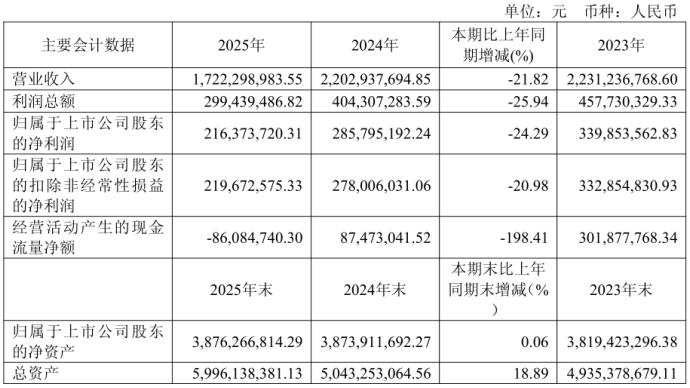
Regarding the reasons for the decline in operating performance, Yilite stated in its annual report that in 2025, China's Baijiu industry ushered in a new round of policy adjustments, with multiple conflicts in the industry becoming prominent: the problem of overcapacity persists while the market demand growth rate slows down; insufficient consumer momentum coupled with high channel inventory has led to price inversion for some products, and the batch price of high-end Baijiu once came under pressure. The weakening of consumption scenarios has further increased industrial growth pressure, and the industry is accelerating its bottoming-out process. Affected by the new round of industry policies in the Baijiu market, the company's growth rate started to slow down from the second quarter, which is consistent with the overall trend of the industry.
Just as Yilite said, China's Baijiu industry delivered a full-year performance report full of chill in 2025. Statistics show that for the whole of 2025, 20 major listed Baijiu companies achieved a total operating revenue of about 365.461 billion yuan, down 18.6% year-on-year; the total net profit attributable to shareholders reached about 127.171 billion yuan, down 24.4% year-on-year. Against the backdrop of the intensifying Matthew effect in the industry, the profits of the Baijiu industry are further concentrated among leading enterprises, and the living space for mid- and low-tier Baijiu companies is further compressed.
In this drastic industry reshuffle, Yilite's performance is particularly dismal, with both its revenue and net profit decline rates exceeding the average level of mainstream Baijiu brands. Statistics show that among the 20 listed Baijiu companies, Yilite ranks only 15th in revenue scale and 14th in net profit attributable to shareholders.
Entering 2026, Yilite's downward operating momentum has not improved. In the first quarter of 2026, Yilite recorded revenue of 606 million yuan, down 23.79% year-on-year; net profit reached 105 million yuan, down 27.26% year-on-year. In terms of quarterly performance, Yilite's revenue has seen negative year-on-year growth for eight consecutive quarters.
Facing the continuous decline in operating performance, Yilite has carried out a top leadership adjustment. On December 15, 2025, Yilite issued an announcement stating that former chairman Chen Zhi applied to resign from his position as chairman and other related positions due to approaching the statutory retirement age, and the successor is the company's general manager Li Qiang. This marks another senior management change at a listed Baijiu company, following brands such as Yanghe Co., Ltd., Jinzhongzi Liquor, Zhenjiu Lidu, and Kweichow Moutai.
After the management adjustment, Yilite's stock price failed to stop falling, and its controlling shareholder immediately announced the launch of a new round of share increase plans. On April 23, 2024, Yilite announced that Xinjiang Yilite Group Co., Ltd. (referred to as "Yilite Group"), a wholly-owned subsidiary of the company's controlling shareholder and actual controller, plans to invest 100 million to 200 million yuan to increase its holdings in Yilite without setting a price range.
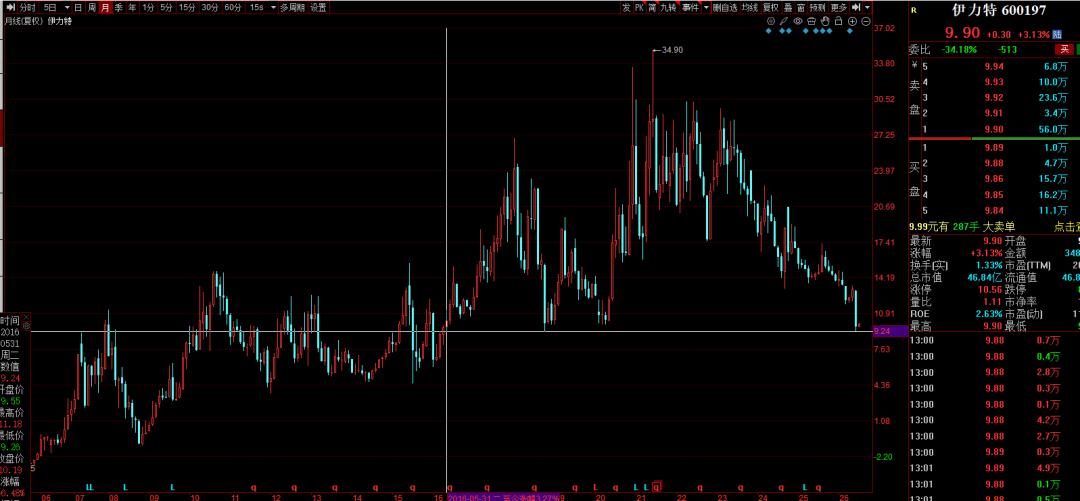
However, in the face of the 100 million-yuan share increase plan proposed by the controlling shareholder and the core management adjustment, secondary market investors did not buy in. Especially after the financial report showing the "double decline" in revenue and net profit was released, Yilite's stock price accelerated its downward movement.
Some analysts believe that Yilite's stalling operating performance is not only negatively affected by the industry cycle, but also exposes a series of deep-seated structural crises, such as the obstruction in its high-end product upgrading and the poor expansion of markets outside Xinjiang. In other words, the deterioration of fundamentals is the fundamental reason for the continued weakness of Yilite's stock price.
2
From a Military Reclamation Workshop to "Moutai Beyond the Great Wall"
Different from many time-honored local famous Baijiu brands, the predecessor of Yilite was just a crude liquor-making group established in 1955 by the sideline processing factory of the 10th Regiment Farm of the Xinjiang Production and Construction Corps.
It is reported that among the 16 members of the liquor-making team at that time, only one person had experience in making liquor in his hometown. In the end, the military reclamation soldiers overcame the difficulties of material shortage, made their own equipment, rebuilt workshops, and successfully trial-produced the first pot of liquor using indigenous methods. They officially started production in 1956 and named the product "Yili Daqu".
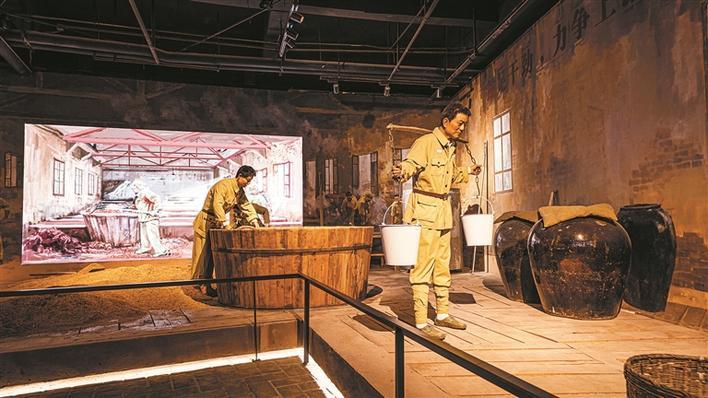
In 1957, the original liquor-making group was separated from the processing factory and relocated to Xiaoerbulak County, Ili Prefecture, officially establishing the "10th Regiment Distillery". After that, the 10th Regiment Distillery quickly demonstrated a keen awareness of technology, actively introducing college students majoring in liquor-making to improve production processes. With this technological advantage, Yilite quickly won market favor and became a household name Baijiu across Xinjiang.
It is reported that Ho Chi Minh, the President of Vietnam, visited Xinjiang in February 1959. Tao Zhiyue, then commander of the Xinjiang Production and Construction Corps, received him with the self-made "Yili Daqu" from the Corps. During the dinner, President Ho Chi Minh praised "Yili Daqu" nonstop, and the reputation of "Xinjiang Moutai" spread far and wide from then on.
Later, the 10th Regiment Distillery was renamed successively as "72nd Regiment Yili Daqu Distillery" and "Xinjiang Ili General Distillery", and successively developed and launched products such as Yilite Brew, Yili Laojiao (Yili Old Cellar Liquor), and Yili Aged Brew. In the 1990s, during the golden decade of the Baijiu industry, Yilite's sales continued to rise, ranking first in the sales revenue of Baijiu in Northwest China for many consecutive years, establishing its status as the "Northwest King".
In 1999, Xinjiang Ili General Distillery was restructured into Xinjiang Yilite Industrial Co., Ltd. and successfully listed on the A-share market, becoming the 10th listed Baijiu enterprise in China. Since then, Yilite, which carries the red genes of the Corps, has also become a characteristic brand representing Xinjiang's excellent ecological quality.
After entering the capital market, Yilite once attempted diversified expansion, and successively dabbled in multiple fields such as coal chemical industry, building materials, and printing. However, in the face of fierce market competition, Yilite soon realized that its main business is the foundation of its survival, so it decisively divested non-core businesses and refocused its strategic center on the Baijiu main business. In 2019, Yilite's revenue reached 2.302 billion yuan, and its net profit reached 447 million yuan, ranking 13th and 11th among listed Baijiu enterprises that year respectively. In comparison, another Northwest Baijiu company, Jinhui Liquor, recorded revenue of 1.634 billion yuan and net profit of about 272 million yuan in the same year.
However, since 2020, the relatively strict epidemic prevention and control policies in Xinjiang have had a huge impact on consumption scenarios such as banquets, gatherings, tourism, and gift-giving in the region, and Yilite's operating performance has been significantly affected. Data shows that from 2020 to 2022, Yilite's revenue was below 2 billion yuan for three consecutive years, and its business goals were repeatedly missed.
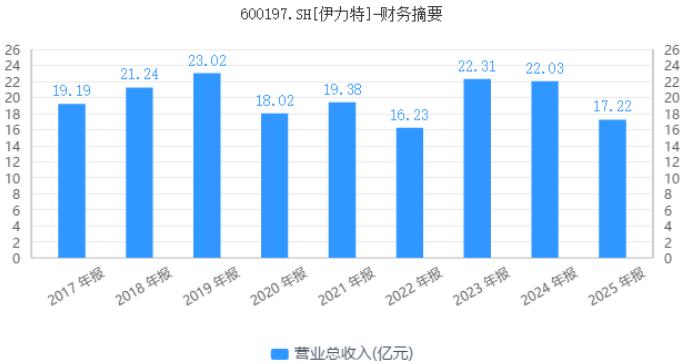
At the same time, in the face of the strong boom of the sub-high-end Baijiu market, Yilite's management at that time failed to keenly capture the market trend, resulting in the company's serious lag in the layout of high-end and sub-high-end Baijiu products, and eventually missed the best window period for the structural upgrading of the Baijiu industry. After a short-term recovery in 2023, Yilite's revenue continued to decline from 2024 onwards, and its revenue scale never exceeded the peak level of 2019.
3
Missed the Sub-high-end Market, Stagnating Outside Xinjiang
In terms of revenue composition, Yilite's product line covers high, medium, and low grades. High-end products include Yili Wangjiu (Yili King Liquor), No.1 Cellar, Yili Sealed Jar, and Yili Laojiao series, accounting for over 60% of revenue; mid-range products include Yili Aged Liquor and Yili Tequ series, accounting for about 20% of revenue; low-end products mainly include Yili Daqu and Yili Chun series, accounting for less than 10% of revenue.
The 2025 annual report data shows that Yilite's high, medium, and low-grade Baijiu all experienced a full decline. Among them, high-end Baijiu including Yili Wangjiu and Yili Laojiao series achieved revenue of 1.281 billion yuan, down 16.16% year-on-year; mid-range Baijiu recorded sales of 307 million yuan, with a year-on-year decline of as high as 39.25%; low-end Baijiu achieved revenue of 99 million yuan, down 26.45% year-on-year.
Due to the accelerated decline of mid- and low-end Baijiu, the proportion of Yilite's high-end Baijiu in total revenue has risen to 74.42% in 2025, an increase of 20 percentage points compared with ten years ago. However, in terms of sales revenue, the revenue scale of Yilite's high-end Baijiu has peaked and declined since 2019. In contrast, local Baijiu brands such as Gujing Gongjiu and Jinshiyuan have achieved substantial growth. That is to say, Yilite's current performance dilemma is not simply caused by the cyclical downturn of the industry; its deep-seated problems lie more in the internal drawbacks of its own strategy and product structure.
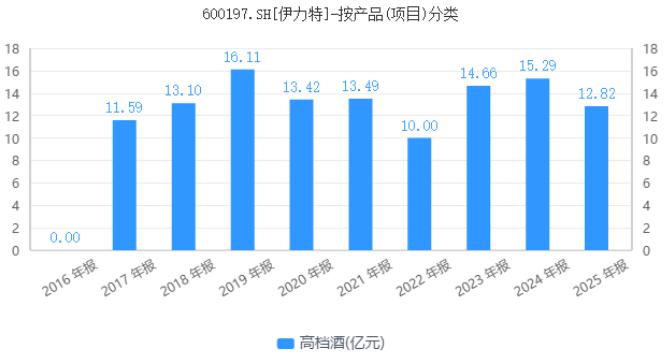
As is well known, the sub-high-end Baijiu market is a strategic springboard for local famous Baijiu brands to break through regional barriers and realize national layout, and it is also a key fulcrum to support the leap of brand value. However, due to the failure in the layout of the sub-high-end Baijiu market, Yilite is currently facing a passive situation of stagnation in markets outside Xinjiang.
As a regional Baijiu enterprise, Yilite put forward the slogan of "Stepping out of Xinjiang" very early, and successively opened up markets in Lanzhou, Xi'an, Zhejiang and other places. Data shows that as early as 2018, Yilite's revenue from markets outside Xinjiang exceeded 500 million yuan. In 2020, Yilite's revenue from markets outside Xinjiang even reached a historical high of 590 million yuan. After that, with the impact of the COVID-19 epidemic, Yilite's revenue from markets outside Xinjiang experienced three consecutive declines, and the scale of revenue fell back below 500 million yuan.
In 2023, Yilite once again proposed the "Hundred Cities Assault" strategy, planning to cover 100 cities within three years, promote the layout of markets outside Xinjiang, and quickly build 1-3 model markets with sales of 100 million yuan in East China and Central China. Data shows that from 2023 to 2024, Yilite's revenue from markets outside Xinjiang reached 489 million yuan and 571 million yuan respectively, with year-on-year growth rates of 5% and 17%. In 2024, the revenue from markets outside Xinjiang accounted for 25.90% of Yilite's total revenue.
But in 2025, Yilite's market outside Xinjiang suffered a severe setback. Data shows that for the whole of 2025, Yilite's revenue from markets outside Xinjiang was 304 million yuan, a sharp decline of 46.64% year-on-year. The significant shrinkage of scale also caused the proportion of Yilite's revenue from outside Xinjiang to drop below 20% again.
