A group of meat sellers break into the pet food track
On pet food shelves, "fresh meat" is becoming an increasingly prominent selling point.
Whether it's cat food or dog food, a growing number of products are highlighting information such as fresh chicken, fresh duck, and the proportion of fresh meat added on their packaging. Some brands go a step further by labeling "0 meat meal", "0 grains", and "0 bone meal", attempting to bring pet food standards closer to those of human food.
This has also presented a new business opportunity for a group of meat enterprises that originally served the human dining table.
JIEMIAN News has learned that Jinluo's pet food subsidiary, Chong'aijia Pet Food (Shandong) Co., Ltd., has recently officially launched its 200,000-ton annual output pet food project in Linyi, Shandong Province.
Founded in 1990, Jinluo is a meat enterprise headquartered in Linyi. It operates 11 production bases across China, with an annual slaughter capacity of 20 million pigs and 200 million broilers, producing 2 million tons of meat and meat products and processing 500,000 tons of soybeans per year.
Jinluo is not the only meat enterprise that has set its sights on the pet food sector. Over the past two years, meat giants including Shuanghui, Wen's, Delisi, and Sunner have successively entered this track through investments, partnerships, or joint factory construction. Meat enterprises that once competed for the human dining table are now extending their business to cat and dog food.
Behind this cross-border expansion of production capacity is the active layout of China's meat giants in the pet industry in recent years. In addition to Jinluo, which directly operates its own brand and builds factories through a wholly-owned subsidiary, several other enterprises have joined the fray through investments and collaborations.
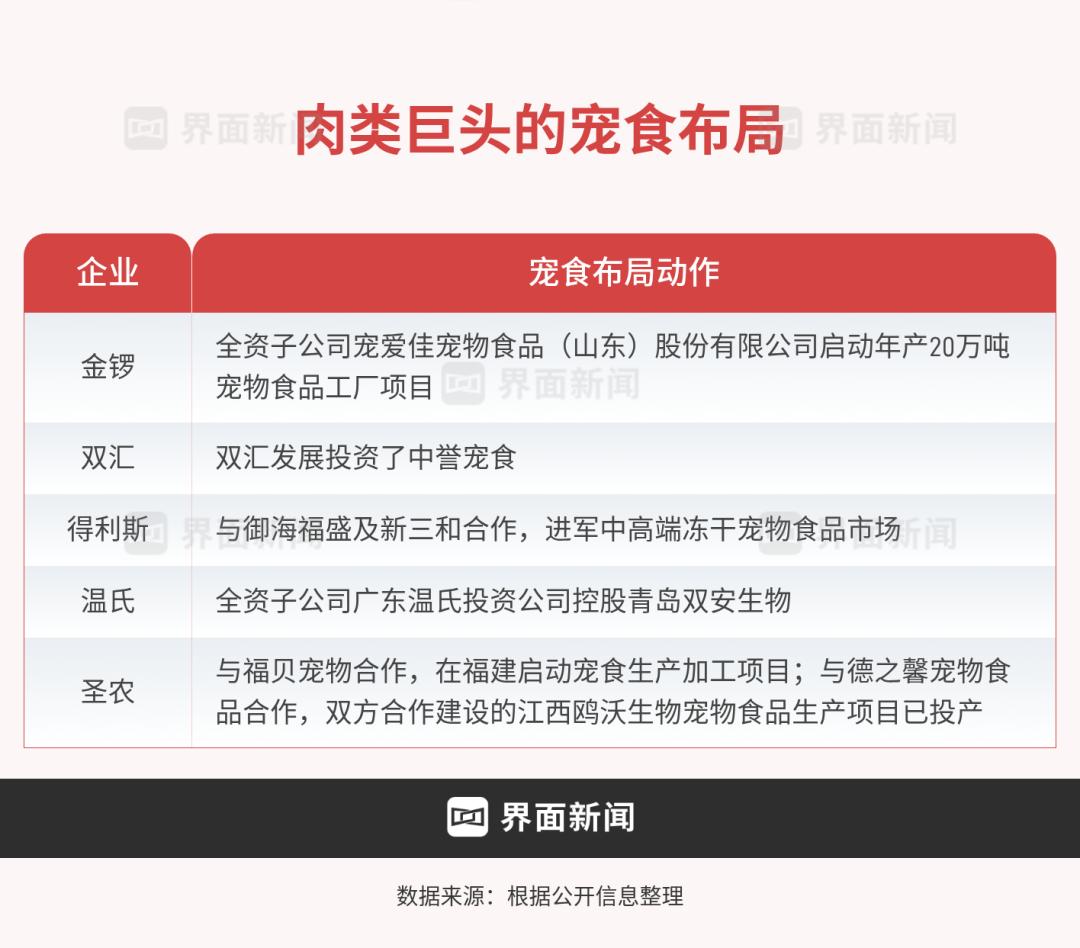
Chart produced by: JIEMIAN News, Ma Yue
For example, Wen's Co., Ltd. announced in February this year that its wholly-owned subsidiary Guangdong Wen's Investment Co., Ltd. had taken controlling stake in Qingdao Shuang'an Biotechnology, becoming the largest shareholder of this pet food company; Shuanghui Development announced in September 2025 that it had led the 100-million-yuan Series B+ financing for Zhongyu Pet Food; Delisi announced in August 2025 that it had reached a strategic cooperation with freeze-drying technology giant Haifusheng and Xinsanhe to jointly enter the mid-to-high-end freeze-dried pet food market; Sunner signed a strategic cooperation agreement with Shanghai Fubei Pet in January 2024 to launch a pet food production and processing project in Pucheng County, Nanping, Fujian Province.
The logic behind meat giants venturing into the pet industry is not difficult to understand.
One reason is that the pet food market still appears to have considerable room for growth. According to the *2026 China Pet Industry White Paper (Consumer Report)*, the consumption market size of urban pets (dogs and cats) reached 3.126 trillion yuan in 2025, a 4.1% increase over 2024; the number of urban dogs and cats stood at 126 million in 2025, a year-on-year increase of 1.8%. Pet food accounted for 53.7% of this market share. According to Euromonitor data, the compound annual growth rate of China's pet food market will reach 9.64% from 2025 to 2028.
Against the backdrop of weak meat consumption and intensified stock competition in the industry, meat enterprises facing performance pressure are eager to find new growth drivers.
For instance, Shuanghui Development's revenue has experienced slight declines for three consecutive years from 2023 to 2025, and its meat product revenue has also shrunk for three consecutive years; Delisi suffered large losses for two consecutive years from 2023 to 2024 before turning profitable in 2025.
From catering to human consumption to feeding "fur kids", these meat enterprises are actually leveraging their advantages in raw material supply chains and production.
"Leading meat enterprises like Jinluo and Shuanghui entering the pet industry is essentially an extension of their product categories based on their advantages in supply chains, costs, and production capacity. In particular, the supply chain advantages of leading enterprises, through their own farms, can effectively use other parts of meat to produce pet food on the basis of their core business, greatly reducing product costs," Lin Yue, chief consultant of Lingyan Management Consulting, told JIEMIAN News.
It is worth noting that the locations of Jinluo and Shuanghui's new pet food production projects are very close to their existing production bases. The Chong'aijia factory is located within Jinluo's own Linyi slaughtering industrial park; Zhongyu Pet Food's park in Luohe, Henan Province, is only about 1.8 kilometers away from Shuanghui's facilities. This proximity reduces cold chain costs, and chicken breast, chicken frames, and other by-products from Shuanghui's slaughtering process are highly compatible with the poultry protein requirements of pet food.
In October 2025, the secretary of the board of Shuanghui Development, when answering investor questions, stated that the company is cooperating with Zhongyu Pet Food on fresh meat supply and has no plans to launch its own pet food brand at present.
A distinctive advantage of large meat enterprises in producing pet food lies in the raw materials for fresh meat-based pet food.
"Fresh meat" has become a prominent selling point in the current pet food market, referring to the use of fresh meat as raw material, which is different from frozen meat, meat meal, etc. In actual products, fresh meat pet food usually commands a higher price.
JIEMIAN News visited supermarkets such as Hema and Wumart in Beijing and found that cat and dog food using fresh meat formulas emphasize this selling point on their packaging, indicating the proportion of fresh meat, and even claiming "0 bone meal", "0 grains", and so on. For example, a Hema private-label freeze-dried three-mix complete fresh meat cat food lists 85% fresh chicken and 1.5% fresh chicken liver in its ingredient list.
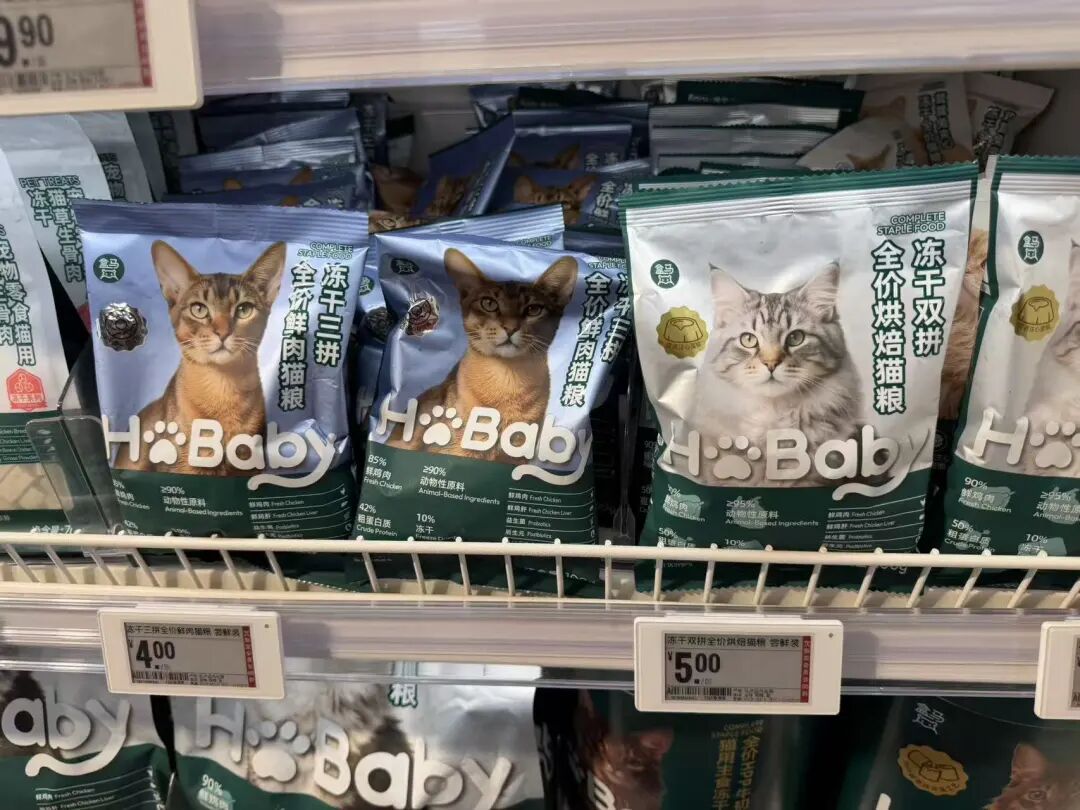
Hema Freeze-dried Three-mix Fresh Meat Cat Food, Photo by JIEMIAN News, Ma Yue
Meanwhile, Wumart's shelves also feature NetEase Yanxuan's complete dog food, whose ingredients mainly include frozen chicken, beef meal, and chicken meal. Calculated by kilogram, this product costs 18 yuan per kilogram, which is only half the price of Wanpy's fresh meat complete dog food on the same shelf, priced at 36 yuan per kilogram.
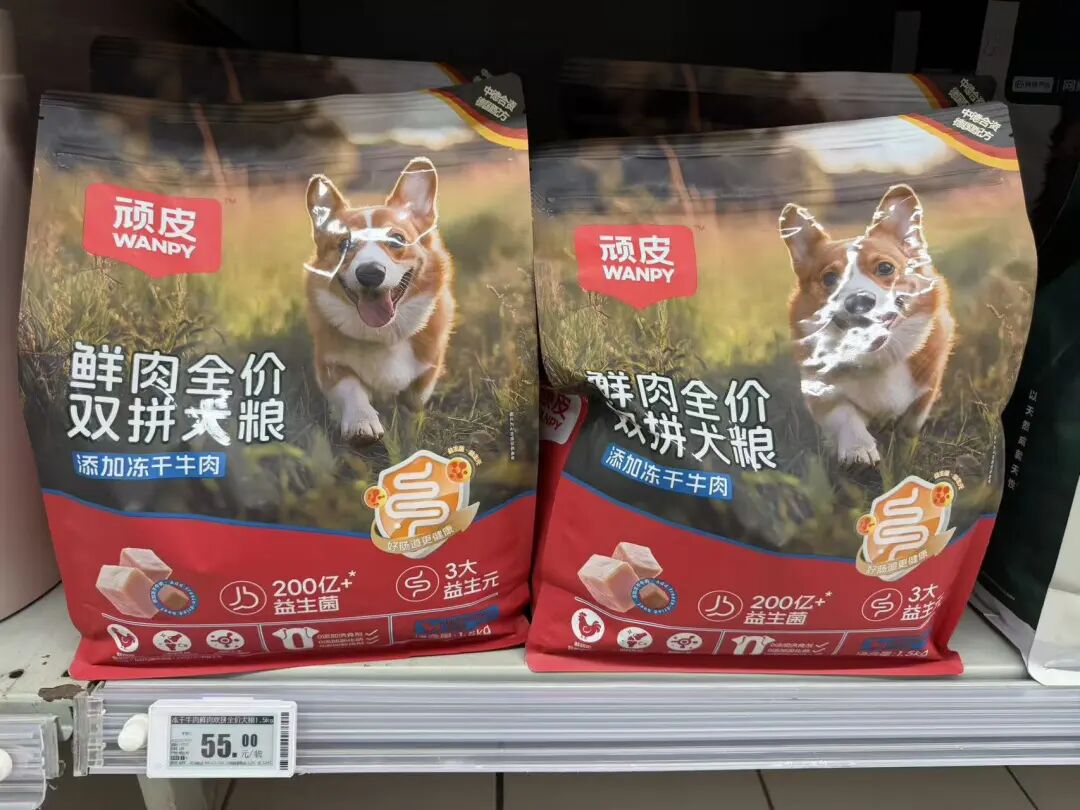
Wanpy Fresh Meat Dog Food, Photo by JIEMIAN News, Ma Yue
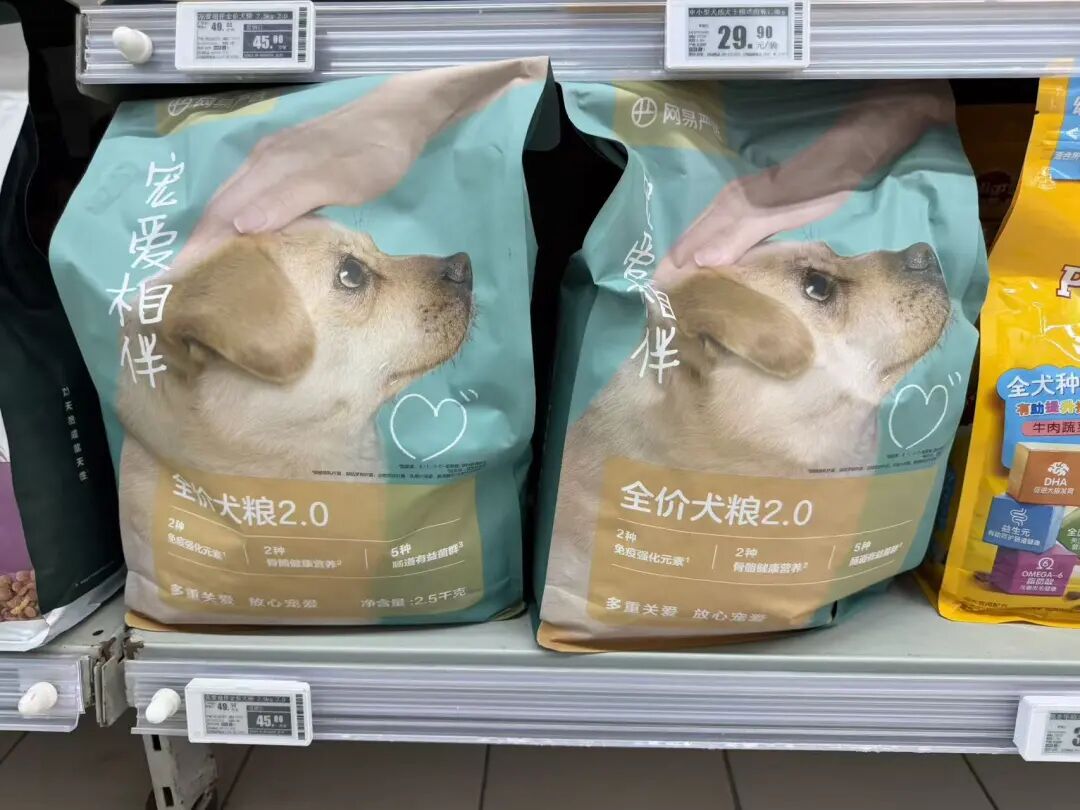
NetEase Yanxuan Dog Food, Photo by JIEMIAN News, Ma Yue
"In the future, there will be a clearer distinction between fresh meat and frozen meat pet food," Peng Han, founder of pet brand Gaoyejia, told JIEMIAN News in an interview. "Fresh meat is directly sent from the pre-cooling slaughterhouse to the factory to make cat food, which is fresher. Frozen meat is not necessarily so. Good frozen meat is also of good quality, but meat frozen for a week, a month, or even a year or two is all called frozen meat. It's not that frozen meat is bad, but the key lies in temperature management during the freezing process."
Peng Han told JIEMIAN News that fresh meat production places higher demands on equipment, but currently such equipment in China is very mature, with numerous equipment suppliers providing complete solutions.
The difference between using fresh meat, frozen meat, or even meat meal lies not only in product positioning but also in production costs.
Generally speaking, the dry powder meat meal feeding process only requires ordinary normal-temperature raw material warehouses, no meat pre-treatment equipment, and no temperature control measures, resulting in the lowest equipment investment, shortest process, and lowest loss; the frozen meat raw material area needs to be equipped with a -18°C freezer; the fresh meat direct feeding process requires a closed cold storage for fresh meat below 4°C, with high freshness requirements. In addition, fresh meat has a high water content, leading to a lower yield rate during production than frozen meat and dry powder formula production lines, which results in higher management difficulty and costs.
For a long time, a major pain point in China's pet food market has been the lack of transparency in raw materials.
According to a 2024 investigative report by CCTV Finance, Nanhe District in Xingtai City, Hebei Province, as the largest pet food production base in China, has seen a large amount of low-quality pet food enter the market. The investigation found that falsely labeling ingredient lists has become a common practice for low-cost pet food manufacturers. The so-called fresh chicken is actually chicken meal, or even feather meal as a substitute, and some illegally add montmorillonite.
The entry of more meat giants like Jinluo and Shuanghui into the competition can, to a certain extent, build differentiated competitive barriers. Relying on their entire industrial chain system of self-breeding, slaughtering, and processing, meat enterprises can achieve independent control and full traceability of core raw materials for pet food, solving industry pain points such as unstable raw material quality and supply cycle fluctuations from the source, and improving the stability and safety of the industry's supply chain.
A trend is that China's pet industry is gradually transforming from small workshop-style low-price competition to industrialization. Lin Yue told JIEMIAN News in an interview that the entry of upstream supply chain giants will also accelerate the reshuffling of the pet industry, increasing industry concentration. Brands without core supply chains or relying on OEM production will find it difficult to survive.
However, with the expansion of production capacity, competition in the pet food industry is shifting to quality and brand competition. In a market environment where companies compete on formulas and R&D, cross-border meat enterprises still lack accumulation in R&D, channels, and brand marketing. How to truly transform their supply chain and production capacity into products with brand premium is a proposition that these meat enterprises need to continuously address.
This article is from the WeChat official account "JIEMIAN News", author: Ma Yue, editor: Ya Han, published with authorization from 36Kr.