Revealing the Average Wages in 19 Provinces: Who Is Propping Up the Ceiling?
Recently, multiple regions across China have successively released the 2025 annual average wage data for employees in urban work units. As of now, 19 provincial-level administrative regions have published the relevant statistics.
According to the released data, the average wage across all regions is still maintaining a growth trend.
Among them, the annual average wage of employees in urban non-private units in Tianjin has reached 149,507 yuan, temporarily ranking first nationwide; Guangdong recorded 143,284 yuan, exceeding 140,000 yuan for the first time; Zhejiang and Jiangsu stood at 141,902 yuan and 134,969 yuan respectively, continuing to occupy the top tier nationwide.
Among private units, Guangdong takes the leading position with 83,930 yuan, followed closely by coastal provinces such as Zhejiang, Jiangsu and Fujian.
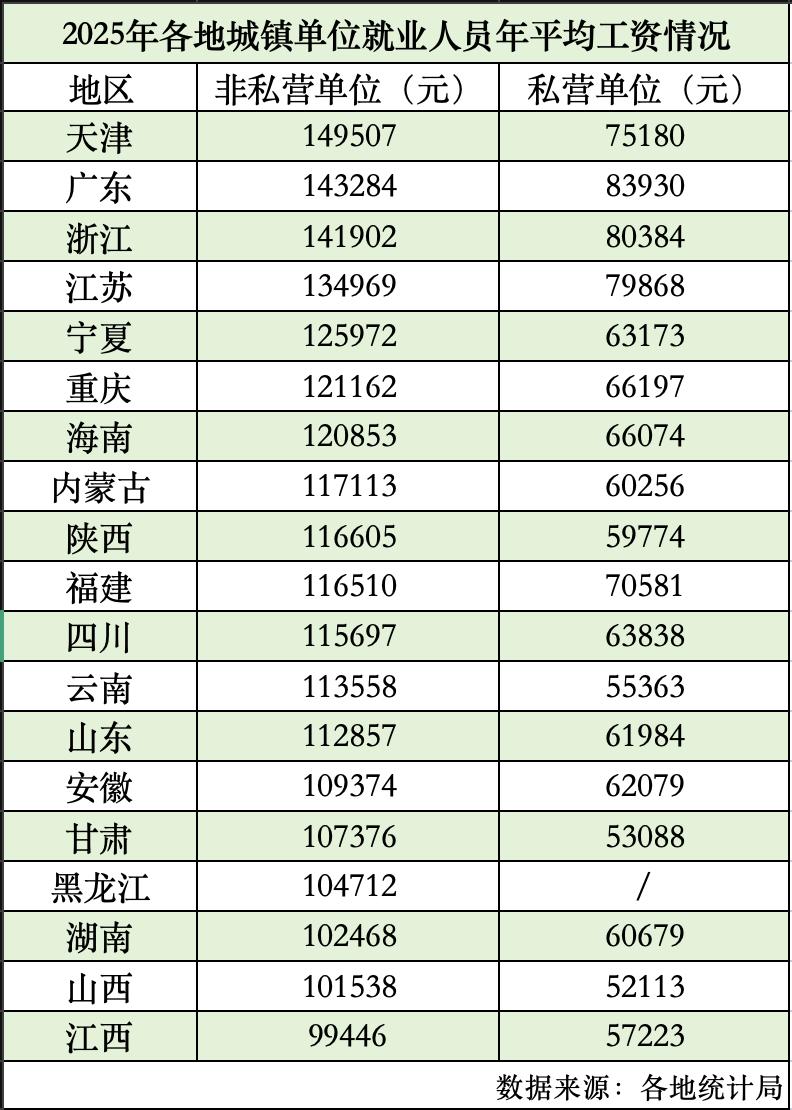
2025 Annual Average Wage of Employees in Urban Work Units Across Different Regions
The average wage hits a new record almost every year. However, while the statistical data keeps rising, individual perceptions do not fully align with this trend.
When compiling the latest data from all regions, a question that may deserve more attention than "how much wages have increased" is:
Who exactly is driving up the average wage of Chinese workers?
01
The Manufacturing Industry Sees the Fastest Wage Growth
In terms of industries with concentrated high wages, the internet and financial sectors still maintain high wage levels. Notably, the manufacturing industry has become the field with the fastest wage growth in recent years.
Take Guangdong as an example: in 2025, the annual average wage of employees in urban non-private units reached 143,284 yuan. Among all sectors, the information transmission, software and information technology services industry ranked first with an annual average of 270,000 yuan, while the financial sector and mining industry recorded 263,000 yuan and 261,000 yuan respectively.
However, across all industries, the manufacturing sector has the fastest wage growth rate, with its annual average wage rising from 110,484 yuan in 2024 to 120,883 yuan, marking a 9.4% year-on-year increase.
This trend is not unique to Guangdong.
Data from the National Bureau of Statistics shows that in 2025, the average wage of employees in urban non-private units and private units in the national manufacturing industry increased by 5.2% and 6.4% year-on-year respectively, 0.9 and 3.4 percentage points higher than the overall wage growth rate, making it a key force driving the growth of average wages.
Behind the rising wages in the manufacturing industry lies the ongoing transformation of the industrial structure.
In recent years, advanced manufacturing sectors such as new energy vehicles, intelligent robots, integrated circuits and new materials have developed rapidly, attracting a continuous influx of high-skilled talents including a large number of R&D personnel, algorithm engineers and industrial software engineers. The manufacturing industry is increasingly expanding into high-value-added segments such as R&D, design and intelligent manufacturing, with a growing number of high-paying positions directly pushing up the overall wage level of the industry.
From a horizontal perspective, major manufacturing provinces still firmly occupy the high-wage territory.
The average wages of non-private units in Guangdong, Jiangsu and Zhejiang all rank among the top nationwide. Further observation of the five-year wage growth rate in the manufacturing industry of these three regions shows that it is generally faster than the overall local wage growth rate.
The common underlying feature is the high concentration of advanced manufacturing and strategic emerging industries.
Jiangsu has been continuously developing industries such as new energy, biomedicine, high-end equipment and industrial software, promoting the steady expansion of high-value-added manufacturing; leveraging the advantages of the digital economy and private economy, Zhejiang maintains a leading position in fields including digital trade, intelligent manufacturing and the platform economy; Guangdong, relying on industries such as new energy vehicles, electronic information and artificial intelligence, continuously attracts R&D talents to gather.
At the same time, "taking a factory job" has become a new choice for a growing number of young people.
The 2025 China Undergraduate Employment Report shows that the average monthly income of the 2024 cohort of undergraduate graduates after entering the manufacturing industry reached 6,755 yuan, a 25% increase compared with five years ago, and the wage advantage of the manufacturing industry has expanded for three consecutive years.
Recruitment data released by 51job shows that the recruitment demand for advanced manufacturing represented by intelligent manufacturing and semiconductors continues to grow. In 2026, the recruitment share of intelligent manufacturing rose to 14.88%, ranking first among all industries.
A research report from Renmin University of China predicts that by 2035, among the "purple-collar" positions in the manufacturing industry, the proportion of talents with a bachelor's degree or above will increase from 28% in 2022 to 57%.
The traditional manufacturing industry, which once relied on manual labor, is gradually evolving into a key sector that absorbs highly educated and high-skilled talents, and has also become an important force driving up the average wage in China.
02
Competitive Industries Are Reshaping the Wage Map
In addition to industrial changes, the wage structure between different regions and different types of work units is undergoing new transformations.
Based on the currently published data, wages in non-private units are still significantly higher than those in private units.
The average wage of non-private units in Guangdong reaches 143,284 yuan, while that of private units is 83,930 yuan, with a gap of nearly 60,000 yuan between the two; the figure for non-private units in Jiangsu is 134,969 yuan, more than 50,000 yuan higher than that of private units; similar situations can also be observed in regions such as Fujian, Chongqing and Anhui.
This gap does not mean a decline in the competitiveness of private enterprises, but rather that non-private units in the statistical scope not only include government agencies and public institutions, but also a large number of state-owned enterprises, scientific research institutes and large listed companies.
These units usually have more stable salary systems, higher talent density and greater R&D investment, with more concentrated high-paying positions, resulting in a higher overall average wage.
In a sense, high-paying positions are increasingly concentrated in large-scale work units and high-value-added industries, and this change is reshaping China's wage landscape.
Among the 19 provincial-level regions that have released data so far, Tianjin ranks first in the non-private unit wage ranking with 149,507 yuan, while Guangdong, Zhejiang and Jiangsu form the second tier; in the private unit category, Guangdong takes the top spot with 83,930 yuan.
Combined with data from recent years, Beijing, Shanghai, Guangdong, Jiangsu and Zhejiang still form the top tier with the highest wages nationwide, whose advantages mainly stem from the headquarters economy, modern service industry and advanced manufacturing.
At the same time, some regions that were relatively low-profile in the past have begun to catch up rapidly by leveraging their respective strengths.
The average wage of non-private units in Ningxia, Chongqing and Hainan has all exceeded 120,000 yuan.
Among them, the annual average wage of the mining industry in Ningxia has reached 235,000 yuan, far higher than other industries, highlighting the prominent advantages of resource-based industries; the information transmission, software and information technology services industry in Chongqing has for the first time surpassed the financial sector to become the local industry with the highest wages, shaping wage advantages through industrial upgrading.
The wage growth rates of Hainan's agriculture, forestry, animal husbandry and fishery industry, mining industry, as well as wholesale and retail industry all reached double digits, which is mainly driven by policies. Analysis from the Hainan Provincial Bureau of Statistics believes that the continuous advancement of Hainan Free Trade Port construction, the development of key industrial parks, energy security and the concentrated launch of major projects have driven the rapid development of the secondary industry, and also promoted wage growth in related industries.
In fact, the wage increase in these regions not only represents the growth of residents' income, but also means that different regions have begun to form their own high-wage industrial support systems.
Ningxia relies on the energy and mining industries, Chongqing relies on the digital economy and information industry, and Hainan benefits from the investment and industrial agglomeration brought about by the Free Trade Port construction. Although different regions take different paths, their common feature is that competitive industries continue to create more high-paying positions, driving the continuous increase of local average wages.
03
What Does the Average Wage Mean?
However, the continuous rise of average wage does not mean that everyone's income is growing at the same rate.
The statistical caliber of average wage refers to the total pre-tax labor remuneration for the whole year, which is not equal to the actual take-home income of employees each month. It includes not only the basic salary, but also bonuses, performance pay, allowances, overtime pay, year-end bonuses, as well as individual income tax, social insurance and housing provident fund withheld and paid by the work units.
The main reason why the average wage released by local statistical departments is inconsistent with the perception of most ordinary people is that the average value itself is easily affected by high-income groups. The more concentrated high-income industries and high-paying positions are in a region, the easier it is for the overall average wage to be driven up, while the income level of a large number of ordinary positions may still be below the average.
Therefore, compared with the average wage, the median wage usually better reflects the real income level of ordinary workers, but most regions do not release median wage data.
In addition, the statistical objects of average wage are mainly employees in urban work units, excluding a large number of self-employed individuals, flexible employees and some workers in new forms of employment, so it cannot be simply equated with the per capita disposable income of residents.
For this reason, the greater significance of the "average wage" does not lie in answering how much money each person earns, but in reflecting the changing trend of a region's industrial structure, employment quality and economic development.
Judging from the 2025 data that has been released, wages in China are still maintaining growth, indicating that high-quality employment brought by industrial upgrading is still constantly increasing. But at the same time, income differentiation between industries, regions and different types of work units still exists, and with the development of high-tech industries, this structural difference may further expand.
For a city, paying attention to which industries can continuously provide high-quality employment and how many ordinary workers can share the income growth brought by industrial upgrading may be the matter that deserves more attention.
This article is from the WeChat Official Account "City Reading Studio", written by Wang Chenting, edited by Liang Li, and published with authorization from 36Kr.