The battle for seizing new ADC assets has begun.
When ADCs became the most crowded track in the pharmaceutical industry, with continuous BD deals and giants busy in an "arms race", Novartis stood out as an "outlier", always adhering to a distinct development philosophy: no blind following of trends.
Back in 2024, Novartis made it clear that it believed the ADC track was plagued by excessive internal competition and not worth heavy bets. Of course, this was not a denial of ADCs themselves, but rather Novartis' reluctance to pour massive capital into a pile of "lookalike" assets in an increasingly competitive space.
Staying calm does not mean permanent absence. Two years later, Novartis finally made its move.
On July 6, UK-based biotech firm Myricx Bio officially announced its acquisition by Novartis. The total transaction value can reach up to $1.5 billion, with $1.1 billion as upfront cash consideration and the remainder as potential milestone payments.
This acquisition is not contradictory to Novartis' previous strategy. Myricx Bio is a highly representative innovative enterprise in the ADC space, with its core highlight being the N-myristoyltransferase inhibitor (NMTi) payload platform featuring prominent differentiated advantages, targeting current pain points in the ADC industry such as homogeneity, drug resistance, and safety issues.
In other words, Novartis has always understood that in a rapidly changing industry landscape, to achieve steady development, it must stick to its core logic and build differentiated competitive barriers. This is exactly where the value of novel ADC assets lies.
Novartis' proactive entry without following trends may signal that the tide has turned. A battle for differentiated high-quality assets has officially begun.
The Longstanding Issues of ADCs
The ADC track continues to gain momentum, but the long-unresolved fundamental shortcomings of the industry have not been eliminated accordingly.
Drug resistance, dose-limiting toxicity, and insufficient efficacy are three unavoidable mountains weighing on existing ADCs. The root causes are complex, spanning multiple dimensions including molecular design, inherent target properties, and the tumor microenvironment, ultimately converging on the three core components of ADCs: antibodies, toxin payloads, and linkers.
For example, even after multiple iterations of effective payloads in the industry, the current mainstream microtubule inhibitors and DNA-damaging toxins still have hard-to-break ceilings.
Toxicity is the most intuitive clinical constraint. Excessive toxic side effects force clinical dose reduction or treatment suspension, making it impossible for toxins to reach effective killing concentrations at the lesion, directly undermining therapeutic effects.
A single mechanism of action is another critical flaw. Existing toxins rely heavily on cell division and DNA replication to exert effects, resulting in weak lethality against dormant cancer stem cells and tumors with highly drug-resistant phenotypes.
The drug resistance issue is also closely related to the payload itself. Tumor cells can significantly weaken toxin lethality through target gene mutations and downregulated antigen expression. For instance, TOP1 mutations make tumors resistant to TOP1 inhibitor payloads like DXd and SN-38; tubulin isoform variations can block the binding pathways of microtubule inhibitors such as DM1.
As Mohit Rawat, CEO of Myricx Bio, stated: "There are a large number of unmet clinical needs. The market urgently needs a new generation of ADC payloads to raise current treatment standards, address payload-related resistance, improve drug tolerance, and broaden the therapeutic window."
It is precisely against this backdrop that Myricx Bio caught Novartis' attention.
A New Solution for Payloads?
Novartis' acquisition has directly pushed the novel NMTi-ADC payload platform into the industry spotlight.
The so-called NMTi-ADC is a new generation ADC that uses N-myristoyltransferase inhibitor (NMTi) as its toxin payload, with a fundamentally different underlying mechanism of action from existing products on the market.
NMT is an upstream key enzyme regulating cellular protein modification, responsible for attaching myristoyl lipid chains to hundreds of intracellular proteins. Most of these proteins are core drivers of tumor proliferation, invasion, and survival, covering a range of hard-to-target entities including the Src kinase family, RAS/RHO small GTPases, AKT/PDK1, and MYC/MYCN transcription factors.
The mechanism of NMTi is clear: it specifically suppresses NMT enzyme activity, blocking the myristoylation modification of key cancer cell proteins. Without lipid chain modification, these proteins cannot achieve proper membrane localization, lose their original oncogenic functions, and ultimately drive tumor cell apoptosis.
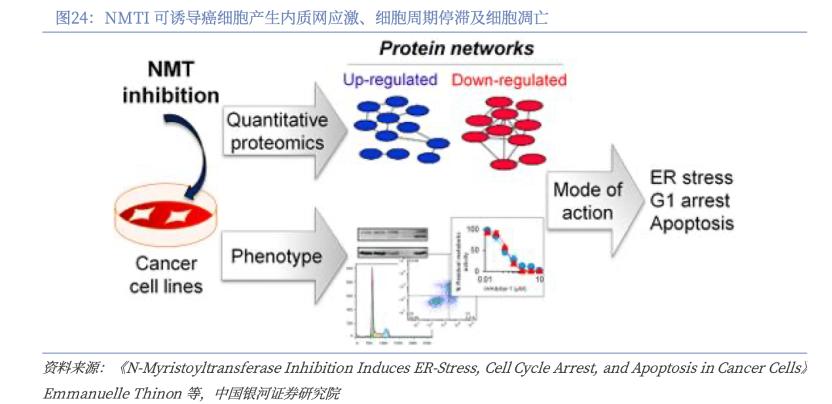
This pathway is not a theoretical fantasy, as its value has been validated by a commercialized drug: Asciminib, the world's first marketed drug targeting the myristoylation modification mechanism. While traditional TKIs crowd the competitive ATP binding pocket and easily induce drug resistance, Asciminib takes a different approach by targeting the myristoyl pocket of BCR-ABL1 to achieve allosteric inhibition, without occupying the ATP site. It effectively combats drug-resistant BCR-ABL targets, achieving a breakthrough in druggability for previously untreatable targets.
NMTi-ADC essentially integrates the mature NMTi mechanism into the ADC delivery framework. By conjugating the inhibitor to a tumor-specific monoclonal antibody via a linker, it is precisely delivered to the lesion to inhibit protein myristoylation, disrupt the function of oncogenic signaling proteins, and directly trigger tumor apoptosis.
Theoretically, NMTi is almost a perfect next-generation ADC payload, with its core advantages directly addressing industry pain points.
First, it has broad-spectrum anti-tumor potential, covering multiple solid tumors including triple-negative breast cancer, HER2 low-expression breast cancer, endocrine/traditional ADC-resistant prostate cancer, colorectal cancer, pancreatic cancer, and lung cancer;
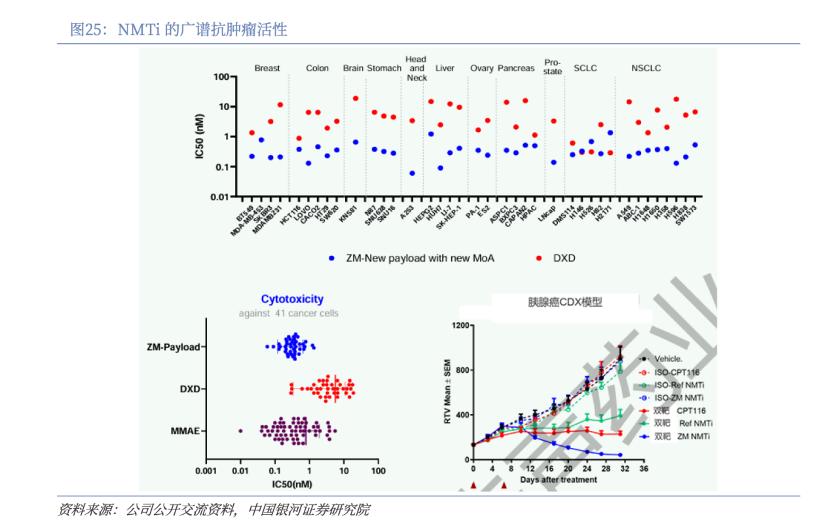
Second, its mechanism is completely orthogonal, with no overlap with the pathways of mainstream payloads such as microtubule inhibitors and topoisomerase inhibitors, resulting in no cross-resistance. It still has strong killing ability against ADC-resistant, slowly proliferating dormant tumors.
Meanwhile, its controllable bystander killing effect aligns with the development direction of ADCs.
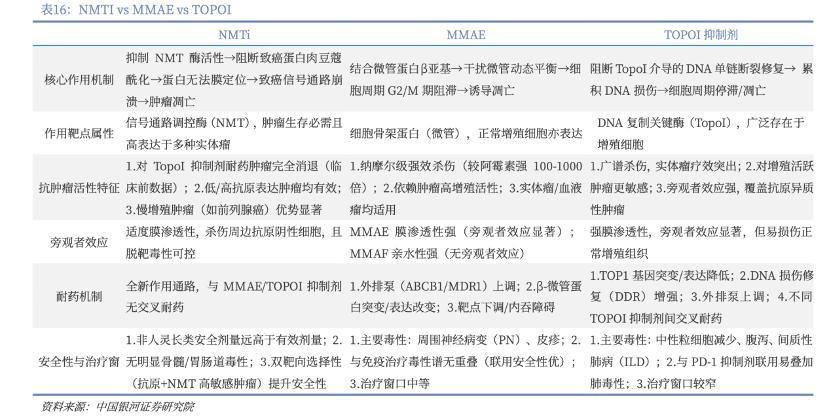
Of course, all these advantages currently remain at the preclinical theoretical stage, as NMTi-ADC has not yet undergone sufficient human clinical validation. Whether this differentiated platform can truly deliver on its potential and successfully achieve commercialization will ultimately depend on clinical data.
Who Is Next
While it remains uncertain whether NMTi-ADC can succeed, Novartis' acquisition sends a clear signal: the industry's battle for differentiated novel ADC assets has only just begun.
After DS-8201 ignited the industry boom, the global next-generation ADC pipeline entered a period of massive explosion.
At the 2026 AACR Annual Meeting, ADCs were one of the hottest tracks with the most concentrated achievements in the oncology session, with over 400 related abstracts published, doubling the number from the previous year.
Behind the surge in pipeline numbers is the explosion of next-generation ADC assets. In this round of expansion, bispecific ADCs and dual-payload ADCs have become mainstream innovation directions, with over 100 pipelines featuring multi-target and multi-payload combinations.
However, under this boom, homogeneous internal competition is an unavoidable reality. A review of public pipelines reveals that enterprises are crowding into mature antigen combinations such as B7-H4, TROP-2, HER2, EGFR, and c-Met; payload designs are also highly similar, mostly centered on Topo I inhibitors with standard additions of MMAE or RNA Pol2 inhibitors.
But in the context of the innovative drug R&D cycle, the early stage of any technology track's boom is inevitably accompanied by crowded pipelines and extensive trial and error, and ADCs are no exception.
The current phenomenon of crowded pipelines and highly overlapping target-payload combinations is a necessary stage of technological iteration. Two types of differentiation will continue to emerge in the future: a large number of homogeneous follow-up pipelines will gradually be phased out; a group of technology platforms that achieve clinical advantages through fundamental innovation will continue to attract heavyweight M&A deals from pharmaceutical giants.
This means that as more differentiated technologies complete clinical validation, major ADC BD and acquisition deals will continue to emerge intensively.
This article originates from the WeChat Official Account "Amino Watch" (ID: anjiguancha), authored by Zheng Xiao, and published by 36Kr with authorization.