Can copper stage a comeback in the second half of the year?
In the first half of 2026, the A-share market exhibited extreme divergence in performance — the Science and Technology Innovation 50 Index surged by 64%, while the Shanghai 50 Index declined by 1.4%. Among sectors, non-ferrous metals led by copper experienced a sharp rally in January, but ultimately closed with a drop of over 12%, ranking near the bottom across all market segments.
So, can copper stage a comeback in the second half of the year?
The Mystery of the Decline
From early April 2025 to the end of January this year, the non-ferrous metals sector led by copper went through a bull run, with most stocks more than doubling their value. During this period, China Molybdenum even soared by 350%, leading the entire industry upward.
At that time, the non-ferrous metals sector benefited from multiple tailwinds — the AI investment boom strengthened the copper consumption narrative, combined with persistently tight supply, putting the copper industry in a state of tight balance. Meanwhile, the Federal Reserve was in an interest rate-cutting cycle, which was inherently favorable for non-ferrous metals. As an industrial metal with strong financial attributes, copper benefited second only to gold and silver.
However, starting from the end of January, the bullish super-narrative for copper began to unravel one by one.
The first major blow came on January 30, when COMEX silver plummeted by 35% at one point, marking its largest single-day drop since the 1980s. The trigger was the nomination of hawkish figure Wash as the head of the Federal Reserve. This event ended the previous prolonged silver short squeeze and simultaneously exacerbated copper's peak-to-trough decline.
On February 27, a conflict broke out between the United States and Iran, temporarily reversing the logic behind the Federal Reserve's interest rate cuts and becoming the core driver of the sharp drop in copper mining stocks.
The transmission chain was clear: oil prices surged, inflation skyrocketed, and the market began pricing in Federal Reserve interest rate hikes. Subsequently, economic data confirmed this trend, with the US CPI year-on-year growth rates in April and May reaching as high as 3.8% and 4.2% respectively, completely shattering the market's earlier expectations of multiple interest rate cuts at the start of the year.
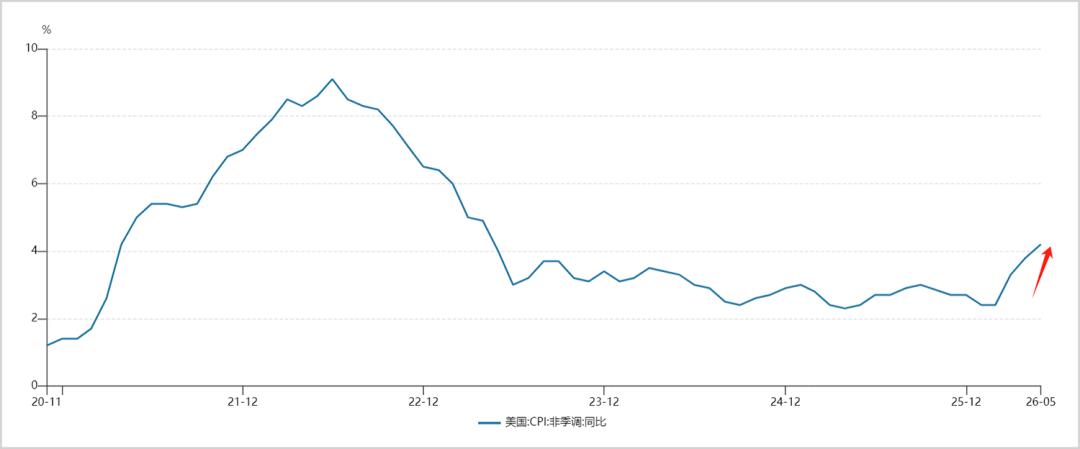
▲ US CPI Trend Chart, Source: Wind
Immediately after, the May non-farm payroll data far exceeded expectations, further reinforcing interest rate hike expectations. Some Wall Street institutions even predicted three 25-basis-point rate hikes totaling 75 basis points for the year, putting continuous downward pressure on commodity prices and making it impossible for copper mining stocks to avoid the slump.
Apart from the reversal of fundamental logic, the extreme divergence of capital flows in the A-share market also exacerbated the decline of copper mining stocks.
Starting from the end of April, technology sectors such as AI and semiconductors outperformed all others, spiraling upward alongside the sustained rally of South Korean and US tech stocks. This trend required abundant liquidity support, but with limited incremental capital from outside the market, funds were siphoned from other segments within the market.
In early May, capital was drawn away from consumer stocks — more and more fund managers sold off their consumer holdings at a loss to join the surging tech sector. By mid-May, the siphoning effect extended to micro-cap stocks and the pharmaceutical sector. By June, traditional cyclical, high-dividend, and financial sectors were all affected without exception.
During this period, the micro-cap stock index and the high-dividend index plummeted by 23% and 15% respectively, approaching their largest drawdowns in history outside of liquidity crisis periods. This clearly demonstrates how extreme the performance divergence between tech stocks and traditional sectors was, comparable to the "Mao Index" siphoning capital from small and mid-cap stocks before February 2021.
The non-ferrous metals sector led by copper remained at a relatively high level in the second quarter, so it naturally could not escape the fate of being drained of capital.
Will the Narrative Reverse Again?
Entering the second half of the year, the super bullish narrative for copper has an opportunity to reassert itself.
Currently, whether in the commodity market, US-listed resource stocks, or A-share copper mining stocks, all have experienced a sustained decline in recent months, and the market has fully priced in expectations of the Federal Reserve raising interest rates this year.
However, in the view of Market Cap Observer, this mainstream market expectation of aggressive interest rate hikes may face many uncertainties.
The most critical point is that oil prices have experienced a rapid and continuous decline since May 20. Brent crude futures dropped from a peak of $111 per barrel to $71, a decline of 36%, basically returning to pre-conflict levels.
Changes in oil prices usually have a lagged effect on US inflation data — the June CPI may not immediately reflect this shift, but a significant month-on-month decline in CPI is highly likely to be seen in July and August.
Historically, the Federal Reserve has always formulated monetary policies based on economic data. In June, Wash's first public appearance will almost certainly feature hawkish remarks, not only to maintain the Federal Reserve's independent image, but also because the non-farm payroll and inflation data from May and earlier periods do not support interest rate cuts.
But entering the third quarter, as the sequentially lower inflation data is released one after another, the market may have to revise its expectations again. Once the market shifts from pricing in interest rate hikes to expecting a pause in rate hikes, the commodity market will get a respite, which may also create a favorable environment for copper mining stocks to enjoy a new period of upward momentum.
In addition, the potential style rebalancing of the broader A-share market will also benefit copper mining enterprises.
After the continuous surge in the first half of the year, the valuation of tech stocks has reached an extreme historical level. As of June 30, the PE-TTM of the Science and Technology Innovation 50 Index stood as high as 250 times, while its median value since listing is only 71 times.
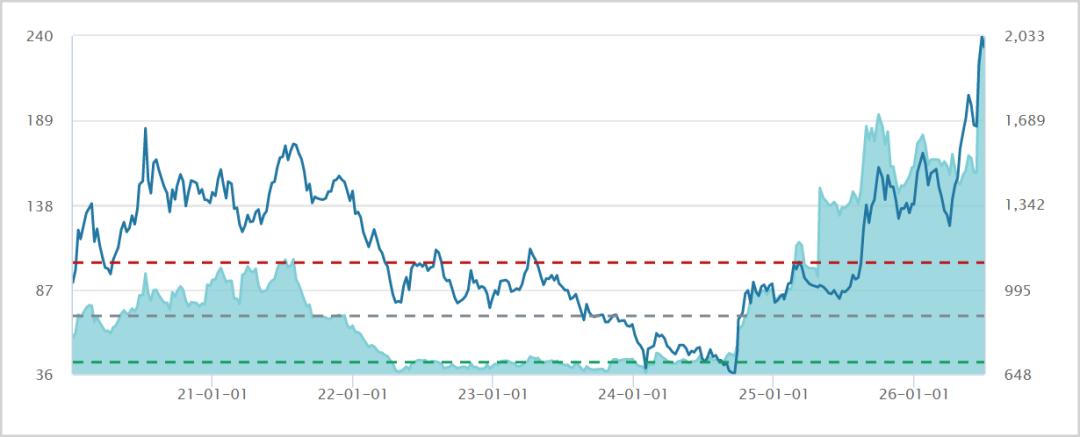
PE Trend Chart of the Science and Technology Innovation 50 Index, Source: Wind
Currently, the strong performance of tech stocks is beyond doubt, especially the semiconductor sector which is benefiting from the price surge driven by the AI super infrastructure cycle. According to data from the National Bureau of Statistics, from January to May this year, the profits of the computer, communications, and other electronic equipment manufacturing industries increased by 103.9% year-on-year, contributing 43% to the total profit growth of the industrial sector.
However, the prosperity of the non-ferrous metals sector is equally strong, with total profits reaching 260.94 billion yuan in the first five months, representing a year-on-year growth rate of 117% — even faster than that of the tech sector. Yet this sector has experienced a sharp decline amid expectations of macro monetary policy shifts and market style divergence, with its low valuation becoming prominent once again.
In general, the rotation of major asset classes depends not only on strong earnings performance, but also requires comprehensive consideration of valuation levels. When valuations have far outpaced earnings growth, and there are still undervalued sectors with strong prosperity in the market, the probability of a style switch increases significantly.
In fact, since the start of July, the Science and Technology Innovation 50 Index has plummeted by 10% in just two trading sessions, while previously underperforming sectors such as copper, chemicals, and consumer stocks have shown resilience against the trend. The market style switch may already be underway.
Zijin Mining VS China Molybdenum VS Jiangxi Copper
In the A-share market, the top three copper mining stocks by market capitalization are Zijin Mining, China Molybdenum, and Jiangxi Copper. The three companies have different business structures, so their degrees of benefit from rising copper prices naturally vary.
Zijin Mining is already a world-class mining giant, with business covering multiple metals, but its core assets remain copper and gold. In 2025, copper and gold accounted for 27.6% and 44.4% of its total revenue respectively, and 34.5% and 40.9% of its gross profit respectively.
During the same period, China Molybdenum's copper mining business accounted for 26.7% of its revenue, but contributed over 60% of its gross profit, making it the most pure-play copper enterprise among the three.
As of the end of 2025, Zijin Mining's equity copper resources reached 73.72 million tons, ranking first domestically — twice the amount of China Molybdenum and three times that of Jiangxi Copper. Its gold resources stood at 4,610 tons, ranking fifth globally. It is clear that Zijin Mining has the most abundant resource base among the three.
From a historical perspective, Zijin Mining can be regarded as a growth-oriented enterprise in the cyclical sector. From 2007 to 2025, the company's revenue continued to grow from 10.78 billion yuan to 349.1 billion yuan, with an annual compound growth rate of 19%, without a single year of negative growth. During the same period, the annual compound growth rates of China Molybdenum and Jiangxi Copper were 21.9% and 18.7% respectively.
However, Zijin Mining's net profit performance is even more impressive. Especially from 2020 to 2025, both its copper and gold businesses saw "volume and price rise simultaneously", with its attributable net profit surging from 6.5 billion yuan to 51.77 billion yuan.
China Molybdenum also delivered a strong performance, with its net profit jumping from 2.33 billion yuan to 20.34 billion yuan over the same period. In contrast, Jiangxi Copper had the weakest performance, with annual profits remaining below 8 billion yuan, a situation directly related to its business model.
Zijin Mining and China Molybdenum are relatively pure resource miners, while Jiangxi Copper has limited self-owned resources. Its business mainly relies on purchased ore and smelting operations, earning income from smelting fees and trade spreads, so its profitability is naturally far lower than the former two.
In the first quarter of 2026, the net profit margins of Zijin Mining, China Molybdenum, and Jiangxi Copper were 25.5%, 13.3%, and 2.26% respectively. The reason why Zijin Mining's margin is higher than China Molybdenum's is mainly because the former has gold business — gold surged by over 60% in 2025, far exceeding the increase in copper prices, leading to stronger overall profitability.
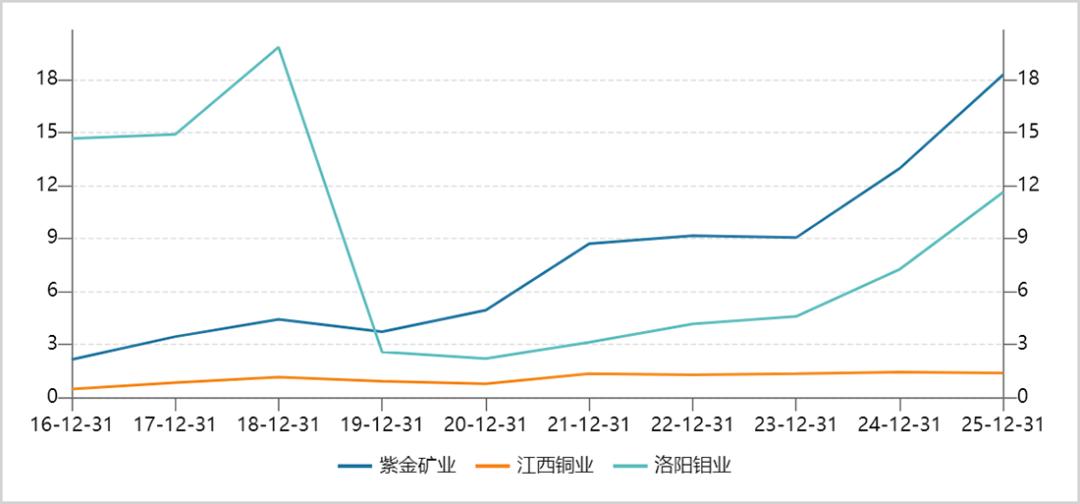
Net Profit Margin Trend of the Three Copper Mining Enterprises, Source: Wind
Looking ahead, which company has the most promising earnings growth potential?
Over the next three years, Zijin Mining has clear development plans: its annual mined copper output will increase from 1.09 million tons in 2025 to 1.6 million tons in 2028, and its annual mined gold output will rise from 90 tons to 140 tons, with both metals achieving an annual compound growth rate of over 12%.
For China Molybdenum, its copper production capacity is expected to increase from 741,100 tons in 2025 to 800,000-1,000,000 tons in 2028, with a central annual compound growth rate of 6.5%.
In addition to volume growth, there is also a price-driven growth logic. After a continuous surge in previous years, gold encountered headwinds this year, dropping from $5,626 per ounce to below $4,000, but its price center is still expected to resume its upward trend in the coming years. With extremely low production costs, gold miners remain highly profitable at current price levels. Copper prices have risen relatively modestly in recent years, and if the logic of Federal Reserve interest rate cuts resumes, there is still considerable upside potential.
It can be seen that although Zijin Mining already has the largest operating scale in the entire industry, it still boasts the strongest growth potential among the three leading companies in the coming years. Restricted by its business characteristics, Jiangxi Copper has relatively limited growth space.
Overall, as the sharp drop in oil prices will suppress inflation, the Federal Reserve's policy expectations are likely to correct, coupled with the expected capital reflow from high-valuation to low-valuation sectors, there is no longer any reason to adopt a pessimistic attitude towards copper mining stocks based on past logic. And if copper truly makes a comeback, Zijin Mining will undoubtedly remain the most reliable investment choice.
This article is from the WeChat public account "Market Cap Observer", author: Li Xiaofeidao, published by 36Kr with authorization.