Journey to Surpass | WAIC 2026 AI for Science: As AI4S Evolves from "Assisted Computing" to "Autonomous Discovery", How Will China Reshape the Global Scientific Research Landscape?

In 2026, the integration of artificial intelligence and scientific research is evolving from an "auxiliary tool" to an "active discoverer". NVIDIA has listed AI4S (AI for Science) as one of the three key AI directions alongside large language models and embodied intelligence, with its long-term market size expected to reach hundreds of billions of dollars. From AlphaFold 2 boosting the accuracy of protein structure prediction to the atomic level, to AI weather models outperforming traditional numerical forecasts, AI4S is advancing from "technical validation" to "full-scale application".
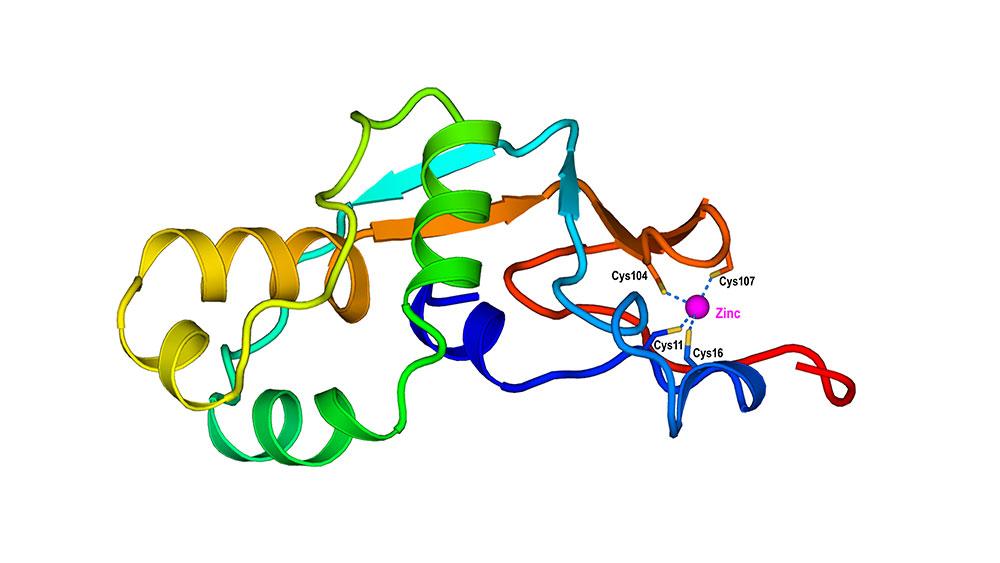
AlphaFold 2 predicts protein structures
However, the industry still faces three core bottlenecks: fragmented computing architectures leading to insufficient efficiency in scientific computing, isolated research data that cannot support AI training, and immature end-to-end integration between AI models and real-world scientific research workflows.
As AI4S transitions from "assisted computing" to "autonomous discovery", what will drive its leap from technical validation to industrial implementation? The Scientific Intelligence track at WAIC 2026 will provide a systematic answer from three dimensions: scientific discovery paradigms, autonomous discovery platforms, and vertical industry empowerment.
Scientific Discovery Paradigm: How Does AI Evolve from a "Computing Tool" to a "Discovery Engine"?
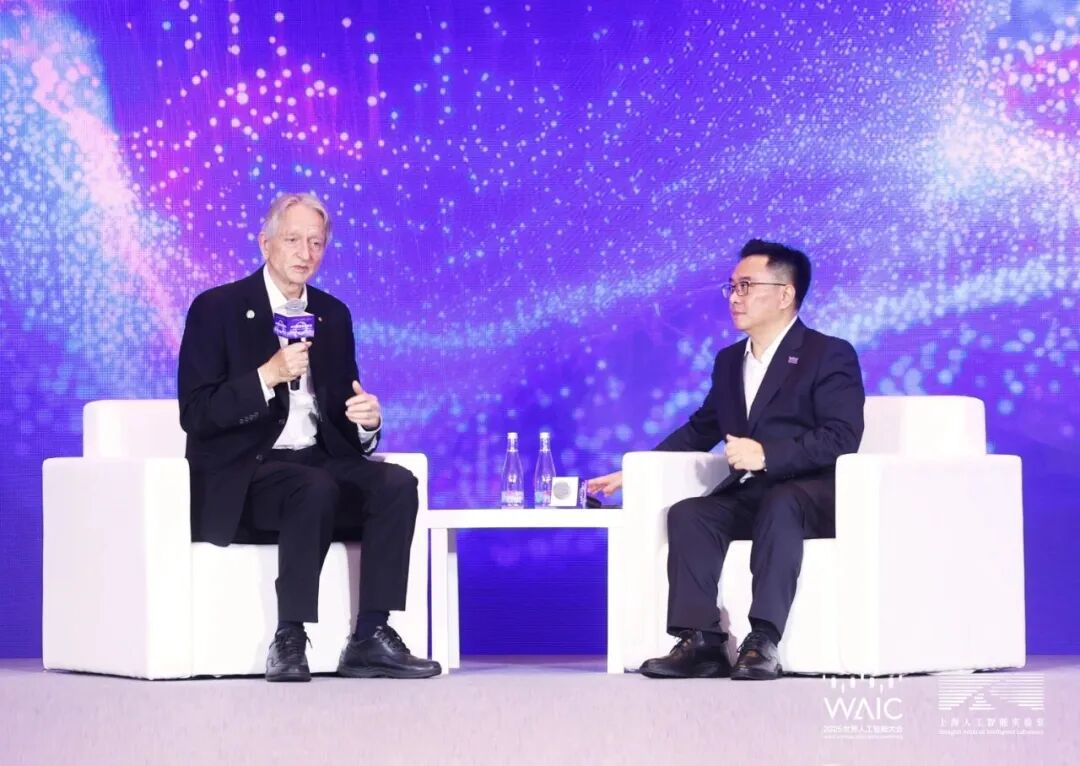
The Frontier Science Forum has long served as a stage for the collision of top global minds. At the 2025 WAIC Frontier Science Forum, Zhou Bowen, Director of the Shanghai AI Laboratory, and the "Godfather of Deep Learning" Geoffrey Hinton held an in-depth dialogue that sent shockwaves through the industry. Ranging from the "subjective experience" of multimodal robots to rational debates on agent safety governance, this summit dialogue not only sparked cutting-edge intellectual exchanges but also pushed the topic of safety defense lines in the AGI era to the core of the global tech community.
At the WAIC 2026 Frontier Science Forum, the top scholars set to attend will also share profound insights from various perspectives. Professor Max Tegmark, a physicist at MIT and President of the Future of Life Institute, will propose the "Path to Better AI" from a holistic perspective, advocating that AI development must advance in tandem with safety, ethics, and humanity's long-term well-being, ensuring technology acts as a partner that enhances human intelligence and expands cognitive boundaries rather than an out-of-control black box.
From completing defect-free arrangement of 2024 quantum bits in 60 milliseconds, to autonomously discovering and validating new therapeutic targets for cancer, to analyzing global climate change in minutes and tracking multiple space debris... AI is rewriting new paradigms for scientific discovery.
As large models evolve from "being able to converse" to "being able to act", and as AI begins to call tools, execute tasks, and reason autonomously, the way scientific discovery is conducted is being redefined. A true scientific agent requires capabilities for deep reasoning, complex task execution, and cross-tool collaboration—it must not only demonstrate concepts in laboratories but also achieve a full closed loop in real research scenarios, from experimental design and data validation to iterative optimization.
As AI begins to "discover actively", where will the boundaries of scientific research be pushed? How can artificial intelligence advance toward a healthier, controllable AGI future that benefits humanity?
In 2026, more intellectual collisions will unfold at the Frontier Science Forum.

Human-AI Collaboration
Platform and Ecosystem Improvement: Consolidate the Foundation for Autonomous Research and Unlock the Innovative Value of Scientific Intelligence
The transition of AI4S from theoretical paradigms to real-world implementation cannot happen without supporting talent systems, research platforms, and industry ecosystems. Traditional scientific research workflows feature cumbersome linear processes, slow iteration speeds, and low reusability of results, making them incompatible with the R&D needs of AI-driven autonomous discovery. This year's WAIC 2026 focuses on practical implementation, leveraging two specialized forums, top-tier talent development systems, and a series of authoritative result releases to address the underlying gaps in AI4S, building an implementation framework of "talent support + platform empowerment + collaborative standard ecosystem construction" to effectively advance intelligent scientific research from isolated breakthroughs to large-scale, systematic deployment.
At a time when artificial intelligence is accelerating its integration into the physical world and profoundly reshaping scientific research and industrial development, the 2026 WAIC Shanghai Qizhi Institute "Intelligent Science Forum for the Physical World" serves as a cutting-edge response to this era-defining proposition.
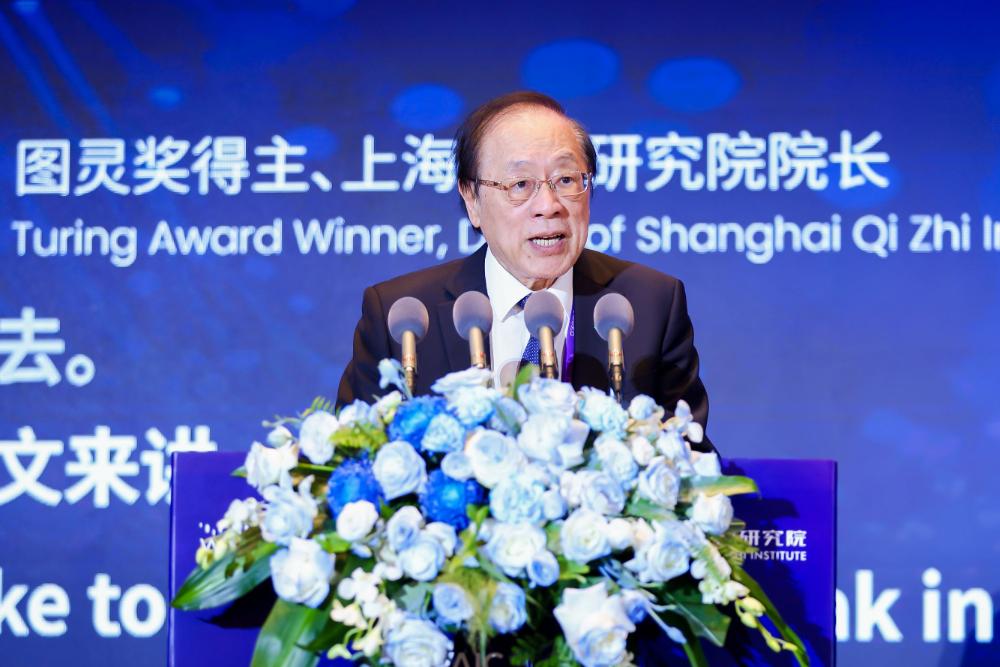
During the 2025 World Artificial Intelligence Conference, the "Interdisciplinary AI Forum" hosted by the Shanghai Qizhi Institute attracted over 700 on-site attendees and more than 8,000 online viewers, establishing itself as one of the conference's key forums balancing academic depth and industrial influence.
In 2026, the forum will undergo a comprehensive upgrade. Academician Yao Qizhi will personally lead the event. Following last year's summit dialogue with Turing Award laureate Geoffrey Hinton, this year he will share the stage with Turing Award winner Gilles Brassard to jointly discuss how artificial intelligence can reshape the paradigms of scientific discovery, industrial innovation, and human social development.
The forum will also bring together a host of international academic giants to share in-depth insights on cutting-edge topics such as the theoretical foundations and implementation paths of general artificial intelligence, the innovation of intelligent computing paradigms and breakthroughs in computing power, as well as the safety governance and ethical boundaries of trustworthy AI, presenting the latest thinking and breakthroughs in global artificial intelligence development.
Meanwhile, the forum will for the first time gather outstanding scientists and entrepreneurs from "three generations of Yao's Class", who will draw on their dual identities as scholars and innovators to jointly explore cutting-edge directions including AI for Science, AI safety, and embodied intelligence, promoting deep integration between basic research and industrial needs to accelerate the implementation of innovative results.
As a critical pillar supporting the forum, the Shanghai Qizhi Institute continues to build a high-level talent development system. It has established joint training mechanisms with universities including Shanghai Jiao Tong University, Tongji University, East China Normal University, and ShanghaiTech University, cultivating over 300 joint doctoral students and research interns to conduct cutting-edge research in fields such as artificial intelligence, scientific intelligence, and embodied intelligence.
From "Yao's Class" to the Shanghai Qizhi Institute, from talent development to original scientific research and then to industrial transformation, a complete chain of China's artificial intelligence innovation and development is taking shape at an accelerated pace, continuously pooling global wisdom and nurturing innovative forces for the intelligent era of the physical world.
2025 WAIC Interdisciplinary AI Forum
This year, Fudan University and the Shanghai Scientific Intelligence Institute will host the "Open Scientific Intelligence Forum", inviting Nobel Prize laureates and Turing Award winners to lead the event, joined by multiple Chinese and foreign academicians and top scientists. Starting from their landmark scientific breakthroughs, they will explore the first principles of scientific discovery, setting the tone for cutting-edge research with world-class academic rigor.
As the execution layer of scientific discovery is profoundly reshaped by AI, a larger question emerges: how will the mechanisms of original innovation and the paths of talent development evolve? Presidents of multiple top universities and academicians from the Chinese Academy of Sciences and Chinese Academy of Engineering will engage in a dialogue to discuss China's mechanisms and implementation paths for original innovation in the AI-native era, presenting the highest-level ideological exchanges in China's scientific community.
How are hypotheses proposed, experiments validated, and discoveries closed? New research infrastructure supporting the autonomous closed loop of scientific discovery is developing in parallel. Key achievements including foundational scientific models, dry-wet closed-loop technology systems, and computational discovery targeting major scientific problems will be showcased, demonstrating China's solutions for AI-driven scientific discovery and its industry-university-research innovation ecosystem.
Tools, platforms, super partners... How is AI's role in scientific research being rewritten? Is the AI-native paradigm pushing scientific discovery toward autonomous closed loops? Let's dive into this forum to find out.
Vertical Industry Empowerment: How Does AI4S Move from Laboratories to Energy, Materials, and Life Sciences?
The ultimate test for theoretical breakthroughs and platform capabilities lies in their ability to take root in vertical industries. AI4S cannot remain confined to papers and algorithms—it must penetrate real research scenarios in energy, materials, life sciences and other fields to solve the "last mile" problem from laboratory to industrialization.
In the energy sector, the Institute of Modern Physics of the Chinese Academy of Sciences will host the themed forum "AI and Advanced Nuclear Energy Co-Build a Sustainable Intelligent Future", inviting top experts including Academician Zhan Wenlong and Chief Engineer He Yuan to lead the event. Joined by leading research and industry representatives in the field, they will officially release the AI for ADANES technology roadmap, application scenarios, and a global innovation alliance, driving the nuclear energy industry to evolve from the traditional "experience-driven" paradigm to a new paradigm of "triple-driven by data + physical models + expert experience". This technology roadmap has for the first time constructed an AI-usable model with inherent physical properties for the nuclear energy sector, which suffers from data scarcity, fundamentally breaking the "black box" challenge of AI. It provides core technical support for artificial intelligence to deeply integrate into the full lifecycle of reactor design, safety assessment, and facility decommissioning while achieving continuous self-evolution.
In the materials sector, the Deep Principle Mira platform has been validated through 40 experimental property predictions, compressing materials R&D timelines from "several years" to "several months". This means materials discovery is no longer the result of "accidental trial and error", but a product of "active AI design"—researchers' work has shifted from repeated experiments to setting targets and evaluating results, marking a qualitative leap in R&D efficiency.
In the life sciences sector, Tianwu Technology will showcase its one-stop protein R&D platform Matwings Venus™ at the WAIC 2026 exhibition. This platform enables users to conduct in-depth research, enzyme mining, directed evolution, de novo design, and automated wet experiment collaboration through natural language conversations, making the protein R&D process more intuitive and efficient. Founded in 2021 by an elite team from Shanghai Jiao Tong University, Tianwu Technology has successfully delivered over 30 protein projects and secured four rounds of financing from leading investment institutions including Qiming Venture Partners and BVCF. The platform's value lies in eliminating the disconnect between "AI generating ideas" and "humans conducting experiments"—its natural language-driven full-process collaboration has truly realized a conversation-driven dry-wet closed loop for protein R&D.
Industrial Implementation Validation: Multi-Scenario Deployment to Verify the Practical Value of AI4S
The industrial exploration across the three directions directly addresses the three most critical questions in AI4S implementation: For energy—how can AI effectively empower high-barrier industries with scarce data? For materials—can AI transform "trial and error" into "intentional design"? For life sciences—how can AI advance from "reading papers" to "hands-on experimentation"? This set of questions collectively points to the complete validation of AI4S from theoretical breakthrough to industrial deployment.
Evolving from "assisted computing" to "autonomous discovery", AI4S is undergoing a systematic transformation of scientific paradigms. WAIC 2026, through the three dimensions of scientific discovery paradigms, autonomous discovery platforms, and vertical industry empowerment, for the first time systematically presents China's full capability map of AI4S spanning theoretical breakthroughs, platform construction, and industrial implementation. These three dimensions also address the three bottlenecks raised at the beginning: paradigm transformation breaks the barrier between research workflows and AI, platform tools solve the data isolation problem, and industrial deployment validates the real value of computing architectures.
July 17-20, WAIC 2026. The transformative momentum of AI4S is now within reach.
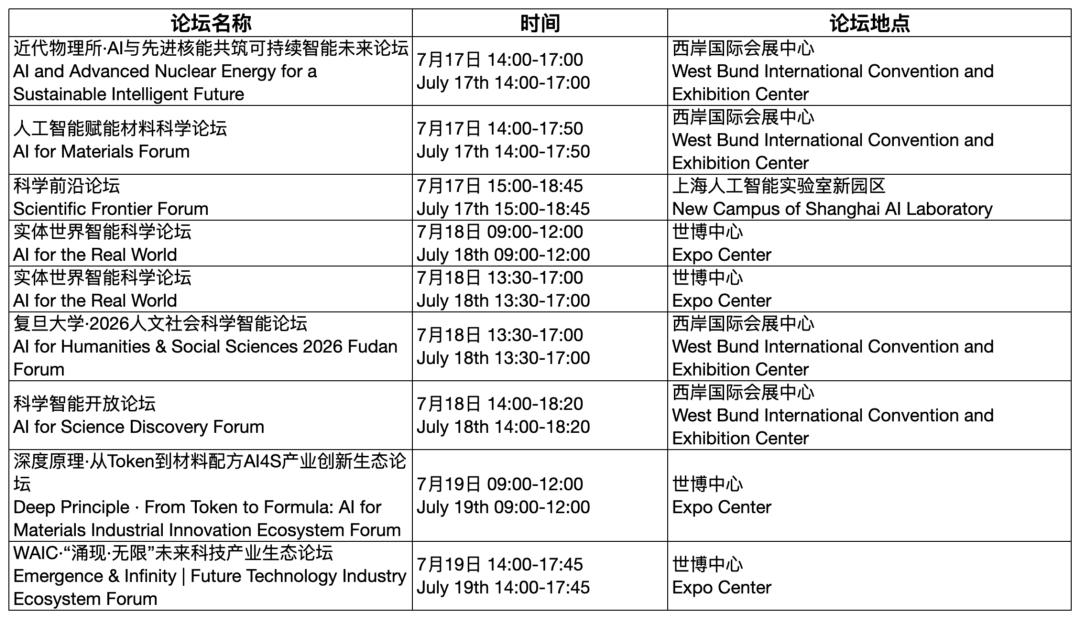
Appendix: WAIC 2026 AI4S Forums