HappyHorse, who is always one step behind others, don't fall behind even in your own areas of advantage.
Within a week of Seedance 2.0 Mini's launch, on June 22, Alibaba quietly updated HappyHorse to version 1.1.
The official website, Alibaba Cloud Bailian, and Qwen Cloud have simultaneously integrated the new version. This minor update brings enhancements across five dimensions: dynamic expressiveness, multi-image reference consistency, instruction following, visual texture, and audio capabilities.
Announced alongside the version update was the "Horsepower" AI Film Festival co-hosted by HappyHorse and Orca Entertainment. Renowned director Zhang Jizhong serves as a judge, and winners can secure million-yuan commercial orders.

The model upgrade paired with the film festival, backed by a famous director's endorsement and commercial incentives, makes HappyHorse's combined strategy seem formidable, yet every move feels strangely familiar.
Rewind to over two months ago, HappyHorse was the true dark horse in every sense of the word.
In early April, it anonymously stormed the Artificial Analysis Video Arena, claiming top spots in both text-to-video and image-to-video categories, pushing the then red-hot Seedance 2.0 to second place. It wasn't until Alibaba officially claimed ownership on April 10 that the public learned where this "horse" came from.
However, HappyHorse seemed to peak right at its debut, with its subsequent momentum experiencing a noticeable drop-off.
From its gray-scale testing at the end of April, to announcing pricing and launching commercial services in May, and then the 1.1 version and film festival in June, almost every step HappyHorse has taken at the application level can find precedents in the moves made by Jimeng, Keling, and even iQiyi's Nadou over the past year.
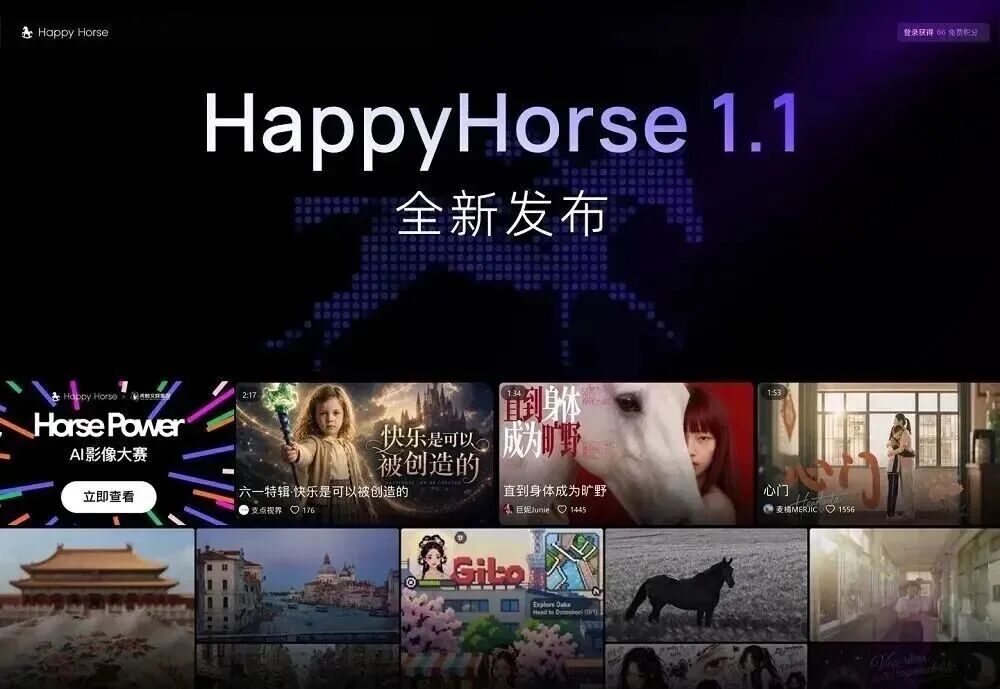
Screenshot of HappyHorse official website
Seemingly half a step ahead at its debut, but a beat behind in execution — this is probably the most accurate summary of HappyHorse's past four months.
Yet in today's AI video track, high benchmark scores actually hold little significance. The ability to secure a stable commercial niche is the key to everything.
01、From Commercialization to Ecosystem: How Far Behind Is HappyHorse Exactly?
First, the pace of commercialization itself.
HappyHorse topped the benchmarks on April 7, Alibaba claimed ownership on April 10, gray-scale testing began on April 27, and commercial services launched in May — the entire process took nearly a month.
In other industries, this speed wouldn't be considered slow, but the harsh reality of the AI video sector in recent years is that the "number one" title's shelf life has been compressed to be measured in months.
Keling led the pack for more than half a year thanks to its first-mover advantage, but its position began to waver after Seedance 1.0's release; in February this year, Seedance 2.0 integrated into Doubao and dominated the spotlight for just three months before HappyHorse took the top spot... At this pace, by the time HappyHorse truly converts its top-ranking prestige into paying users, the next dark horse will most likely already be on its way.
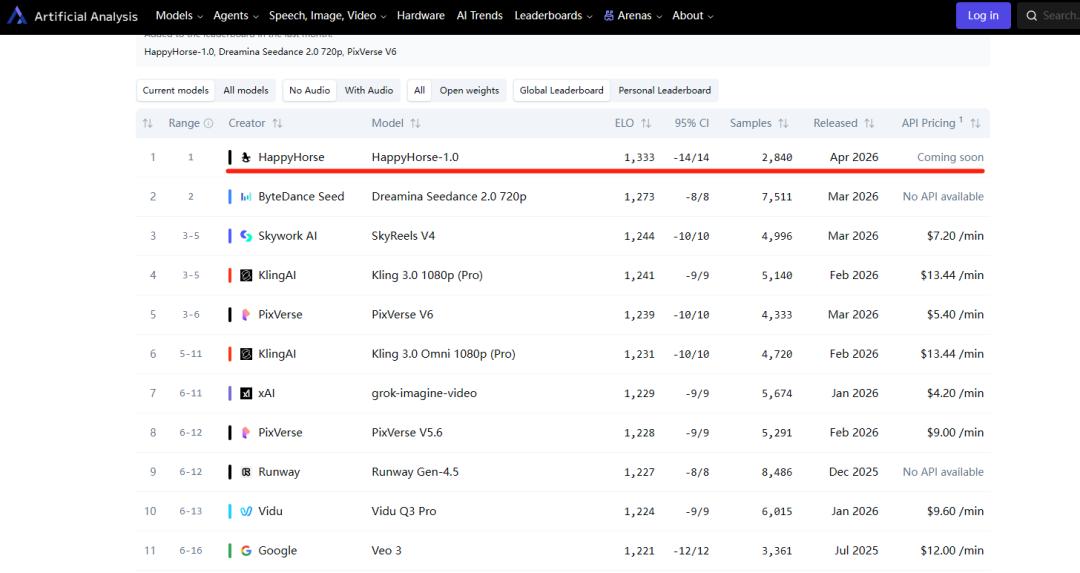
Artificial Analysis April Leaderboard
Leading benchmark scores cannot form a moat, a truth that has been repeatedly verified countless times in this track.
Looking further at the maturity of application products, the gap is even more glaring than the commercialization pace.
ByteDance's Jimeng has a complete closed loop spanning models, tools, and distribution behind it: the Skylark AI Short Drama Agent has fully produced hit series like *The Supreme of All Beasts*, and the visual customizations for multiple Spring Festival Gala programs also came from its capabilities.
By this year, the daily token consumption of ByteDance's manhua (comic-style) dramas has exceeded 70 million yuan, surpassing live-action short dramas for the first time. Its multi-camera narrative and professional-level reference control capabilities have made it a standard tool for many short drama teams.
In contrast, HappyHorse's main entry point for general users is currently a new tab on the Qwen App homepage, while professional users access it through Alibaba Cloud Bailian.

Screenshot of Qwen App
The tools exist, and the pricing is not expensive, but there are still no clear answers to where the generated content goes and how creators can earn returns.
Finally, looking at professional film and television layout, this is precisely the area where HappyHorse has been promoting the hardest yet lags the most.
iQiyi and Oscar-winning cinematographer Peter Pau launched the AI Theater Creation Camp, planning to incubate 15 creative teams. The first batch of AI narrative films over 15 minutes long launched as early as the first quarter of this year, and Nadou AI has already participated in post-production for professional films; Tencent Video even stated directly that it will release a full-length drama in the third quarter of this year where 100% of the script to special effects work is completed by AI.
Keling, on the other hand, has focused on professional film and television production from the very beginning. Besides sponsoring various short films and securing famous director endorsements, its direct participation in post-production special effects for the large-scale historical drama *Taiping Era* is undoubtedly a key strategic move.
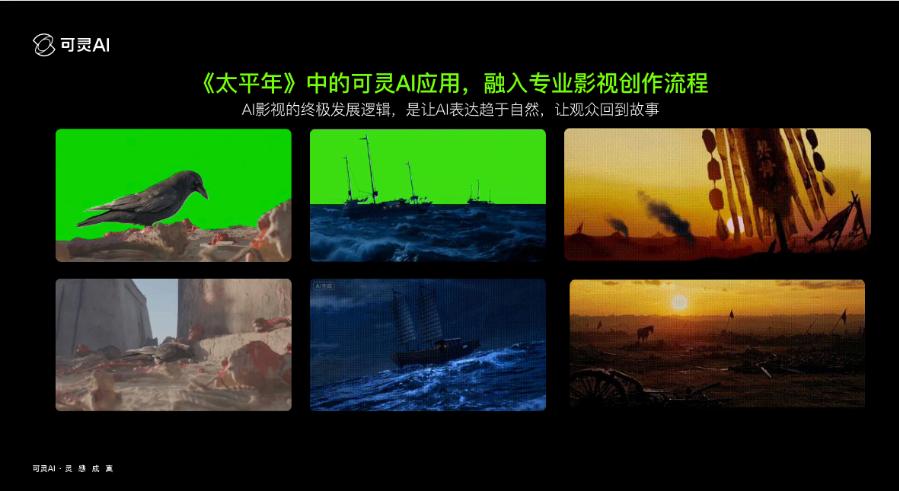
Application of Keling AI in *Taiping Era*
Putting all these side by side, the Horsepower competition — with its famous director judges, million-yuan commercial orders, and open call for films — follows an almost identical template, but arrives half a year to a year behind schedule.
The more critical difference is that when Jimeng and Keling host competitions, they are adding another link to their existing content ecosystem closed loop, with Douyin and Kuaishou providing distribution support for the outputs; when HappyHorse hosts a competition, it feels more like an isolated brand activity. After the excitement fades, neither the winning works nor the winners have a stable place to go.
Gaps in technical capabilities can be closed by investing more manpower, capital, and computing power, but the lag in the film and television creation ecosystem is far harder to bridge.
02、Film and Television Only Needs Suppliers, E-Commerce Is the Real Home Turf
What's interesting is that if you only look at the product itself, HappyHorse has actually provided answers pointing to another direction.
The version 1.1's key enhanced capabilities include precise preservation of product details and brand elements under multi-image references, realistic skin texture restoration, character close-ups optimized for short drama and advertising scenarios, and seven-language lip synchronization.
Mapping these capabilities one by one to real-world scenarios, they correspond to e-commerce product videos, digital human spokesperson content, feed ad materials, and cross-border localized content respectively.
In other words, the product is moving toward e-commerce and marketing, yet the public narrative still leans toward film festivals and famous directors. This misalignment itself is the most direct evidence that HappyHorse has not yet found its clear direction.

Screenshot of a video generated by HappyHorse
And the e-commerce and marketing sector is precisely Alibaba's strongest advantage over other AI players.
Tmall and Taobao's product pool of billions of items means nearly unlimited real materials and demand scenarios; Alibaba Mom controls merchants' advertising budgets and conversion data, so the effectiveness of AI-generated materials can be directly verified through ROI; AliExpress and Lazada's cross-border business naturally relies on the production capacity of multi-language translated video content. Of course Jimeng and Keling are also working on e-commerce content, but Douyin and Kuaishou's e-commerce ultimately follows a traffic logic. Alibaba's combination of shelves, supply, and cross-border operations cannot be replicated in the short term.
For merchants, the value of a product video can be clearly calculated, and their willingness to pay is far more stable than C-end users. Compared to the C-end entertainment generation market where prices have been driven down to a few cents per second, "supplying" to merchants is almost one of the few certain business opportunities in AI video right now.
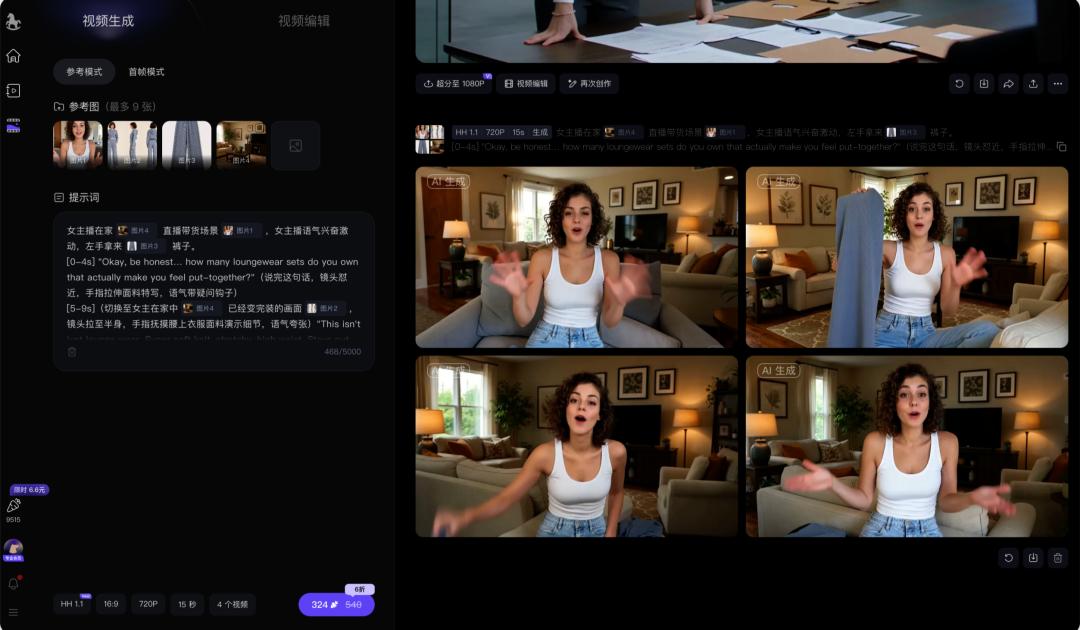
Application of HappyHorse in e-commerce
As for professional film and television, there's no need to abandon it entirely — but its role needs to be redefined.
Long video platforms' demand for AI is real. Gong Yu has publicly stated that after large-scale AI adoption in the next one to three years, production costs will plummet. iQiyi, Youku, and other platforms will all need stable and reliable model capabilities, which in itself is a B2B business.
HappyHorse can fully serve as a capability supplier for these platforms — Youku is already an internal business, while external clients like iQiyi can be reached through Alibaba Cloud's channels. For example, Nadou Pro has already integrated HappyHorse 1.1, treating the model as a utility service like water, electricity, and gas.
What truly needs restraint is the urge to intervene in downstream segments.
Running creation camps, incubating teams, investing in content, and competing for creators — these paths that Jimeng and Keling have already tested with real money for over a year — will only incur higher costs for HappyHorse if it follows now, and the positions it can seize will only be more marginalized.
In the AI era, the imagination space for "selling shovels" is far greater than doing everything yourself. Earning reliable money as a supplier while leaving the downstream excitement and troubles to others is not necessarily an unwise choice.
Ultimately, HappyHorse's problem right now is definitely not insufficient capability — it's that every time it climbs a new hill, it finds someone else's flag already planted there.
Rather than continuing to chase others' roadmaps, it's better to look back at what it already has — those billions of products on the shelves are the place where this "horse" should truly gallop freely.
This article is from the WeChat Official Account "Yiyu Observation" (ID: yiyuguancha), author: HAL, republished with authorization from 36Kr.