No products, no revenue — how did this AI company reach a $5.1 billion valuation?
Multi-tranche financing deals, in which different investors buy stakes at wildly disparate prices, are enabling a cohort of AI founders to raise unprecedented sums and secure sky-high valuations before their products even hit the market.
Earlier this year, David Silver, the renowned former scientist at Google DeepMind, joined a Zoom call to pitch his new startup, Ineffable Intelligence, to a venture capital firm. Silver, who spent over a decade at Google, argued that the current paradigm for training AI models is not viable long-term. He spent half an hour laying out his vision: building a digital environment where AI systems can learn autonomously, without requiring human-provided data or manual intervention.
At the end of the meeting, he told the investors on the call that AI would eventually advance to such a high level that it could learn to autonomously control all kinds of devices in the real world. One attendee recalled Silver saying: "Even toasters could have AI in them."
The vision sounded, at the time, more than a little overblown. "I went into that pitch excited, and then it was absurd," the investor says. "He rambled for half an hour, no deck, no memo."
By the end of the presentation, the VC was not convinced. "We left with more questions than answers," the investor says. "It just felt weird, coming from someone who is that senior and that respected in the industry."
Despite Silver having no plans to launch a product anytime soon, let alone make money from one, he ultimately closed a $1.1 billion seed round for Ineffable Intelligence. Touted as the largest seed round in European history, the startup was valued at a staggering $5.1 billion.
At least, that's what all the headlines said.
But the financing actually came in two tranches. According to corporate filings, the first tranche raised $11 million from firms including Sequoia Capital at a pre-money valuation of roughly $55 million. Then, barely a month later, the company raised a follow-on $1.1 billion at a massively stepped-up $4 billion pre-money valuation; Lightspeed, Index Ventures, DST Global and Sequoia all invested at that higher price. In just a matter of weeks, entry prices for the same company diverged by more than 70x.
A person familiar with the transaction says most of Sequoia's money went into the second, higher-valuation tranche. Sequoia and Ineffable Intelligence both declined to comment.
01
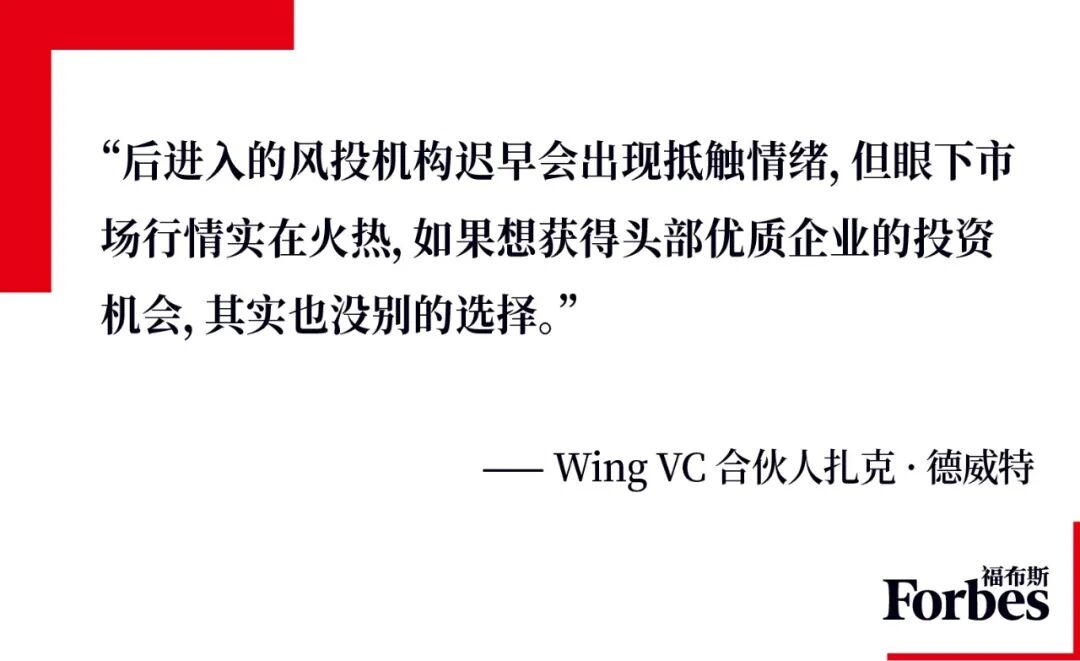
This kind of multi-tranche financing structure is becoming increasingly common amid the red-hot AI funding boom, especially among "neolab" startups—companies that raise billions of dollars at inception to focus on cutting-edge research rather than product development. Building an AI lab requires massive GPU computing power, which means startups need huge sums of capital from day one to fund deep R&D. Zach DeWitt, a partner at Wing VC, says founders' funding needs are so large that lead investors are naturally pushing for more favorable terms.
"The later VCs will push back at some point," he says, "but the market is so hot right now there's really no alternative if you want access to the best companies."
Even AI infrastructure and application startups are now widely adopting multi-tranche financing structures.
Baseten, which provides infrastructure and computing power for companies building and running AI tools, recently raised $1.5 billion across two tranches at valuations of $11 billion and $13 billion, respectively. Multiple sources told Forbes that high-profile AI startups including Aaru and Serval have used similar structures. "Founders looking to maximize their valuation will almost always choose this approach," one VC says.
Some investors argue this model is a win-win for both startups and venture firms.
Early-stage founders deliberately inflate valuations to generate buzz, landing eye-catching headlines that not only help secure business partnerships and follow-on funding, but also attract top talent—who typically hold multiple job offers. Equity makes up a large portion of employee compensation, and a company's stated valuation is often the decisive factor in their choice. The same goes for founders, whose paper net worth can reach the billion-dollar mark on the back of a high valuation, even though full equity realization usually takes years.
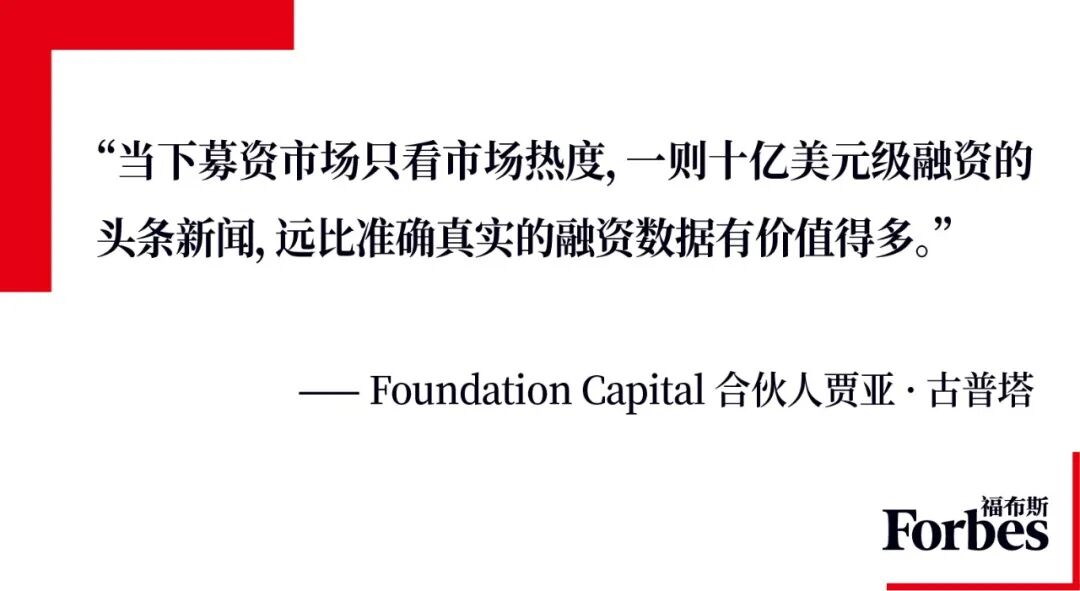
"The fundraising market right now is momentum-driven," Jaya Gupta, a partner at Foundation Capital, told Forbes. "A headline about a $1 billion round is worth far more than accurate, truthful financing numbers."
A company's true value is usually a blended valuation—a weighted average based on the equity sold in each tranche—which Sarah Catanzaro, a partner at Amplify Partners, says is rarely disclosed publicly. Because the internal structure of these multi-tranche deals is kept private, the publicly announced massive headline valuation creates the illusion that top-tier firms like Sequoia are so bullish on the startup that they are willing to pay an exorbitant price, when the reality is far more nuanced.
Brendan Foody, CEO of Mercor, posted on X in early June: "In the last 6 months, I've seen 6 or 7 deals where Sequoia invests in two tranches." He called the practice the "Sequoia Scam," noting that "everyone pretends they raised the whole round at the high price. Founders misrepresent this to employees, then use that high valuation to fool angel investors."
Foody later added to his thread: "To be fair, it's not just Sequoia. All the top firms do this." He declined further comment beyond his posts on X.
Sequoia partner Shaun Maguire replied to Foody's post, saying the "Sequoia Scam" label was "unfair," adding that in his seven years at the firm, the situation had occurred only five times. "The reality is other investors want to get into hot companies (usually AI) so badly they are willing to pay that price—many multiples more than we were willing to pay," he wrote.
02
Firms like Sequoia have a clear rationale for this strategy: they can bet on a star founding team with little more than an idea at a low entry price, secure more equity, justify their investment, and amplify their upside. In the case of Ineffable Intelligence, Sequoia could be sitting on a 70x paper gain almost as soon as the ink on the term sheet is dry.
The sums involved are enormous.
Deedy Das, a partner at Menlo Ventures, tallied in May that there are more than 63 neolabs today with a combined valuation exceeding $300 billion and roughly $48 billion in capital raised. It's unclear if all neolabs use multi-tranche structures, but these labs account for 16% of the roughly $283 billion invested in startups outside of OpenAI and Anthropic over the past year.
The lead investor in the first tranche typically helps organize the overall round, signaling to strategic backers like Nvidia, Google or Microsoft that the startup is a promising bet. These large corporate investors are said to be less price-sensitive, since their big checks quickly translate into chip contracts and cloud service deals. Now blue-chip VC firms are also encouraging startups to open a second tranche simultaneously, using their own powerful brand name to stoke hype around the funding. "That creates some competition and urgency," Gupta says.
But why would a VC that enters in the second tranche pay such a wildly disparate price for the same startup?
Some funds missed out on AI giants like OpenAI and Anthropic, and now see neolabs as an opportunity to bet on the next wave of cutting-edge startups in a market where access to top deals is fiercely competitive. Even if the startup doesn't have a clear commercial path, as long as demand stays high, investors can sell their shares on the secondary market at an even higher valuation—a practice known as a "pump and dump" financing. Of course, they could also strike gold and become early backers of the next OpenAI or Anthropic.
The capital isn't just coming from Silicon Valley VCs and tech giants. Silver's Ineffable Intelligence, for example, received funding from the UK's newly launched sovereign AI fund and the British Business Bank. The £500 million ($670 million) fund, launched in April, and the development bank are both backed by UK taxpayers. It remains unclear what valuation they paid for their stake in Ineffable. The sovereign AI fund and the British Business Bank did not respond to Forbes' requests for comment.
But rank-and-file workers who rely on these valuation numbers to decide which startup to join could be left at a disadvantage.
Employees hired after the financing is announced could end up paying an exercise price for their options that is much closer to the higher headline valuation than the company's blended value. "They're taking on more risk and getting less upside," Gupta says. "The social contract that made startup equity attractive is breaking down, and most candidates won't realize it until there's an exit—or a lack of one."
For neolabs like Ineffable Intelligence, structuring a financing this way makes sense. They can pick and choose their preferred investors, and raise huge sums of capital. After all, as a pioneer in reinforcement learning, Silver knows his startup is a high-stakes gamble.
A post on the company's website in January put it this way: "To pursue outsized success, one must take on meaningful risk. But if achieved, that success could positively alter the trajectory of AI, and therefore humanity itself."
This article is translated from: https://www.forbes.com/sites/rashishrivastava/2026/06/25/ai-startups-with-no-revenue-are-using-this-tactic-to-supersize-their-valuations/
Original Title: The Secret AI Startup Financing Trick That Creates Sky-High Valuations
This article is from the WeChat Official Account "Forbes" (ID: forbes_china), authors: Rashi Shrivastava & Iain Martin; translation: Elaine & Nora; proofreading: Lemin, published with authorization from 36Kr.