Even without securing a substantial share of the Galaxy S27 orders, BOE still managed to make Samsung feel a bit nervous.
Several weeks ago, a major milestone arrived in China's display panel industry—BOE's 8.6th-generation AMOLED production line officially commenced mass production.
This production line, with a total investment of 63 billion yuan, covering 1,388 mu of land and spanning an area equivalent to 130 standard football fields, stands as one of the world's most advanced mid-sized high-end OLED production lines with leading progress and top-tier technical maturity. It carries the core expectation for domestic panel makers to achieve leapfrog development.
As the news broke, the entire internet was abuzz. Claims that "domestic panels are overtaking Samsung" spread far and wide, and BOE's stock price surged immediately in response.

Image Source: Related reports from South Korean media
But before the "overtaking" could be realized, a sudden reversal quietly unfolded. Recently, South Korean media outlets revealed that BOE's plan to supply OLED panels for Samsung's next-generation flagship smartphone, the Galaxy S27, had fallen through, and BOE had already halted development on S27 OLED panels.
Coincidentally, on the very same day Samsung called off the order, Chengdu BOE Display Technology Co., Ltd. posted an international bidding announcement for the G8.6 production line upgrade and renovation project, seeking to procure critical instruments such as lighting test equipment, ellipsometers, and compensation value measurement devices.
On one side, production capacity is being expanded, while on the other, orders are being rejected—all in the span of less than half a month. The contrast between the peak and the trough arrived with such stark abruptness.
01. Why Did Samsung Turn to BOE?
The story has to start from the beginning.
The Galaxy S series is Samsung's flagship bar smartphone, with annual sales of around 30 million units. For many years in the past, the OLED displays for the S series had been exclusively supplied by Samsung's own panel subsidiary, Samsung Display. It seemed only natural that a parent company would let its own subsidiary handle its flagship orders.
But in 2026, a problem emerged—storage chip prices skyrocketed. The AI boom occupied a large portion of general-purpose memory production capacity, driving mobile DRAM prices steadily upward. Samsung Electronics' mobile business division saw its profit margins squeezed heavily, yet there was almost no room to negotiate lower memory prices.
As displays are the second-largest cost component in smartphones, Samsung Electronics began to deliberate: Could they bring in a second panel supplier for the base model of the S27 to push down procurement prices?
BOE was undoubtedly the most suitable candidate.
For one thing, BOE was already a supplier of LCD panels for Samsung TVs; for another, the two sides had just reached a global OLED patent settlement in November 2025. That nearly three-year patent war reportedly concluded with BOE paying around 1 trillion won (approximately 4.85 billion yuan) in patent licensing fees.
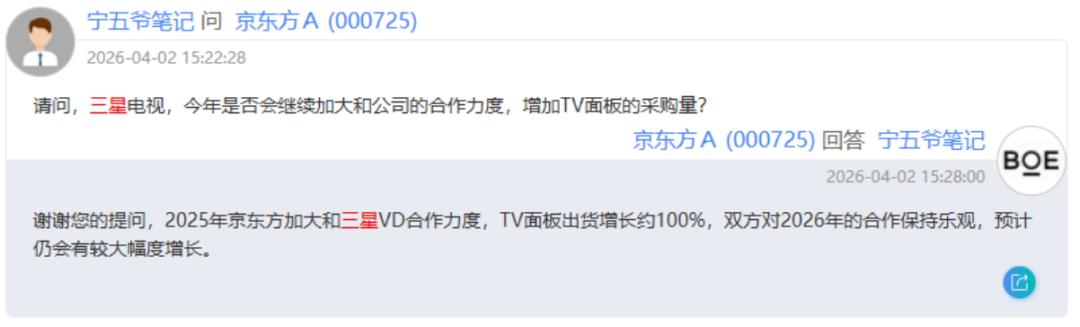
Image Source: Investor interaction platform
With the patent lawsuit resolved, supply chain cooperation seemed like a logical next step. This May, Samsung sent a technical inquiry letter to BOE. According to supply chain sources, BOE's quoted price to Samsung was roughly $5 cheaper than Samsung's in-house displays of the same specification. For 30 million flagship phones, saving $5 per unit adds up to $150 million.
Samsung Electronics was tempted. In mid-June, Roh Tae-moon, head of Samsung Electronics' DX division, personally visited BOE. The general public widely assumed that the cooperation between the two sides was essentially finalized.
So what was the outcome? During Roh Tae-moon's visit to China, he did not convey any positive signals. Two weeks later, the project was officially called off.
The core resistance to halting the cooperation was not technical differences, but internal interest games within Samsung—according to comprehensive sources, the reversal of Samsung Electronics' cooperation plan is suspected to be linked to pressure from Samsung Display.
The logic is easy to follow. The OLED panels for the Galaxy S series flagships have always been exclusively supplied by Samsung Display, which is its most stable source of revenue. Now that the parent company wanted to split the pie with a competitor—a Chinese rival that has been closing in step by step in the OLED market—how could Samsung Display accept that?
According to data from market research firm Omdia, Samsung Display held a 44.6% share of the small-to-mid-sized OLED market in 2025, while BOE ranked second with 14%. Although Samsung Display remains the leader, BOE has already become the top Chinese manufacturer and the world's second-largest player in the field.
More crucially, there is the issue of pricing power. Once BOE enters the high-end panel supply chain for Galaxy S flagships, it would not only mean the loss of around 30 million flagship phone display orders annually, but could also undermine Samsung Display's long-standing pricing power in the high-end OLED market.
This is not an exaggeration. Samsung Display's supply share to Samsung Electronics has long remained at around 99%. Once this solid foundation is cracked open, BOE could next set its sights on not just the S27 standard edition, but also the S27 Plus, S27 Ultra, and even all future flagship models.
Samsung Display's opposition is essentially a battle to defend its moat.
02. Samsung's Self-Contradictory Tug-of-War
This paints a peculiar picture: Samsung Electronics, gasping for air amid surging storage chip prices, is scouring the world for cheaper displays; meanwhile, Samsung Display is clinging tightly to its flagship orders, determined not to let BOE step foot into the S series ecosystem.
One hand wants to cut costs, the other wants to protect its interests—two departments within one company are at odds.
Clearly, the outcome of this internal game saw the conservative faction emerge victorious.
Samsung Electronics ultimately abandoned its plan to bring BOE on board for the S27. Market sources indicate that the wave of internal opposition within Samsung has gradually gained the upper hand in recent times. A large amount of resources BOE invested earlier to secure the S27 order may end up being wasted.
The S27 series will continue to have its OLED panels exclusively supplied by Samsung Display.
For BOE, this is not the first time it has been shut out of a high-end flagship supply chain.
In 2025, BOE originally planned to supply up to 10 million OLED panels for the iPhone 17 Pro in the Chinese market. But issues arose on the technical front: BOE had never previously supplied LTPO OLED panels to Apple, a type of panel that supports always-on display and ProMotion adaptive refresh rates.
According to supply chain disclosures, BOE's panels failed to meet Apple's LTPO performance requirements in terms of reliability, yield, and performance. Specifically, the yield of its new-generation LTPO+ panel technology temporarily fell short of Apple's standards. In the end, Apple redirected the orders back to Samsung.
The scenario of BOE fumbling at the final hurdle played out once again, after happening once with Apple, now repeating with Samsung.
In all fairness, BOE's progress over the years is clearly visible.
The 8.6th-generation AMOLED production line that entered mass production on June 17 has a designed monthly capacity of 32,000 glass substrates, more than double the capacity of Samsung's 8.6th-generation line in South Korea. BOE operates 4 AMOLED production lines in the Sichuan-Chongqing region, forming one of the world's largest flexible OLED industrial clusters.
According to statistics from CINNO Research, in the first quarter of 2026, BOE's AMOLED smartphone panel shipments increased by 17.7% year-on-year, with its market share rising 3.1 percentage points year-on-year to 20.1%.
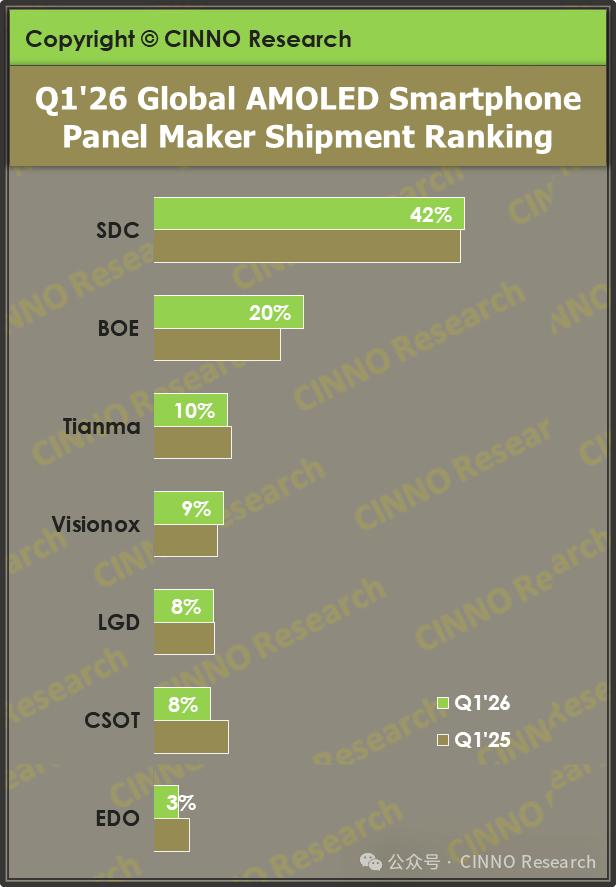
Image Source: CINNOResearch
Production capacity has ramped up, technology has caught up, but BOE still lacks that final bit of trust from high-end customers.
Apple's high-end Pro series does not use BOE displays, and Samsung's S series flagships do not use BOE displays either. The world's two leading high-end smartphone brands have both said "no" to BOE on their most important flagship product lines.
BOE can build the world's most advanced production lines, yet it cannot secure the world's most high-end orders.
Production capacity does not equal recognition, and scale does not equal quality. This is the soul-searching question that China's display panel industry must confront head-on as it evolves from "large to strong."
03. Who Ends Up Footing the Bill?
Clearly, the winner of this self-contradictory tug-of-war is Samsung Display, which has preserved its orders and pricing power.
The loser is BOE, whose investments have gone to waste and whose high-end breakthrough has been delayed once again.
But there is another hidden loser—consumers.
Samsung Electronics originally hoped to leverage BOE to lower display costs, thereby easing upward price pressure on the S27. Now that path is blocked, the S27's costs cannot be reduced. The Galaxy S26 series already saw a price hike once, and the S27 will most likely continue that trend.

Image Source: Media reports
Samsung Electronics saved face but lost out in substance. Cost pressures will not disappear—they will only be passed on, transferred to consumers.
For Samsung Display, this victory may not come without a price.
In March 2026, Samsung Electronics had already decided to procure around 15 million flexible OLED panels from TCL China Star Optoelectronics Technology for mid-to-low-end Galaxy models. Samsung Display's defensive line is being gradually eroded from the edges.
As for BOE? Its S27 dream may have been shattered, but its OLED offensive will not stop.
The 8.6th-generation line has already entered mass production, and with its capacity in place, it must find an outlet. But the problem is that the 8.6th-generation line was designed for IT panels and mid-sized OLEDs, while mobile OLED capacity will still need to be absorbed by its existing 4 flexible production lines. The designed capacity of these lines was originally intended for Apple and Samsung flagships.
If it remains locked out of the high-end flagship segment, BOE will have to rely on mid-tier models to keep these production lines at full capacity. Using flagship-grade production capacity to manufacture mid-tier displays is like a dull knife cutting flesh with depreciation costs. BOE itself has disclosed that its depreciation expenses reached a peak in 2025.
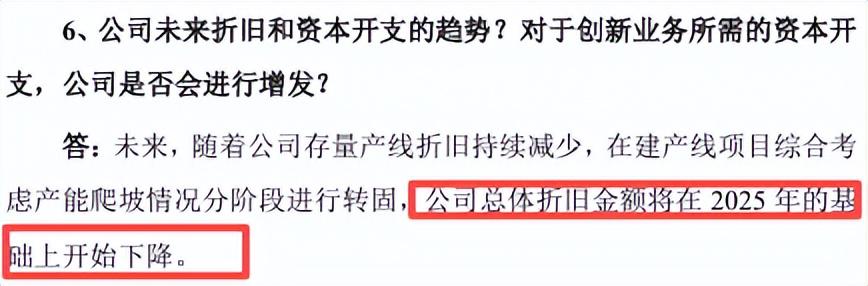
Image Source: BOE Investor Relations Activity Record
Temporarily locked out of high-end flagships, BOE will naturally not let go of opportunities in mid-tier markets, IT panels, automotive displays, and other tracks. But the economics of running mid-tier orders on flagship production lines simply do not add up.
This battle is far from over. The question is, next time, can BOE land a decisive blow?
The time left for BOE is tighter than it realizes.
Note: Article materials are sourced from official reports and public information, and the views expressed are for reference only | Some images are generated by AI or from the internet; please notify us for removal if there is any infringement.
This article is from the WeChat public account "Yuan Media", author: Xie Chunsheng, published with authorization from 36Kr.