From 410 billion to 100 billion, what happened to MiniMax?
On July 9th, nearly half of MiniMax's shares became unrestricted.
Half a year ago, on January 9th, it was listed on the Hong Kong Stock Exchange, one day later than Zhipu. On the first day of listing, MiniMax's stock price soared by 109%, far exceeding that of Zhipu, and it was once a more sought - after large - model target in the market. In March, its stock price reached a high of HK$1330, and its market value exceeded HK$410 billion, once surpassing Baidu.
Subsequently, the stock price began to reverse. On June 1st, when it released its flagship large model M3, the stock price opened high but then dived and closed down 15%. In the next two weeks, the stock price was halved. By early July, it had fallen 72% from the high. As of the close on July 3rd, its stock price was HK$346, and its market value was HK$108.7 billion.
Zhipu, on the other hand, caught up from behind. Its market value once exceeded HK$1 trillion and is now around HK$800 billion.
On July 8th and 9th, the two companies respectively faced their six - month share lock - up expirations. For Zhipu, it was just a minor test, while for MiniMax, it was a major exam. Only about 5.76% of Zhipu's shares were unlocked this time, while about 44.85% of MiniMax's shares became unrestricted, and the potential floating shares suddenly expanded to about 50%.
An investor who pays attention to Hong Kong stocks judged that "it's normal for the stock price to fall in the short term. There was too much sentiment and scarcity premium in the previous stock price." Another industry insider emphasized to "Focus One": "It still has a 110% increase compared to the issue price, but investors' enthusiasm has completely changed."
In the past six months, MiniMax's presence in the Chinese large - model market has declined. In terms of model capabilities, its position in the first echelon still needs to be strengthened; in terms of market influence, it is also less likely to attract attention than DeepSeek and Zhipu.
Liu Yujia, an investment partner at Zhengjing Capital, believes that the stock price divergence between MiniMax and Zhipu in the past six months cannot be simply understood as whose model is stronger. Instead, the market is re - pricing different AI paths. MiniMax's advantages lie in multi - modality, C - end products, and overseas growth, but the market is still observing whether it can transform these advantages into Agent, Coding, developer ecosystems, and stable commercial revenues. Zhipu is closer to the narratives of domestic basic models, enterprise services, developer platforms, and domestic AI infrastructure, so it is more likely to obtain valuation premiums in the current market style.
However, stock price performance is short - term. In his view, MiniMax's real test is whether it can run a closed - loop in terms of models, products, and commercialization. "If it can, the ceiling will be relatively high. Otherwise, it may remain in a'superficially comprehensive' state."
01. This round of decline has wiped out two types of premiums
Although MiniMax's stock price has fallen sharply, the capital market has not completely negated this large - model company. "It just means that the market premium brought about by the soaring market in March this year is gradually returning to rationality," said Leo, a practitioner who focuses on large - model companies.
The premiums that have declined are mainly in two aspects.
Firstly, the premium of model capabilities.
MiniMax positions itself as one of the only four full - modality AI companies in the first echelon globally, competing with OpenAI, Google, and ByteDance. Standing in the first echelon means having pricing power, and the market is also willing to give a higher valuation multiple. The problem is that after six months of market testing, this label is questionable.
The official claims that M3's programming ability achieved 59% on SWE - Bench Pro, exceeding GPT - 5.5. However, the Intelligence Index of the independent evaluation Artificial Analysis ranked it ninth among mainstream models. On Chatbot Arena, which focuses on users' real preferences, it was ranked outside the top forty or fifty. More than one interviewee mentioned that the first echelon of domestic large models consists of Zhipu, Kimi, and DeepSeek, and MiniMax's performance is questionable.
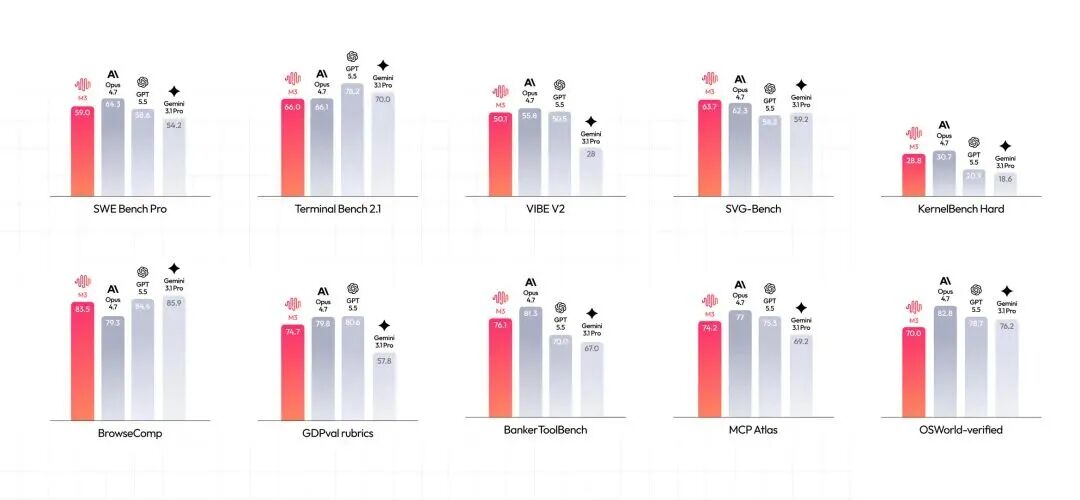
Image source / MiniMax
More importantly, one week after the launch of M3, MiniMax permanently halved the API price. JPMorgan Chase immediately downgraded its rating from "Overweight" to "Neutral" and lowered the target price from HK$1100 to HK$400, stating that "since the M2 model, MiniMax has not launched a new domestic SOTA (state - of - the - art) model, and from the perspective of pure model capabilities, MiniMax is still in the catching - up stage."
During the same period, Zhipu raised the API pricing several times, with a cumulative increase of more than 80%, and the call volume increased fourfold.
A price cut caused such a big shock. Li Zeming, the chief investment officer of Red Ant Capital, said that the Hong Kong stock market basically uses the price - to - sales ratio (market value/income) to price large - model companies. "So when you hear that a large - model company cuts prices significantly, the entire sector will plunge." MiniMax's price cut lowered the income expectation and thus the valuation.
Secondly, the premium of the C - end story.
In 2025, 67% of MiniMax's income came from C - end AI products. The main ones were emotional companionship applications such as Talkie overseas and Xingye in China, plus the video tool Conch AI. At the time of listing, this was the fastest - growing business, and the high valuation given by the market was largely based on "C - end globalization."
However, the C - end data declined significantly later.
The monthly active users of Talkie and Xingye decreased by 60% quarter - on - quarter in the fourth quarter of 2025. The emotional companionship track itself was also tightening. Talkie was removed from the app stores in some overseas regions, and Xingye in China also underwent rectification.
The video segment was also under pressure. Conch AI has lost its leading position in the video model ranking of Artificial Analysis and has been surpassed by multiple models such as Alibaba's HappyHorse, ByteDance's Seedance, and Kuaishou's Keling.
During this period, the market's view of MiniMax's model also changed. Liu Yujia summarized it as a "relatively traditional but complete" internationalization path, "a bit like ByteDance's early overseas expansion strategy." The market initially recognized this model, so MiniMax once enjoyed the valuation dividend of overseas AI applications. Later, the rise of Agent ecosystems such as OpenClaw also brought some temporary opportunities for its model and API calls. As the industry narrative further shifted towards Agent, developer ecosystems, and tool - chain platforms, the market began to re - question: Is MiniMax a model company with several global products, or can it become the basic model entry in the Agent era?
02. It's easy to be 'big and comprehensive,' but hard to be 'big and strong'
MiniMax's business path is different from other large - model companies.
As domestic large models, DeepSeek iterates its model through community feedback, and Zhipu iterates its model through B - end enterprise data. MiniMax's route is the most resource - intensive among the three. Its foundation is a self - developed full - modality large model, covering language, video, voice, and music.
Based on this model, it conducts two businesses simultaneously: for individual users, it has developed a batch of AI - native apps mainly targeting overseas markets; for enterprises and developers, it has established an open platform and sells model capabilities through API based on the call volume. "It actually started from the B - end and then fully embraced C - end globalization," Leo believes. This adjustment brought about rapid revenue growth but also made the company's revenue structure overly dependent on the C - end.
MiniMax's betting logic is: the model creates products, the products attract users and data globally, and the data continuously feeds back to the model for iteration. Liu Yujia believes that when the model, products, and data form a positive cycle, the upper limit is to be "big and strong," and the lower limit is to be "big and comprehensive."
Currently, problems have emerged in three aspects: the model, products, and commercialization.
At the model level, there are highlights, but there is a lack of irreplaceability.
MiniMax has advantages in vertical capabilities: the speech synthesis model Speech - 02 once topped the global TTS ranking of Artificial Analysis, and the text model MiniMax - 01 series is also known for its ultra - long context window of 4 million tokens. However, these technical parameters have not been translated into user stickiness.
Li Zeming's judgment is that the technical gap between domestic leading large models may be only one or two months. "If you rank high this month, the entire ranking may change next month." With rapid technological iteration and unstable rankings, in this environment, "irreplaceability" is difficult to establish through single - point technical advantages. Instead, it requires continuously leading engineering capabilities and user stickiness accumulated over a long - term use. From the market feedback, MiniMax has not yet entered the first echelon in terms of model recognition and user perception.
At the product level, four lines are progressing simultaneously, but the data link needs to be verified.
MiniMax's external story is "full - modality self - development": the data of the four lines feed each other, and the models enhance each other. However, the user behaviors of each product line vary greatly. Conch AI is for video creation, while Talkie/Xingye focuses on AI role - playing and emotional companionship. The data of Talkie can feed back to the emotional companionship model itself, but it has limited help in improving core capabilities such as programming and reasoning. It is currently uncertain whether the data can flow across products and modalities.
Liu Yujia provided three specific observation indicators: first, whether cross - modality migration can be achieved, for example, whether video data can improve the model's understanding of the physical world and temporal relationships, and whether voice data can enhance the judgment of emotions and rhythms; second, whether the originally scattered text, voice, and video training frameworks can be focused into a unified engineering basic model; third, whether the comprehensive ability is based on sufficiently strong single - item capabilities, rather than just an average of various capabilities. "Unifying multi - modality is the right direction, and the real difference lies in whether large - scale engineering, productization, and commercialization can be achieved."
At the commercialization level, the C - end gross profit margin is too thin, and the B - end model is too light.
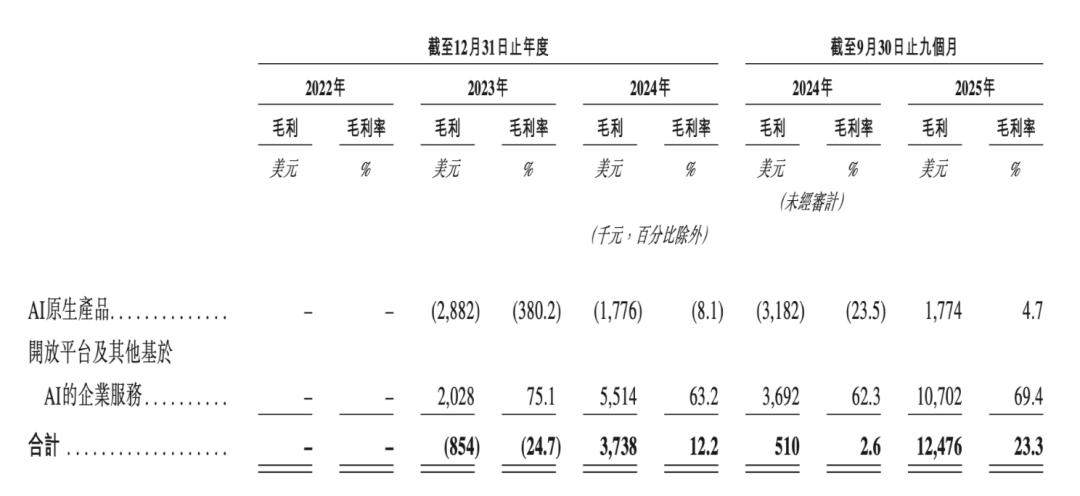
MiniMax's gross profit margin situation. Image source / Prospectus
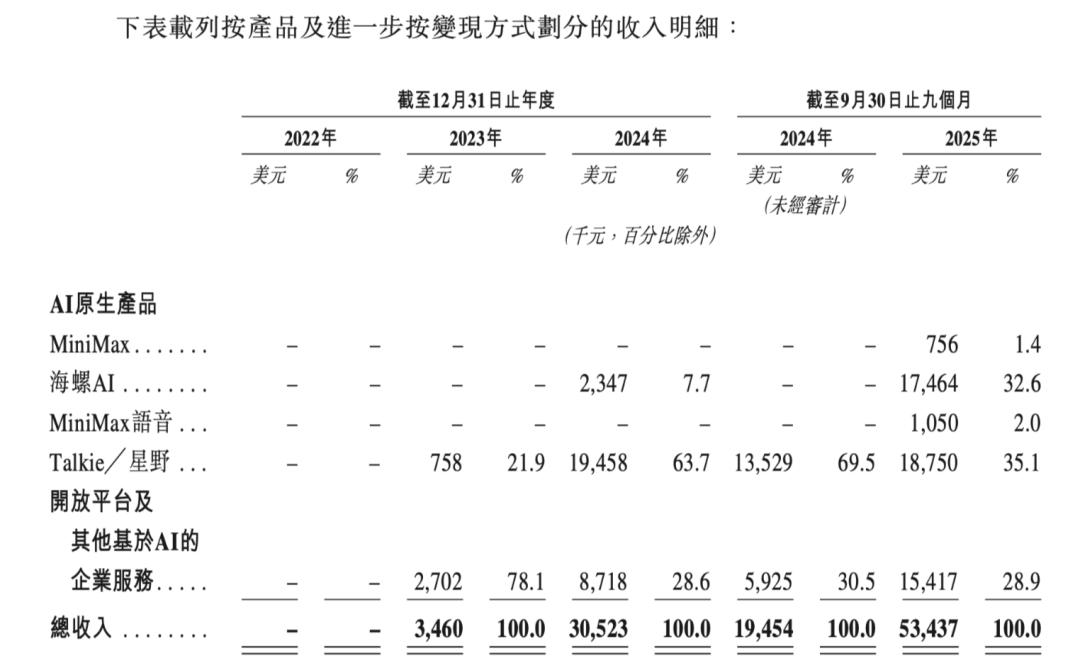
MiniMax's revenue composition. Image source / Prospectus
The prospectus shows that as of the first three quarters of 2025, the overall C - end gross profit margin was only 4.7%. In the C - end revenue structure, Talkie and Xingye, which focus on emotional companionship, and Conch AI, which focuses on video creation, contributed approximately 49% and 46% of the revenue respectively.
The monetization logics of these two major products are different. Conch AI mainly adopts the subscription system, and the average revenue per paying user (ARPPU) is as high as US$56. However, the users of Talkie and Xingye have a weak willingness to pay, with an ARPPU of only US$5, and nearly 60% of their revenue comes from advertising monetization.
The improvement of the underlying model capabilities can directly boost the pricing power of "effect - sensitive" tools such as Conch AI and MiniMax App (with an ARPPU of US$73), but it has limited impact on advertising - driven products. The scale of Conch AI is already close to that of Talkie/Xingye. Whether the newly - started Agent commercialization can become the third monetization mainline deserves key attention.
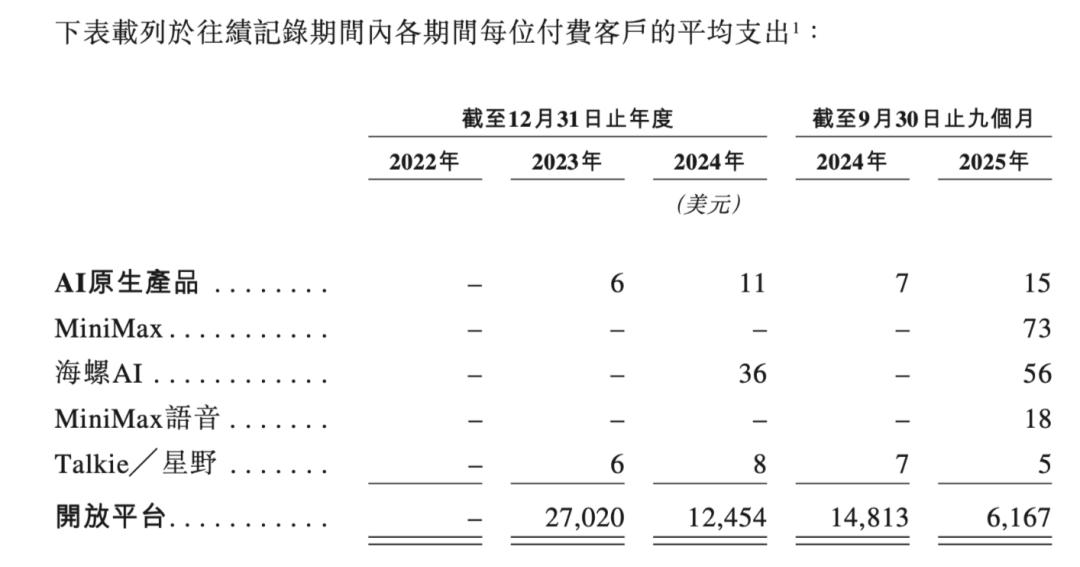
MiniMax's ARPPU (average revenue per paying user). Image source / Prospectus
In contrast, the B - end growth figures are more impressive, but the problem lies in the model. The full - year financial report for 2025 shows that the revenue from enterprise services such as the open platform was US$25.963 million, a year - on - year increase of 197.8%. However, MiniMax is engaged in a "light - service" business. Founder Yan Junjie proposed at the earnings meeting that the value of the AI platform is equal to "intelligence density × Token throughput." This determines that the company's B - end strategy is to build scale through Token call volume rather than through customized projects with a large amount of human resources.
The prospectus shows (as of the first three quarters of 2025) that the number of paying customers on its open platform increased from about 100 in 2023 to about 2500, but the ARPPU decreased from about US$12,000 in 2024 to about US$6000. This reflects that its main customer structure is shifting from large enterprises to small and medium - sized enterprises and developers.
For Internet customers with development capabilities (such as Kingsoft Office), MiniMax only needs to provide API interfaces. However, for government and enterprise customers with greater payment potential, they usually require a complete set of heavy - duty services such as private deployment, compliance guarantee, and customized delivery. MiniMax's configuration determines that it is more proficient in serving the former type of customers.
An investor who pays attention to AI told "Focus One" that the switching cost of large - model APIs is extremely low, and it is difficult to build stickiness by just selling interfaces. Sooner or later, it has to do Agent. MiniMax's Agent platform is a step for it to move from "selling interfaces" to "selling results." The investor's evaluation is that "the initial experience was average, but it has improved a lot now," but whether it can build a barrier still needs to be proven.
Currently, MiniMax can be regarded as a platform - type company still under verification: its model has highlights, but it still needs to prove whether these highlights can form a stable user perception; its products have traffic, but the data flywheel and model feedback mechanism need more time to be verified; its commercialization is growing rapidly, but there is still room for optimization in terms of structure and quality.
In Liu Yujia's view, if MiniMax can prove itself to be a company with "model capabilities + global products + data closed - loop + platform ecosystem," the valuation space will be huge. However, if the market ultimately believes that it is a company with good model capabilities and some overseas products, its attractiveness will be weaker than those companies that are in the first echelon of cutting - edge models and have Agent platforms, developer ecosystems, or tool - chain entrances.