A post-2000s Tsinghua doctoral student breaks an 80-year deadlock in the mathematics community with a single idea
In May 2026, Inventiones Mathematicae, one of the four top journals in mathematics, published a paper by a Chinese team.
The authors are: Ma Jie, a dual - appointed professor at Tsinghua University and the University of Science and Technology of China (USTC), Shen Wujie, a doctoral student at Tsinghua University, and Xie Shengjie, a doctoral student at USTC.
Paper link: https://link.springer.com/article/10.1007/s00222-026-01421-9
The probabilistic method invented by Erdős in 1947 laid the foundation for the entire field of probabilistic combinatorics.
For nearly 80 years after that, no one was able to fundamentally break through its limitations.
This paper, however, presented the first exponential improvement.
A Coin Tossed for 80 Years
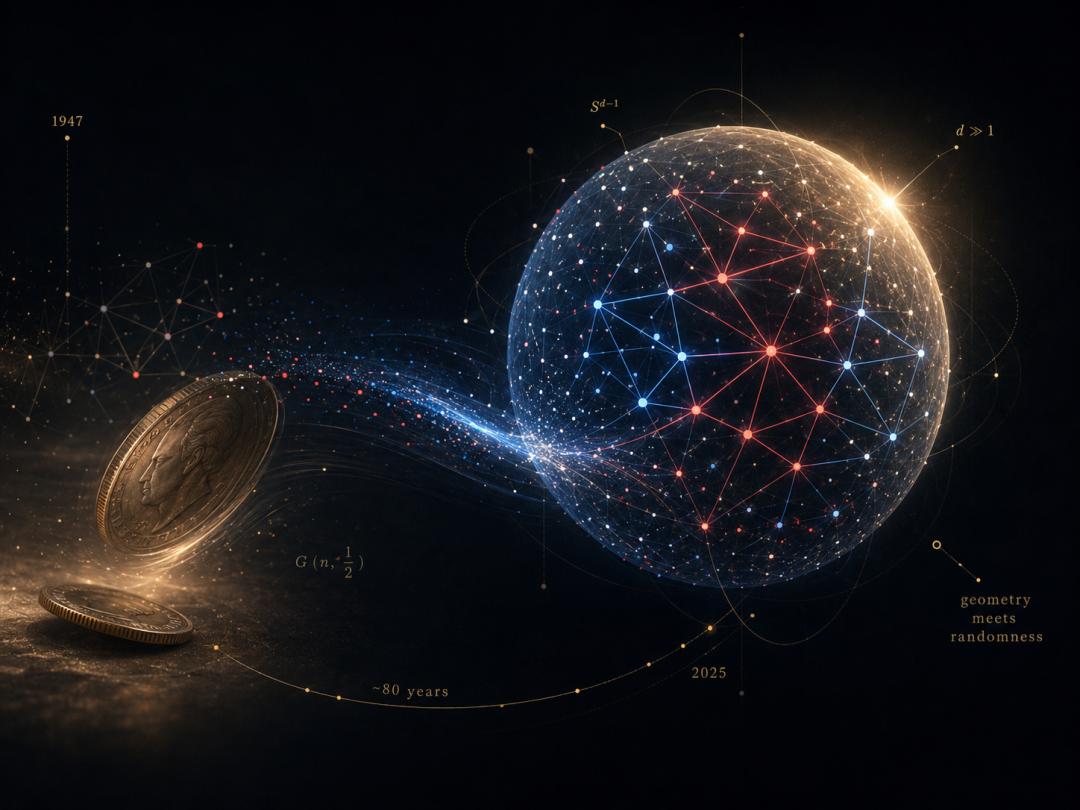
Erdős' method is very simple: Toss a coin for each edge of a complete graph. If it lands on heads, color the edge red; if it lands on tails, color it blue.
For example, in any large enough social network, there must be a group of people who either all know each other or all don't know each other. Erdős used this coin to prove that "large enough" is at least exponential.
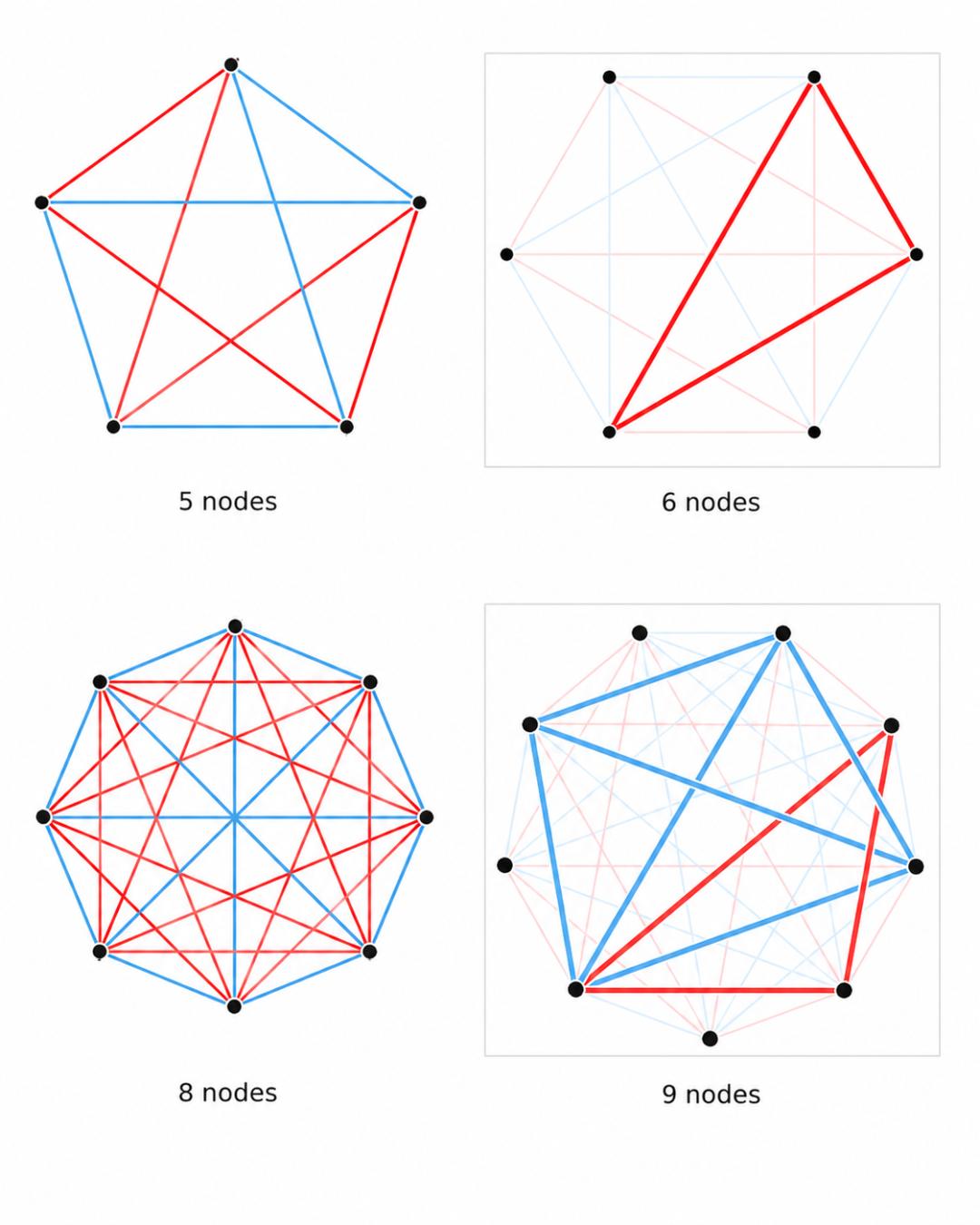
Interestingly, the upper bound has been continuously improved over the years. In 2023, it was reduced from approximately 4 to 3.7992. However, the base of the lower bound has remained unchanged for nearly 80 years since Erdős proposed it.
It wasn't until Ma Jie's team came up with the idea related to the sphere.
But the Coin is Too Naive
The characteristic of coin - coloring is that each edge has an equal chance of being red or blue and is completely independent.
It is simple and easy to analyze, but it doesn't utilize any geometric structure to suppress the formation of monochromatic cliques, thus wasting information.

Shen Wujie's idea was to introduce geometry into randomness.
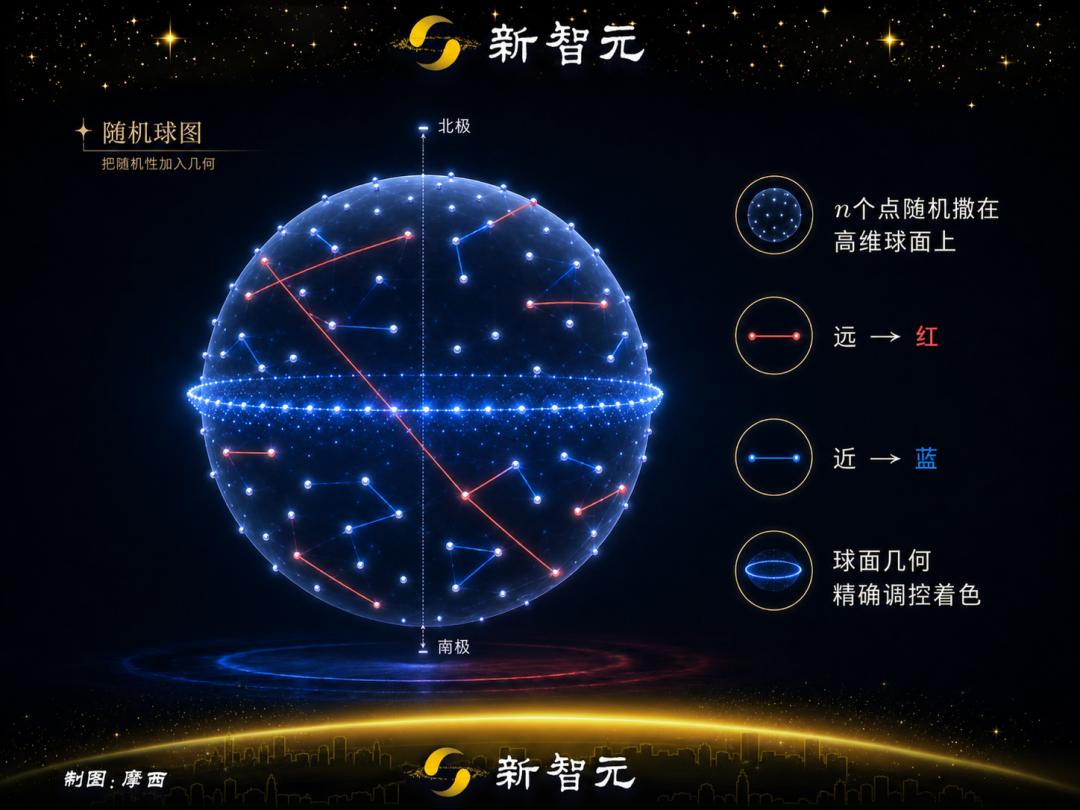
He proposed the "random sphere graph" model, which involves randomly scattering n nodes on a high - dimensional sphere. Edges between nodes that are far apart are colored red, while those between close nodes are colored blue.
A high - dimensional sphere has a very counter - intuitive property —
As the dimension increases, almost all points are concentrated near the equator. When two radial lines are randomly selected, the included angle is almost certainly close to 90 degrees.
The distances between point pairs are concentrated in a very narrow range. Coloring is no longer completely random but is precisely regulated by the geometric symmetry of the sphere. The spherical structure naturally suppresses the formation of large monochromatic cliques.
However, there is a trade - off here. The spherical model reduces the probability of red cliques.
That is to say, for a large red clique to form, many nodes need to be far from each other. Since the spherical space is limited, this is unlikely to happen. But by the same token, the probability of blue cliques increases.
Subsequently, the three of them conducted verifications on small - scale graphs.
Among tens of thousands of coloring schemes, the probability of a clique - free coloring is still greater than zero — the benefits do outweigh the costs.
The next step was to prove this, and the key lies precisely in the extremely counter - intuitive geometric properties of high - dimensional spheres.
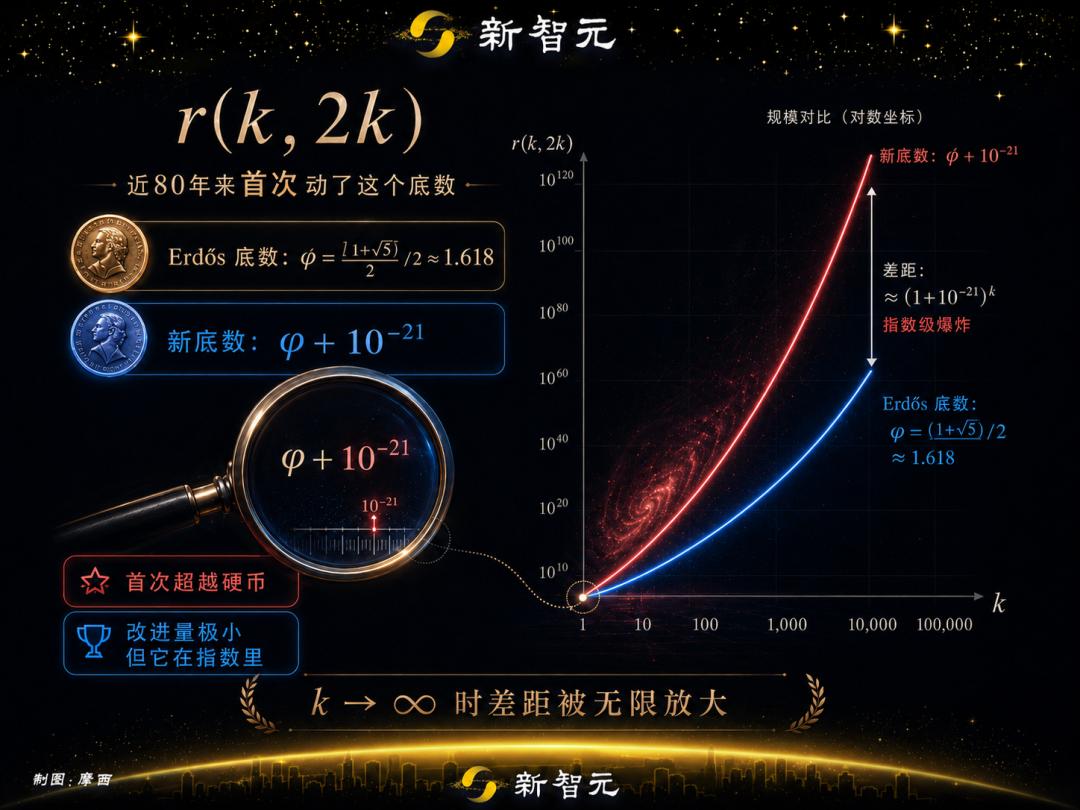
Taking the near - diagonal Ramsey number r(k, 2k) as an example, in the case where one parameter is twice the other, the base of the lower bound given by Erdős' coin is precisely the golden ratio (1 + √5)/2 ≈ 1.618.
Ma Jie, Shen Wujie, and Xie Shengjie increased this base to (1 + √5)/2 + 10⁻²¹.
You read that right. The improvement is approximately 10⁻²¹ — 20 zeros after the decimal point and then a 1.
But the key lies in the exponent.
Ramsey numbers grow exponentially. Even if the base is increased by only 0.000000000000000000001, as k approaches infinity, the new lower bound will far exceed the old one.
No one has touched this base in nearly 80 years.
They not only increased the number slightly but also proved that Erdős' coin is not the optimal coloring scheme.
The random sphere graph is strictly superior to pure random coloring in structure, which means that the ceiling of the probabilistic method is far from being reached.
This is the first exponential improvement in this direction since Erdős, and it is also the first time that someone has provided a path beyond the coin.
However, this path has a clear boundary: it is only effective when the blue cliques are larger than the red cliques.
When the forbidden cliques of the two colors are of the same size, that is, in the diagonal case that Erdős initially focused on, the benefits of the new method will disappear.
The Entire Community is Shaken
The paper was posted on arXiv in July 2025. Within less than a week, Gil Kalai, a titan in combinatorics, published a long blog post with a title starting with "Amazing", stating that this model "has considerable independent research value".

Julian Sahasrabudhe from the University of Cambridge sighed: "It's a bit shocking that a familiar thing can solve a familiar problem." In his view, this technique has been right under our noses.
In December 2025, Benny Sudakov, Ma Jie's former supervisor at UCLA, and his students proved that the Gaussian random graph is also effective, and the sphere is not even necessary. This simplification means that more people can participate in the promotion.
At the beginning of 2026, someone extended it to the multi - color Ramsey numbers.
In May 2026, the article was officially published in Inventiones Mathematicae.
The Intuition of a Post - 2000 Tsinghua Student
Ma Jie is currently a professor at the Yau Mathematical Sciences Center of Tsinghua University and a professor at the University of Science and Technology of China.
He graduated from USTC with a bachelor's degree in 2007 and obtained his doctorate from the Georgia Institute of Technology in 2011 under the supervision of Xingxing Yu. He then worked as an assistant professor at UCLA under Benny Sudakov and later did a post - doc at Carnegie Mellon University. He returned to China in 2015 and joined USTC. In 2024, he joined both the YMSC at Tsinghua and the BIMSA.
He won the National Excellent Young Scientist Fund in 2017 and the National Science Fund for Distinguished Young Scholars in 2022. He is an editorial board member of SIDMA. In 2020, he won the Hall Medal of the ICA — this award is given to at most two outstanding combinatorial mathematicians under 40 years old each year.

Xie Shengjie won the first prize in the Guangdong Mathematics League in high school and was admitted to USTC through the Youth Innovation Class in his sophomore year of high school.
He won a bronze medal in the Qiu Ming - chiu Mathematical Competition during his undergraduate years. He was directly admitted to pursue a doctorate at USTC in 2023 under the supervision of Ma Jie. He was in his third year of doctoral studies when the results were published.

Shen Wujie, a post - 2000 student, is currently pursuing a doctorate at the Yau Mathematical Sciences Center of Tsinghua University under the supervision of Yau Shing - tung. He was in his fourth year of doctoral studies when the results were published.
He won the third prize in the CMO in high school and was admitted to the School of Mathematics at Peking University in 2018. During his undergraduate years, he won the first prize in the National Undergraduate Mathematics Competition, the silver prize in the Alibaba Mathematics Competition, and the ICCM Creative Undergraduate Thesis Award. He was directly admitted to pursue a doctorate at Tsinghua in 2022.
In the first few semesters of his doctoral studies, Shen Wujie mainly worked on geometry and topology, which had no connection with Ramsey theory.
In the spring of 2024, he accidentally read a paper on Ramsey numbers and was deeply attracted. He began to wonder: Is there a random model that can generate clique - free colorings more efficiently than Erdős' coin?
In the autumn of 2024, Ma Jie visited Tsinghua to give lectures. Shen Wujie brought this idea to him, and Ma Jie's student Xie Shengjie also joined in. The three of them spent a year writing 40 pages of intensive calculations to complete the proof.
Ma Jie later said: "We were very lucky. It felt like all our efforts were rewarded. But it was really difficult for a long time."

AI Problem - Solving vs. Human - Made Tools
In the same month that this article was published, DeepMind released the complete report of AlphaProof Nexus.
It solved 9 out of 353 open Erdős problems. It also proved 44 OEIS conjectures. All were verified in Lean. Two of the problems had been unsolved for 56 years. Each problem cost only a few hundred dollars.
Driven by Gemini 3.1 Pro, the agentic loop repeatedly searches for proof paths until the formal verifier approves.
But ultimately, it is searching within a known framework.
Tao Zhexuan once said: AI is a competent assistant, but not a peer. It is good at scanning and matching within known methods but not good at proposing original ideas.
What Ma Jie's team did was exactly the latter. They didn't solve a specific Erdős problem; they upgraded the method invented by Erdős itself.
AI knocked down 9 walls from Erdős' legacy. Three Chinese people remade his most proud hammer.
In the mathematical frontier that requires the most creative insights, humans are still irreplaceable for now. At least for today.

Epilogue
In 1947, Erdős took out a coin and opened up the field of probabilistic combinatorics.
Nearly 80 years later, a post - 2000 Chinese doctoral student said: "Try throwing the nodes onto a sphere."
Reference materials:
https://www.quantamagazine.org/after-80-years-mat