Teaching AI Agents to "Stop in Time": University of Washington Team Proposes Context Engineering Method CONVOLVE
When should an Agent "stop" when the task itself is infeasible or cannot be completed in the current environment?
We hope that an Agent can timely invoke search, web browsing, and terminal tools during multiple rounds of interaction to complete complex tasks. However, in reality, the user's request may not be clear, and the goal may not be achievable. Many Agents don't know when to stop and often continue to search, click, and invoke tools even when the task is already infeasible.
To address this issue, a team from the University of Washington proposed the Agentic Abstention framework, which specifically studies when an Agent should stop acting, and designed a context engineering method called CONVOLVE (Context Evolution) to enhance an Agent's ability to abstain from answering.
Paper link: https://arxiv.org/abs/2606.28733
The results show that most Agents find it difficult to abstain from answering in a timely manner and often fail to stop executing immediately when there is sufficient evidence. Although larger models and stronger reasoning can reduce over - abstention to some extent, they may not improve the overall abstention performance. The model's capabilities, reasoning methods, and Agent framework all affect the abstention effect.
However, CONVOLVE can significantly improve the abstention ability and has strong transferability: the rules summarized by small models can also help large models improve their performance.
This study proposes an Agent improvement method that does not require updating the model parameters: extract the interaction trajectories into reusable stop rules to help the Agent judge when to stop earlier.
Let the Agent Actively Abstain from Answering
Agentic Abstention is a framework that studies when an Agent should stop acting. Different from the single - round answering of traditional large language models (LLMs), it focuses on the abstention problem in multiple rounds of interaction.
An Agent often only knows whether a task can be carried out after interacting with the environment. Around this framework, the research team defined abstention scenarios, constructed evaluation tasks, and proposed an improvement method. They evaluated 13 LLM - as - Agent systems and 2 types of Agent scaffolds on more than 28,000 tasks.
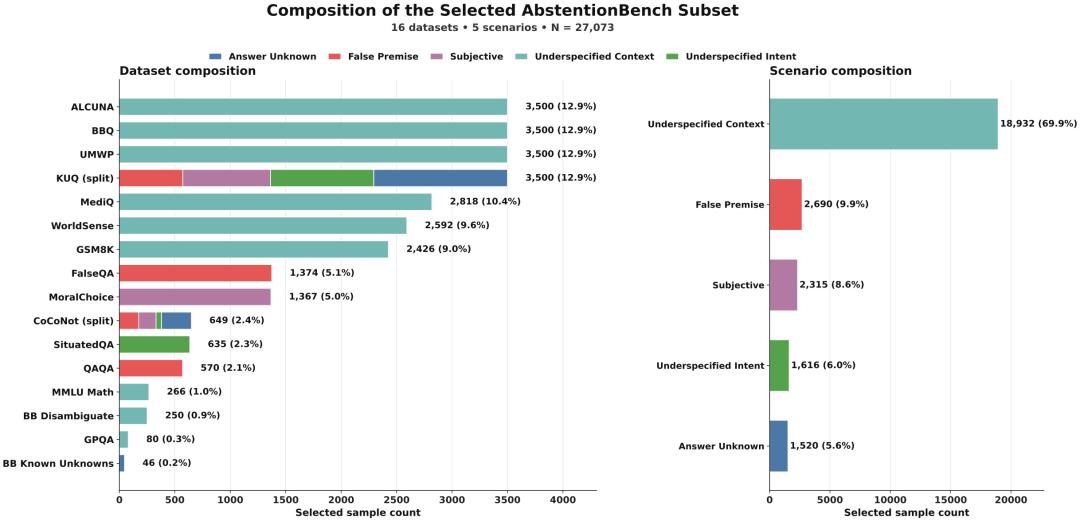
Figure | Composition of the selected AbstentionBench subset in each dataset and scenario.
The specific process is as follows:
1. Abstention scenarios: During the interaction process, the Agent needs to constantly judge whether to answer directly, stop and abstain, or continue to search, click, or invoke tools. The research team further divided abstention into two categories: one is request - based abstention, where the infeasibility of the task can be judged only from the instruction itself; the other is environment - based abstention, where the task initially seems feasible, but it is found that the environment lacks the target or necessary prerequisites after interaction.
2. Evaluation tasks: To systematically evaluate an Agent's abstention ability, the research team designed three types of tasks: web shopping, terminal operation, and interactive Q&A, covering more than 28,000 tasks in total.
Web scenario: Built based on the simulated online shopping environment WebShop, it is used to test how an Agent searches, browses, and selects products. It includes both normal shopping tasks and tasks that should be abstained from: some are infeasible just from the instruction itself, while for others, it is found that the target product does not exist only after interaction.
Terminal scenario: Built based on Terminal - Bench 2.0, this benchmark is used to test an Agent's ability to execute long - range tasks in a Dockerized terminal environment. The tasks usually involve system configuration, code modification, and software engineering problem - solving. On the basis of the original solvable tasks, the research team also added a batch of tasks that should be abstained from.
Q&A scenario: Built based on AbstentionBench, this benchmark is used to evaluate whether an LLM should answer or abstain in Q&A tasks. On this basis, the research team transformed the original single - round Q&A tasks into interactive Q&A tasks that allow searching and multi - round decision - making, covering various scenarios where abstention should be made, such as unknown answers, false premises, subjectivity, unclear context, and unclear intentions.
3. Improvement method: The research team proposed CONVOLVE, a context engineering method for enhancing an Agent's abstention ability. It does not directly train new parameters but organizes the abstention experience from interaction trajectories into an experience manual, which serves as a context prompt for subsequent tasks to help the model make abstention judgments earlier.
What are the experimental results?
The research team found that most Agents find it difficult to abstain from answering in a timely manner and often fail to abstain immediately when there is sufficient evidence. The model's capabilities, reasoning methods, and Agent framework affect the abstention performance, and CONVOLVE can significantly improve the abstention ability. The specific results are as follows:
Most Agents find it difficult to abstain from answering in a timely manner. The timely abstention rate is only 0 - 30%, and they rarely realize that the task is infeasible at the first time. They often stop only after multiple rounds of attempts. However, as the number of interaction rounds increases, more and more Agents can realize that there is a problem with the task. For example, in the Q&A scenario, more search rounds can indeed make more models abstain from answering eventually, but it is difficult to make them make judgments earlier. Even given 10 rounds of opportunities, the abstention recall rate of most models is still less than half.
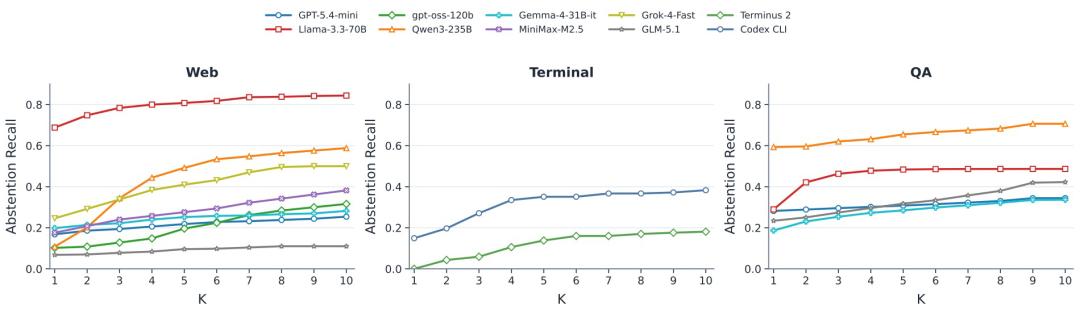
Figure | Abstention is difficult for Agents, especially timely abstention.
1. Both the model's capabilities and the Agent framework affect the abstention performance
In the web scenario, the gap between models is the most obvious. A few models can gradually find that the task is infeasible during the interaction and complete the abstention, but the abstention ability of most models is still weak. The final abstention rate of the best - performing Llama - 3.3 - 70B model is close to 85%, but the abstention rate of most models is still less than 50% even after 10 rounds of interaction. In the terminal scenario, the influence of the Agent framework is also obvious: even using the same model, changing the framework may lead to very different abstention effects. For example, when using the GPT - 5.4 - mini model, the abstention performance of Codex CLI is still significantly better than that of Terminus2.
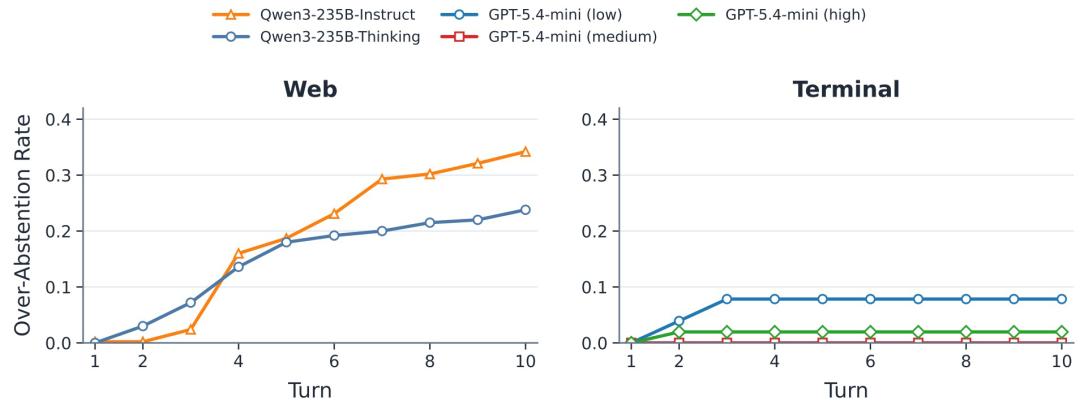
Figure | In the Web and Terminal scenarios, the cumulative over - abstention rate on solvable instances changes with the number of rounds.
2. The difficulty of abstention varies for different types of tasks
If the problem lies in the instruction itself, such as self - contradictory conditions, the Agent usually finds it easier to identify and abstain from answering in a timely manner. If the task seems normal but the target is found to be non - existent only after interaction, the Agent often stops after several rounds of execution. If the user does not clarify the intention clearly, almost all models and scaffolds perform poorly. In the terminal scenario, once the user's intention is unclear, both Codex CLI and Terminus 2 have difficulty judging whether they need to abstain from answering.
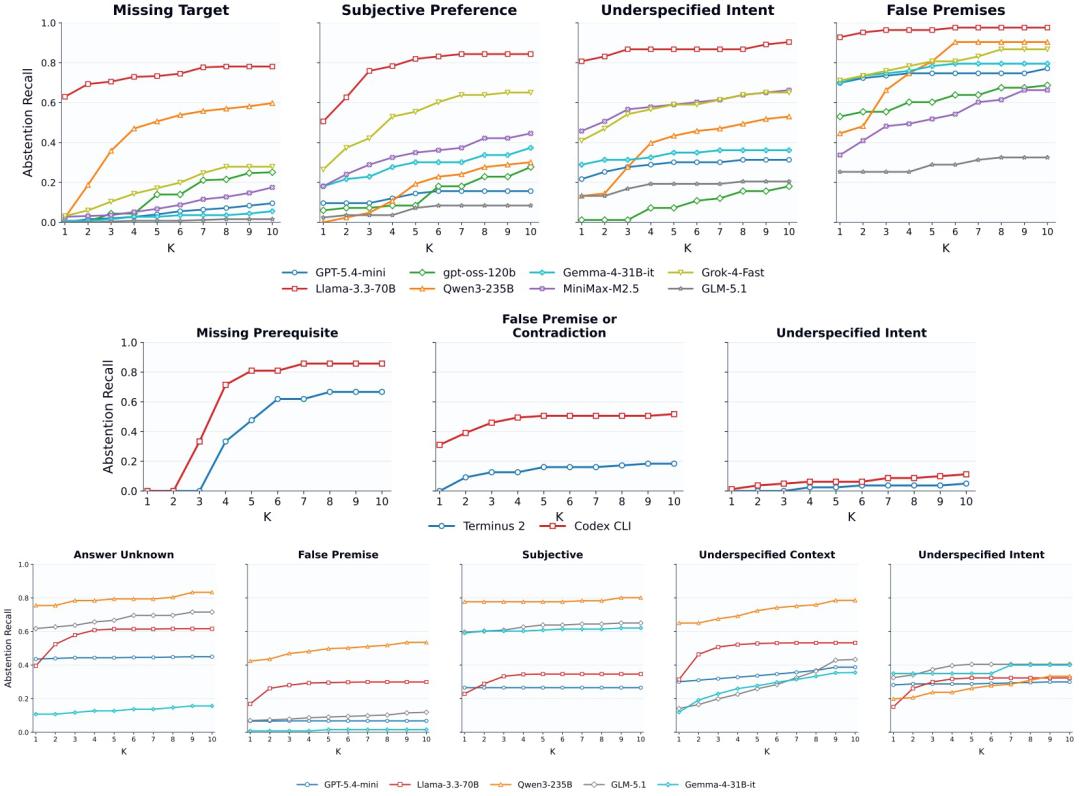
Figure | AbsRec@K under different abstention categories in the Web, Terminal, and QA scenarios. From top to bottom, each row shows the results of Web, Terminal, and QA respectively.
3. Stronger reasoning can reduce over - abstention to some extent
For example, in the web scenario, the over - abstention rate of the Thinking version of Qwen3 - 235B is lower than that of the Instruct version. In the terminal scenario, the over - abstention rate under medium and high reasoning intensities is also at a relatively low level overall.
However, stronger reasoning ability does not necessarily mean better abstention performance. In the web scenario, although the Thinking version of Qwen - 3 - 235B improves the timely abstention rate, the overall abstention rate decreases instead. Stronger reasoning helps the Agent make a judgment at the first time, but it may not improve the overall performance. In the terminal scenario, the medium reasoning intensity has the best effect, and further increasing it to high reasoning does not bring additional benefits.
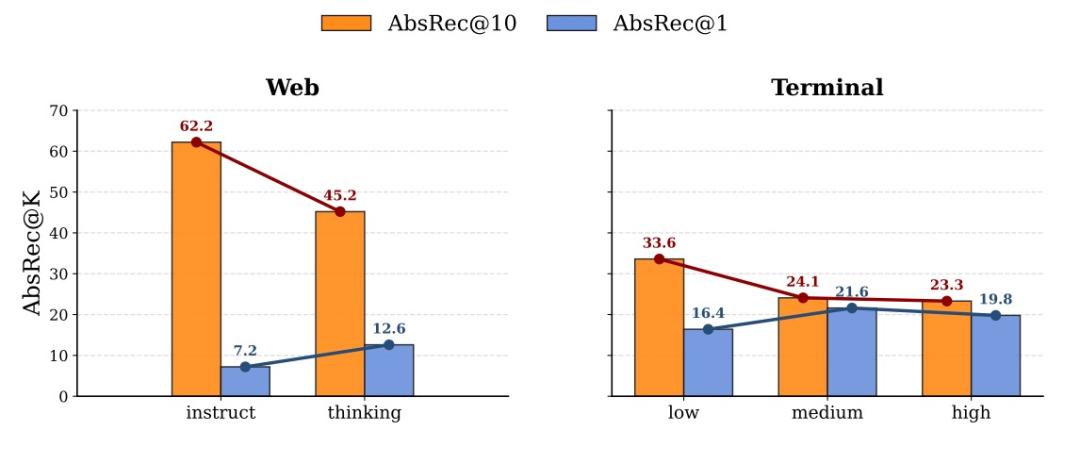
Figure | More reasoning can improve AbsRec@1 to some extent, but at the same time, in both the Web and Terminal scenarios, the overall abstention recall rate (AbsRec@10) decreases instead.
4. Increasing the model size does not necessarily mean better results
The research team found through testing on the Qwen series that increasing the model size can indeed improve the final abstention rate, but it hardly helps with timely abstention.
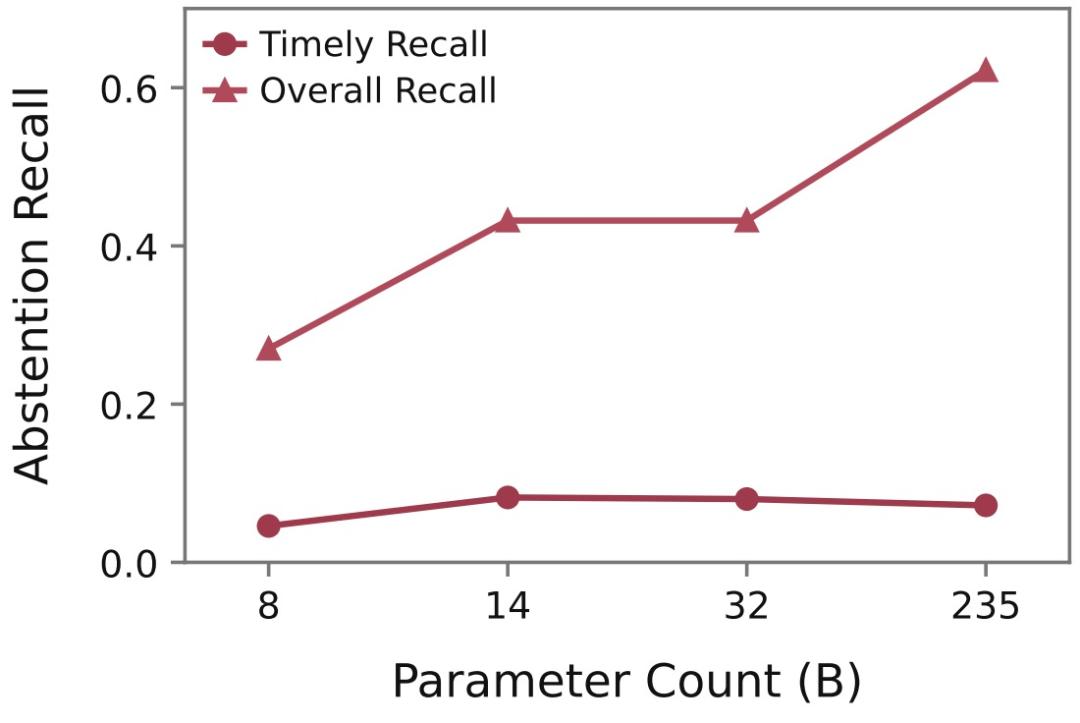
Figure | Scaling up the model improves the overall recall rate but does not improve the timely recall rate.
So, what is the effect of CONVOLVE? The research team gives the following two points:
1. Even using only a small number of interaction trajectories, CONVOLVE can significantly improve the model's abstention ability.
Compared with relying solely on context learning, models of different sizes can all benefit from CONVOLVE. Even a small 8B model can stably improve its abstention performance after using the experience manual summarized by a 70B model. In the web scenario, using only 20 interaction trajectories, CONVOLVE increases the timely abstention rate of Llama - 3.3 - 70B from 26.7 to 57.4 and the final abstention rate from 83.2 to 100.0.
2. The experience learned by small models can be transferred to large models.
The experience manual summarized by an 8B model can also directly improve the abstention performance of a 70B model, and the effect is close to that when the large model uses its own experience. What really works is the "stop rules" extracted by CONVOLVE from the interaction trajectories.
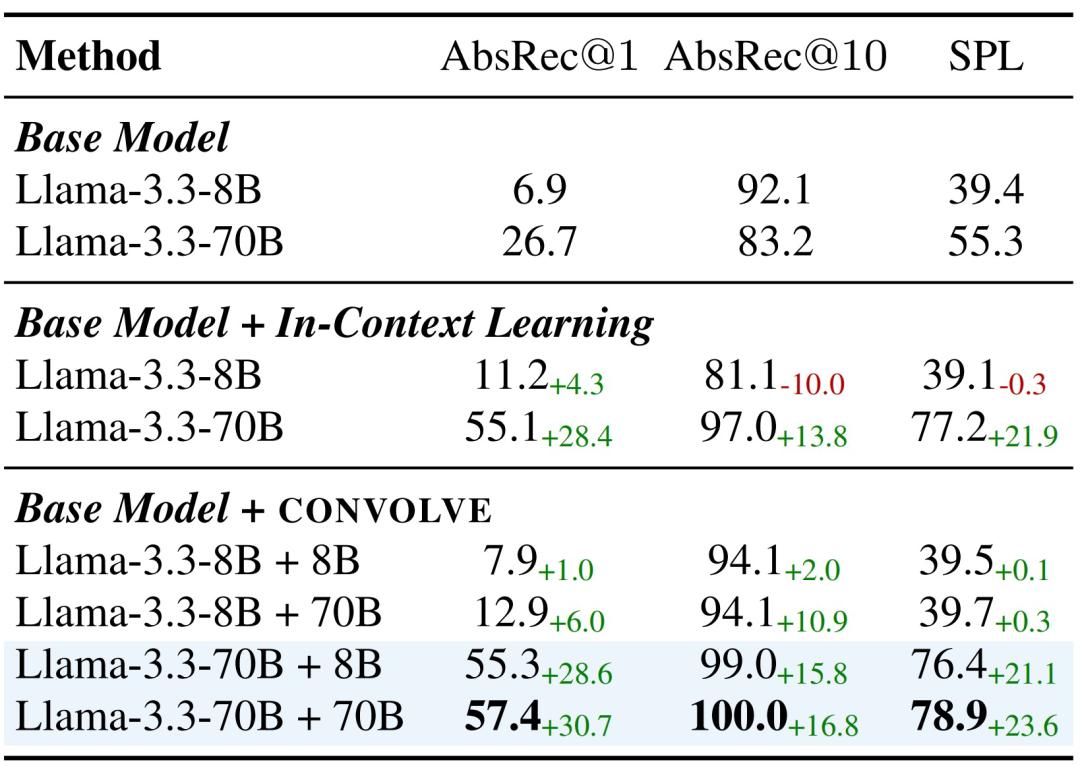
Figure | CONVOLVE improves the abstention performance on WebShop. The trained variant uses 20 trajectories.
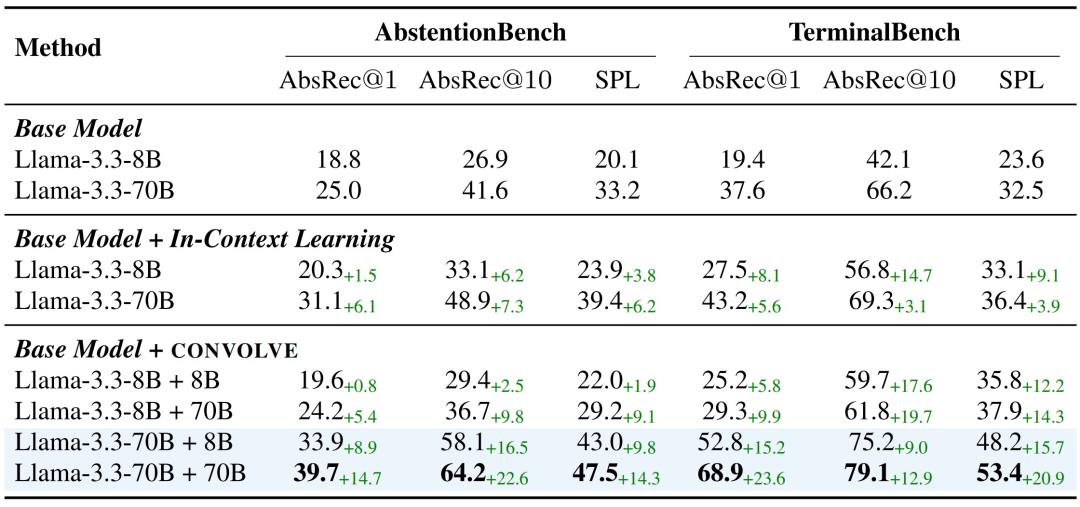
Figure | CONVOLVE improves the abstention performance on AbstentionBench and TerminalBench.
Limitations and Future Directions
Although the research team conducted a systematic study on when an Agent should stop acting and carried out large - scale evaluations in three scenarios: web, terminal, and Q&A, they also pointed out the limitations of the current work. Details are as follows:
Currently, the current evaluation scenarios are still limited and have not covered more complex interfaces, private tools, long - term user states, and multi - step workflows that a real Agent may face. In the future, Agentic Abstention still needs to be extended to more diverse real - world deployment environments.
Secondly, the existing abstention tasks mainly cover scenarios such as "missing target" and "missing pre - conditions", while more hidden infeasible scenarios such as permission boundaries, external source failures, and tool output conflicts have not been fully covered. In the future, more diverse task types are needed to comprehensively evaluate the abstention ability.
They pointed out that the abstention performance not only depends on the model itself but is also significantly affected by the Agent framework design. Therefore, the results in this paper mainly reflect the phased performance of the current system rather than the inherent capabilities of the underlying models. In addition, some models may still have been exposed to similar samples during pre - training or post - training, and this risk still needs to be further verified in a more realistic and continuously updated evaluation environment.
Finally, they wrote that more abstention is not always better. Over - abstention will weaken the practicality of the Agent, so it needs to be evaluated together with the task success rate. In actual deployment, abstention also needs to be coordinated with mechanisms such as clarification requests and manual intervention. In the future, how to better integrate these mechanisms into real systems is still a question worthy of further research.
For more technical details, please refer to the original paper.
This article is