Cheng Yixiao is set to lead Keling AI in a "betting game"
Can KeLing AI Secure $3 Billion in Funding? Can Cheng Yixiao Smile?
On the evening of July 2nd, Kuaishou released an announcement on the Hong Kong Stock Exchange, officially finalizing the independent spin - off and financing plan for KeLing AI. It will use Beijing KeLing (Beijing KeLing Intelligent Technology Co., Ltd.) as an independent entity, with a pre - investment valuation of $15 billion. Through capital increase and share expansion, it will introduce up to $3 billion in external investment, and the post - investment valuation will be approximately $18 billion.
Compared with the $20 billion valuation target when Kuaishou first planned to spin off KeLing AI in April, this valuation has been adjusted downward, which also reflects the change in the market's expectations for KeLing AI.
However, Kuaishou still calls it the largest single - round financing for a global video large - model company.
BAT in the Same Frame: Defending Against ByteDance?
The lineup of investors in this round is truly luxurious. Among the leading investors are capitals with different backgrounds such as Shanghai Guofang Digital Science, CITIC Securities, Lisi Capital, and Qiming Venture Partners.
Among them, Alibaba, Baidu, and Tencent, as industrial capitals, are rarely "in the same frame." After the share expansion, the three companies will hold approximately 1.11%, 0.28%, and 1.12% of the shares respectively. Alibaba Cloud's investment is 1.363 billion yuan, making it the second - largest single disclosed external investor.
The announcement states that after the financing is completed, Kuaishou's shareholding in KeLing will be diluted from 100% to approximately 68.33%, which is equivalent to selling approximately 31.67% of the equity. Beijing KeLing will still be a non - wholly - owned subsidiary of Kuaishou, and its financial performance will continue to be consolidated into Kuaishou's financial statements.
For the first time, BAT stands together. Many people's first reaction is, is this going to form an "anti - ByteDance alliance"? In my opinion, this statement is both right and wrong.
In the field of AI video, the two most competitive products in China are Seedance under ByteDance and Kuaishou's KeLing. Whether in terms of user scale, technical computing power reserve, product, or commercialization ability, Seedance and KeLing are repeating the story of Douyin and Kuaishou, with the later - comers overtaking the former.
Previously, market news indicated that the current annual recurring revenue (ARR) of ByteDance's Seedance video generation model has reached $2 billion (approximately 14.3 billion yuan), and the monthly revenue exceeds 1 billion yuan. Its latest Seedance 2.5 has also entered the internal testing phase and is expected to be officially launched in early July.
According to the data disclosed by Kuaishou, Beijing KeLing's revenue in 2025 was approximately 1.1 billion yuan; the annual recurring revenue (ARR) in March 2026 reached $500 million; and the revenue in the first quarter of 2026 exceeded 650 million yuan, a year - on - year increase of more than 300%.
That is to say, in the field of AI video, if Seedance is allowed to dominate, in the future, the entire AI video's technical standards, ecological rules, and pricing power will be in ByteDance's hands. This is not good for Alibaba, Baidu, and Tencent, and their related businesses will also be restricted.
It is almost impossible for Seedance to conduct independent financing, and KeLing is one of the few available targets. Supporting KeLing, an independent third - party, is equivalent to adding a variable to the track at the lowest cost. The three companies don't need to get directly involved in a tough fight. As long as KeLing can hold the second place, it can put pressure on ByteDance and avoid the situation where one company dominates too early.
The three major companies will not compete with Cheng Yixiao for control, nor will they pour all their core resources into it. They still have their own battles to fight. Investing a sum of money and taking a stake is a win - win situation for everyone.
Each company has a clear plan: Tencent needs AI video technology to make up for the content production short - board of Video Account; Alibaba outputs computing power through Alibaba Cloud and links its AI capabilities; Baidu needs to find a landing scenario for its Wenxin large - model in video generation.
The three major companies didn't agree to enter the field together. After calculating their own interests, they just happened to choose the same target: not aiming to defeat ByteDance, but at least not letting ByteDance win too easily.
However, this loose alliance can bring limited support to KeLing. Their shareholding ratios are all very low, with the highest being just over 1%. The scenarios, computing power, and channel resources they can bring, and how much can ultimately be converted, still depend on KeLing's own technology and commercialization ability.
KeLing's Independence: No Way Back Under the Bet
Many people regard the $3 billion in financing as KeLing's "ammunition depot" and think that Cheng Yixiao, by joining forces with various parties, can continue to compete with ByteDance in the domestic AI video field. However, this money is not as abundant as expected.
AI video is a typical capital - intensive competition. Model iteration, computing power infrastructure, talent reserve, and user costs all require huge amounts of real - money investment.
Public reports show that ByteDance has raised its AI infrastructure expenditure in 2026 from 160 billion yuan to 200 billion yuan, an increase of at least 25%. Some media have also reported that ByteDance is discussing an annual AI capital expenditure of up to $70 billion. In the domestic AI industry, only Alibaba and Tencent, which have invested at the level of hundreds of billions, can match this level of money - burning.
Kuaishou does not have the financial strength of ByteDance and can hardly withstand the "money - gobbling beast" of AI. Kuaishou's CFO disclosed at the performance meeting in March 2026 that the group's overall capital expenditure (Capex) in 2026 is expected to reach 26 billion yuan, an increase of approximately 11 billion yuan compared with 14.5 billion yuan in 2025. The newly added funds are mainly used for the computing power investment of KeLing's large - model and other basic large - models, as well as the infrastructure construction of data and computing power centers.
In an ideal state, based on KeLing AI's current ARR of approximately $500 million and an annual loss of approximately 1.9 billion yuan (approximately $260 million), it can cover the R & D and market investment for the next 3 - 5 years.
The $3 billion in financing is the admission ticket to stay in the game. Its most core value is that Kuaishou moves this high - investment business of KeLing out of the parent company's profit statement, allowing external capital to share the money - burning pressure.
Cheng Yixiao can no longer afford to support KeLing. However, the tough battle after independence has just begun, and its most realistic challenge is the gambling agreement on its shoulders.
According to the announcement, KeLing AI needs to bear the pressure of the exit clause for not going public on schedule. If Beijing KeLing fails to complete an IPO before October 30, 2031, investors have the right to require it to repurchase at the original price plus an 8% simple - interest annual return.
An 8% annual repurchase interest rate is not low in the primary market, which provides a guarantee for all investors. If they win, they can earn the valuation premium; if they lose, they can get a fixed return. Almost all the risks are transferred to KeLing and Kuaishou.
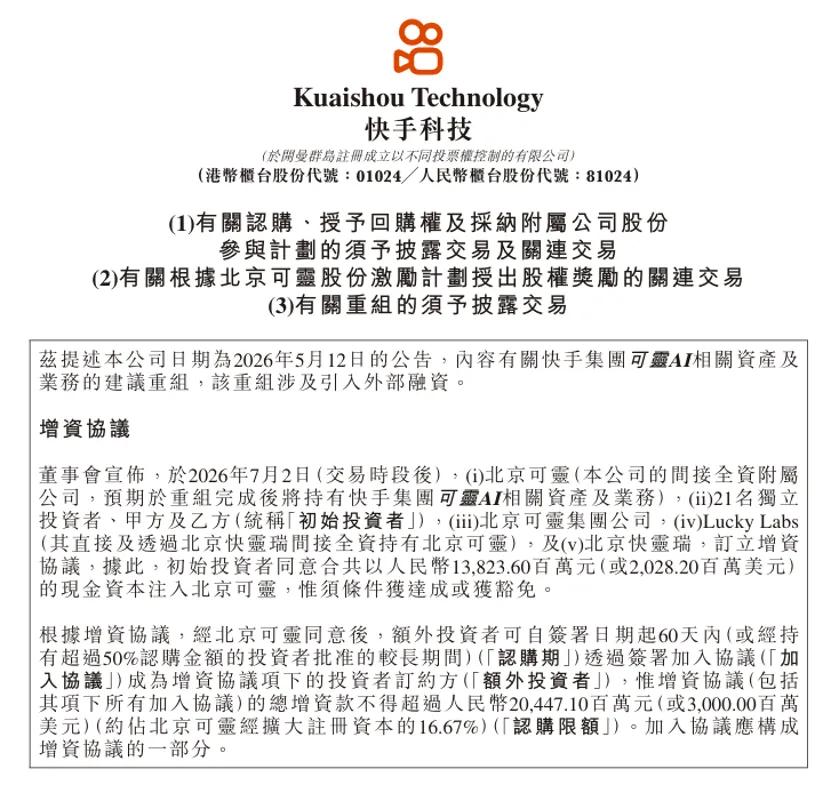
Picture | Kuaishou Technology's Hong Kong Stock Exchange announcement, disclosing part of the capital increase agreement
Although "going public in Hong Kong within 12 months" is the current established route, the capital market in 2026 is becoming more and more strict in evaluating AI companies. KeLing AI's ARR revenue is growing, but the competitive pressure it faces is also increasing. It still needs to prove that its business ability and business model can support the post - investment valuation of $18 billion and successfully go public.
At the same time, Kuaishou has made a five - year non - competition commitment: after the restructuring is completed, as long as Kuaishou remains the controlling shareholder, it cannot directly or indirectly control any other video generation model entity within five years.
This is equivalent to putting all the chips of the group's internal AI video business on KeLing. Once KeLing goes astray, Kuaishou won't even have a chance to start over.
The governance structure is also forcing KeLing to fight to the death. After the financing is completed, Kuaishou still holds approximately 68.33% of the shares and retains the controlling right. In addition, Cheng Yixiao holds approximately 1% of the shares, and KeLing's CEO, Gai Kun, holds approximately 3% of the shares, and Gai Kun has ten - fold voting rights.
This design is closer to the governance logic of an independent AI company: the decision - making power of the business is fully delegated to the core team, and the parent company no longer takes care of everything. At the same time, this also means that the management team needs to take responsibility for KeLing's profits and losses, and even its survival, and can no longer rely on Kuaishou's system for "blood transfusion."
Now, KeLing is burning money much faster than making money, and it will directly face the suppression of Seedance and overseas giants such as Google. Attack is the only way out. Only by running through commercialization, maintaining the valuation, and going public on schedule can it go further in the AI race.
KeLing AI Spins Off. What Will Kuaishou Do?
Since KeLing AI was launched in June 2024, its valuation has caught up with 70% of Kuaishou's current market value in just two years, creating a wealth - creating myth in the AI era.
Behind this inverted valuation of "the son is valuable while the mother is weak" is also Kuaishou's embarrassment. There is a cognitive gap between Kuaishou, the market, and investors: Is Kuaishou a short - video content company, an e - commerce company, or a technology company?
In the past two years, Kuaishou's main business has reached its ceiling. For example, in 2025, Kuaishou's annual revenue was 142.8 billion yuan, and the adjusted net profit was 20.6 billion yuan. Although the book profit seems stable, the DAU growth rate was only 2.76%, and user growth has basically reached its peak. The basic business of internal and external cycles such as live - streaming rewards, advertising, and e - commerce live - streaming have all entered the stage of stock competition, and it is difficult to tell a story of high - growth.
Cheng Yixiao needs KeLing AI to save the situation, enhance its technological attribute, and emphasize that Kuaishou is a technology company.
It can even be said that almost all of the technological narrative, AI imagination space, and valuation premium after Cheng Yixiao regained control of Kuaishou are supported by KeLing AI.
One detail is that in order to increase the "AI content," Kuaishou has stopped separately disclosing the quarterly and annual GMV figures of its e - commerce business since the first quarter of 2026. The management clearly pointed out in the quarterly report that one of the main reasons for the growth of other services is the growth of KeLing AI business.
Whether there is KeLing or not makes two completely different market narratives for Kuaishou.
Cheng Yixiao can surely calculate this account clearly. For him, this is a game of self - conflict. If either Kuaishou or KeLing becomes bigger, he will be a winner.
In the short term, it is a win - win situation. KeLing gets external financing, and the money - burning no longer goes through the parent company's statement, so Kuaishou's profit statement will look better. At the same time, Kuaishou still retains the controlling right. If KeLing's valuation rises, the parent company can still enjoy the benefits. It is equivalent to using the way of diluting equity to exchange for KeLing's independent survival space and also preserve Kuaishou's technology story.
However, the risk is one - way. If KeLing fails, it will be a double blow. On the one hand, KeLing will trigger the repurchase clause, and Kuaishou, as the major shareholder, will bear the corresponding pressure. On the other hand, the market will directly remove Kuaishou's AI valuation premium. Since there is no new growth in the main business, the valuation and performance will be hit simultaneously.
Therefore, Kuaishou is not throwing off a burden by spinning off KeLing. Instead, it is putting the relationship of sharing weal and woe on the table.
For the next step, Kuaishou needs to take three right steps to have a chance of winning:
First, hold on to the basic business. Mature businesses such as live - streaming, e - commerce, and local life are Kuaishou's last source of cash flow. While KeLing is charging ahead, the parent company's cash flow cannot be interrupted. This is the fundamental guarantee. Once the main business declines and there is no more support from the rear, no matter how capable KeLing is, it won't be able to hold on.
Second, deepen ecological synergy. Spin - off is not a complete cut. Instead, the synergy should be made more substantial. KeLing's AI generation ability should be fully integrated into Kuaishou's main - site content production, e - commerce material production, and live - streaming interaction scenarios, using AI to reduce costs and improve efficiency for creators and merchants, and in turn, consolidate the barriers of the main business. KeLing and Kuaishou cannot become two separate entities.
Third, find new narrative fulcrums. Don't put all growth expectations on KeLing. The AI track is volatile, and the valuation fluctuates rapidly. Betting all on one business is too risky. Kuaishou needs to find new technological or business growth points outside of AI video. Even if there is no short - term return, it should leave some imagination space for the market.
After all, KeLing's spin - off and being put on the gambling table is not because Cheng Yixiao is too radical, binding the most valuable asset in his hand with China's top capitals such as BAT. The real pressure comes from the AI arms race. Independent survival may still give it a chance to fight.
Whether it is Cheng Yixiao, Kuaishou, or KeLing, there is no way back.
Reference materials:
Tang Chen, "What Will Kuaishou Do After KeLing's 'Separation'?"
Yicai Global, "KeLing AI 'Takes on' ByteDance and Google"
This article is from the WeChat official account "Tang Chen", author: Tang Chen. Republished by 36Kr with permission.