From demo to commercial delivery, how does Kling capture the global creative market?
Rule changes always happen quietly.
In the early summer of 2026, two events took place simultaneously in Cannes.
On the one hand, the global creative industry completed an unobtrusive paradigm shift. The Cannes Lions International Festival of Creativity for the first time systematically incorporated the AI Craft into its jury structure, spanning multiple dimensions including Film Craft, Digital Craft, and Industry Craft. AI was for the first time included in the evaluation framework of "creative craftsmanship" rather than being just a new thing for discussion. In this sub - track, two advertising works produced with the participation of KeLing AI won awards.
On the other hand, in the theme forum of the Cannes International Film Festival held earlier, directors from China, the United States, and South Korea shared the implementation paths of KeLing AI in real film and television workflows from different dimensions such as Hollywood industrial - grade TV series, pure AI theatrical movies, and AI animated feature films.
In the past two years, the iteration speed of AI video models has been extremely fast. However, there has always been a gap between the rapid development of technology and the adoption by the industrial sector.
Now, this gap is being bridged.
The events that took place in Cannes come from two systems that are more difficult to convince. One is the evaluation standard of the global advertising creative industry, and the other is the production site of the professional film and television industry.
It can be found that AI video is going through a clear verification chain. In addition to product penetration at the mass level, it also needs to be recognized by the jury system of the world's top creative halls and be adopted on a large scale by the advertising and film and television industries.
From this perspective, KeLing AI is exactly one of the few models that have fully crossed these three thresholds. As of June 2026, the global users of KeLing AI have exceeded 100 million, covering 224 countries and regions, with an ARR approaching $500 million, a nearly 400% increase in one year. Behind these figures, the commercialization of AI video has begun to be verified by real users, real projects, and real revenues.
Thus, a convincing example has emerged.
The Shift in the Jury Seats of the Cannes Lions Awards with the Presence of AI
Two works in which KeLing AI participated and won awards: "L’Ultimo Uomo Reale" won the Silver Award for Film in the Classic category and the Bronze Award for Film Craft in the Craft category;
"Lorem Ipsum" won the Bronze Award for Film in the Classic category.
The client of "The Last Real Man" is The RealReal, a leading second - hand luxury e - commerce platform in the United States, which emphasizes its core value of authenticity.
The main line of this April Fools' Day advertisement is the story of a protagonist who tries to find "reality" in a world full of fictions and replicas. Most of the shots in the whole film were generated by KeLing AI. Even the protagonist, who is known as the last real man, was generated by AI. The only real - shot material is the bag.
The ingenious part of the creativity lies in the nesting. The brand needs to convey "reality", but the production method is "generation". The whole film looks extremely realistic. However, when the audience realizes that everything is produced by AI, the brand proposition of "what is real" is re - activated. The real - shot bag has become the only real anchor in the AI world. This itself is a physical expression of The RealReal's brand proposition. The more complete the AI - generated world is, the more prominent its sense of reality becomes.
On the other hand, the original meaning of "Lorem Ipsum" is the common meaningless Latin placeholder text in design software and website construction. Starting from this concept, Purga Films applied the visual grammar of three classic film genres: Japanese samurai, Western cowboys, and gangsters. Although the lines in the content are meaningless throughout, the audience can still read a complete emotion and narrative.
This is not a project where AI is used for post - production modification after real shooting. Under the director's control, AI was precisely deployed to reproduce the visual symbol systems in the three film genres. Those costumes, lighting, composition, character postures, and action rhythms, which used to require complex processes to achieve the desired texture, have been compressed into a more flexible and efficient process.
AI is no longer just an auxiliary tool. It can be a creative language and the core productive force that can be precisely deployed.
One of the two works is from Germany and the other is from Argentina, and the judgment comes from the global jury. This geographical distribution itself is also a fact. The AI video technology represented by KeLing AI is no longer an outsider being discussed in the global industry, but an on - site participant.
Sebastian Strasser, the founder of Lipstick Film, made a very accurate judgment. "AI will not replace directors. It just takes away all the excuses for not directing seriously."
This is exactly the significance of the Cannes Festival of Creativity incorporating the AI Craft system. It doesn't simply declare the victory of AI but incorporates AI into a more rigorous creative order. The entry of AI into the creative industry is no longer just an experiment of a few people or a display of the capabilities of technology companies. It has begun to be regarded as a measurable creative craft by the highest - level jury system.
Crossing the Threshold of Commercial Delivery
The recognition of the jury system solves the problem of whether it can be measured by professional standards. For the advertising and film and television industries, a more practical problem is how to make the risky leap of commercial delivery.
The creative industry has never lacked interest in new technologies. In the past two years, almost all advertising agencies, film and television studios, directors, and creators have been trying out different AI video tools. However, there is still an obvious threshold between exploration and commercial delivery.
Taking the advertising industry as an example, it can't be said that it has been rejecting AI video, but its attitude has been relatively conservative. There are indeed objective reasons for this. In the early stage of AI video technology, the content produced often lacked consistency of characters across shots, the output was not reproducible, and the cost of post - production correction was even higher than reshooting.
This is the actual need of commercial delivery. As long as these problems are not solved, AI cannot truly become the core productive force. The reason why KeLing AI has been widely accepted by the advertising industry and even becomes the core technological support for award - winning products is its ability to meet the actual delivery scenarios.
The large - scale native 4K output, high - quality pictures, precise controllable generation, and coherent characters... This has been fully proven by the quality presentation and award recognition of "The Last Real Man" and "Lorem Ipsum".
It's not just in foreign countries. Previously, the April Fools' Day advertisement "So Annoying" by Meituan was delivered by the creator @Uncle Xixi through KeLing AI. In his opinion, commercial projects are most afraid of uncertainty, while KeLing AI has achieved character consistency, which can ensure the continuous narration of brand characters. The controllability at the storyboard level has turned the generation from a "lucky draw" - like operation into an expected production. The stable output with native 4K - level quality has saved a lot of time. The delivery of the entire TVC only took two weeks. If it were produced in the traditional way, it would usually take four to six weeks.
In an exclusive interview, Uncle Xixi once mentioned that in the production of "So Annoying", the time actually spent on AI - generating key shots and dynamic drafts only accounted for a part, and more time was spent on the pre - production creative tone - setting and post - production refinement. The energy of the creator has been completely released and can be devoted to creativity itself.
Kevin Zhu, the CEO of the China region of VML, the world's largest creative agency under WPP, also highly approves of this. "Often, only two or three adjustments of the prompt words are needed to get highly accurate pictures."
KeLing ensures the stability of brand visual assets such as LOGOs, fonts, and packaging, which is the prerequisite. And the efficiency improvement at the partner level directly leads to a change in the way of creative decision - making. "In the past, we could only focus on one creative direction, but now we can run through five different creative branches at the same time and finally choose the best one."
Of course, the commercial delivery in the advertising industry is usually of a relatively short - term and short - length nature. In the film and television industry, can AI video meet the long - term requirements for continuity, stability, and collaboration efficiency in long - running TV series or even under the Hollywood industrial standards?
At the on - site forum of the Cannes International Film Festival, the answers of the three directors were naturally positive. Among them is Hollywood director Jon Erwin.
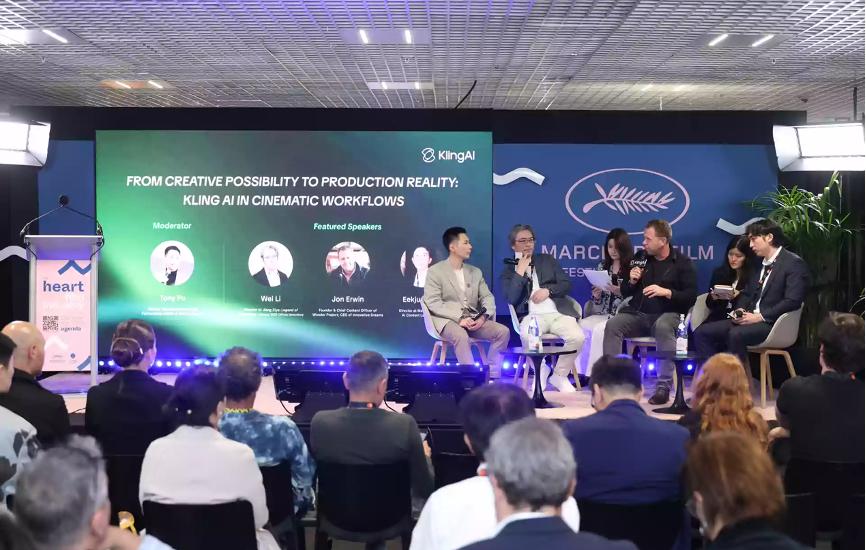
The scene of the Cannes Film Festival
In the Amazon Prime TV series "House of David" he directed, the first season had 44 million global views and ranked first on Prime Video in the United States. In this season, many shots generated by KeLing AI were also used.
In the second season, the number of shots generated by KeLing AI increased by nearly six times, reaching 400 groups. The production team confirmed the reliability of AI in terms of continuity, stability, and industrial standards throughout the whole season and then made the decision to adopt it on a large scale. The trust of a production system in a tool weighs much more than the personal preference of a director.
In another work of Erwin, "The Old Stories: Moses", in the LED virtual studio on Manhattan Beach, with the parallel way of real shooting and AI virtual production, the shooting of a three - episode miniseries that originally required six months of preparation was completed in one week.
This change in the hybrid production mode has also spread to the actors on the set. When Oscar - winning actor Ben Kingsley first performed in an AI - generated scene, he said that he once couldn't tell where the real - built scene ended and where the computer - generated world began. "The whole transition was seamless."
The AI - generated environment is no longer just post - production pictures, but has begun to become a scene where actors can enter, believe in, and complete their performances accordingly.
The secret of the soaring efficiency is that the shooting of actors and the generation of visual effects are almost carried out simultaneously. The special effects of the Red Sea water body and huge waves, which used to take several weeks to produce, can now be produced in less than an hour with the support of KeLing AI.
"I think the greater threat to employment in our industry is actually the high production cost and long cycle." In the atmosphere of anxiety about "AI destroying employment" in Hollywood, Jon Erwin gave an opposite conclusion in an exclusive interview with the Los Angeles Times. "AI can complete these tasks three to five times faster and at a cost of less than 30%. I actually regard this tool as the solution to the employment problem in the industry." Moreover, he directly said that if AI was not used, "Moses" would never have been produced.
If a technology can make a project that originally didn't exist feasible, its role in the industry is no longer just optimization but a prerequisite.
There are also many cases in China. In the hit TV series "Peaceful Years" that won the Magnolia Award, there are also many shots in which KeLing AI participated. For example, the famous scene of crows eating carrion cost less than 1% of the traditional plan. According to public reports, AI covered 30% - 40% of the production process of this TV series.
Chen Yi, the founder of the production team Time Coordinate, even built a dedicated workflow throughout the 48 - episode series on KeLing AI, realizing pre - production image classification, digital asset accumulation, and unified style management, so that the texture and character images can be reused sustainably throughout the life cycle of the whole series.
In these commercial delivery scenarios, the output of AI has gradually detached from single blockbuster shots and entered the actual workflow, turning the originally expensive, long - term, and uncontrollable image production into a more certain and continuous process.
The signal from the Cannes jury represents the creative order, while the signal from the advertising and film and television production sites represents the commercial order. The former shows that AI video can now be evaluated, and the latter shows that AI video is being relied on, rather than a zero - sum game of replacement.
Diverse Forms of Infrastructure for Professional Production and Mass Expression
The fact that AI video can enter more complex production systems does not mean that its value only belongs to film sets, advertising agencies, and film and television studios.
The creative order and the commercial order are things within the professional system. However, the ultimate goal of a technology is always to become an everyday ability at the mass level.
Professional creators are the group that can most sense this spill - over effect. As of June 2026, the global users of KeLing AI have exceeded 100 million, among which the proportion of professional creators is not low, covering the fields of film and television, short dramas, advertising, games, and self - media. A large part of these people are embedded in the organizational structures of various studios, covering various occupations such as directors, producers, visual effects artists, designers, and editors.
Their daily choices will be transmitted upwards and downwards along the organizational context. The upward transmission is easy to understand. When a visual effects artist continuously uses KeLing to deliver projects, the entire production line he belongs to will follow suit. Correspondingly, downwards, the content models or generation techniques produced by these professional creators will be disseminated to the mass level.
The masses consume content in the field of social media and even directly participate through the native capabilities of AI.
A vivid example is the "baseball field special effects" that became a global sensation in May this year. Starting from the stands of a Korean baseball game, it directly spread to the World Cup site. A large number of users created their own special - effect videos of "being captured by the camera", and the spread quickly swept across the world.
The data from Sensor Tower shows a clear chain. On May 12th, the daily downloads of KeLing AI reached 969,000, an increase of about 649% compared with the beginning of the month; the daily active users increased from 663,000 to 1,489,000; and the daily revenue increased from $141,000 to $319,000.
Before that, at the end of 2025, the "motion control" function launched in KeLing 2.6 also triggered a wave of mass enthusiasm. Users only need to upload a reference motion and a target image to get a video of up to 30 seconds with camera movements. Those dancing cats and dogs quickly became blockbusters with tens of millions of views. Users are also really willing to pay for it. Data shows that the number of paid users of KeLing AI skyrocketed by 350% in a single month.
The rhythms and forms of the two times of going viral are completely different, but their common feature is that the content creation and consumption at the mass level form a cycle. What KeLing AI provides is obviously not a one - time novelty experience, but a creative ability that can be used repeatedly, a content infrastructure. Users stay because there is something to do.
A more quiet penetration at the mass level is happening in hardware terminals. The Honor 600 series is equipped with the KeLing O3 model, allowing users to