Qiu Sheng | Yuan Jinhui's New Company Rushes for Hong Kong Stock IPO, Founded Less Than Three Years
This article is approximately 2,700 words long. It is recommended to read it for 6 minutes.
Author | Peng Xiaoqiu
Editor's note: Amid the AI boom, more and more companies are entering the capital market. Every page turn of a prospectus holds all that a company wants to say and what remains unsaid.
In view of this, Yingke has launched the "Autumn Sound" column. "Autumn Sound" is taken from Ouyang Xiu's "Ode to the Autumn Sound". By "listening to the autumn sound", we aim to sense the industry trends, evaluate the quality of companies, and record the truths written and hidden during enterprises' sprints towards IPOs. This is our seventh issue, SiliconFlow.
On the last day of Q2, SiliconFlow submitted a listing application to the Hong Kong Stock Exchange. This IPO is filed as an 18C uncommercialized company. The joint sponsors are Huatai and Haitong International.
If you are in the AI developer circle, the name SiliconFlow won't be unfamiliar. It was the first platform to deploy R1/V3 on domestic chips to run token services when DeepSeek became extremely popular. The data in its prospectus is truly astonishing: the number of registered users exceeded 10 million in just over two years; the average daily token throughput from December 2024 to April 2026 increased by 12 times; the number of paying customers increased by 292 times in a year, and its valuation soared to 7.7 billion in just two and a half years.
However, after Yingke went through all 347 pages of the prospectus, a cold fact behind the magnificent growth curve was revealed: SiliconFlow is selling tokens at a loss, with a gross profit margin of -24% in 2025.
SiliconFlow was established in August 2023 and is less than three years old. The prospectus states that it is a leading open and independent token supply platform in China. In essence, it is an AI inference infrastructure company. It aggregates heterogeneous computing power from NVIDIA, AMD, and Ascend, Musix, Moore Threads, etc. With its self-developed inference engine and computing power orchestration system, it translates the underlying computing power into standardized token supply and delivers it through two channels: public cloud services (serverless token services + dedicated instances) and on-premises deployment solutions.
According to a third - party source, in terms of the annual token throughput in 2025, it is the largest independent ecosystem token supplier in China and ranks fifth among all token suppliers.

A business selling tokens at $1 each with a cost of $1.24
SiliconFlow's revenue curve is extremely steep: in the first four months after its establishment in 2023, the revenue was only 6,000 yuan; in 2024, it was 7.346 million yuan; in 2025, it was 55.33 million yuan. The revenue increased by more than seven times in a year. However, the cost structure behind the revenue reveals the truth of this business.
Looking at the three - year trajectory of the gross profit in 2024, it was 39.4%; in 2025, it was -24.0%. In 2025, SiliconFlow's cost of sales was as high as 68.632 million yuan, which was 124.0% of the annual revenue of 55.33 million yuan. In other words, for every dollar of tokens it sells, the cost of computing power and other expenses behind it is $1.24, resulting in a direct negative gross profit. The gross loss in that year was 13.302 million yuan.
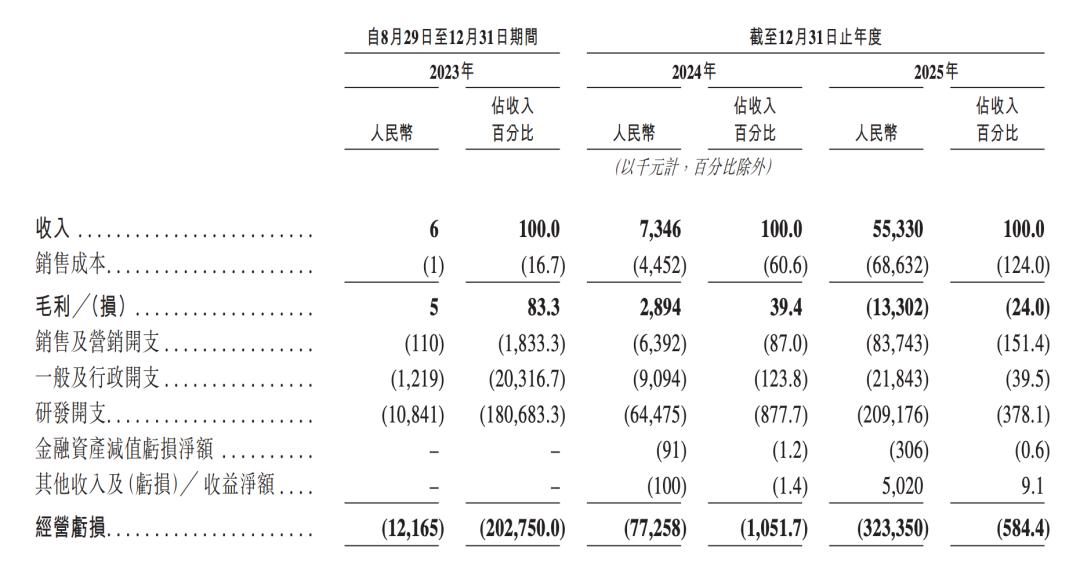
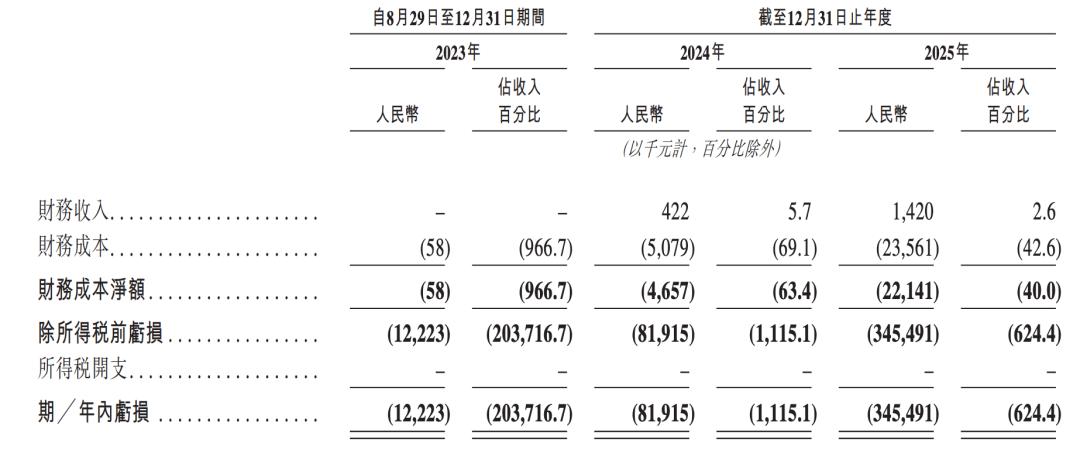
This is a direct reflection of the current price war in AI inference tokens. The prices of large - model APIs have been continuously slashed, and big tech companies have driven the unit price of tokens to rock - bottom. As an intermediate layer, SiliconFlow's cost pressure mainly comes from computing power leasing. In 2025, the cost of computing power resources was 59.627 million yuan, accounting for 86.9% of the cost of sales. The prospectus also mentioned that the significant increase in the cost of sales in 2025 was due to the rapid expansion of computing power resource consumption to support the growing service demand.
Among the other two expense lines:
The R & D expenditure in 2025 was 209 million yuan, which was 378.1% of the annual revenue; the cumulative R & D expenditure in three years was 284 million yuan (10.84 million yuan in 2023 → 64.48 million yuan in 2024 → 209 million yuan in 2025).
The sales and marketing expenses in 2025 were 83.743 million yuan, which was 151.4% of the revenue.
With a revenue of 55.33 million yuan, the R & D and sales expenses alone burned nearly 300 million yuan. Therefore, the net losses from 2023 - 2025 were 12.223 million yuan, 81.915 million yuan, and 345 million yuan. The net loss rate in 2025 was -624.4%, and the loss per share was 33.33 yuan. Even after adjusting by adding back the share - based payment of 135 million yuan + the interest on redeemable liabilities of 23.076 million yuan, the adjusted net loss in 2025 still reached 187.1 million yuan.
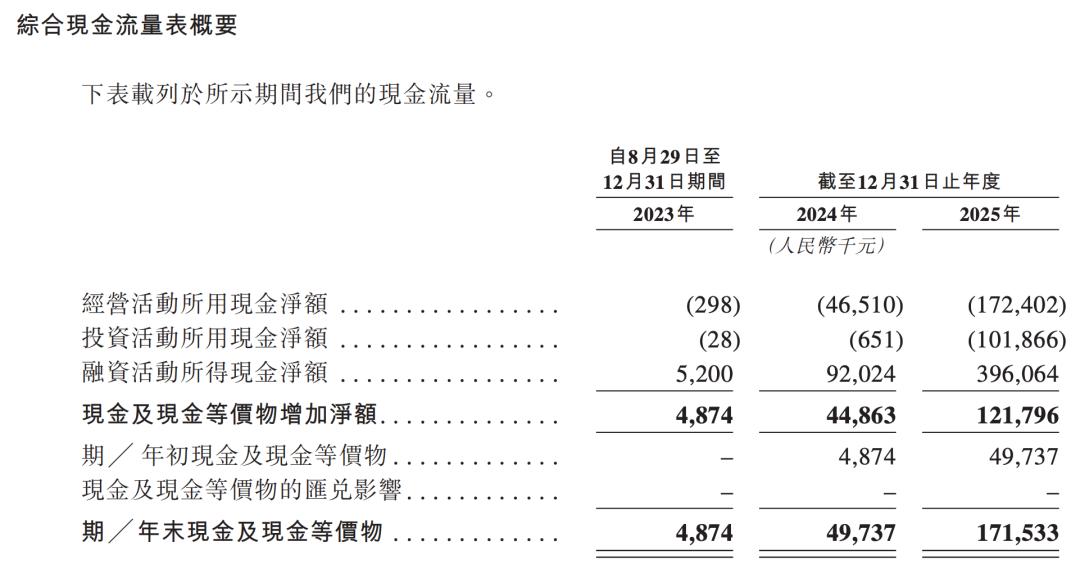
The net cash outflow from operating activities has continued for three consecutive years. In 2025, the net cash outflow from operating activities was 172 million yuan. The good news is that it has had seven rounds of financing. As of the end of 2025, it had 171 million yuan in cash and cash equivalents and another 100 million yuan in time deposits.
In the revenue structure in 2025, the public cloud services revenue was 29.261 million yuan, accounting for 52.9%. Among them, the serverless token service revenue was 14.3 million yuan, and the dedicated instance revenue was 15 million yuan; the on - premises deployment solution revenue was 26.069 million yuan, accounting for 47.1%. That is, on one hand, it targets the large - scale traffic of developers and small - and medium - sized enterprises, and on the other hand, it undertakes high - value projects of large enterprises and institutions.
Among them, the number of serverless paying customers increased from 2,455 to 716,000, an increase of about 292 times. It has served 13,000 enterprise customers, and the platform has cumulatively supported more than 170 models. The number of active serverless users was 5.453 million in 2025 and 1.454 million in the first four months of 2026. From 2024 to 2025, the number of dedicated instance customers increased from 7 to 49, and it was 20 in the first four months of 2026; the number of on - premises deployment customers decreased from 28 to 20, and it was 5 in the first four months of 2026, but the revenue per customer increased significantly.
However, SiliconFlow does not directly purchase chips but mainly leases computing power resources through partners. In the prospectus, several major items state that the funds will be used for leasing computing power resources. The procurement concentration of its top five suppliers (computing power and cloud service providers) is high. In 2025, the top five suppliers accounted for 70.8% of the procurement amount, and the largest single supplier accounted for 20.4%. In addition, two major business partners are both customers and suppliers.
In the risk warning, SiliconFlow stated that it largely depends on the availability of high - quality open - source AI models. Once the models stop being open - sourced or the licensing terms change, its core supply will be affected.
If only looking at the operation data, SiliconFlow is growing rapidly. At the end of 2024, the end of 2025, and the end of April 2026, the number of registered users was 127,000, 9.197 million, and 10.282 million respectively; from December 2024 to April 2026, its average daily token throughput increased by about 12 times; among them, it increased by 241.1% from 2024 to 2025 and further increased by 254.7% from December 2025 to April 2026.
However, all this traffic only translated into 55.33 million yuan in revenue in 2025, and it was a negative - gross - margin conversion. In 2025, SiliconFlow's cost of sales reached 68.632 million yuan, accounting for 124.0% of the revenue, and the overall gross loss rate was 24.0%. There is a huge gap between the explosive growth of users, throughput, and paying customers and the meager and negative - gross - margin monetization.
The prospectus also admitted that the serverless token services target developers and small - and medium - sized enterprises, mostly with prepaid and low - priced consumption. This type of traffic has a large scale, a low unit price, and the supply is close to or even below the cost.

Seven rounds of financing, with the valuation soaring from 280 million to 7.7 billion
From December 2023 to June 2026, SiliconFlow had seven rounds of financing in two and a half years (Angel, Angel +, Pre - A, A, A +, B, B +). In fact, only about 32% of the net financing amount has been used.
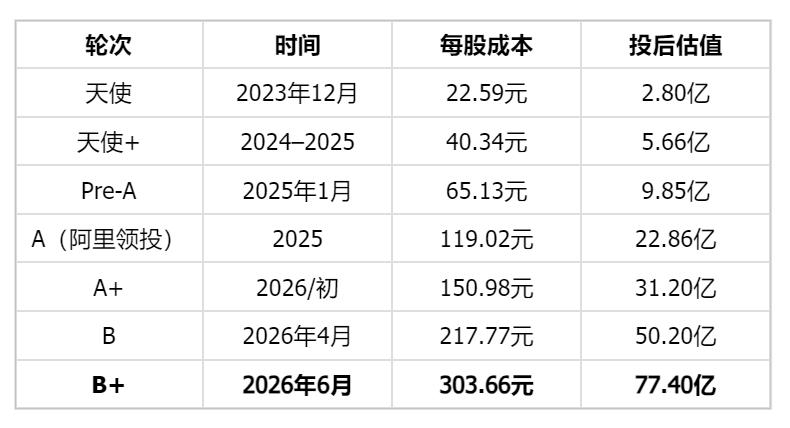
The post - investment valuation soared from 280 million yuan in the Angel round to 7.74 billion yuan in the B + round. It increased by 27.6 times in two and a half years, and the cost per share increased by 13.4 times.
In 2026 alone, SiliconFlow completed three rounds of financing, from 3.1 billion yuan in the A + round to 5 billion yuan in the B round, and then to the B + round. It is worth mentioning that the B + round was just completed one month before submitting the prospectus. Based on the post - investment valuation of 7.74 billion yuan in the B + round, it is approximately equivalent to HK$8.4 billion, which just meets the listing threshold for 18C uncommercialized companies.
In the shareholder structure, the controlling shareholder is Yuan Jinhui, who directly holds 14.35%. Through the employee incentive platforms (Silicon Innovation/Future/Exploration each at 7.85% + Silicon Excellence at 6.59%), he controls approximately 44.48% of the voting rights in total; Alibaba holds 7.42% and has sent director Chen Yingjie; Huawei holds 4.07%; Innovation Works holds 4.01%; Suzhou Yaotu (Yaotu Capital, a semiconductor VC) holds 3.01%; Nanjing Lüyong holds 3.01% ; Wang Huiwen holds 2.06%; Puhua Fund holds 1.81%; Guotai Junan holds 1.56%; SenseTime holds 0.64%, Biren holds 0.39%, Kingdee, and Meituan.
The founder, Yuan Jinhui, is 45 years old this year. He has a Ph.D. in Computer Science from Tsinghua University and an undergraduate degree from Xidian University. From OneFlow to SiliconFlow, he holds multiple positions: Chairman of the Board, CEO, General Manager, and Chief Financial Officer. Yuan Jinhui is an AI veteran. From 2013 - 2016, he served as a principal research fellow at Microsoft (China) and led the development of LightLDA, the world's fastest large - scale topic model training system at that time; from 2017 - 2023, he founded and led OneFlow, a deep - learning framework company, which was later acquired by Guangnian Zhiwai founded by Wang Huiwen and finally merged into Meituan. In August 2023, he founded SiliconFlow with the core team of OneFlow - CTO Liu Juncheng and COO Zhao Zhen are both former employees of OneFlow, and Deputy General Manager Zeng Hua is from the vice - president level of JD.com Group.
Non - executive director Chen Yingjie, 49 years old, is the managing director of Alibaba's strategic investment department and also serves as a non - executive director of MiniMax.
SiliconFlow's story is about a super - growth team led by OneFlow veterans, riding the big wave of AI inference and the token revolution. However, in 2025, it was selling tokens at a loss, with a gross profit margin of -24% (the cost of sales was 124% of the revenue); R & D expenses