AI home smart hardware company raises tens of millions in financing, first product to launch overseas this year | HardKE Exclusive
Author | Huang Nan
Editor | Yuan Silai
36Kr has learned that Weilian Robot Technology (Shenzhen) Co., Ltd. (hereinafter referred to as "MOVA LINCO") recently completed tens of millions of yuan in angel financing. The raised funds will be mainly used for the R&D of underlying AI algorithm technologies, improving the product mass production system, as well as the layout of global channels and the continuous construction of the home AI ecosystem.
The core team of MOVA LINCO comes from leading network communication and smart hardware enterprises, with profound technical accumulation and product experience in routers, NAS storage, and AI computing power devices. The company's product matrix centers on three categories: AI smart voice routers, AI NAS, and AI computing boxes, building a trinity home AI infrastructure architecture of "connection + storage + computing power", covering full-scenario needs from smart home hubs, data storage to local computing power allocation, and focusing on providing intelligent and proactive home AI service experiences for global users.
For a long time, routers have occupied a rather special position. They perform the key function of a connection hub in digital infrastructure, but rarely enter users' daily awareness. After purchasing the product, apart from a brief configuration process, this device is often hidden in a weak current box or behind a TV cabinet, rarely receiving active attention from users. However, once the network is interrupted, the operation of life and work will be immediately hindered, and its irreplaceable and essential attribute will become apparent.
This situation of "being indispensable yet almost invisible" has hardly undergone fundamental changes in the past two decades. Based on this connection hub attribute, it has been promoted to become a non-negligible entry option in the layout of home AI infrastructure.
According to data from the China Industry Research Institute, the market size of China's router industry reached 26.2 billion yuan in 2025. The emergence of AI routers will further expand the imagination space of this product category. It is estimated that by 2032, the global AI router market will grow to more than 5.1 billion US dollars, with a compound annual growth rate of over 16%.
Jia Xinrun, President of MOVA LINCO, told 36Kr, "Routers are one of the few devices in the home that can simultaneously meet the three conditions of being continuously online, powered uninterruptedly, and connecting various smart IoT devices wirelessly. In contrast, for previous terminals such as smart speakers, central control screens, or TVs to control other devices, their communication links must first pass through the router; once the router malfunctions, the entire smart home network will face a complete outage."
Based on this observation, the team focused its first launched product on this area and introduced the AI smart voice router X1 Pro.
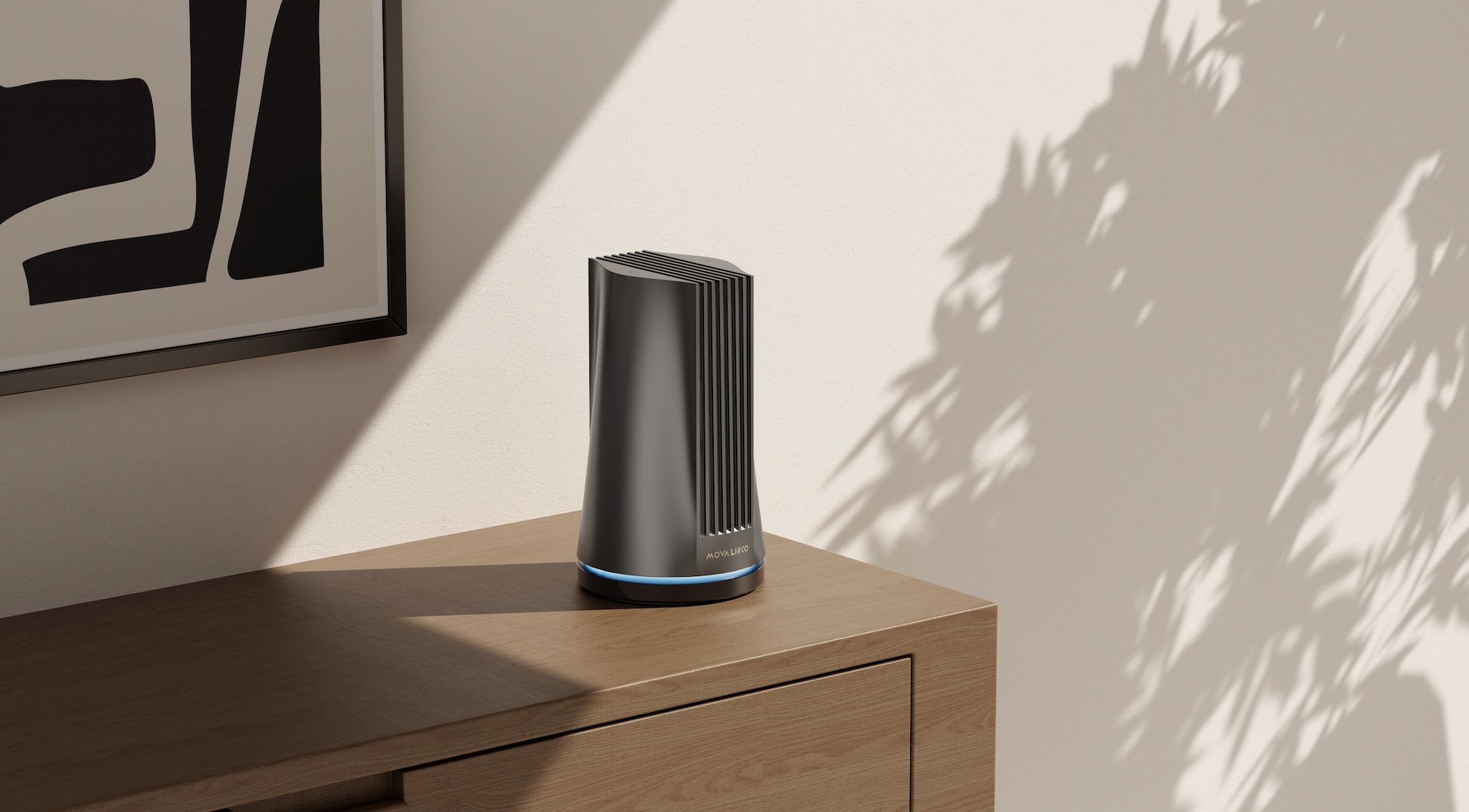
MOVA LINCO AI Smart Voice Router X1 Pro (Source / Enterprise)
The most core change of the X1 Pro lies in its interaction method. Traditional routers complete all operations through an APP, and users need to manually open the software to adjust the network or manage devices. MOVA LINCO has built a custom voice chip and self-developed voice algorithm into the X1 Pro body to support natural and fuzzy voice interaction.
In addition to recognizing standard commands such as turning the network on/off and adjusting devices, the X1 Pro can also understand the real demands behind users' daily expressions. There is no need to use fixed wake-up words; users can directly voice their needs to send control commands to all devices in the home. For example, they can tell the sweeper to start cleaning, adjust the air conditioner temperature, or open the curtains, eliminating the lengthy steps of manual operation.
In terms of hardware configuration, to cope with the complexity of home scenarios, the X1 Pro supports whole-home Mesh networking, covering large-area residences such as luxury apartments and duplex houses. At the same time, the device is equipped with four sets of 2.5G high-speed wired network ports to adapt to high-traffic scenarios such as high-definition audio and video playback and local material transmission.
As a connection hub, the X1 Pro can obtain real-time data information of all devices in the home: what time users get home, what temperature the air conditioner is set to, and when the curtains are opened. A large amount of data is gathered at this local router. But Jia Xinrun is clear that data is only raw material. To make home AI truly understand users and provide proactive services, "connection" alone is far from enough. Data needs to be stored to form long-term awareness of users' living habits and processed locally through computing power.
Previously, MOVA LINCO exhibited the AI NAS UP6 at CES 2026. This product is positioned as a "home private cloud" to solve the problems of home data storage and intelligent retrieval. The UP6 comes with a 6-inch 2K touch screen, allowing configuration and status checks without relying on a mobile phone or computer.
It supports natural language retrieval, enabling users to quickly access photos and files of specific times, locations, or people through voice or text commands. At the same time, it can automatically classify and intelligently identify videos recorded by cameras, filtering out clips containing specific objects or events.
The AI Box anchors the computing power layer of the product matrix. It is positioned as the home computing center, allocating computing resources according to the needs of different devices. For example, tasks such as face recognition by cameras, path planning for sweepers, and semantic understanding of voice commands can all be undertaken by the AI Box in a unified manner.

MOVA LINCO Products Exhibited at AWE (Source / Enterprise)
The three products each perform their own duties. The router is responsible for connection, sensing the online status and data flow of devices in real time; the NAS is responsible for storage, recording traces of every operation, every voice command, and every usage habit; the Box is responsible for computing, completing judgments and responses to user behaviors in the background. "Connection, storage, and computing power are all indispensable. Only by working together can AI move from passive response to proactive service, forming a complete set of home AI infrastructure," said Jia Xinrun.
36Kr has learned that the MOVA LINCO AI Smart Router X1 Pro and AI NAS UP6 are expected to be officially launched overseas in the late 2026, with the domestic version to follow simultaneously. At the same time, relying on the supply chain cluster advantages of Shenzhen and the Greater Bay Area will provide basic support for its mass production and iteration.
The following is an excerpt from the interview between 36Kr and Jia Xinrun, President of MOVA LINCO (slightly edited):
36Kr: There are obvious structural differences between the current domestic AI NAS category and the overseas market. What are the factors affecting its development? What key nodes need to be crossed for household NAS to achieve mass popularization?
Jia Xinrun: This difference is actually the result of the superposition of three factors.
In terms of privacy, European and American users are extremely vigilant about the data sovereignty and security of public clouds. It is difficult for them to accept storing family photos and personal work documents on third-party cloud platforms, so local private storage has been a rigid demand from the very beginning. Domestic users have long been covered by free cloud disk services, and the awareness of private storage has not really been established.
In terms of cost structure, the total cost of long-term subscription services far exceeds the one-time cost of purchasing a NAS. The large-scale supply of free domestic cloud disks has instead delayed the public's re-recognition of the cost-effectiveness of local storage.
There is also a generational gap in usage habits. Overseas, the culture of photography and the tradition of home recording are more profound, and the accumulated volume of family digital assets is far higher than that in China, so the pressure of storage and management has emerged earlier.
We judge that the mass inflection point of AI NAS products will enter a period of accelerated penetration in the next two to three years. At present, the global NAS maintains a compound annual growth rate of 30% to 40%, and there is a consensus in the industrial chain that the track is promising in terms of market volume growth.
The premise is that several conditions need to mature simultaneously: first, the hardware manufacturing cost will continue to decline, as the current price of professional-grade NAS is still a threshold for ordinary families; second, manufacturers need to create perceptible differentiated value in segmented scenarios, such as AI photo selection and fast editing for photography enthusiasts, which can reduce post-processing time from several hours to less than one hour, making it an efficiency tool for specific groups of people; third, functions such as AI retrieval, voice interaction, and automatic classification need to lower the operation threshold sufficiently, so that ordinary users without professional knowledge can also use them.
When the three lines of price, scenario value, and ease of use are all met, NAS will be able to step out of the professional circle and truly enter the decision-making list of families.
36Kr: Different markets have systematic differences in housing forms and smart home foundations. What localized adaptations have you made?
Jia Xinrun: We have carried out layered customization from three dimensions: hardware radio frequency, system software, and functional priority.
Let's start with hardware. Most European and American residences are single-family houses with walls mainly made of wood and gypsum board. The structure is relatively open, but the coverage distance is long. We have re-adjusted the antenna layout and transmission power for US-standard and European-standard models to ensure the stability of Mesh coverage in long-distance and multi-wall scenarios. In China, residential buildings have reinforced concrete structures with compact apartment layouts but strong signal interference, so the radio frequency solution focuses more on anti-interference capability.
Then look at the software. Overseas users have high demand for VPN usage, so we natively integrate complete VPN client and server functions to facilitate their remote access to home devices. In contrast, what domestic users are more concerned about is the reasonable allocation of network resources, such as ensuring no lag during video conferences when multiple people in the family use the network at the same time. The team has designed these two sets of functional logic separately.
Finally, ecosystem adaptation. There are a large number of existing devices supporting Matter and Thread protocols in overseas markets, so overseas models will prioritize connecting these universal smart home protocols, allowing users' existing third-party devices to access the system with one click. In China, we focus more on the in-depth interconnection of our own ecosystem devices, while continuously promoting compatibility and adaptation with mainstream domestic IoT brands.