In the first half of the year, VCs poured half of their capital into AI, with these 30 companies alone raising over 170 billion yuan in financing.
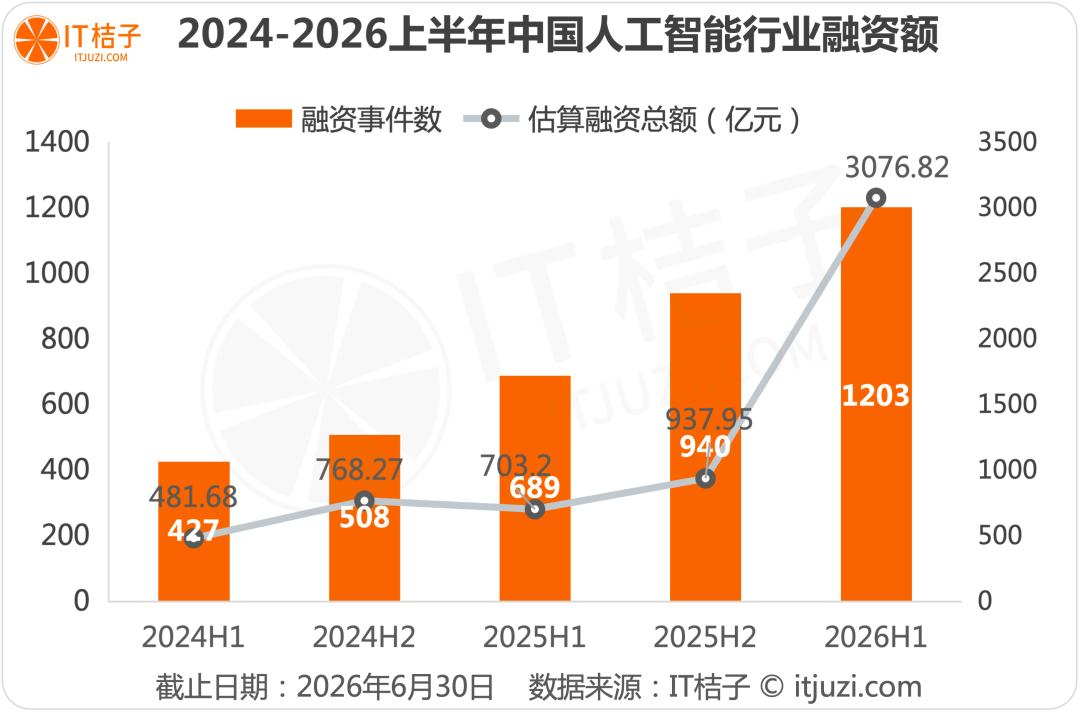
In the first half of 2026, Chinese AI startups experienced a frenzied financing boom, with the total financing amount exceeding 300 billion yuan. The financing volume in just six months had already surpassed that of the entire year of 2025.
AI financing accounted for approximately 48.6% of the market, nearly half, and the number of financing events accounted for about 22.5%.
In other words, in the first half of 2026, for every 2 yuan raised in the primary market, nearly 1 yuan flowed into AI. Although the number of events only accounted for a little over 20%, the amount accounted for nearly half, indicating that the single - deal financing amount in the AI track was much higher than that in other tracks.
More significant than the total financing volume is the structural shift in capital flow. Our core findings include:
① The large - model track was the most attractive to capital, and the funds were highly concentrated in the top players. Three companies, DeepSeek, Jieyue Xingchen, and Yuezhi Anmian Kimi, raised a combined equivalent of about 93 billion yuan, accounting for 30% of the total market financing. Capital heavily invested in the top players following the "winner - takes - all" logic.
② The world - model became the greatest consensus in early - stage investment. Six early - stage startups focusing on the world - model raised a combined total of about 9.7 billion yuan. Capital was rushing to gain a foothold in the "operating system layer" of embodied intelligence.
③ The AIGC application track was the most mature track for the commercialization of AI technology, represented by image and video generation.
01 The AI Track Rushed Forward in the First Half of the Year, with Soaring Financing Amounts
From January to June 2026, data from IT Juzi showed that equity financing in the domestic AI track was characterized by "a significant increase in total volume and a substantial explosion in financing amounts." Capital continued to increase its investment in AI. The financing scale in just six months had far exceeded that of the entire year of 2025.
Data statement:
1. The data screening criteria were entries labeled "Artificial Intelligence" in the "Event Database" of the IT Juzi database, excluding non - AI industries.
2. The statistical scope was limited to equity financing events in the primary market, excluding company listings (IPO) and post - listing refinancing, mergers and acquisitions, etc.
IT Juzi data showed that in the first half of 2026, there were 1,203 financing events in the AI track, and the total financing amount had exceeded 300 billion yuan, far exceeding that of the entire year of 2025. This reflected that capital's investment confidence in the AI track continued to increase, and the AI industry had fully entered the explosive stage of large - scale implementation from the technology verification stage.
In the first half of 2026, the financing rhythm of the AI track maintained a high - level financing scale starting from March. From March to May, the domestic AI financing scale remained above 40 billion yuan continuously. In June, there was an explosive growth, with the total monthly financing amount exceeding 100 billion yuan. The main reason was the completion of DeepSeek's first - round financing of 51 billion yuan, which continuously pushed up the overall financing scale of the track.
In the first half of 2026, the regional pattern of AI track financing showed a pattern of "Beijing, Hangzhou, Shanghai, and Shenzhen leading absolutely, a significant agglomeration effect in the Yangtze River Delta region, and new first - tier cities accelerating their follow - up." The characteristics of industrial cluster development were prominent.
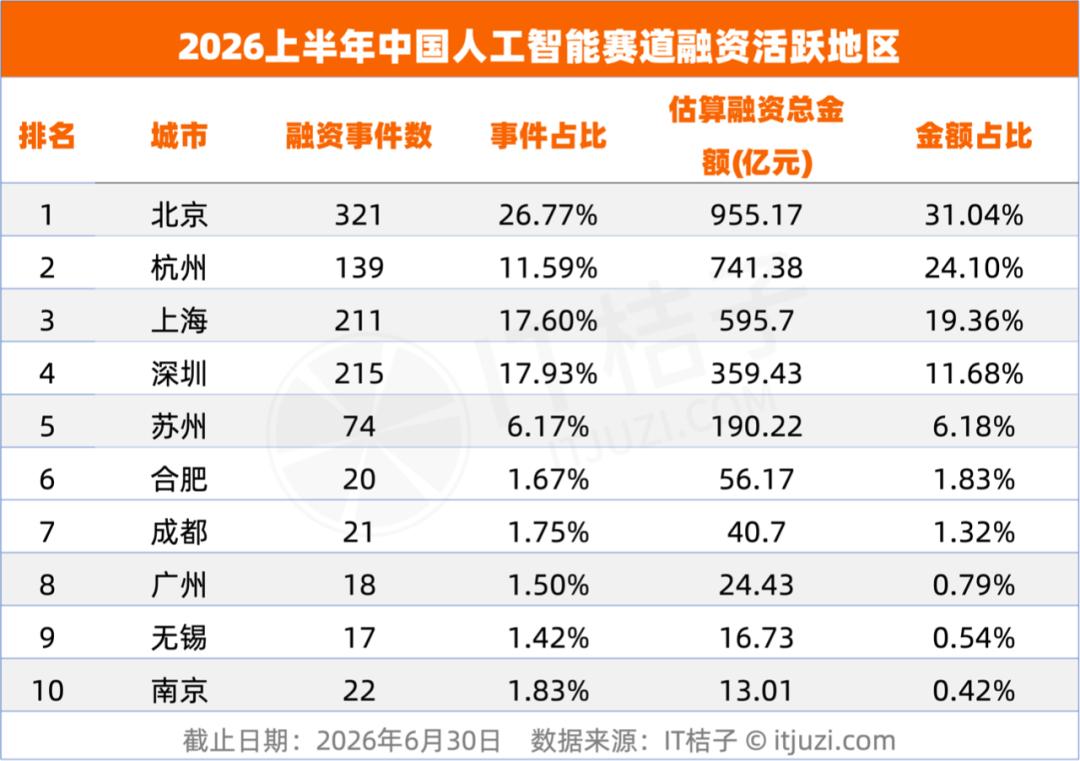
In the AI industry financing pattern in the first half of the year, Beijing, Shanghai, Hangzhou, and Shenzhen led absolutely, contributing 73.89% of the total number of financing transactions and monopolizing 86% of the financing scale, becoming the absolute core of AI financing in China.
Among them, Beijing ranked first in the country with 321 financing events and a total financing amount of 95.517 billion yuan, being the absolute core of domestic AI track financing. Benefiting from the popularity of Deepseek and the subscription of over 50 billion yuan in the first round, Hangzhou's financing amount surpassed that of Shanghai and Shenzhen at once, ranking second in the country and becoming the absolute leader among new first - tier cities.
In the first half of the year, there were 211 financing events in the AI industry in Shanghai with a total financing amount of 59.570 billion yuan, and 215 financing events in Shenzhen with a total financing amount of 35.943 billion yuan. Although their financing volumes were comparable, the overall capital - attracting ability of Shanghai's AI enterprises was stronger, reflecting that the valuation center of Shanghai's AI enterprises was higher and institutions placed heavier single - deal bets.
Suzhou ranked fifth in the country with 19.022 billion yuan, becoming the third pole in the Yangtze River Delta. Among them, Momenta's Cornerstone round of HK$2.9 billion + Pre - IPO round of US$1 billion financing contributed about 9.7 billion yuan in total, accounting for more than half of the AI financing amount in Suzhou in the first half of the year.
In addition to cities in the Yangtze River Delta such as Hangzhou, Shanghai, Suzhou, Wuxi, and Nanjing, new first - tier cities such as Hefei, Chengdu, Guangzhou, Xi'an, and Wuhan all had AI projects complete financing. Some cities achieved a zero - breakthrough in financing events, reflecting that the radiation scope of the AI industry continued to expand. Second - tier cities were accelerating the layout of the AI track through policy support and industrial spill - over acceptance.
02 The Financing Scale of Each Sub - track in AI
Since the artificial intelligence industry has a wide coverage, it is impossible to see its full picture with just one concept term. Therefore, we conducted a statistical analysis of a wider range of sub - fields.
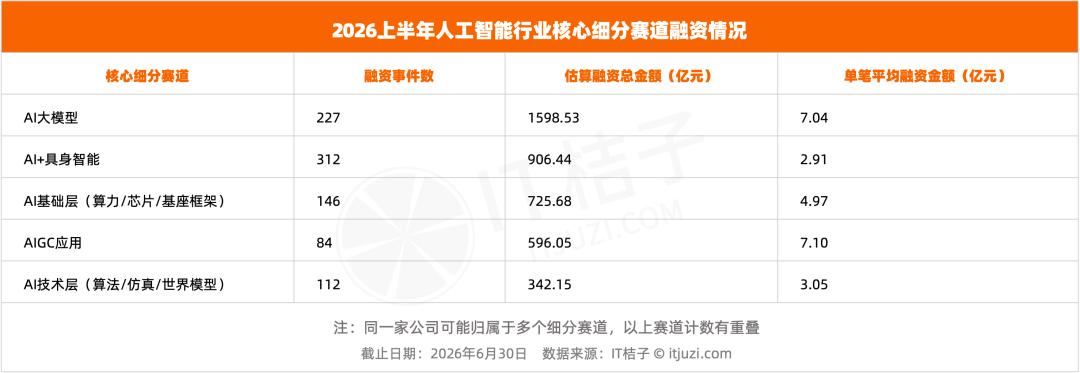
From the distribution characteristics of sub - tracks: In terms of the total financing amount distribution, the large - model track dominated, taking more than half of the funds in the entire track.
The large - model track became the absolute core technical base of the AI track with a total financing amount of 159.853 billion yuan. Frequent single - deal financing of tens of billions yuan in top projects was common. The Matthew effect of funds was the strongest, and it was the top - heavy track in the primary market.
In addition, in the first half of 2026, the total financing amount of the AI basic layer was 72.568 billion yuan. Computing power, AI chips, and training frameworks belonged to heavy - asset tracks, with frequent large - scale financing. The AI technology layer was more inclined to simulation and spatial algorithms. Both the number of financing events and the funds were lower than those of the basic layer, and most of them were jointly financed with large - model and embodied - intelligence enterprises.
The total number of events in these two tracks was 258, and the total financing amount was 106.783 billion yuan, accounting for 18.00% of the total aggregated funds. They were the core investment directions of the AI industry's technical base besides the large - model track.
The AI + Embodied Intelligence track was the second growth pole, with a total financing amount of 90.644 billion yuan. It was the core hardware carrier track for the implementation of AI technology. The number of financing events reached 312, making it the track with the most financing events in the entire track and the highest project activity.
The total financing amount of the AIGC application track in half a year was 59.605 billion yuan. It was the most mature track for the commercialization of AI technology, and capital had the highest recognition of its commercial value.
In terms of the distribution of financing events, the number of financing events in the AI + Embodied Intelligence track reached 312, accounting for 26.02% of the entire track. It was the track with the densest projects in the entire track, covering projects from early - stage startups to leading companies in the growth stage. The industry had the strongest innovation vitality.
In terms of the single - project financing ability, the large - model and AIGC tracks were the most prominent. The three tracks with the highest average single - deal financing amounts were: AIGC (710 million yuan) and Large - model (704 million yuan), far exceeding the average of the entire track. This reflected that capital was willing to give extremely high valuation premiums and large - scale capital support to the leading projects in these three tracks, making them the core targets of heavy - asset investment.
03 The Core Betting Rhythm of Capital
In - Depth Analysis of the Matching of Different AI Enterprises' Financing and Development Stages
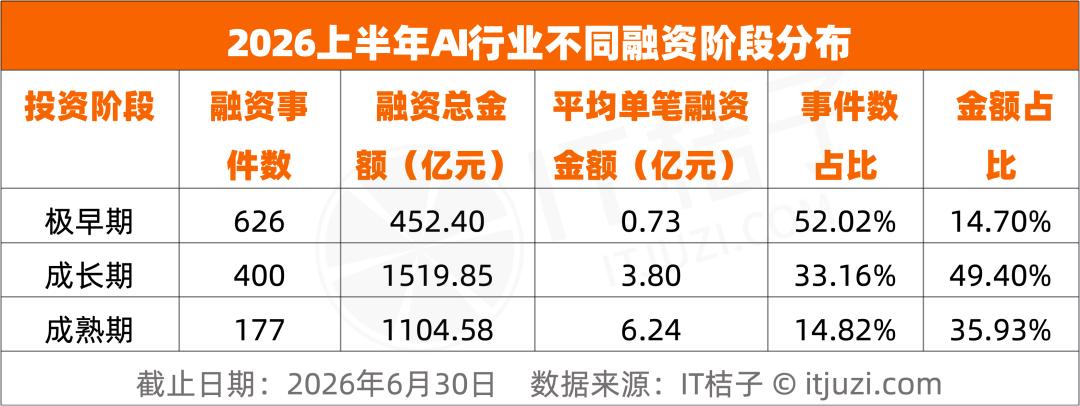
In the first half of 2026, the capital layout of the AI track showed a clear rhythm of "heavy investment in the growth stage, stabilizing the market in the mature stage, and early - stage incubation." There were significant differences in the financing scale, the number of events, and capital preferences among the three investment stages.
From the core data, we can clearly see the core betting logic of capital:
These enterprises in the extremely early stage (seed, angel, Pre - A rounds) were the core source of technological innovation in the AI track, contributing 626 events, accounting for more than half. However, the average single - deal financing amount was only 73 million yuan. The core logic of early - stage investment was to "cast a wide net, make early layouts, and bet on the future," locking in early - stage projects with innovation potential in advance through small - scale and high - frequency investments.
AI enterprises in the growth stage (A round, A+ round, B round, B+ round) were the core battlefield for capital layout in the AI track in the first half of 2026. Enterprises at this stage had completed technology verification and had preliminary product implementation capabilities and commercialization potential. They contributed a total of 49.40% of the total financing amount, and the average single - deal financing amount reached 380 million yuan.
AI enterprises in the mature stage were the ballast stones of the track. Although there were only 177 events, they contributed a total financing amount of over 100 billion yuan, and the average single - deal financing amount was the highest, reaching 624 million yuan. These mature enterprises that had established leading positions in the industry and had stable profitability were often able to receive greater capital support.
In order to penetrate the surface information of the "financing amount," we divided it into two stages - the early stage and the middle - late stage, and conducted an in - depth analysis of the enterprises with the highest financing amounts to answer a core question: What exactly is each penny of capital betting on?
Early Stage: The Source of Innovation and Incubation Pool of the Track
According to IT Juzi statistics, the top 10 early - stage enterprises jointly received 16.589 billion yuan, accounting for 36.7% of the total extremely early - stage financing. Which companies were able to obtain large - scale, or even over 1 billion yuan in financing in the early stage?
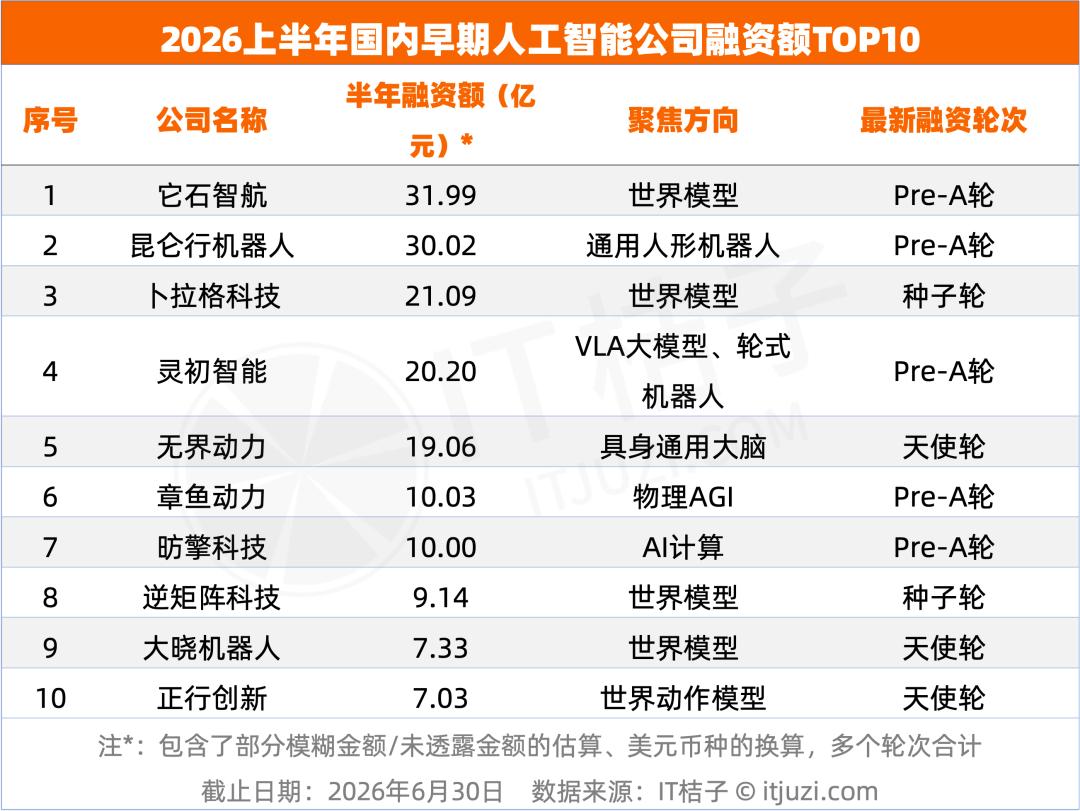
Four Key Insights from the Top 10 Early - Stage Enterprises
Insight 1: The world - model became the "first consensus" in early - stage investment.
Six enterprises in the world - model direction jointly raised 9.7 billion yuan (accounting for 58%). The world - model was regarded as the "operating system" of embodied intelligence - whoever mastered the world - model would master the ability of robots to understand the physical world. The logic of early - stage VCs was to gain a foothold at the operating system level, which was more strategically valuable than being involved in the competition at the application level.
Insight 2: The "inflation" of angel - round financing amounts was significant.
Four of the top 10 enterprises completed financing of over 700 million yuan in the seed or angel round (Bulaoge 2.1 billion, Wujie Dongli 1.9 billion, Niju Zhen 900 million, Daxiao 700 million), which was unimaginable before 2024. This phenomenon indicated that the academic/industrial background premium of the founding teams in the AI track was extremely high; top VCs were moving towards earlier stages to compete for scarce top - level teams.
Insight 3: The spill - over effect of the talent ecosystem of large enterprises emerged.
Daxiao Robotics, established in 2025, was an embodied - intelligence company incubated by SenseTime. It launched the first domestic open - source and commercially applied "Kaiwu" world - model 3.0. The inclusion of Daxiao Robotics on the list represented a trend - the AI talents and technologies of large enterprises were spreading outward through incubation/entrepreneurship, forming an entrepreneurial ecosystem of "large - enterprise affiliated" companies.
Insight 4: There was not a single pure large - model company among the top 10 early - stage enterprises.
This was an extremely important signal - the early - stage window of the large - model track had basically closed. Capital judged that the competitive landscape of basic large - models had initially taken shape, and it was difficult for new early - stage large - model projects to obtain support from top - level VCs. Capital turned to the "downstream of large - models" - world - models, embodied brains, and physical AGI.
Growth/Maturity Stage: The Core Targets of Heavy - Asset Investment by Capital
Large - scale financing occurred frequently in the growth and maturity stages, so we analyzed them together. According to IT Juzi statistics, the top 20 enterprises jointly raised 156.5 billion yuan, accounting for more than half of the total financing in the entire track. So, who could receive intensive bets from capital?
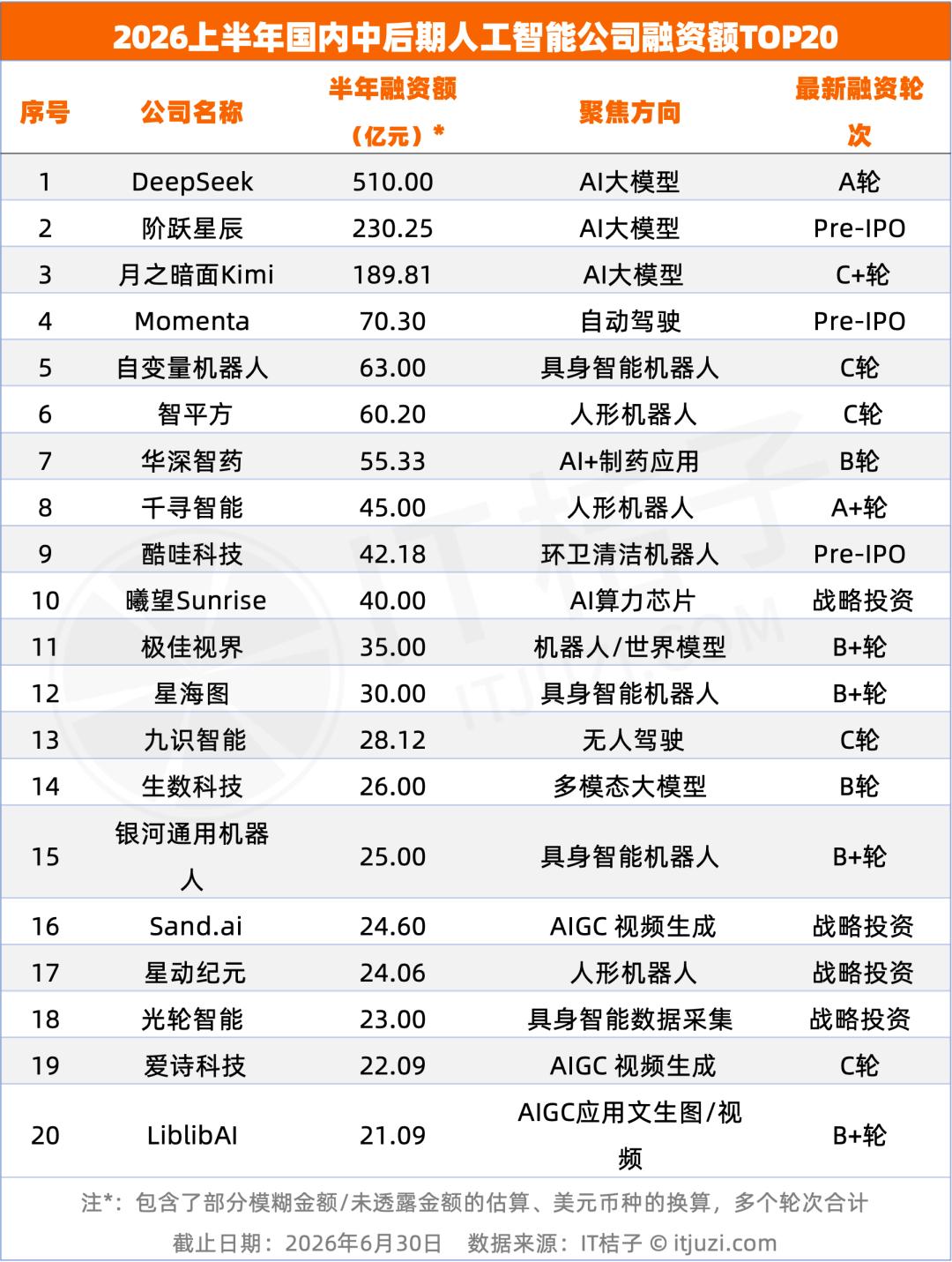
According to their focus directions, we divided the