When Walmart Meets Disney: A Co-Branded Collaboration Years in the Making
Recently, Walmart China and Disney China announced a long - term and in - depth cooperation. Riding on the wave of the release of Toy Story 5, the first project launched nearly a hundred co - branded and exclusive products all at once.
It seems a bit of an "extreme" cross - border move for a global retail giant to collaborate with the world's most recognized and excellent IP licensor. However, the reaction on social media was unexpected. The main battlefield of this co - branding, "Walmart's Xiangmihu Store in Shenzhen", now resembles a Disney "mecca" — a giant Buzz Lightyear installation stands at the entrance, attracting passers - by to stop and take a look. The exclusive shopping carts printed with Woody and Buzz Lightyear, the Buzz Lightyear patting pillow, the strawberry bear question - mark pillow, and the big - capacity yogurt have become the must - have props for young people to check in at the store. A consumer wrote on a social platform, "I never thought I'd make a special trip to Walmart just to go grocery shopping one day."
Interestingly, in this wave of co - branding driven by Toy Story 5, there are other younger - oriented consumer brands. However, Walmart seems to be the unexpected "stand - out" one. How did a supermarket brand that entered China in 1996 manage to grab the first - wave attention in the battlefield of the youth, who value "freshness" the most?
1. Deepen the co - branding and embrace the big IP with product strength
In this co - branding initiative, the most worthy thing to analyze first is the nearly a hundred co - branded products themselves.
Looking through the list of co - branded products, among the food items, there's the big - capacity yogurt with only three ingredients in the ingredient list: raw milk, sugar, and lactic acid bacteria; organic chestnut kernels made solely from Yanshan chestnut kernels; 4.0 pure milk toast bread with a milk addition of no less than 10%; as well as red - heart apple juice sparkling water, 100% HPP kiwifruit watermelon juice, and green grape and summer black grape double - layer Swiss roll. The non - food items cover trendy plush toys, clothing accessories, household items, and bedding. Among them are products with strong design sense, such as the over - 1 - meter - long patting good - dream pillow series, the cold - sensitive color - changing water cup, and the cute friend walkie - talkie.
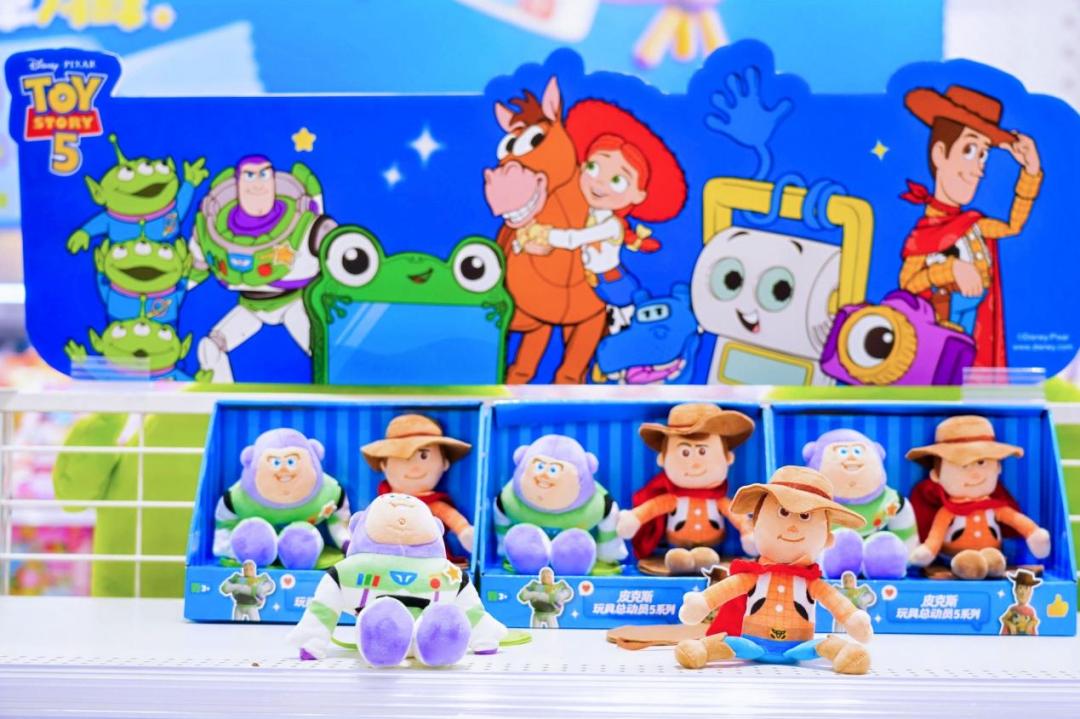
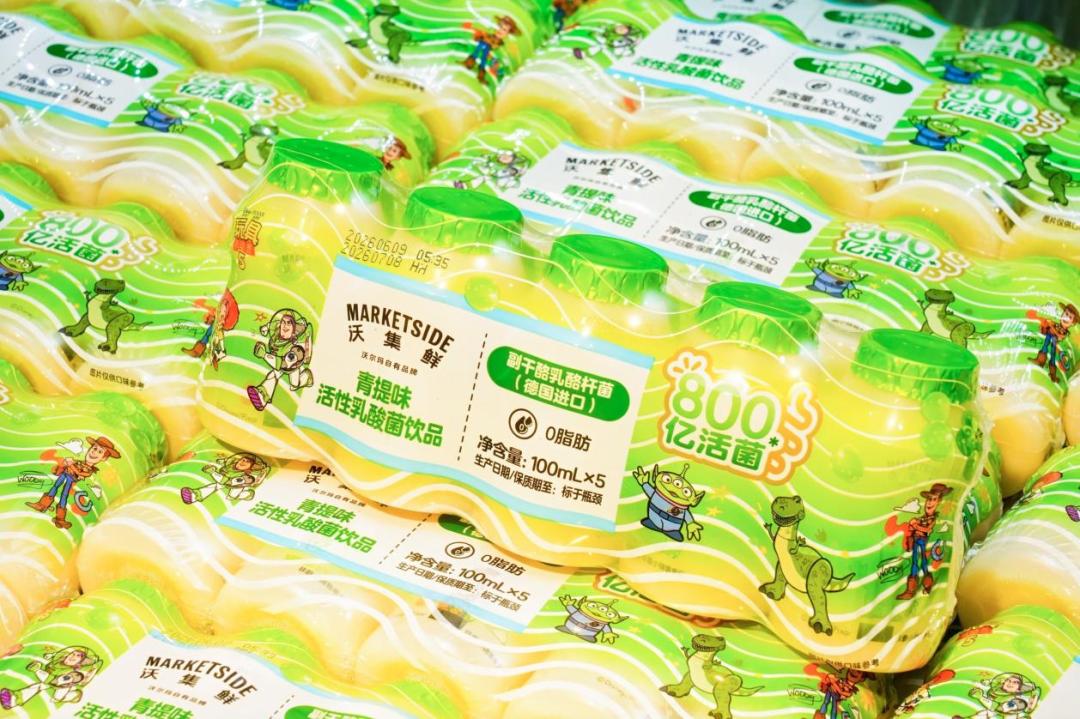
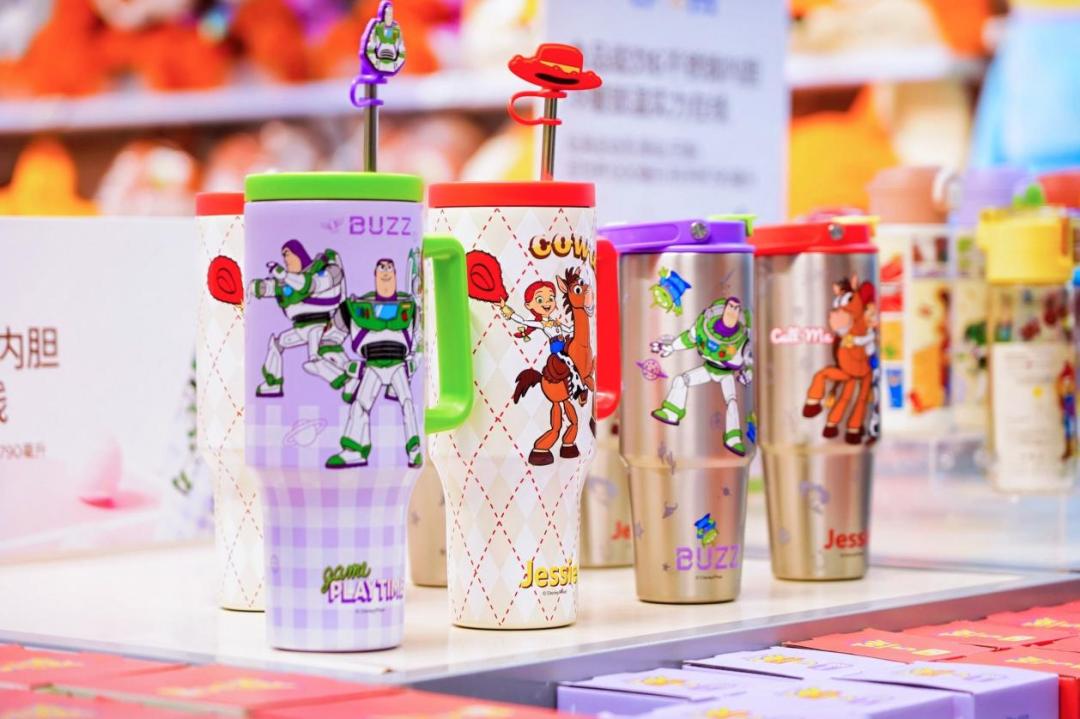
The common feature of these products is that they have all been redefined.
In the past, the common practice of IP co - branding was that after the brand obtained the IP license, it would print the character images on the packaging of existing products or a few new products, and then boost sales along with the rising popularity of the IP. Once the popularity faded, the products would return to their original state. The essence of this model is "traffic leasing", where the IP owner lends its attention and the brand pays the licensing fee. After a superficial transaction, both parties get what they need.
Walmart's co - branding with Disney clearly goes beyond this simple "safety line". It is co - defining the products with Disney, starting from customer insights, and redesigning the product form, packaging logic, and even usage scenarios. The "patting good - dream pillow" creatively combines IP images like the strawberry bear with question marks. The "cute friend walkie - talkie" breaks the traditional character - pairing logic, and the "cold - sensitive color - changing water cup" adds an interactive feeling to an everyday container.
These products can stand on their own even without the IP elements. First and foremost, they are good products, and only then are they co - branded products.
How did Walmart manage to achieve this? The accumulation of its private label "Marketside" over the past few years is a microcosm of this giant retailer's continuous efforts to improve its product strength. When "Marketside" was first launched, it mainly covered basic categories such as ready - to - eat food and fresh produce. Later, it gradually included categories like snacks, dairy products, and baked goods. By 2025, it had a major breakthrough after its renewal and upgrade.
In fact, if we observe the development path of Marketside since its transformation and upgrading over a longer time frame, we'll find that it has taken a completely different path from Sam's Club in building product strength. Marketside focuses on urban middle - class families and single people, with a distinct brand concept of "simplicity for freshness". It has formulated a product strategy of high - quality, high - cost - performance, and small - packaged products around "five meals a day" to meet customers' needs. Moreover, through different IP collaborations, it creates scenario - based experiences and establishes deep emotional connections and resonances with its target customers.
It's evident that Walmart differs from Sam's Club in both customer groups and product differentiation. The so - called "budget alternative to Sam's Club" statement has been completely shattered in the face of Marketside's brand leap. It's not copying anyone but is forging its own path.
After its renewal, Marketside established the core concept of "simplicity for freshness" — simple ingredients, fresh raw materials, fresh origin, and fresh experience.
A batch of "self - generating - traffic" hit products emerged from this. Products such as the small green - bottle milk, Guizhou red - sour - soup - flavored potato chips, apple chips, and butter thick - cut toast bread have gained a large number of fans on social media. Marketside has gradually evolved from a "supermarket private label" into a brand that young people are willing to actively recommend. This transformation is crucial as it means that Walmart has developed its own independent brand influence and is no longer just a channel provider.
For Walmart, the young customer flow brought by continuous transformation and upgrading and the customer recognition of its private label have provided a reliable foundation for this co - branding. In addition, Disney has specific nutritional requirements for licensed food, and Marketside's philosophy of "doing subtraction" in ingredients happens to meet these requirements — fermented milk with only three ingredients and chestnut kernels with only one ingredient. The alignment of the two product standards is the result of their long - term adherence to their respective product concepts.
Looking back, the nearly a hundred co - branded products span multiple categories such as food, beverages, and baked goods. Each product has to pass both Walmart's and Disney's quality checks. This places extremely high requirements on the supply - chain collaboration ability, from raw material traceability, production and processing, to terminal display. Every link requires in - depth participation from both parties.
When talking about this cooperation, Zhu Jun used the three words "customer insight", "product design", and "imagination" to summarize the direction of the integration of the two parties. These three aspects precisely point to the three capabilities that Walmart has been most willing to invest in over the past few years in terms of product strength.
Now, these co - branded products are like a "report card" — they once again answer the questions of how much Walmart has invested in its private label, how much it has reformed its supply chain, and how much it has improved its quality control standards over the past few years.
2. The transformation of an old store: years of painstaking efforts
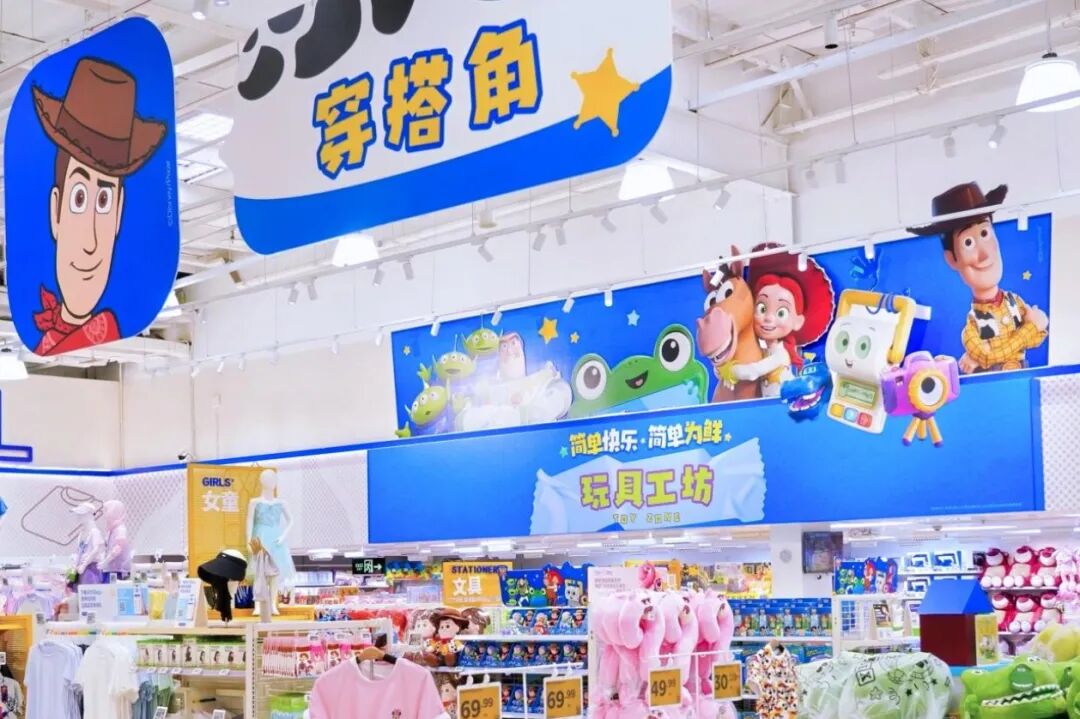
Walmart's Xiangmihu Store in Shenzhen has been transformed into a Toy Story themed space, with IP elements integrated from the exterior wall to the cashier counter. It's worth noting that this store has a history of nearly 20 years.
An old store with a 20 - year history is not the top choice for resource investment and transformation in any supermarket asset inventory. Walmart's confidence in choosing it as the main venue for this co - branding comes from the accumulation of store transformation over the past few years.
Walmart has been continuously promoting new store openings and store renovations with considerable intensity. In April 2026, Walmart launched a new - generation store in Chengdu and then announced that it would complete the upgrading of more than 100 stores within the year and open 5 - 10 new stores at the same time.
These 100 stores are not just superficially renovated. The newly renovated new - generation store in Chengdu can serve as an observation sample: the store area has been reduced to just over 3,000 square meters, a significant reduction compared to traditional hypermarkets, and the SKUs have been streamlined to about 10,000. The shopping route has been changed to a U - shaped single - layer circuit, with high - frequency categories such as fresh produce placed at the front. The delivery service covers a five - kilometer radius centered around the store. Behind these adjustments is a systematic re - thinking — what to sell in the store, how the customers' shopping route should be, and how to divide the labor between online and offline operations.
The origin of this underlying logic can be traced back to a systematic elaboration of the product philosophy by Zhu Xiaojing, the President and CEO of Walmart China. She summarized it as "rooted in rationality, achieved through sensibility": data analysis and trend prediction form the rational basis, but the real breakthrough lies in going beyond a simple review of users' past behaviors to capture the potential needs that consumers themselves can't clearly express.
Following this line of thought, Zhu Xiaojing set a direction for the team — to deepen the transformation from a "product operator" to a "lifestyle proposer". The parameter adjustments of the new store in Chengdu are essentially the implementation of this philosophy in the spatial dimension. The U - shaped route and the front - placement of fresh produce solve the efficiency problem at the rational level, while the scenario - based display and tasting stations respond to the experience needs at the emotional level. The store is no longer just a container for displaying products but has been redefined as a specific proposal for a lifestyle.
The transformation of the Xiangmihu Store is also based on this methodology. It takes advantage of the large store area and wide product coverage to create themed zones, with each zone carrying an independent narrative theme. Walking through the store is like visiting a small - scale exhibition. A key causal chain here is that if the store is well - renovated, the shopping experience will be improved, and the customer flow will increase. Only when the customer flow increases can the store support the themed experience.
Zhu Xiaojing's concept of a "lifestyle proposer" also gets a concrete interpretation at the Xiangmihu Store: when a supermarket starts to use IP stories to organize the spatial narrative and replaces shelf displays with themed scenarios, it is already making a "proposal". The proposal is not about a single product but a lifestyle experience worth making a special trip to the store for.
Lin Lizhen, the Vice President and General Manager of the Consumer Products Division of The Walt Disney Company in Greater China and South Korea, used the word "breakthrough" to define this cooperation.
Walmart provides a differentiated channel form. It has a large enough area to create an immersive experience, sufficient customer flow to support the spread of the promotion, and a strong enough supply chain to undertake the development and distribution of a large - scale co - branded product line. These advantages form the basis of this "breakthrough".
The transformation of this 20 - year - old store is not due to the co - branding idea but the store - renovation ability, the rising customer flow, and the full - channel coverage that Walmart has gradually built up over the past few years.
3. "Swim Upstream": Walmart's unique path
The product development and store renovation in this eye - catching co - branding initiative ultimately point to the same thing — Walmart has completed a series of basic tasks over the past few years that are slow - to - yield - results and hard to tell a short - term story about. The accumulation of these tasks has now been concentratedly realized in the nearly a hundred co - branded products and a themed store in this co - branding project.
Looking at it in the context of the retail industry, Walmart's reform path will become clearer.
Since 2025, the keyword for major supermarkets has almost always been "adjustment and renovation". A report jointly released by the China Chain Store & Franchise Association and Nielsen IQ shows that more than 70% of retail enterprises carried out store adjustments and renovations in the past year. At the same time, a large number of players have entered the hard - discount market, and internet giants have also entered the physical - store business. The industry is looking for a way out, and the directions are concentrated on several popular models.
Walmart has taken a different path. The model of learning from benchmarks highly depends on specific founders and regional cultures. The logic of competing on low prices is to offer low prices and a high proportion of private - label products. However, Walmart's private label follows a path of differentiation and cost - performance, with a different underlying logic. It has chosen a task that lacks short - term storytelling value — spending several years to solidify its product strength, renovate its stores, establish a full - channel operation, and build an independent appeal for its private label. None of these things can be achieved overnight through a wave of marketing hype. Each of them requires time for precipitation.
At the CCFA Retail Leaders Summit in 2025, Zhu Xiaojing said, "The popularity of traffic and internet celebrities will eventually fade away. After the hustle and bustle, what really remains is our solid internal strength." She also quoted Sam Walton's business rule "Swim Upstream" and corrected the common translation. Its original meaning is not a confrontational "go against the current" but "blaze a new trail and defy convention". The core lies in finding a suitable position for oneself and creating differentiated value for customers. This also reflects Walmart's strategic attitude. It has no intention of copying other models but focuses on building its own basic capabilities.
Regarding this co - branding, the cooperation between Walmart and Disney is essentially a win - win situation where both parties get what they need. Disney needs a channel. Previously, the retail implementation of its IP in China mainly focused on trendy toy stores and convenience stores. Now it needs a channel form that can reach hundreds of millions of consumers, support immersive experiences, and undertake the development and distribution of large - scale co - branded products. Walmart needs content. As online channels have pushed prices to extremely low levels, the touchable products, immersive scenarios, and shareable experiences that offline stores can offer have become scarce, and Disney's IP is exactly the top - notch content resource. Both parties come to the table with their core capabilities. One provides the content and image, and the other offers the products and channels, thus making the cooperation possible.
The reference value of this co - branding for the industry is not that retailers "should engage in IP co - branding". What it really proves is the feasibility of a "slow" path. The value of retailers will not disappear due to the impact of e - commerce, but winning back consumers' favor has a pre - condition. Retailers need to spend a lot of time building up their product strength, store strength, and brand strength layer by layer before they can talk about the new "offline experience", and there is no shortcut on this path.
The nearly a hundred co - branded products, a themed store, and the check - in craze on social media are all external manifestations of the accumulated achievements. What supports them are the thousands of products launched by Marketside over the years, the shopping - route and zoning logic repeatedly refined in the 100 - store upgrading plan, the gradual establishment of the full - channel network, Walmart's solid supply chain and quality control, and the consistency of the "simplicity for freshness" product philosophy from concept to implementation.
Individually, none of these things forms a barrier, but when combined, they form a system that is difficult