After three years of dedicated efforts in developing embodied intelligence brains, Roobotics Technology deploys robots into high-risk scenarios.
The true value of embodied intelligence is to serve as an extension of human capabilities.
The embodied intelligence sector has always faced a core question: Should we first focus on "physical hardware" or tackle the "general brain" first? In fact, this is not an either-or choice but a collaborative evolution where hardware and intelligence spiral upwards.
Ruoyu Technology focuses more on the latter. In their view, the key bottleneck restricting the implementation of robots currently is not the degree of freedom of the robot, but whether the machine is endowed with a "general brain" that can understand, adapt to, and operate in the complex physical world.
But how to prove to the outside world that this brain is smart and reliable enough? Ruoyu Technology was the first to choose an extremely demanding "examination venue": special operation scenarios in high-risk industries.
Here, the open and changeable environment and highly complex tasks precisely become the touchstone for testing the "brain"'s perception, reasoning, and decision-making abilities. And this is the exploration path they see towards the real implementation of embodied intelligence technology.
Among the more than 110,000 gas stations across the country, countless staff members repeat the operations of unscrewing the fuel gun, connecting the oil pipe, and refueling every day. However, seemingly insignificant problems such as static electricity, sparks, or minor operational errors can all potentially lead to major safety accidents.
Even if there are no accidents, long-term inhalation of gasoline volatiles can cause continuous damage to the health of gas station attendants. The hidden dangers at gas stations are just the tip of the iceberg. Similar situations also widely exist in scenarios such as underground mine inspections, post-disaster ruins exploration, and electric welding in heavy industrial workshops. These special operations have extremely high physical requirements and are accompanied by the risk of irreversible occupational diseases. Many workers will withdraw from the labor market in their middle age due to injuries and illnesses.
In the era of artificial intelligence, a real question is: Why haven't robots played a role in these high-risk, complex, and repetitive jobs?
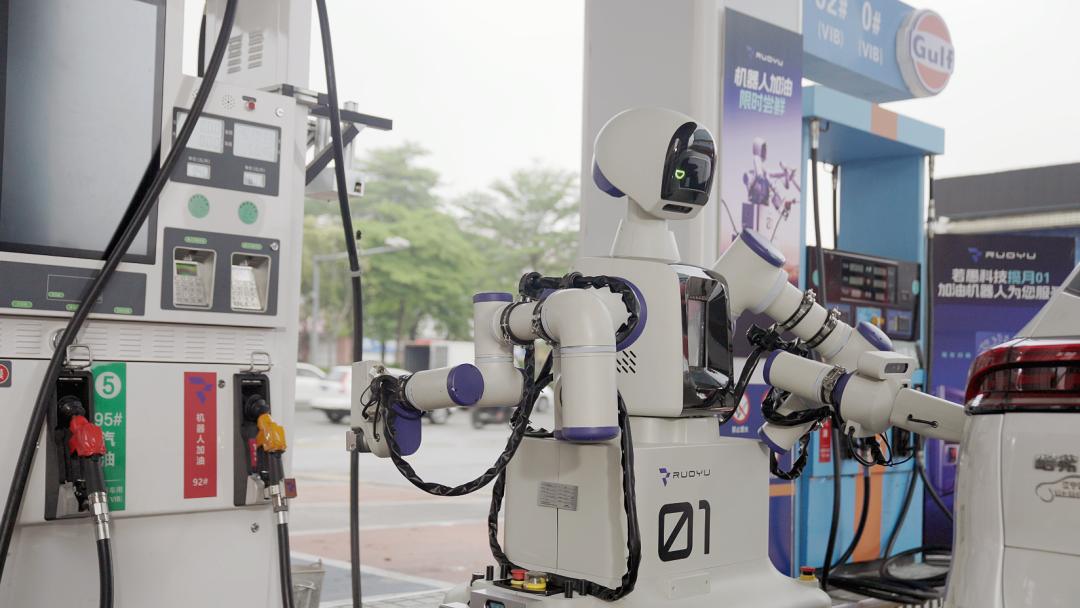
As a cutting-edge technology company focusing on the research and development of robot brains and scenario-based applications, Ruoyu Technology has presented its answer - the world's first explosion-proof robot "Lanyue 01" equipped with a robot brain system. It can autonomously complete the entire refueling operation smoothly through autonomous perception, planning, and execution.
The refueling scenario is just one of the scenarios where Ruoyu Technology's full-stack solution for the embodied intelligence brain system is first implemented. Ruoyu Technology has spent three years "grinding" the core technology. What they really want to create is not an automated device that can only refuel, but an "embodied brain" that can take root in any physical scenario.
Trinity: Breaking the Isolation of "Scattered Systems"
The core architecture of Ruoyu Technology's full-stack solution for the embodied intelligence brain system is mainly divided into three layers: the brain, the body, and scenario data.
First is the "brain" level. In the past, the visual perception, language understanding, and motion control of robots often operated independently, like a "scattered system" pieced together. The Ruoyu Jiutian robot brain independently developed by Ruoyu Technology breaks the industry pain point of the traditional robot's "perception - planning - execution" being mutually separated. It can deeply integrate visual changes, mechanical feedback, spatial position, and semantic instructions to directly achieve end-to-end data processing.
Taking the refueling scenario as an example, there are two seemingly insignificant but extremely technically challenging actions.
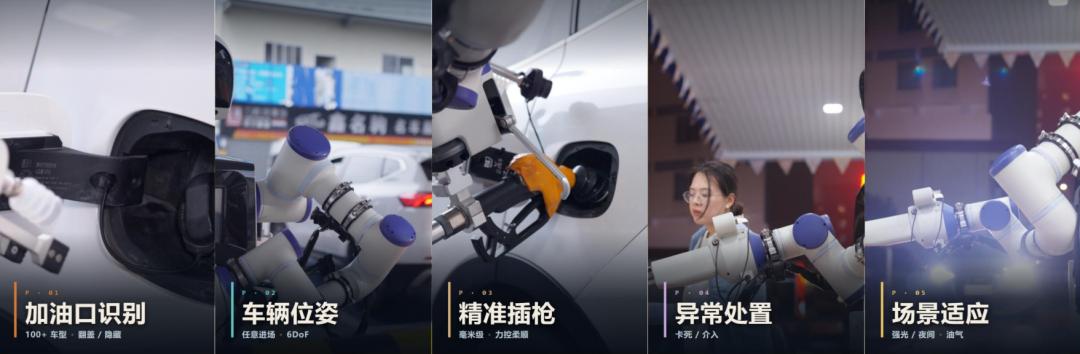
The first action is to open the inner cap: Since the designs of the inner caps of the fuel tanks of different vehicles vary widely and the lengths of the traction ropes are also different, if the robot applies too much force, it will break the traction rope, and if the force is too small, it cannot open the cap. The Ruoyu Jiutian robot brain can use multi-modal sensors to sense the state of the inner cap and the resistance of the traction rope in real-time and dynamically adjust the force to open the inner cap accordingly to ensure accurate and stable operation. This process may seem simple, but in fact, it extremely tests the brain system's accurate perception and judgment of the "degree" of operation.
The second action is to insert the fuel gun and inject oil: For experienced gas station attendants, inserting the fuel gun at the right angle and depth is a piece of cake. But for robots, the fuel inlet is small and the inside is invisible. A slight deviation in the movement of the robotic arm will cause a collision. Facing such a "blind spot" challenge, the Ruoyu Jiutian robot brain can still rely on the data feedback from the end sensor to fine-tune the angle and force of inserting the fuel gun in a timely and accurate manner, and finally smoothly insert the fuel gun into the fuel inlet.
It is worth mentioning that the Ruoyu Jiutian robot brain also has a strong "cross-border" ability. Ruoyu Technology uses a lightweight architecture of "one brain, multiple bodies", enabling the same brain system to be quickly reused for robots of different configurations. This not only helps to achieve cluster operations of robots but also allows for rapid deployment and efficient operation when switching application scenarios.
However, even if the brain is very smart, dealing with high-risk operations still requires a solid hardware foundation as support, which involves the second layer of the architecture: the body.
The entry threshold for high-risk special scenarios is not whether the robot is flexible enough but whether it is safe enough. As the world's first wheeled humanoid robot with explosion-proof qualifications, the Ruoyu Lanyue 01 uses a four-fold composite explosion-proof design. The core premise solved by this design is "whether the robot can legally and safely stand in the dangerous scenario". Without this safety admission ticket, even the most powerful intelligence has no place to be used.
The last layer is scenario data: No matter how perfect the simulation environment is, it cannot replace the holding angle of the fuel gun, the reflection of the fuel tank cap, or the suddenly appearing obstacles in the real environment. The robot must actually go into the field to run and iterate.
Ruoyu Technology's strategy is to implement the robot in the real refueling scenario. While achieving all-weather on-duty and full-process autonomous operation, it can continuously accumulate valuable real data in actual operation without any modification to the existing facilities.
Taking Root in the Deep Water Area: Becoming an Extension of Human Capabilities
Obviously, the application potential of the "trinity" solution launched by Ruoyu Technology is far more than just the refueling scenario. At the 4th China International Supply Chain Promotion Expo, the Ruoyu Lanyue 01 successfully completed the integrated equipment inspection and operation tasks many times in the on-site simulated oil and gas field station.
In the on-site demonstration of the integrated inspection and operation scenario, relying on the Ruoyu Jiutian robot brain system, the Ruoyu Lanyue 01 can independently identify the open environment and fine components, accurately understand instructions, and finally complete the execution of complex tasks. These long-sequence, multi-step, and structured complex tasks are precisely the areas where the solution of the embodied intelligence brain system can most highlight its core value.
In addition to applications in scenarios such as intelligent refueling and integrated training and operation, Ruoyu Technology is also continuously delving into high-risk operation-intensive vertical fields such as smart ports, emergency rescue, disaster prevention and mitigation, and safety production. It plans to gradually extend the robot brain technology to a wider range of human production and living fields, break through the application boundaries of embodied intelligence, and contribute to the development of new-quality productivity.
From gas stations to oil and gas field stations, and to more scenarios that are still being explored, what changes is only the carrier, and what remains unchanged is that the same brain system is continuously learning, migrating, and generalizing. What Ruoyu Technology wants to do has never been to "replace humans with machines" in a certain scenario, but to develop a set of general capabilities that can continuously grow in high-risk and more diverse scenarios.
The true value of embodied intelligence is by no means to compete with ordinary workers for jobs but to become an extension of human capabilities and undertake those jobs that people are reluctant to engage in and are full of danger. Completing high-intensity mechanized operations in a flammable and explosive environment for a long time is a great physical and mental consumption for workers. In the past, limited by technological bottlenecks, we could only rely on humans to act as the "executors" in high-risk stations.
Today, with the maturity of the embodied intelligence brain, robots are already capable of replacing humans from these dangerous environments. This is the real meaning of technological change and the temperature that technology should have. Only when the general brain completely breaks through the scenario barriers and allows robots to truly undertake high-risk, heavy, and complex work can the entire embodied intelligence industry jump out of the strange circle of "performative innovation" and truly plunge into the deep water area of real applications.