"I spent 4 yuan to attend the shareholders' meeting" — the once top new tea beverage stock now has a share price of less than HKD 1, Nayuki has posted losses for four consecutive years, yet the founding couple still draws an annual salary of 3.1 million yuan.
A "note" has once again pushed the "world's first new tea beverage stock" into the spotlight.
Recently, Xie Haicheng, a post - 2000 minority shareholder, shared on a social platform the real - time notes from the general meeting of shareholders of Nayuki (HK02150, stock price HK$0.65, market value HK$1.1 billion). The straightforward content made many market insiders sigh - they expected Nayuki to be gradually falling behind, but didn't expect it to be so obvious.
"The atmosphere was intense but restrained. For example, some questions raised by shareholders were quite sharp, like why doesn't the chairman take an annual salary of HK$1? Why have freshly - made European - style breads been replaced by pre - made ones? But there was no quarrel among everyone," Xie Haicheng recalled the scene to a reporter from Jiemian News.
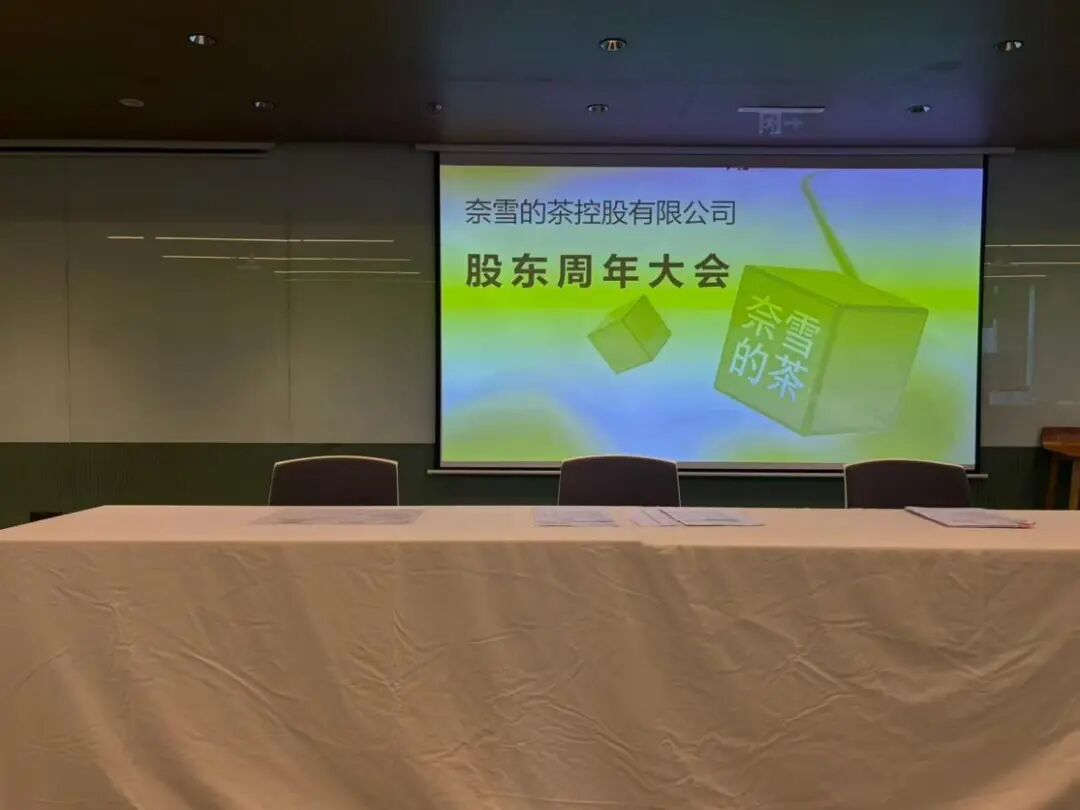
The annual general meeting of Nayuki's shareholders. Photo source: Provided by the interviewee
For Xie Haicheng himself, attending the meeting was more of a novel experience. He only bought 4 shares through the trading of odd - lot shares in the Hong Kong stock market, with a holding cost of only about HK$4 (equivalent to about RMB3.5). He joked that he had already recovered his cost by getting two free drinks at the scene. However, the other shareholders present had completely different feelings. "Some investors at the scene had a floating loss of over one million yuan on their books."
Bearing the halo of the "world's first new tea beverage stock", Nayuki's situation has changed drastically: It was listed at an issue price of HK$19.8 per share in 2021, but now its stock price has dropped to less than HK$1, becoming a penny stock. In the five full fiscal years after listing, it has suffered losses in four years, and still failed to achieve profitability in the fiscal year 2025. The couple, Chairman Zhao Lin and General Manager Peng Xin, have thus been constantly under the scrutiny of market public opinion.
A reporter from Jiemian News asked the company and Peng Xin about relevant issues. On July 1, the relevant person - in - charge replied that they would not accept interviews for the time being.
Nayuki's ups and downs are also a mirror of the new tea beverage and new consumption industry.
Large - store reform: When can the high cost come down?
"I attended the general meeting of shareholders of this company at Nayuki's headquarters in Shenzhen," Xie Haicheng said. "The headquarters is not large, and there weren't many shareholders present. There were no institutional shareholders." Xie Haicheng recalled to a reporter from Jiemian News, "On June 10, I attended the general meeting of shareholders of Zhou Hei Ya (HK01458, stock price HK$1.19, market value HK$2.476 billion). There was a shuttle bus, and institutional shareholders sat at a special table at the meeting."
At 3 p.m. on June 24, Nayuki's annual general meeting of shareholders started. After the speeches according to the process, it came to the question - and - answer session for shareholders.
The high cost and when the company can turn losses into profits were the first questions that shareholders were concerned about.
"One shareholder, in his sixties or seventies, asked: Why is Nayuki's cost so much higher than other tea beverage brands? Is there any improvement plan in the future?" Xie Haicheng said.
The core mall stores and spacious outlets are obvious manifestations of Nayuki's high cost. In 2018, just over three years after Nayuki was founded, when founder Peng Xin was interviewed by a reporter from Jiemian News, she specifically mentioned that she witnessed a consumer only choosing to take Starbucks into the Shangri - La Hotel. "Tea beverages can also be something of high quality and taste." In the first few years, Nayuki was indeed positioned by the industry as the "Chinese version of Starbucks" - it could be located at the most prominent entrance of shopping malls, just like Starbucks.
However, this model has obviously faced great pressure in the past two years. In the IFS mall on Chunxi Road in Chengdu, a Heytea Black Gold Store and a Nayuki PRO Store were once opened. Now, the former has moved to the basement level, and the latter has suspended business. At the same time, its product prices are also difficult to support the high cost of stores. The prospectus shows that the average sales value per order of Nayuki was HK$43.3 in the first three quarters of 2020, and by 2025, this indicator in direct - operated stores had dropped to HK$24.4.
Regarding the shareholders' question, Xie Haicheng recalled that the key point of Zhao Lin's reply was "to change large stores into small ones, and it is expected to be completed this year." Nayuki also mentioned in its 2025 annual report that it had taken corresponding optimization measures for under - performing stores, such as actively closing, renovating or adjusting the store types. Moreover, it will also launch a variety of store types for franchisees to choose from.
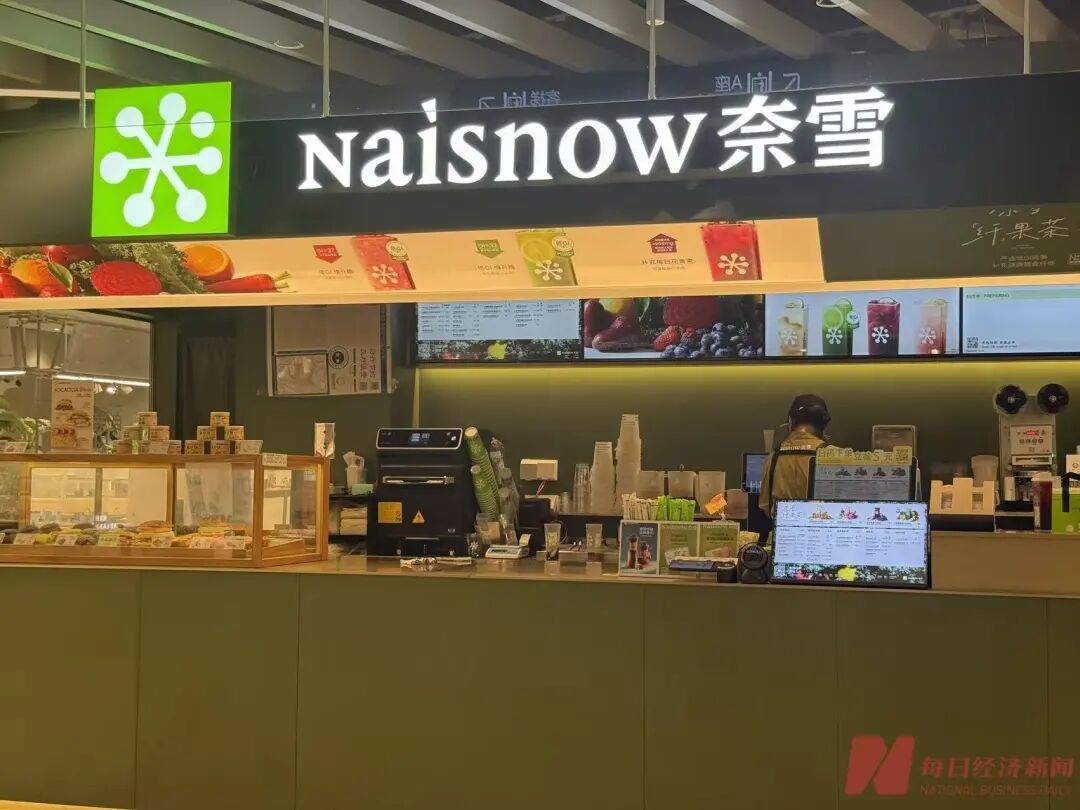
Photo taken by a Jiemian News reporter in Beijing on July 1. Nayuki's new green store type, focusing on light meals
Parallel operation of dual models: Is the online traffic support for franchise stores less than that for direct - operated stores?
Shifting from more than a thousand fully direct - operated stores to a model of "direct - operation + franchising" is another measure taken by Nayuki in recent years.
Shareholder Li Hu (a pseudonym) also attended Nayuki's general meeting of shareholders a few days ago. In his view, Nayuki is undervalued in the capital market, and he started building his position after New Year's Day this year. "My family lives in Shenzhen, and the two 'Nayuki' stores within a straight - line distance of 300 meters from my home have very good business. I looked at its financial statements, and it has a lot of cash on its books. However, if a self - operated store needs to change its area, relocate or close after the contract with the mall expires, the company will fully account for the previous decoration costs (tens of thousands of yuan for a single store) as an asset impairment in its finances. So even if the current business is good, such changes will affect the company's profits," he analyzed to a reporter from Jiemian News.
Li Hu said that he also spoke and asked questions at Nayuki's general meeting of shareholders. "Zhao Lin responded that it is expected to open 300 stores this year, with half being direct - operated and half being franchised. He also specifically mentioned Nayuki's stores in the United States. It has opened several stores in the United States, all of which are franchised stores, with an average monthly turnover of US$300,000, much higher than other new tea beverage brands going overseas to the United States. Two direct - operated stores are also planned to be opened this year."
Some shareholders at the scene questioned that the company should first improve its domestic profitability before considering overseas expansion, especially in the United States, where the cost is higher.
What is the current situation of domestic franchisees? Does the brand treat franchisees and direct - operated stores equally?
Zhang Shifeng (a pseudonym), the manager of a Nayuki franchise store, told a reporter from Jiemian News that his store was originally directly operated by Nayuki. After the contract with the mall expired, due to poor performance, it was originally planned to close the store, but a partner franchisee took it over and reopened it as a franchise store in 2025.
"We spent nearly HK$600,000 on the pre - opening investment for changing machines, renovating the decoration, etc. Among them, the equipment cost more than HK$200,000," Zhang Shifeng said. "Unexpectedly, after becoming a franchise store, the sales volume was almost halved. The brand didn't provide the same kind of traffic promotion as before (such as promotion on e - commerce platforms), and we have to handle all the marketing ourselves. But we still have to continue, otherwise, all the previous investment will be wasted. Our contract with Nayuki is renewed every three years, and we're prepared to recover the cost in three years."
Back to the scene of the general meeting of shareholders, both Li Hu and Xie Haicheng mentioned to the Jiemian News reporter the small number of participants and the short duration of the meeting. "I counted the people present, and there were only about 10 shareholders, and they were all individual shareholders with little influence. The meeting started at 3 p.m. and they wanted to end it at 4 p.m. The financial director said that Mr. Zhao had another meeting later. I said: Let's finish answering everyone's questions first. What meeting could be more important than the general meeting of shareholders?"
Shareholders asked on - site: Why doesn't the chairman take an annual salary of HK$1 before turning losses into profits?
Market value is another major concern for shareholders.
"One shareholder said that he held more than 400,000 shares, with a cost of more than HK$10 per share, and had a loss of millions of yuan. Another said that he was a boss who started a business overseas and also lost more than one million yuan," Xie Haicheng recalled. "At this time, the coffee that Peng Xin had arranged arrived, and Zhao Lin said that he would pause for a while and asked the shareholders to have some cold drinks to calm down."
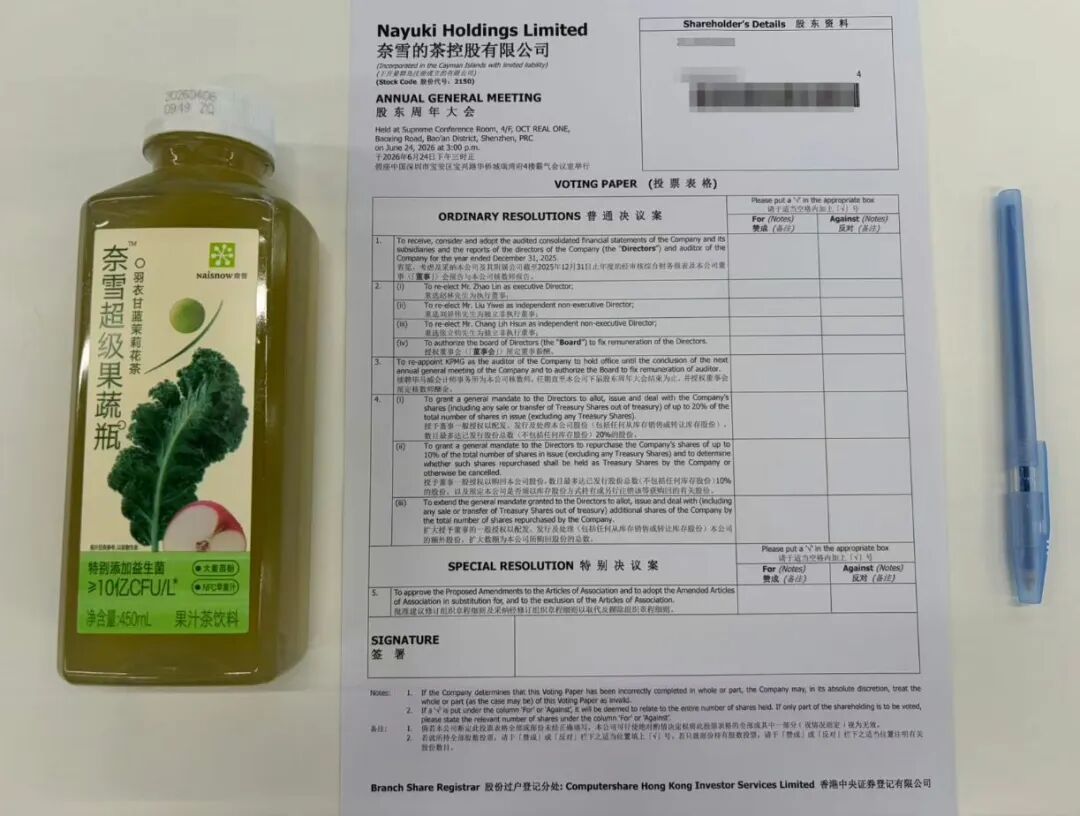
The voting form at Nayuki's general meeting of shareholders. Photo source: Provided by the interviewee
Regarding market value management, according to the recollection of the participating investors, Zhao Lin said that the company would use a portion of the funds for share buy - backs.
In fact, Nayuki frequently bought back its shares in June this year. From June 4 to 18, within half a month, Nayuki issued 10 share buy - back announcements. According to statistics, the total number of shares repurchased by the company was about 6.57 million, with an amount of about HK$4.79 million. In late June, Nayuki continued to buy back shares. On June 26, it spent HK$519,000 to repurchase 847,500 shares.
Even earlier, since the first quarter of 2024, Nayuki has repeatedly used funds to implement share buy - backs. However, the frequent buy - backs have not reversed the stock price. As of now, Nayuki's stock price has dropped by more than 96% compared with the issue price.
"But at the same time, the salaries of Nayuki's management have been increasing year by year. I'm also a business owner, and I won't pay myself a salary before the company makes a profit. Can your (Zhao Lin's) salary be linked to the company's performance? Pay yourself an annual salary of HK$1 and get other income through performance incentives?" Xie Haicheng mentioned the sharpest question at the scene. "Everyone present almost couldn't hold back their emotions. Peng Xin replied that after the listing, they haven't reduced their shareholdings, and he (Zhao Lin) also needs a salary to live on. Paying HK$1 is not realistic." Another person who attended the general meeting of shareholders also confirmed this scene to a reporter from Jiemian News.
Looking at the five new tea beverage companies listed in Hong Kong, namely Mixue Group, Guming, Cha Baidao, Nayuki, and Shanghai Auntie, there is a significant divergence between their 2025 performance and the compensation of their founders.
Mixue led the pack with revenues of 33.56 billion yuan and a net profit of 5.88 billion yuan; the salaries of Chairman Zhang Hongchao and Co - Chairman Zhang Hongfu were 24.08 million yuan and 14.62 million yuan respectively, which were the highest among the senior management of the five companies.
In 2025, Guming had revenues of 12.91 billion yuan and a net profit of 3.109 billion yuan, a year - on - year increase of 110.3%; the annual salary of founder and Board Chairman Wang Yunan was 1.604 million yuan, a year - on - year decrease of 1.145 million yuan.
Cha Baidao had annual revenues of 5.395 billion yuan and a net profit of 821 million yuan; the annual salaries of controlling - shareholder couple Wang Xiaokun and Liu Weihong were 2.614 million yuan and 151,000 yuan respectively, a year - on - year decrease of 4.195 million yuan and 869,000 yuan respectively.
Shanghai Auntie had revenues of 4.46 billion yuan and a net profit of 501 million yuan; the annual salaries of founder couple Shan Weijun and Zhou Rongrong were both 523,000 yuan, a year - on - year decrease of 83,000 yuan.
Nayuki was the only one among the five with declining revenues and an annual loss; the salaries of Chairman Zhao Lin and General Manager Peng Xin were 1.372 million yuan and 1.728 million yuan respectively, totaling 3.1 million yuan.
Customers question the change in taste? European - style breads changed from freshly - baked to pre - made
Once upon a time, "a bite of European - style bread and a sip of milk tea" was Nayuki's differentiated competitive combination. Has the freshly - baked European - style bread become "pre - made bread" due to the reduction in store size?
Xie Haicheng said that two young shareholder couples at the scene admitted that they had been loyal consumers of the brand since their student days, but recently when they went to Nayuki to buy European - style bread, they found that the bread was (re - baked) heated. "Didn't you say before that you wouldn't reduce the quality even if the raw material prices dropped? How did you achieve that? How did Nayuki's bread change from freshly - made to pre - made?"
According to Xie Haicheng, Peng Xin responded that on the premise of ensuring standards such as pesticide residues and not affecting the quality, reducing the diameter of the purchased fruits would lower the cost. After the pandemic, it was found that users' ordering methods had changed to mainly online. "Pre - made bread" was to ensure the taste. If freshly - baked bread was placed in the display cabinet as before and then heated after it got cold, the taste would be worse than that of bread delivered through cold - chain logistics.
A former employee of Nayuki told a reporter from Jiemian News that Nayuki used to have two types of European - style breads. One was "baked at the back of the front - end store" and the other was "delivered through cold - chain logistics." "When I first joined the company and was trained at the store, the stores using the first model had three or four large ovens, and they used four or five types of flour every day. The freshly - baked bread was definitely the freshest. During the peak sales period in July and August, the monthly sales of that store could reach 2 million yuan, and the monthly sales in the off - season were also no less than 1 million yuan."
"On 'Women's Day', the GMV (gross merchandise volume) of that store reached 120,000 yuan, and it took five people just for packing and delivery. For a single store of less than 100 square meters, this was definitely a remarkable performance," the former employee said. "However, for the company, making freshly - made European - style bread would require recruiting additional bread bakers, and the cost of an oven was also nearly 100,000 yuan. So for Nayuki later on, it was not cost -