The hidden business of counterfeit goods: users get deceived, merchants fall into traps, and power banks are filled with nothing but schemes
When people thought that the increasing cost of power banks was an old story, "returning the wrong power bank" has become a new headache for consumers.
On social media, many netizens have shared their experiences of "returning the wrong power bank". Many of them mistook the cabinets of counterfeit brands with similar appearances for those of a certain brand. As a result, the devices were locked, and the background continued to charge. Some netizens with strong hands - on abilities successfully took out the power banks with the help of tools, but more people were eventually forced to spend 99 yuan or even 149 yuan to buy out the power banks.
When such wrong - return incidents occur frequently across the country, it's hard to explain them simply by "user negligence". In fact, behind the "wrong - returned power banks" is a hidden counterfeit ecosystem: a group of little - known small brands don't rely on advertising and brand building to acquire users. Instead, they mislead consumers through strategies of similar appearances and universal card slots, intercept the traffic of leading brands, and thus seize living space. The proliferation of counterfeit shared power banks is also related to a complex industrial capital operation.
Who Causes the "Mistaken Borrowing and Returning" of Power Banks?
"It deliberately looks like Meituan's, and the return place is extremely hard to find. I can't get through to the artificial customer service, and I can't even pause the charging." In April this year, Pinggu, who lives in Fujian, borrowed a shared power bank named "Baoli Charge" at the door of a barbershop when her phone was running out of power. She thought it was Meituan's device at that time and took it after scanning the code. However, she couldn't find the corresponding cabinet when returning it. Eventually, she had to take a taxi back to the original place to return it, incurring an additional cost of more than 30 yuan.
Xiaoxi from Guangdong had an even more tortuous experience. She took her baby to a shopping mall near her home. Due to low phone battery, she borrowed a Meituan power bank at an auto town in the mall and then went to the next - door children's play area. When she came back, Xiaoxi noticed that there was a Meituan power bank cabinet at the entrance of the play area, so she put the power bank in. But she found that the return was not successful. "There are four big characters 'Super Fast Charging' on the Meituan power bank. Coincidentally, the cabinet of Zhicong Fast Charging also has these four characters in the same color and is stacked on top of the Meituan cabinet. Without much thought, I thought it was the same brand, but I returned it to the wrong place."
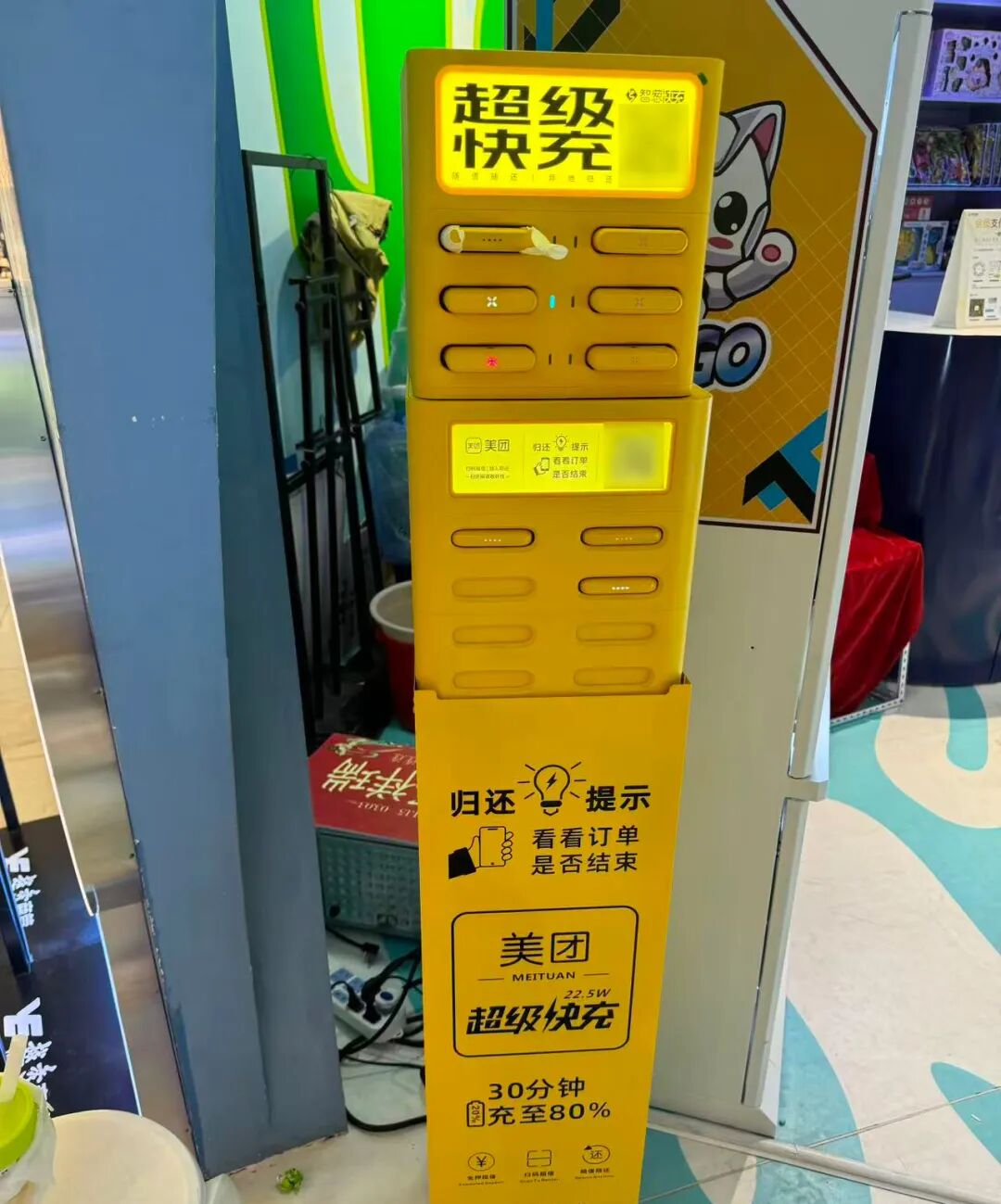
*Photo provided by Xiaoxi
After realizing something was wrong, Xiaoxi tried to call the customer service of Zhicong Fast Charging, but the number didn't exist. When she contacted the online customer service, they just kept asking her to wait, saying that someone would contact her later. Finally, she got a call the next day, but the staff said they couldn't help either and suggested that she "pull it out forcefully".
Later, Xiaoxi followed an online tutorial and tried with a straw. "There are many similar situations online, saying that cutting a straw and inserting it can work." But because the internal spring - buckle was tightly engaged with the groove of the Meituan power bank, she failed. After receiving Xiaoxi's feedback, Meituan power bank urgently applied for a suspension of charging for her. However, since the device couldn't be returned, Xiaoxi finally had to spend 99 yuan to buy it out. A few days later, when she passed by the scene again, the wrongly - returned power bank was still stuck in the cabinet.
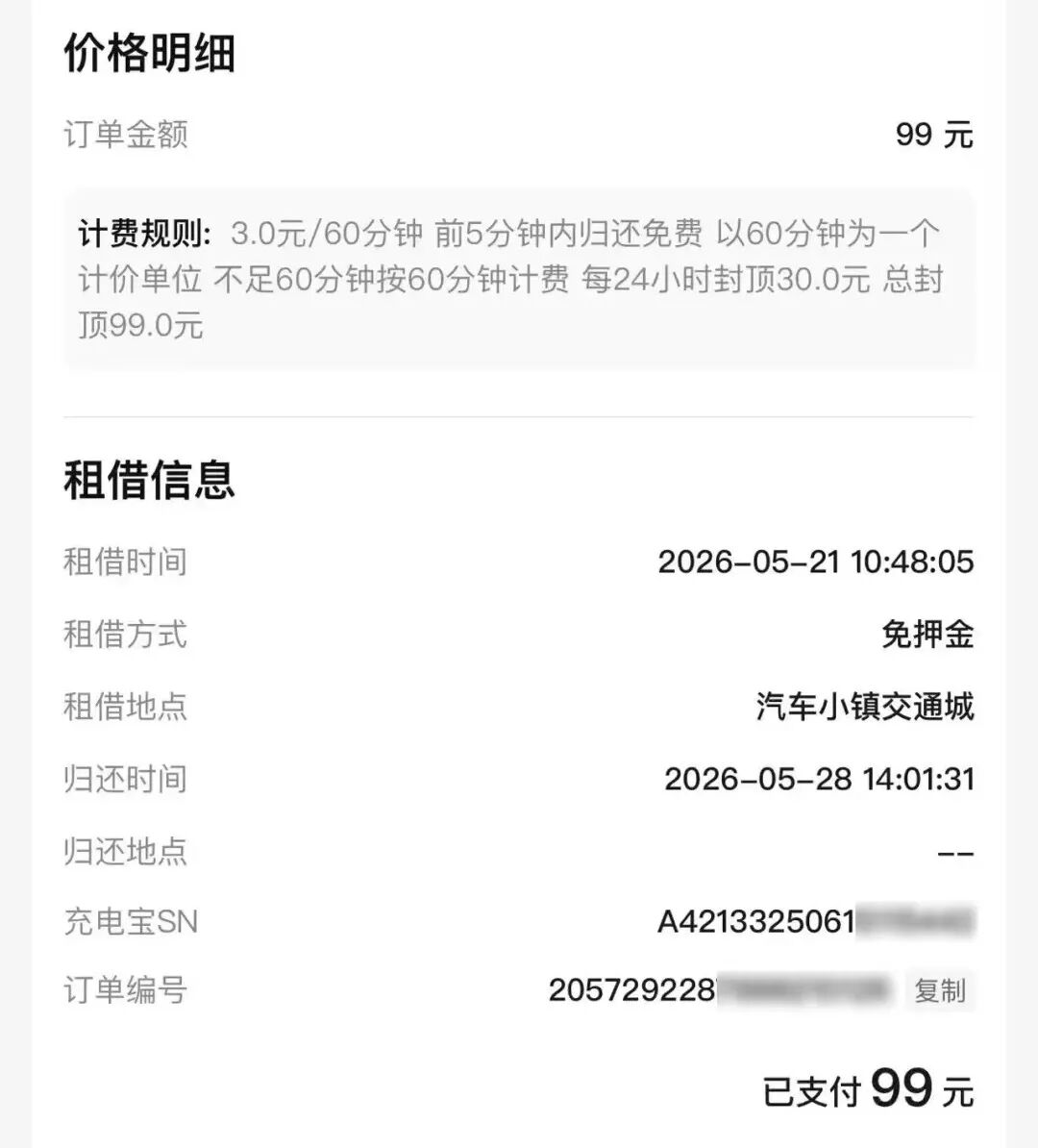
*Photo provided by Xiaoxi
Pinggu and Xiaoxi's experiences are not isolated cases. On social platforms, a large number of consumers have shared highly similar experiences: after borrowing by mistake, they can't find the return point, or return to the wrong cabinet. Contacting customer service is fruitless, and they are finally deducted 99 yuan or even 149 yuan to buy out the power bank. The IP addresses of these users are spread across many places such as Sichuan, Hubei, Guangdong, Hebei, Anhui, Yunnan, Chongqing, Shanghai, Zhejiang, and Guangxi.
When sorting out cases, Jingzhe Research Institute found that there are many brands of such counterfeit shared power banks. In addition to Baoli Charge and Zhicong Fast Charging, there are also more than a dozen brands such as Shangdian, Dianbaobao, Rongyibao, Duxiang Charge, Aoteman, Jubao Charge, Xiudian, Wukong Fast Charging, Like Charge, Juchongchong, and Mandianya. Moreover, the products and cabinets of many shared power bank brands imitate Meituan's shared power banks.
The so - called counterfeiting is not about faking trademarks, but using similar color schemes, fonts, and naming logics to imitate leading brands. They are often placed on top of or next to the genuine devices, creating visual confusion. As a result, when consumers scan the code to borrow, they often only see the color and style of the cabinet and fail to carefully identify the brand name.
Once they borrow by mistake, problems arise. The return networks of these brands are often much smaller than those of leading brands, and the density of return points is sparse. For example, during an on - the - spot visit, Jingzhe Research Institute found that at the door of a barbershop on a street in Songjiang, Shanghai, a cabinet named "Mandianya" was directly stacked on top of Meituan's shared power bank cabinet. Within a 10 - kilometer radius, there are less than 40 borrowing and returning points for Mandianya. In contrast, there are more than 30 Meituan power bank points within 300 meters.
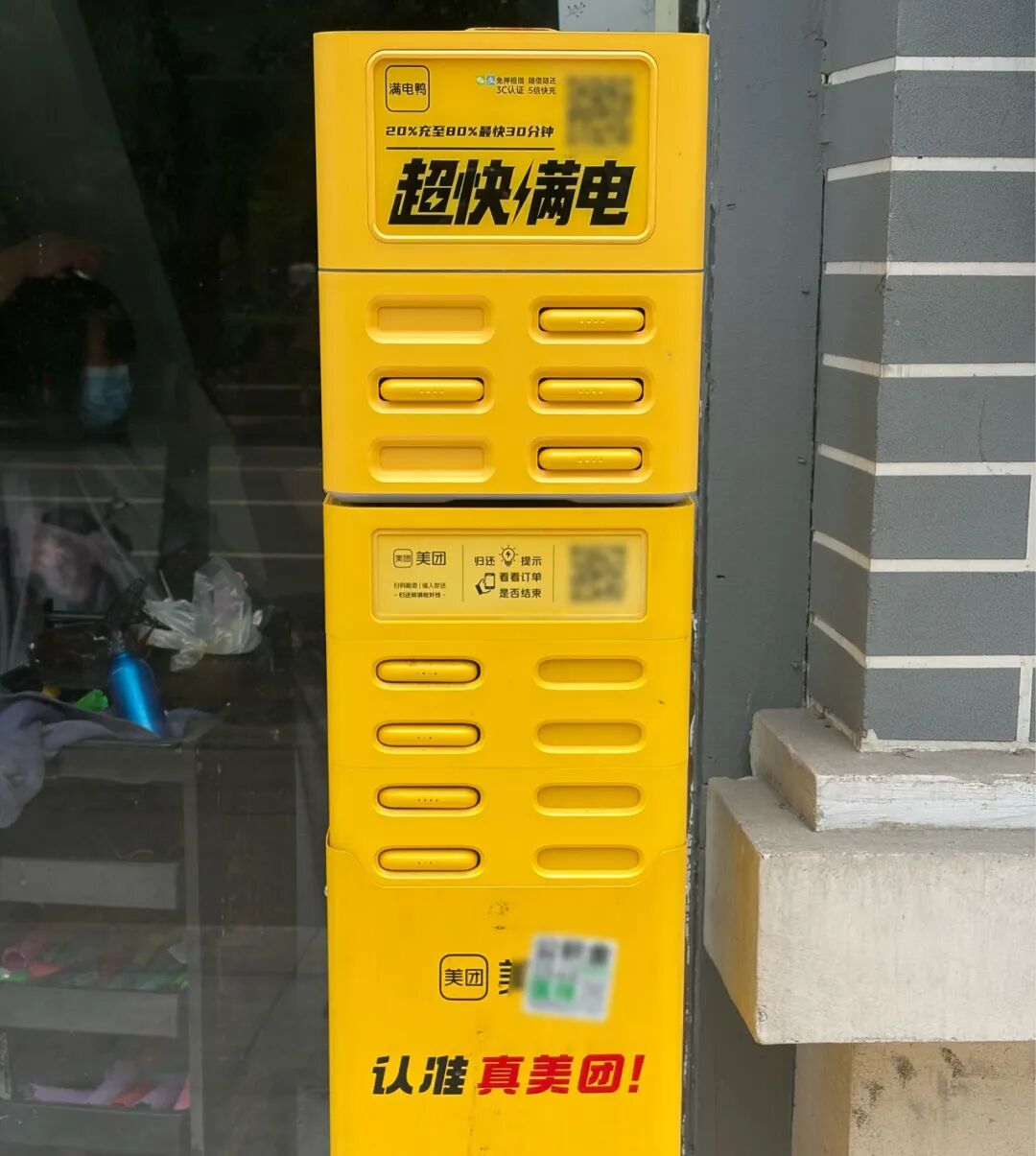
*Photo taken by Jingzhe Research Institute
For consumers, the cost of a "mistaken borrowing" or "mistaken returning" is not only the unexpected time loss but also may include the additional transportation cost for returning and the risk of being forced to buy out after a failed return.
Why do the misleading tactics of counterfeit shared power banks always work? Essentially, shared power banks meet an urgent and necessary demand. According to the "Investigation Data on the Development Status and Consumption Behavior of the Chinese Shared Power Bank Industry" released by iiMedia Research, the top scenario for Chinese consumers to use shared power banks in 2026 is long - term outings (shopping, business trips, traveling) that require continuous power supply.
Most users often scan the code in a hurry when their phone batteries are running out. At that time, their core demand is to borrow power quickly. In this state, consumers' sensitivity to differences such as brand jumps after scanning the code and details of the cabinet's appearance will drop to an extremely low level, and they may not even have time to distinguish. This is the fundamental soil for all counterfeit brands to survive.
The Hidden Business of Counterfeit Shared Power Banks
According to the observation of Jingzhe Research Institute, leading brands of shared power banks burn money to expand their presence and educate the market, while counterfeit brands don't compete head - on from the start. Instead, they precisely parasitize on the market soil developed by leading brands to intercept traffic and acquire customers.
The core of this business lies in the targeted layout of offline outlets. As we all know, the consumption scenarios of shared power banks are rooted in offline merchants. Whoever can get merchants to place cabinets in their stores has a chance to be scanned by users. The core of the counterfeit brands' ground - promotion strategy is a set of words that merchants can't refuse: zero cost, zero risk, and stable profit - sharing.
According to the owner of a barbershop that has placed "Mandianya" shared power banks, the platform actively promoted the product two months ago and promised free equipment. After deducting the electricity cost, the store's actual monthly income is about 100 yuan. The profit - sharing ratio given by Mandianya is the same as that of Meituan, both 35%. The owner revealed that the two shared power bank cabinets consume about 7 degrees of electricity per month. Calculated at 0.7 yuan per degree, the electricity cost is only about 5 yuan. In addition, the store owner can also scan the code to use the power banks for free. In his words, "It's purely for the convenience of myself and guests, and to earn a little extra for electricity."
In a post on the official account of "Mandianya Rapid Power Bank", Jingzhe Research Institute saw that this brand features 22.5W super - fast charging and claims to charge up to 80% in 30 minutes, but it doesn't specify the model of the charging phone and the charging conditions. The article also suggests that franchisees can carry a Mandianya power bank and an ordinary power bank for on - site charging comparison demonstrations during promotion, so that merchants can intuitively feel its charging efficiency and thus improve the deal - making rate.
However, when Jingzhe Research Institute tested it with an iPhone 17, it found that the brand's power bank only charged the battery from 28% to 45% in 30 minutes. In addition, WeChat also prompted that the mini - program has received poor reviews recently. Users' negative comments mainly focus on "the appearance is very similar to Meituan's", "there are very few return points", and "the deposit is not refunded".
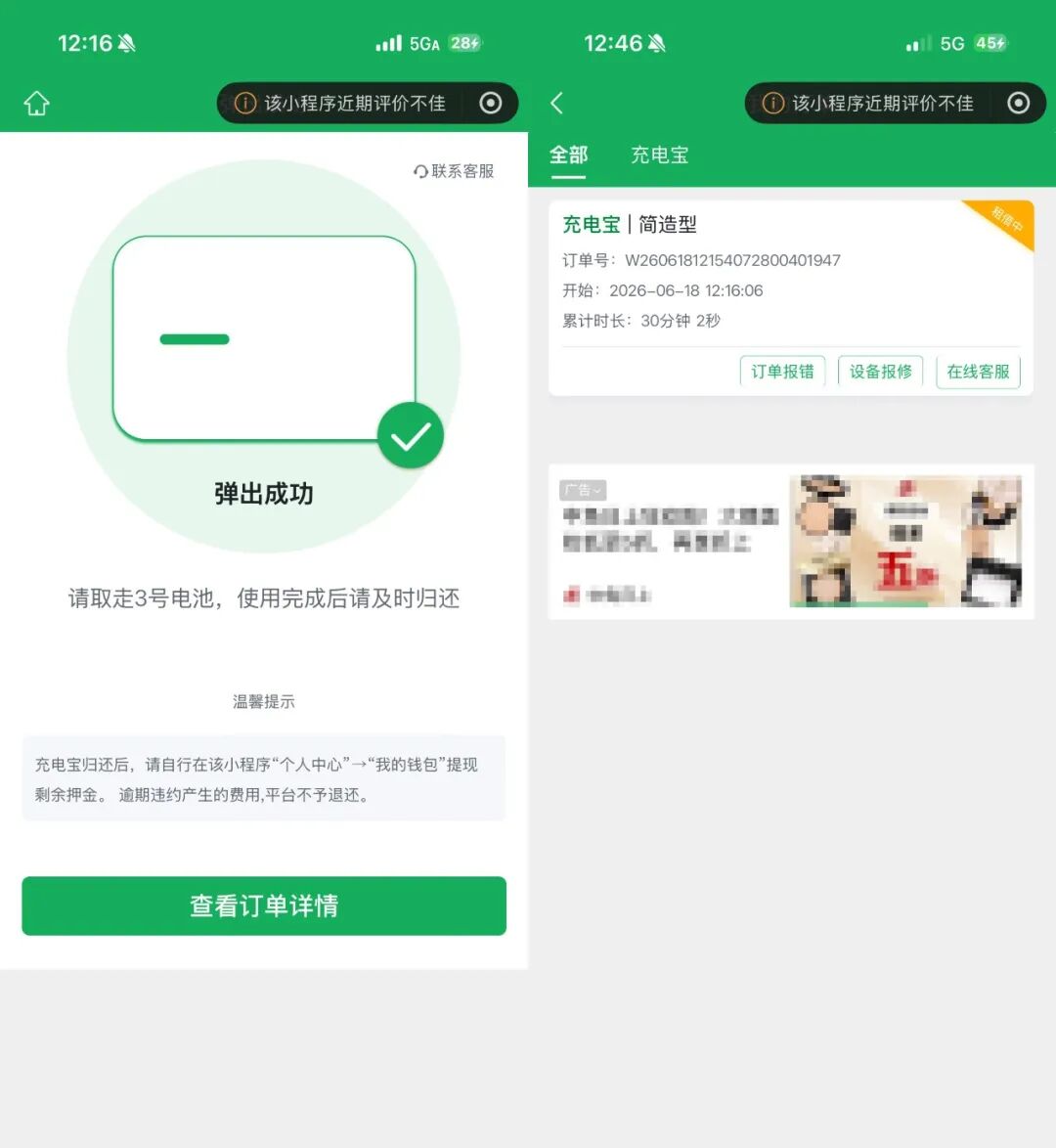
*Source: Screenshot of WeChat mini - program
Jingzhe Research Institute also noticed that some agent merchants of shared power bank brands have started to publicly reflect the problem of difficult cash - out on social media. For example, in January this year, a merchant from Shaanxi posted a question asking why Xiaodian didn't pay. The screenshot shared by the merchant showed that the cash - out application date was in September 2024, which means the payment has been overdue for more than 15 months. Later, the merchant added in the comment section in May this year that he went to the company to get the payment back.
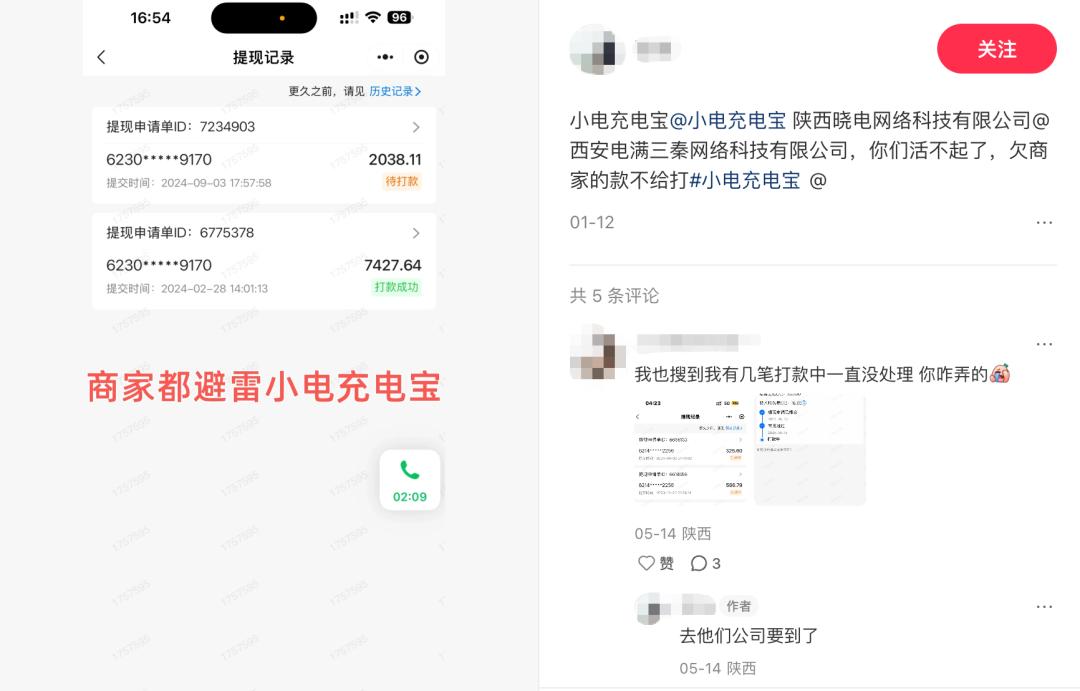
*Source: Screenshot from Xiaohongshu
In addition, a merchant reported in 2024 that after he found he couldn't cash out and called Xiaodian to consult, a salesman came and "secretly took the equipment away". It seems that the business of shared power banks may not be as easy to profit from as merchants imagined.
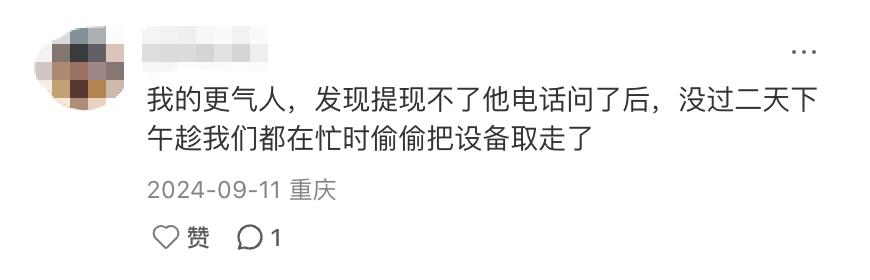
*Source: Screenshot from Xiaohongshu
If analyzed from the perspective of the profit model, it can be found that the cost of counterfeit shared power bank brands is lower than that of leading brands in almost every aspect. For example, they don't spend money on brand building and directly intercept traffic from leading brands. Their customer service is also extremely poor. For example, consumers often encounter non - existent or unconnectable phone numbers, and the problem - handling is very delayed.
On the revenue side, the pricing of counterfeit shared power banks doesn't decrease due to their weak brand power. Instead, it is basically on par with leading brands, generally starting at 3 yuan per hour. In entertainment venues with large traffic such as KTVs and bars, the unit price of some counterfeit shared power banks can reach 6 yuan, 8 yuan, or even 10 yuan per hour. The 24 - hour cap price can be as high as 99 yuan, and the maximum can reach 149 yuan. In some cases, the 24 - hour cap fee is even 10 yuan or more higher. This means that with much lower costs than leading brands but similar revenues, the profit margin is even greater.
In addition to the normal rental fee, there is another very important source of income: the overtime fee generated when users can't find the return point and the buy - out fee triggered by wrong returns or inability to return. According to a previous report by Hongxing News, the ex - factory price of a common 5000 - mAh shared power bank is less than 30 yuan when the single - order volume exceeds 1000. After deducting the equipment cost of less than 30 yuan from a 99 - yuan buy - out fee, the profit margin is more than twice. The return points of counterfeit brands are scarce, and the customer service is almost unreachable. The probability that users can't return the power banks after borrowing is artificially increased, and this part of the income has become a stable and efficient source of profit.
What's more noteworthy is that this is not a simple story of "counterfeiting". The so - called brands are not fighting independently. For example, through Qichacha, Jingzhe Research Institute found that "Baoli Charge" is an investor in another shared power bank enterprise, "Xiudian"; "Zhicong Fast Charging" is a trademark applied for by Hangzhou Xiaodian Technology Co., Ltd., and the appearance of Xiaodian's own shared power banks and charging cabinets is mainly in white and green colors.
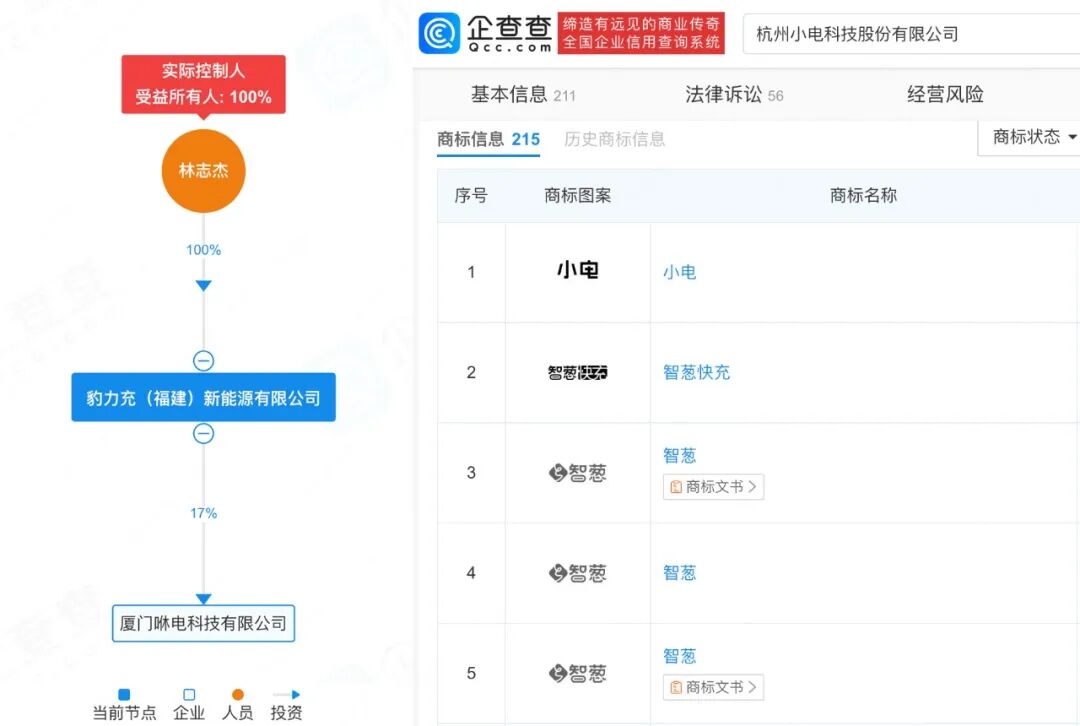
*Source: Screenshot from Qichacha
One brand investing in another shared power bank brand can be understood as a decentralized layout to build a brand matrix. However, supporting a "counterfeit" shared power bank brand that imitates a competitor adds a bit of a "strange" flavor to the business war.
What Determines the Fate of Counterfeit Brands Is Not Their Imitation Ability
As an emerging field, the shared power bank industry still exists, indicating that there is indeed market demand. However, the root cause of the continuous expansion of counterfeit shared power banks lies not in the demand side, but in the fact that after leading brands collectively shifted from the direct - operation model to the agency model, their offline control ability was greatly weakened, creating space for counterfeit products.
In the early stage of the industry, many leading brands adopted the direct - operation model with stronger