Stop arguing. I strongly suggest that hotels refund the accommodation fee on a pro-rata basis for guests whose stay is less than 24 hours.
The issue of "24-hour check-out" at hotels has sparked another round of debate in the past couple of days.
To be honest, this is not a new topic. Similar discussions emerge almost every one or two years. We don't know if some hotels actually operate this way or if it's a marketing gimmick to create traffic before the summer peak season.
Actually, Lao Sha suggests that we stop determining the check-out time based on the consumer's actual 24-hour stay. Instead, simply refund the room rate proportionally to guests who stay less than 24 hours. If guests don't use electricity or water in the room, it's better to refund them the electricity and water fees as well.
Then, let's stop implementing the dynamic pricing mechanism. Keep the room rate the same throughout the year to avoid customer complaints.
Moreover, don't charge guests for canceling hotel orders at will. After all, they haven't checked in yet. Provide a full and immediate refund!
Ultimately, it's all about catering to customers. So, let's engage in unrestricted competition!
If this really happens, let's see who will be hurt in the end: hotel businesses or the entire accommodation industry?
#01
Let's discuss this issue from a rational perspective.
The attitudes of hotel practitioners and users towards "24-hour check-out" are clearly different. It's no longer just a matter of each side stating their own reasons. The two sides have even started to argue with each other, including sarcasm and harsh words.
Hotel operators believe that "check-out at 12:00 and check-in at 14:00" is a long-established industry practice. Breaking this balance will disrupt the rhythm of the entire hotel industry. Some also claim that users are "never satisfied with getting a bargain."
On the other hand, the core argument of users is that if they book a hotel for one day, they should stay for a full 24 hours. The so-called established rules are all unfair terms from the past.
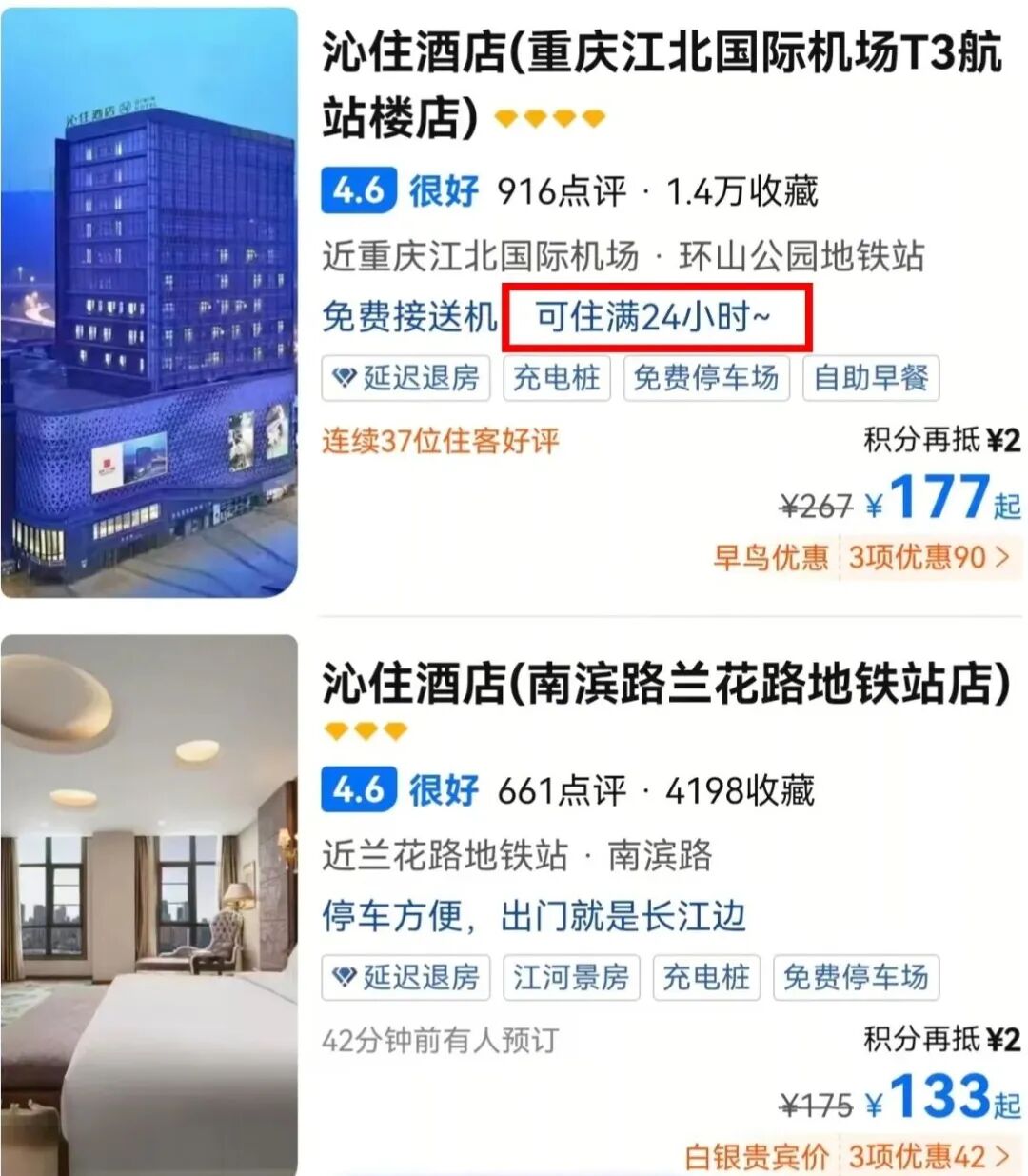
Image source: Ctrip
Some tourists told Lao Sha that originally, hotels had a 12:00 check-out time, but now more and more brands have extended it to 14:00. Some high-level members can even check out at 15:00 or even 16:00. This shows that rules can change. So, why can't we use the guest's actual check-in time as the starting point to ensure consumers' 24-hour stay rights?
Lao Sha believes that we need to understand the operating logic of the hotel industry. Only after understanding this set of rules can we discuss whether "24-hour check-out" can be implemented.
In the hotel industry, for any hotel brand operating on leased properties, the most core element for survival is operational efficiency.
Even if your hotel is a mid-range or mid-high-end hotel, as long as the premium growth is insufficient to offset the cost growth, the hotel has to pursue maximum efficiency.
What is efficiency?
The rule of "check-out at 12:00 and check-in at 14:00" is the most operationally standardized and efficient way summarized by the Chinese hotel industry after learning from foreign development experiences and combining with nearly forty years of local practice.
This rule is also a measure to balance the benefits of hotel operators and the actual experience of users.
If a hotel cannot predict the availability time of rooms, it cannot accurately schedule room cleaning and subsequent room reservation work.
Imagine that with the current staffing, if rooms can be booked at any time within 24 hours and the principle of a 24-hour stay is implemented, it will probably increase the hotel's operational difficulty and labor cost.
If the hotel doesn't add staff or resources, the actual experience of customers will be difficult to guarantee. If the hotel adds staff and resources, the cost will inevitably increase, leading to a rise in room rates.
In other words, most regular hotel bookers are paying for the needs of a small number of users.
To be honest, given the current market situation, hotel room rates can't go up. They can only absorb this cost silently. But let's think sincerely. Is this model a healthy supply state? Is it a sustainable state?
Moreover, there is a very practical problem. Currently, most hotel check-ins are handled through OTA platforms or the hotel's own membership system. When calculating "24-hour check-out", should it be based on the time when the guest arrives at the hotel to check in or the orally agreed check-in time when the guest books the room? If there is a breach of contract or incomplete compliance with the commitment during this process, how should the costs and fees incurred be borne?
"Time is money." This statement is very applicable to the hotel industry.
Different from consumer goods such as bread, beverages, clothes, and cars, which all have expiration dates, hotel rooms are a combination of time and space with a very short time limit. If a room is not occupied at night, it becomes invalid directly on that day.
Therefore, when an established rule is formed in the industry, it must be a comprehensive consideration of the actual interests of both the supply and demand sides of the industry, and then the most efficient operating model is formed.
#02
From the user's perspective, there must be many emotions behind the popularity of "24-hour check-out".
Some friends told Lao Sha that guests basically can't stay for 24 hours. Most people's concerns are concentrated in two aspects:
"Check in at midnight but still be required to check out at 12:00 noon. The stay time is obviously too short."
"The hotel strictly enforces the 12:00 check-out time, which affects my subsequent travel arrangements."
Check in at midnight but still be required to check out at 12:00 noon. The stay time is obviously too short;
The hotel strictly enforces the 12:00 check-out time, which affects my subsequent travel arrangements.
Lao Sha believes that for the first situation, during certain periods (such as non-peak seasons), hotels can set aside some rooms as "midnight rooms" or "midnight special rooms", make concessions in price, and clearly state the room configuration and check-out time.
Regarding the 12:00 check-out time, many hotels have already implemented a policy of delaying it.
In fact, the iron rule of "check-out at 12:00 and check-in at 14:00" has already shown signs of loosening.
Many hotels allow check-in between 12:00 and 14:00. Moreover, during the off-season, some hotels have extended the check-out time to 14:00, and some even to 15:00.

Image source: Ctrip
In Lao Sha's view, this is an adjustment made by hotels to cater to customers' needs at the expense of a certain amount of efficiency.
Lao Sha infers that in the current highly competitive market environment, "24-hour check-out" is unlikely to be fully implemented. However, it is highly likely that check-in will be advanced to before 12:00 and check-out will be extended to after 15:00.
Many hotels may compromise again between sacrificing a certain amount of efficiency and increasing the number of room nights.
Currently, most of the implementers of "24-hour check-out" are single hotels and some small and medium-sized hotel management companies. Relatively speaking, they have shorter decision-making chains and more flexible policies, and the impact of adjustments on the outside world will not be so great.
Moreover, some brands that participate in this policy have many restrictive conditions, such as for certain room types and certain time periods.
From another perspective, we can regard the recent "24-hour check-out" cases as a marketing activity of the brand before the summer peak season.
Just like the promotional activities of supermarkets at important nodes. We can't take a supermarket's promotional flyer and require all supermarkets in the city to offer the same discount policy.
Lao Sha believes that the more a hotel is a chain brand, the more difficult it is to promote the above policy.
When a chain hotel brand develops into a national product, the market environments faced by its investors will be different. If the relatively personalized "24-hour check-out" policy is implemented at this time, it will be unfair to many investors.
Imagine that at the same time, some places are in the peak season while others are in the off-season. Different investors will obviously have very different reactions to the "24-hour check-out" policy.
In addition, if the hotel management company agrees to introduce the above policy, it will surely gain a certain degree of reputation, but in the end, it is still the hotel franchisees and investors who will absorb the increased cost. This will also affect the development of a chain brand.
#03
From the perspective of game theory, this kind of concession should not be made.
If hotel operators give in on the "24-hour check-out" issue, the dynamic pricing mechanism may be the next to be affected.
In the future, if a small chain hotel brand introduces a policy of not adjusting room rates throughout the year and promotes it vigorously, how should the entire industry respond?
This is disorderly competition!
In the past two years, we have seen many times that the free value-added services originally provided by stores have been forced to become standard, there has been a bottomless compromise in the face of unreasonable negative reviews, and some hotel managers have carried out large-scale price cuts in order to achieve full occupancy.
This kind of indulgence has given consumers the illusion that low prices are reasonable and freebies are standard. It has also led to an infinitely long payback period for investors, a decline in hotel product quality, a decrease in industry reputation, and the loss of talents and teams.
Ultimately, the long-term and healthy development of the hotel industry never depends on bottomless competition and one-sided concessions, but on mutual tolerance and two-way concessions between the supply and demand sides.
Making flexible and minor adjustments on the basis of a mature and stable industry operation system is the optimal solution that takes into account the interests of both sides.
Blindly pursuing extreme benefits that are divorced from the business reality will not benefit any party in the end. What will be damaged is the entire accommodation industry and every ordinary person who needs to stay away from home.