The Ultimate Energy Battle at the End of AI: Nuclear Fusion, Ten-Billion Valuation Myths, and Investment Frenzy
This summer, as an investor in a fund, you're likely to receive a stern warning from your boss: By 2026, you must invest in a nuclear fusion company!
Unfortunately, it's highly probable that they won't be able to submit their term sheets. A nuclear fusion company founded in 2025 initially had a valuation of 500 million yuan. After the first round of financing, its valuation soared to 3 billion yuan, and it tripled or quadrupled a few months later. The company's founder is a well - known figure in the industry, and ordinary investors can't even meet the founder in person. At most, they can only have a group meeting with the CFO along with other institutions. The CFO privately told Yingke that when they entered the industry, they thought it would take three years to reach a valuation of 10 billion yuan, but unexpectedly, they were close to achieving this goal in just half a year.
Investors who only bring money to the table have no chance. So they have to "find all kinds of primary school classmates, junior high school deskmates, high school deskmates, college roommates, college teachers, and their own tutors" to get a chance to meet. "They have to humble themselves as much as possible and sign all kinds of unfavorable terms." An investor commented to Yingke. "The whole market has gone a bit crazy."
Nuclear fusion has been developing for more than half a century, but until two years ago, most primary - market investors only gave it a passing glance. Entrepreneurs whose company valuations have now exceeded 1 billion yuan still remember the harsh situation in the past. In 2024, he met with seventy or eighty institutions, spending several hours explaining to each of them, but only one - tenth of them made an investment.
Even if a few investors who focus on the energy sector are optimistic, their investment proposals are often rejected at the investment decision - making meeting. "It's impossible to convince the boss. It always seems that the commercialization of this technology is still a long way off."
The resurgence seems to have happened overnight. In November 2025, suggestions for the 14th Five - Year Plan were released, identifying nuclear fusion, along with quantum computing and embodied intelligence, as future industries. The plan aims to promote them as new economic growth points and strengthen the layout of cutting - edge and disruptive technologies.
In the spring and summer of 2026, an unprecedented amount of capital flooded into the nuclear fusion industry. According to incomplete statistics, in just one - third of 2026, the visible investments on the surface reached about 3 billion yuan, and several deals are still in the process of closing. Among state - owned capital, the National Energy Administration established a 20 - billion - yuan "Fusion Industry Fund", and the scale of the Shanghai Future Industry Fund increased to 15 billion yuan.
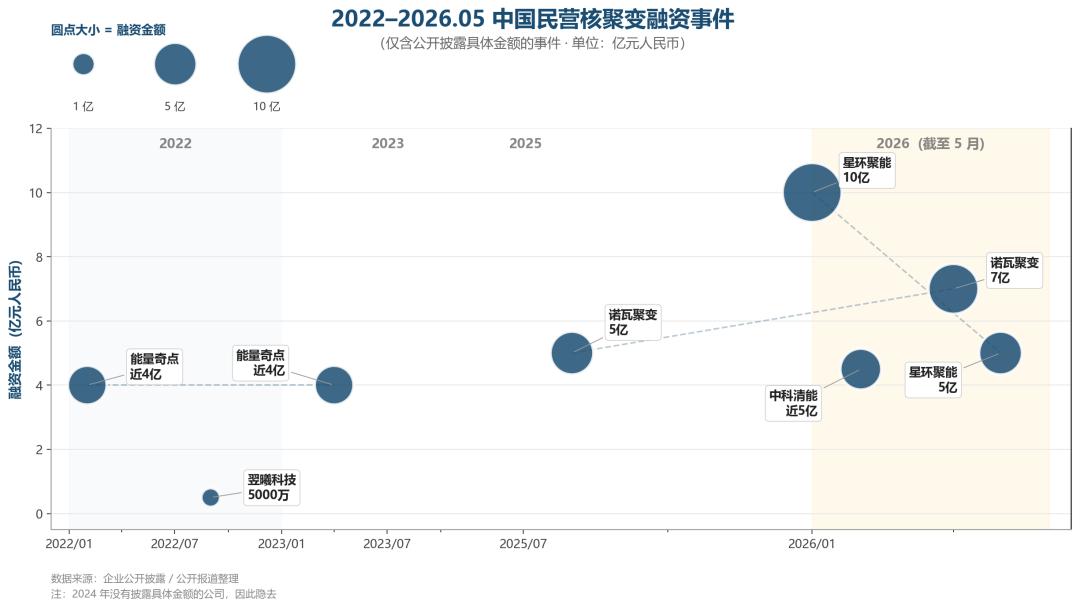
By 2026, there are more financings and larger amounts (Source: Produced by Yingke)
Investors are scrambling for shares, and companies are competing for talent. Previously, Ph.D. graduates in fusion could only change careers, but now they can earn up to one million yuan a year. A CEO who has been researching nuclear fusion at a university for decades is still a bit confused: "How did our once - neglected industry suddenly become so popular?"
In fact, if you look back at the development of the nuclear fusion industry in the past few years, you'll find that this boom has been in the making. The breakthrough in underlying materials in late 2021 and the recent insatiable demand for clean electricity from AI companies have been enough to mature the industry. And the competition between major powers has removed the concerns of capital and added the final push.
The nuclear fusion industry is no longer just a competition between companies. Its development will even affect the global landscape in the next few decades. And commercialization will be the most crucial finishing point.
Is the "perpetual 50 - year wait" over?
For those who have been in the industry for many years, since their student days, they've probably had an indelible thought: The commercialization of nuclear fusion is "always 50 years away."
But in 2023, the US nuclear fusion company Helion announced that it would start generating electricity in 2028.
After more than half a century of development, the nuclear fusion industry has suddenly taken a major turn in recent years.
Since the 1950s, nuclear fusion has been regarded as the ultimate energy source for humanity.
Nuclear fission can be understood as the splitting of atomic nuclei to release huge amounts of energy, while nuclear fusion is the collision and combination of atomic nuclei to form a heavier nucleus, also releasing a large amount of energy. Compared with chemical energy sources such as oil and natural gas, and new energy sources such as wind and solar power, the energy density of nuclear energy is millions of times higher.
Among nuclear energy sources, nuclear fission was developed earlier, but it has a strong environmental radiation and cannot guarantee safety at the current stage. Nuclear fusion has low radiation, no carbon emissions, and is very clean. On the other hand, the deuterium required for nuclear fusion can be extracted from seawater. The energy released by the complete fusion of deuterium extracted from one liter of seawater is equivalent to that of 300 liters of gasoline.
For many years, nuclear fusion could not generate enough energy. In the 1980s, nuclear fusion technology was considered too large - scale and expensive for any single country to undertake alone. To develop nuclear fusion energy, major powers were even willing to temporarily set aside their differences.
In 1983, Europe launched the JET project (Joint European Torus), which involved multiple countries. However, due to equipment aging and high costs, the experiment was stopped in 2023.
Another example is the ITER (International Thermonuclear Experimental Reactor) project. In 1986, the United States, the Soviet Union, the European Union, and Japan jointly initiated the design, aiming to build a much larger device to achieve energy gain. Later, China, South Korea, and India joined. The 35 participating countries account for more than half of the world's population and 85% of the global GDP. However, even after spending tens of billions of dollars and the efforts of countless scientists, ITER is still struggling.
A major breakthrough in recent years occurred in 2021. In September of that year, MIT students and teachers developed a second - generation high - temperature superconducting magnet, which finally reached the magnetic field strength required for a nuclear fusion power plant. More importantly, the partial reaction device using this new material only needs to be 1/40 of the size of ITER, with lower costs and a shorter construction time.
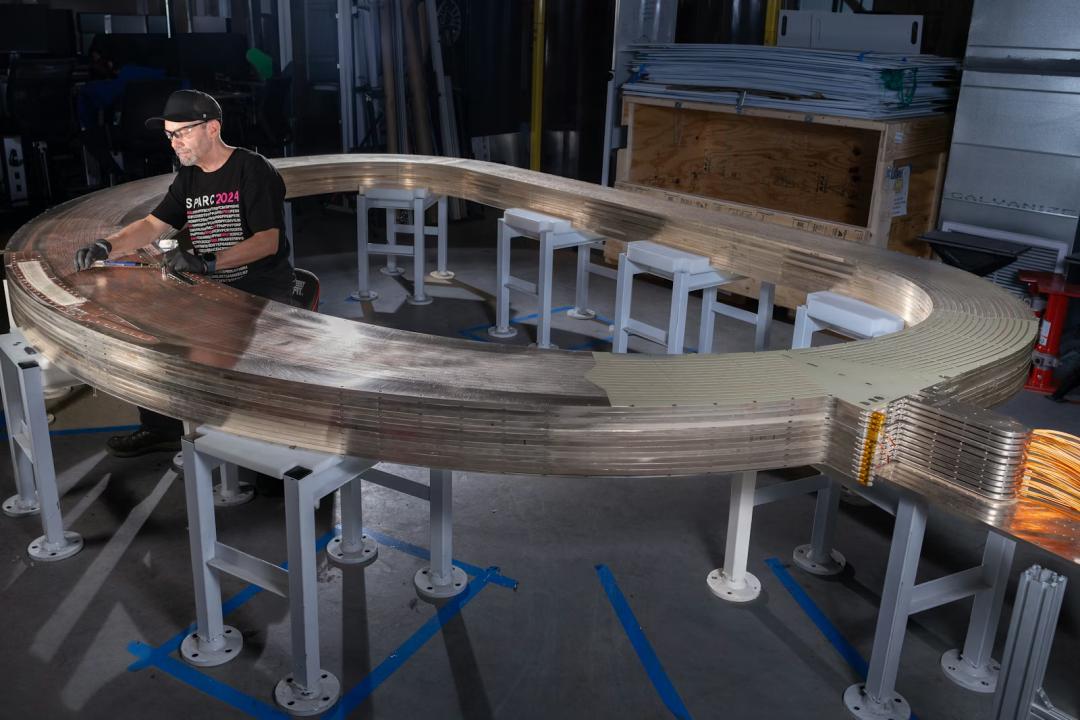
CFS developed a new - generation high - temperature superconducting magnet (Source: CFS official website)
The company CFS, founded by the MIT team, also received the largest single - round financing in the global fusion field, up to 1.8 billion US dollars. Several domestic nuclear fusion companies, such as Energy Singularity and Star Ring Fusion, were also established with this momentum and have received hundreds of millions of yuan in financing.
However, after the financing, there is a long R & D cycle, and it's difficult to see progress in the short term. The market returned to silence until 2025.
In this year, with the rapid development of AI, the demand for computing power has increased exponentially. Among the fields that have received attention due to AI, electricity is considered the core bottleneck for AI development. According to a report released by Goldman Sachs in March 2026, the current global data center power consumption is 55 gigawatts (GW). It is estimated that by 2030, the global data center power demand will increase by 175% compared to 2023.
For this reason, domestic companies such as Alibaba and foreign companies such as Google, OpenAI, and Microsoft are important promoters of nuclear fusion investment. Their core motivation is to ensure the huge amount of clean electricity required for the 24/7 operation of AI data centers.
AI giants have purely market - driven needs, and some more flexible and commercially - viable fusion power generation solutions have finally found their application scenarios.
Take the recently popular company Nova Fusion as an example. It was founded in March 2025. The founder, Guo Houyang, said that he chose this time to start a business because AI companies had a demand. The path he chose can ultimately build a small fusion reactor with a power supply of 50 megawatts, which exactly matches the power consumption of an AI super - computing center. "A few years ago, if you told someone in China that you wanted to build a 50 - megawatt small nuclear fusion power station, they would definitely ask you who would use such a small power station."
Nova Fusion has received a total of 1.2 billion yuan in financing in one year, and its valuation is approaching 10 billion yuan.
The Art of War says: "Only after spending a thousand pieces of gold a day can an army of one hundred thousand be mobilized." If we look at the global picture, after AI enters the era of an arms race, nuclear fusion will inevitably be an industry that major powers will heavily invest in. As Guo Houyang said in a previous interview with Yingke: "The competition in AI is essentially a competition in computing power, and the competition in computing power is essentially a competition in energy."
The nuclear fusion industry needs continuous and large - scale capital injection to thrive. Without the support of national policies, capital is reluctant to take risks. A professor recalled that when a student wanted to start a business, he advised the student not to do it, saying, 'This is not something that a private company can handle.' But now the student's company has a valuation of billions of yuan.
They didn't expect that policies would be introduced so intensively. The real turning point was the introduction of national - level policies at the end of 2025. Only then did primary - market investors and industry insiders gain real confidence. Investor Chen Han told Yingke that although this seems to be a competition between different countries, it is actually about the huge economic changes that hard technology can bring. "It's okay if no one has it, but it's unacceptable if you have it and I don't. It's best if I have it and you don't."
As the industry has been elevated to the national strategic level, a consensus has gradually formed: "People think that one or two technology companies may go public in the short term." Because two US companies are about to go public (TAE Technologies was acquired by Trump Media & Technology Group for 6 billion US dollars and is going public through a merger. General Fusion has announced a merger with Spring Valley Acquisition Corp.III, a special - purpose acquisition company based in Dallas, USA, and plans to list on the NASDAQ this year). "So everyone is betting on this." Another investor, Gu Heng, told Yingke.
This has directly increased the popularity of nuclear fusion. Investors from the energy, AI, and intelligent hardware sectors are all looking at nuclear fusion. The breakthroughs in nuclear fusion technology and the progress of foreign companies have also made people realize that this is no longer an industry that will take "forever 50 years" but an industry that requires a 10 - 20 - year layout. From a financial investment perspective, the return period may be even shorter.
Tracks with such certain returns are quite rare at present. "There is a lot of money, but there are few investable tracks, so everyone is involved." Gu Heng commented.
Next, they need to make a bet and choose the right target.
A race between two routes
The nuclear fusion power generation technology has converged into two routes.
As a science that has been studied since the 1950s, in theory, there are multiple paths to nuclear fusion power generation. The earliest and most mainstream path is called the tokamak.
The tokamak device looks like a huge "doughnut" and can be up to 30 meters high. Its power - generation principle is that a super - strong magnet outside the "doughnut" generates a magnetic field, which acts like an invisible hand to suspend the plasma at hundreds of millions of degrees in the center of the doughnut, preventing it from burning the outer shell. The plasma inside also has an electric current, which, in combination with the external magnetic field, twists the magnetic field lines like a twisted rope, locking the randomly moving particles in orbit and allowing them to collide violently to generate energy.
The advantage of this route is that the physical theory is the most perfect, and there is also the most accumulated research data. For example, the JET and ITER projects, which started in the 1980s, are both tokamak - based. Many professionals told Yingke that the probability of successful power generation using the tokamak route is very high, "as long as you're willing to invest enough money."
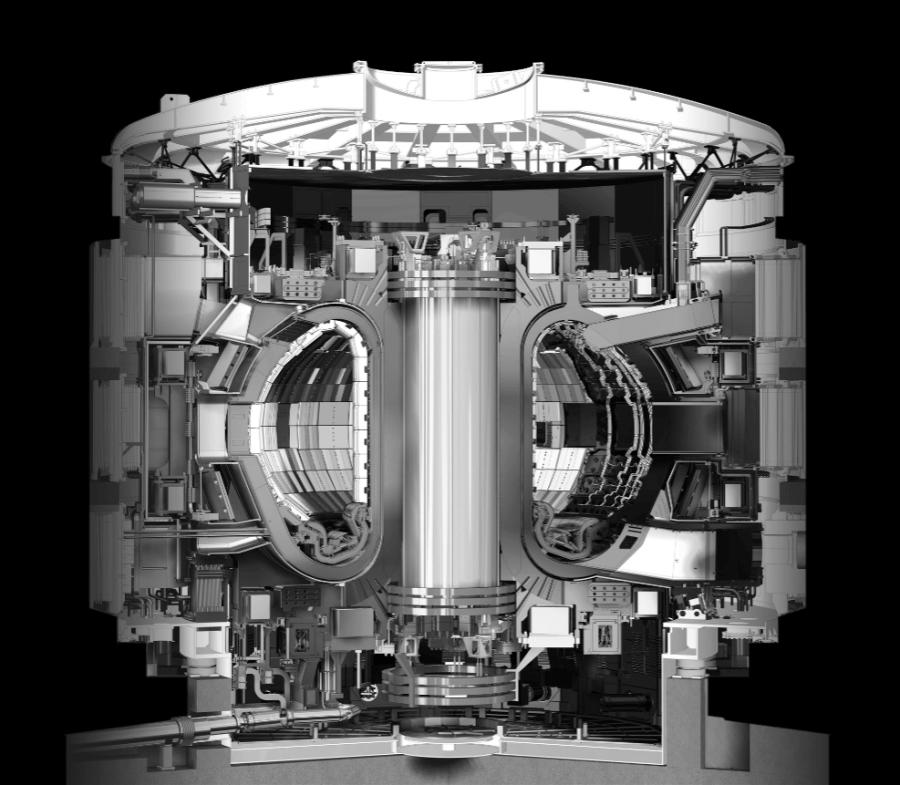
Conceptual diagram of the ITER tokamak device (Source: ITER official website)
This route indeed requires a large amount of capital and a long construction period. Therefore, the tokamak has always been considered to be led by the state. The China Fusion Energy Co., Ltd. (hereinafter referred to as "China Fusion"), established in 2024 in China, follows the tokamak route. China Fusion is led by the China National Nuclear Corporation and jointly funded by 13 central state - owned enterprises, including China Aerospace Science and Technology Corporation, China Electronics Corporation, China National Petroleum Corporation, and State Grid Corporation of China, with a registered capital of up to 11.4 billion yuan.
In the United States, the representative company of the tokamak route is CFS, founded by MIT students and teachers in 2018. Domestic counterparts include Energy Singularity and Star Ring Fusion. The latter announced in May that its valuation exceeded 1 billion US dollars.
Another route with the most commercial applications is the field - reversed configuration, also known as FRC. Compared with the tokamak, the FRC - based device is smaller, has lower construction costs, and a shorter construction period. Therefore, many nuclear fusion companies are following this route, such as TAE, the pioneer of modern commercial nuclear fusion, and domestic companies such as Nova Fusion and Xingneng Xuanguang, which were established in the past two years.
This type of device can be understood as a long, straight tube. At both ends of the device, two groups of plasma are ejected at extremely high speeds and collide violently in the middle of the tube. At the moment of collision, a strong current is induced inside the plasma. This current generates a magnetic field with a direction opposite to that of the external magnetic field of the machine. The collision of the two magnetic fields forms a self - closed magnetic ring.
Due to its relatively short development time, the certainty of successful power generation using the FRC route is lower than that of the tokamak. On the other hand, if it is successful, it will enter the commercial power - generation stage earlier than the tokamak, and the final power - supply cost will also be lower than that of the tokamak route.
However, both routes are still in the early stages of R & D. When the physical Q value is greater than 1, it means that the fusion energy released by the plasma is greater than the heating energy directly injected into it, achieving a break - even point. However, since the entire power plant needs a large amount of electricity to maintain the superconducting magnet, vacuum pumping, and heating equipment, a physical Q