Refrigerants have skyrocketed by 400% in three years: Who is making a fortune quietly?
In the A-share market, the seemingly unremarkable fluorochemical industry has witnessed a spectacular rally. Since the low point in April 2025, the fluorochemical index has more than doubled in cumulative gains. Juhua Co., Ltd. and Yonghe Co., Ltd. have soared by 150% and 120% respectively during the same period.
In fact, the fundamentals of the fluorochemical industry's performance emerged from the doldrums in 2024 and have been continuously recovering, which has become one of the core driving forces for the sharp rise of the sector. More importantly, how long can this upward trend continue?
The Refrigerant Market is Surging
In June 2026, leading domestic fluorochemical manufacturers have raised the ex-factory prices of refrigerants multiple times.
As of the 12th of that month, the average prices of R32, a commonly used refrigerant in the air-conditioning market, and R134a, a commonly used refrigerant in the new energy vehicle market, have climbed to 62,500 yuan/ton and 59,727 yuan/ton respectively, representing year-on-year increases of 34% and 30.8% and both hitting new highs for the same period in the past decade.
Entering the second half of the month, the upward trend continued. The latest quoted price of R32 from mainstream factories has reached 65,500 yuan/ton. In contrast, at the bottom in 2023, R32 was only around 13,000 yuan/ton - in less than three years, the cumulative increase has exceeded 400%.
This figure represents a significant surge in the price history of any commodity, especially for a seemingly traditional chemical product like refrigerant.
However, before the price soared, the domestic refrigerant market had also experienced its darkest hour. From 2020 to 2022, under the expectation of the quota system policy, major enterprises scrambled for market share at all costs, and the industry fell into deep losses. In 2023, a weak recovery began, but the high inventory pressure left over from the previous competition still persisted, and most enterprises barely managed to get out of the quagmire of losses.
It was not until 2024, when the quota system was officially implemented and the basis for the industry's involution no longer existed, that major players shifted towards a profit-oriented approach, and the industry truly embarked on the path of reversal and recovery.
The continuous high prosperity of the fluorochemical industry has been gradually reflected in the financial reports of relevant listed companies.
Take Juhua Co., Ltd., which holds the largest quota of third-generation refrigerants, as an example. In the first quarter of 2024, 2025, and 2026, the year-on-year growth rates of its operating revenue were 18.4%, 10.3%, and 3.8% respectively, which were not particularly high.
However, the performance of its net profit attributable to the parent company was more prominent, with growth rates of 108%, 94%, and 46% during the same period. In 2025, the net profit attributable to the parent company reached 3.78 billion yuan, far exceeding that of any year since its listing.
The significant increase in profit is mainly driven by the price increase of fluorochemical products such as refrigerants, which has greatly improved the company's profitability. Juhua Co., Ltd.'s gross profit margin has risen from 17.5% in 2024 to the latest 34.4%, and its net profit margin has risen from 8.9% to 21.6%, both hitting new highs since 2012.
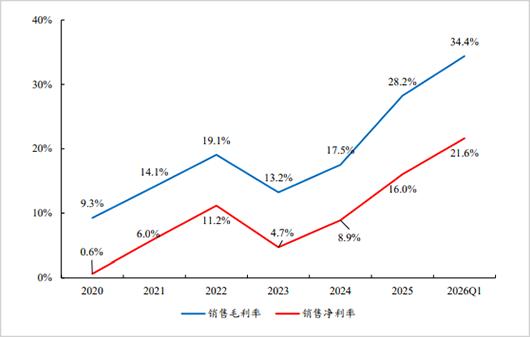
Chart of Juhua Co., Ltd.'s gross profit margin and net profit margin trends, Source: Kaiyuan Securities
The next crucial question is whether the leading companies represented by Juhua Co., Ltd. can continue their spectacular performance?
The Super Cycle is in Full Swing
The most fundamental trigger for this refrigerant super cycle stems from the amendment to the Montreal Protocol adopted in Kigali, the capital of Rwanda, in 2016.
According to the agreement, developing countries, including China, will freeze their refrigerant quotas in 2024 and start reducing them annually from 2029, leaving only 20% of the baseline by 2045. The purpose is clear: to extend the protection of the ozone layer to reducing greenhouse gas emissions and curbing the rapid global warming.
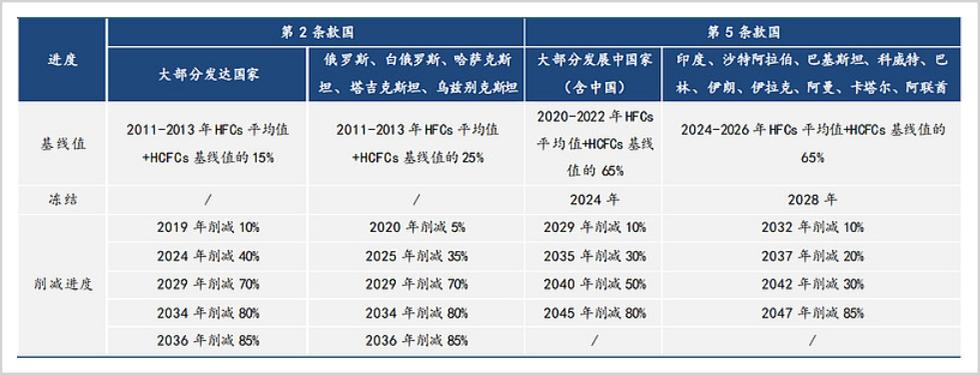
Reduction progress of third-generation refrigerants in different types of countries, Source: Guojin Securities
It is worth noting that China accounts for more than 80% of the global refrigerant quotas, and the domestic market is concentrated in several core leading companies. For the core varieties R32, R134a, and R125, the market concentration of the top three companies is as high as over 70%, and the top five account for more than 90%.
Juhua Co., Ltd. is the largest leading company, accounting for 46%, 36%, and 38% of the above three core varieties respectively. Other leading companies include Sanmei Co., Ltd., Yonghe Co., Ltd., and Dongyue Group.
After the supply is locked in, refrigerant players have completely bid farewell to the script of "capacity expansion - price war - loss - market clearance - re-capacity expansion" in the general commodity market. Their business model is more unique, as they hold franchise licenses globally. This enables the refrigerant industry to break the original cycle curse in the long run and is expected to enjoy an extremely long prosperity cycle.
In addition to the supply side, it is highly likely that the demand for refrigerants will continue to grow steadily.
For many years, the fields of air-conditioning, refrigerators, automotive air-conditioning, and cold chain logistics have been the traditional mainstays of refrigerant demand. After the quota system is implemented, the new demand for third-generation refrigerants mainly comes from maintenance and replacement, exports (to fill the gap left by the reduction in developed countries), and the replacement of second-generation refrigerants.
At the same time, the downstream market of the fluorochemical industry is undergoing a structural upgrade - the continuous explosion of emerging fields such as AI data centers, semiconductors, new energy, and 5G communications has driven the demand for high-end fluoromaterials such as electronic fluorinated liquids, fluorinated specialty gases, and PVDF binders, which together with the third-generation refrigerants under the quota system constitute the core growth drivers for fluorochemical companies.
Overall, before the first reduction node in 2029, the price of refrigerants is likely to maintain an upward trend. Of course, the price increase will not be endless.
The biggest variable is the substitution progress of fourth-generation refrigerants - the fourth-generation refrigerants have a lower GWP value and are in line with the long-term environmental protection trend. However, currently, the patents are mainly held by several overseas giants such as Honeywell, Chemours, and Arkema. The high cost and limited supply make it difficult for them to form a substantial substitution for the third-generation refrigerants in the short term.
However, once the patents expire or domestic enterprises achieve breakthroughs, the significant reduction in the manufacturing cost of the fourth-generation refrigerants and the start of large-scale production will put pressure on the price ceiling of the third-generation refrigerants.
Overall, this refrigerant super cycle is just beginning, and the high prosperity of the performance of relevant fluorochemical companies will continue for several years.
Juhua vs. Sanmei vs. Yonghe
Refrigerants are the most traditional and largest product category in the midstream of the fluorochemical industry. Only by comprehensively analyzing the entire upstream and downstream industries can we more clearly identify the distribution of the value chain.
Fluorite, at the forefront of the industry chain, is known as the "crude oil of the fluorochemical industry" in the industry. China is the world's largest producer of fluorite, accounting for about 60% of the global annual output, but its reserves only account for 27% of the world's total. After reaching the peak output in 2021, with the strengthening of environmental supervision and the reduction of easily exploitable high-grade ore resources, the annual output has begun to slow down significantly.
Jinshi Resources Co., Ltd. is the only pure fluorite mining enterprise and also the leading company in both the reserves and output of single-type fluorite mines in China. Yonghe Co., Ltd. ranks among the top in terms of self-owned fluorite reserves among fluorochemical companies. With self-controlled mines in Inner Mongolia and Jiangxi and hydrofluoric acid smelting, it follows an integrated development path.
Juhua Co., Ltd. is relatively weak in the upstream mining segment. It mainly binds the associated fluorite in Baiyunebo by participating in the integrated fluorite beneficiation and chemical project of Baotou Steel and secures the upstream supply through a long-term agreement with Jinshi Resources Co., Ltd. It can be seen that all three companies have access to the uppermost reaches of the fluorite industry, but the methods and degrees of involvement vary greatly.
The core of the midstream is refrigerants, which is the most profitable part of the industry chain. In addition to the operating thresholds such as capital and technology, the more crucial factor is the quota barrier. Since the quota for third-generation refrigerants has been frozen, other players no longer have the opportunity to enter the market.
In addition, the midstream also includes fluoropolymers and fluorine-containing fine chemicals. The former includes varieties such as PTFE, PFA, FEP, and PVDF, which is one of the core directions for the high-end transformation of fluorochemical companies.
The latter is also an area with high added value in the fluorochemical industry, including fluorinated liquids and fluorine-containing electronic chemicals. Driven by the prosperity of the AI industry chain, it has become a rapidly growing segment in recent years.
The downstream of the fluorochemical industry mainly consists of end-user applications, including air-conditioning, automobiles, cold chain logistics, industrial refrigeration, etc.
In the fluorochemical industry chain, major leading companies have different focuses in their business layouts. Sanmei Co., Ltd. is the company with the highest purity of refrigerants in the A-share market, with refrigerants accounting for more than 80% of its business. It has a strong advantage in R134a, which is mainly used in automotive air-conditioning, with a quota share of 24%, and will benefit from the increasing penetration rate of new energy vehicles. More importantly, the continuous price increase of refrigerants will bring huge performance growth dividends.
Juhua Co., Ltd. and Yonghe Co., Ltd. have both built a full industrial chain along the path of "fluorite - hydrofluoric acid - refrigerants - fluoropolymers - fluorine-containing fine chemicals", but there are significant differences in their business structures and growth logics.
Juhua Co., Ltd. holds the largest quota of third-generation refrigerants. In 2025, refrigerants accounted for 47.7% of its operating revenue. Combined with the petrochemical and basic chemical industries, it is more like a comprehensive fluorochemical platform with strong cash flow and earns the certainty of a franchise-like business model after the quota is locked in.
In 2025, refrigerants accounted for 53.3% and fluoropolymers accounted for 33.4% of Yonghe Co., Ltd.'s business. It has self-owned fluorite reserves of 4.85 million tons, which forms a cost moat. Its AI liquid-cooled fluorinated liquid has passed the compatibility certification of Microsoft and NVIDIA. The 20,000-ton HFO - 1234yf project in Baotou and the 3,000-ton high-purity PFA project in Shaowu will start large-scale production in 2026, combining the logics of resource supply and the ramp-up of high-end production capacity.
Based on the above three core companies, since Sanmei Co., Ltd. is closer to a pure resource manufacturer, its performance growth rate and profitability have been significantly higher than those of the other two companies since 2024. As of the first quarter of 2026, Sanmei Co., Ltd.'s net profit margin was as high as 35.7%, while that of Juhua Co., Ltd. was 21.6% and that of Yonghe Co., Ltd. was 13.7%.
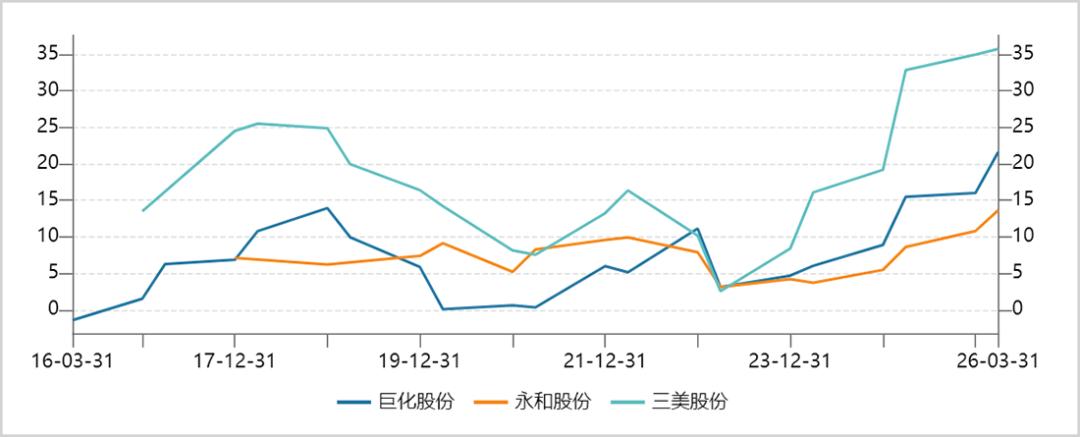
Chart of the net profit margin trends of the three companies, Source: Wind
However, Juhua Co., Ltd. and Yonghe Co., Ltd. have built a full industrial chain, and their products related to fluoropolymers and fluorine-containing fine chemicals are in line with the AI raw material trend. As a result, their valuations are one step higher than that of Sanmei Co., Ltd. - as of July 1st, their PE-TTM ratios are both around 35 times, while that of Sanmei Co., Ltd. is 23.5 times.
Overall, the implementation of the refrigerant quota system in 2024 has completely changed the competitive landscape of the industry. With the supply locked in, the demand stable, and the market structure solidified, leading companies are enjoying an unprecedented long-term prosperity cycle.
The three companies have different development paths and logics. Among them, Juhua Co., Ltd., with the largest quota, has stronger performance certainty. Sanmei Co., Ltd., with the highest purity of refrigerants, has the greatest performance elasticity. Yonghe Co., Ltd., with self-owned fluorite reserves and a leading layout in high-end fluoromaterials, has good growth potential.
In short, this super cycle is far from over.
This article is from the WeChat official account "Market Value Observation" (ID: shizhiguancha), author: Market Value Observation. Republished by 36Kr with authorization.