A "Dimensional Misalignment Competition": How Do Small Home Appliances Capture the Southeast Asian Market?
When Midea sells its split - type air conditioner PortaSplit as a hard currency in Europe and forces foreigners to drive 200 kilometers just to grab a used unit at double the price, everyone is shouting that Chinese manufacturing is making a reverse conquest of Europe and the United States. The proportion of self - owned overseas brands of companies like Midea and Haier has soared all the way to 40%–90%, completing a historic leap from "Made in China" to "Chinese Brands".
However, few people have noticed that in the tropical regions with perennial high temperatures, another even more fierce "flank battle" has already begun.
Avoiding a head - on confrontation with the industry giants in the European and American markets, the domestic small home appliance army has redirected its focus to Southeast Asia. Without the heavy burden of transformation, relying on extreme cost - effectiveness, rich functions, and lightweight and convenient designs, these small home appliance brands that were "squeezed out" in the domestic market have found a new world in the high temperatures and humidity of Southeast Asia.
Small home appliances struggling for survival turn to Southeast Asia

Looking back at 2020, popular small home appliances such as air fryers, sandwich makers, and blenders rode the wave of the "stay - at - home economy" during the pandemic. With precise market segmentation, they filled the gaps in young people's lives. During that special period, for young people living alone in rented apartments, traditional home appliances that cost thousands of yuan seemed bulky and uneconomical. In contrast, those small home appliances with a price tag in the hundreds, high - value appearance, and easy portability became emotional comfort items that could be purchased without much thought.
Most of these brands started from white - label factories in industrial belts. Backed by the extreme cost - effectiveness of direct factory sales, they carried out a brilliant lightning - fast campaign in the market gaps where home appliance giants hadn't had time to penetrate.
However, the tide receded faster than expected. During the 618 shopping festival in 2023, the growth rate of small home appliances showed signs of slowing down. The data from Aowei Cloud Network is even more straightforward: in 2024, the total retail volume of small home appliances in China was about 279 million units, with a year - on - year increase of only 0.3%. However, the retail sales reached 60.9 billion yuan, a year - on - year decline of 0.8%. The volume was increasing while the price was decreasing, indicating that the cut - throat competition was intensifying.
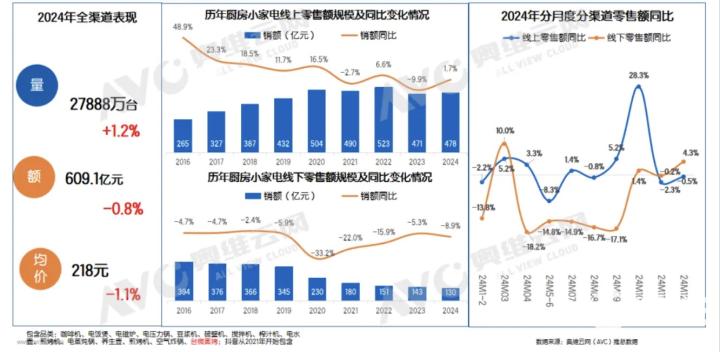
▲ Image/Aowei Cloud Network
Worse still, the survival pressure on small home appliances not only comes from the market penetration of giants but also from the high - level ecological suppression.
As Midea builds the "MevoX self - evolving intelligent system", Robam Appliance delves into the "ROKI digital kitchen appliance system", and Dreame's sub - brand MOVA targets the whole - home smart ecosystem, the battles of home appliance giants have long deviated from the single - product sales logic and shifted to selling system ecosystems. When Midea and Haier redefine the home scenario with the whole - home smart ecosystem, the niche market segments that small home appliances rely on for survival are completely swallowed up. Your sockets, your data, and your interaction portals are either taken over by the giants or completely eliminated from the market.
Moreover, even Pop Mart, a company that sells trendy collectibles, wants to cross - border and grab a share of the market. As early as August 2025, Pop Mart started recruiting talents related to small home appliances. In April 2026, its IP - derived small home appliance products were officially launched, including kitchen appliances such as electric kettles and coffee makers, as well as a limited - edition Labubu cooler. Its intention is obvious: to create "lifestyle" products around its IP. When small home appliances are no longer just living tools but are packaged into emotional consumption and ecological memberships, the survival space of small home appliance brands that rely solely on appearance and cost - effectiveness will only be further squeezed.
Except for companies with certain brand influence such as Bear Electric and Beitender, which can still seek transformation, for most small and medium - sized players without brand heritage, technical accumulation, and financial strength, they have to find new ways. They need to avoid the cut - throat price competition in the domestic market and the head - on confrontation with home appliance giants in the European and American markets, so they turn their attention to the emerging Southeast Asian market.
Digging for gold in Southeast Asia: Precisely harvesting the "tropical dividend"
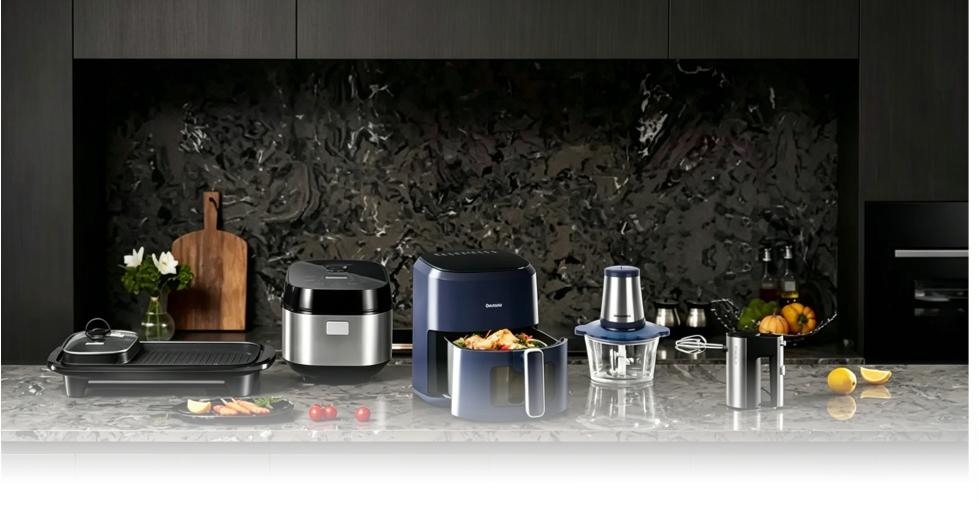
Subsequently, a group of Chinese small home appliance "guerillas" have emerged in Southeast Asia.
The emerging brand Gaabor was established in September 2021. It only took one year for it to achieve sales of over 230 million yuan and a shipment volume of 1.82 million units. The annual sales of its air fryer alone exceeded one million units, and it successively ranked first in the small home appliance category on Shopee and TikTok in multiple Southeast Asian countries. In just four years, it has joined the ranks of billion - level sellers.
Another small home appliance brand, Han River, from Chaoshan, Guangdong, became a top seller in the home appliance category on the Indonesian site of Shopee as early as 2020 and is also one of the top four sellers in Southeast Asia. According to relevant data, its annual revenue exceeded 150 million yuan in 2025, and the monthly sales of some single products exceeded 20,000 units, with sales reaching 2.34 million yuan.

▲ Image/Han River
Bear Electric, which has been deeply involved in the Vietnamese market, customized electric stew pots and air fryers according to the local cooking and eating habits. In 2024, its export sales revenue increased by 26.66% year - on - year, and it ranked second in the online air fryer market share in Vietnam.
According to data from Grand View Research, the market size of small home appliances in Southeast Asia reached 22.3 billion US dollars in 2025 and is continuously expanding at an annual compound growth rate of 6.7%. On one hand, there is a rapidly growing demand, and on the other hand, the export of small home appliances is booming. This naturally makes people wonder: Why is Southeast Asia the fertile ground for the export of domestic small home appliances?
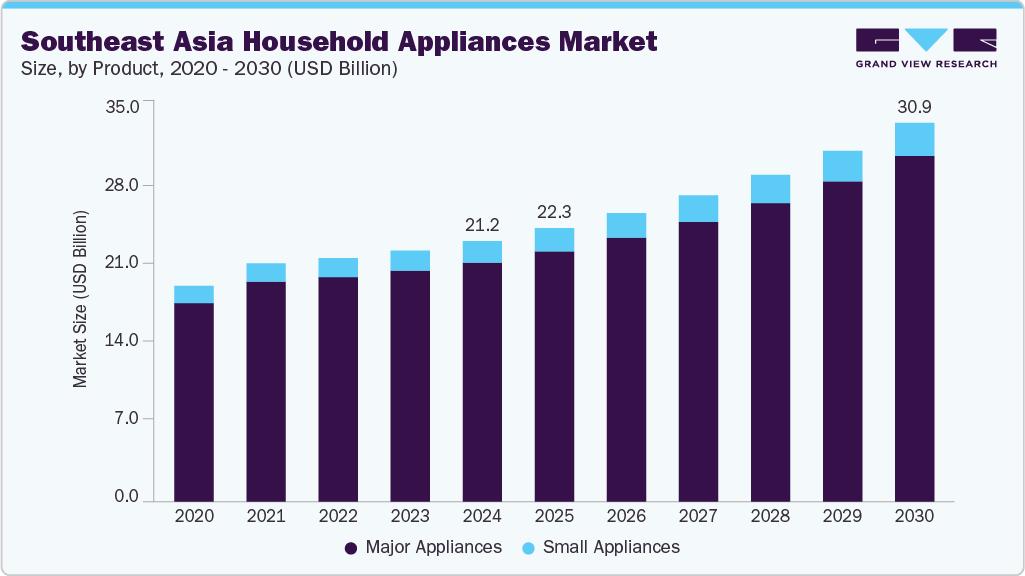
▲ Image/Grand View Research
First, the demographic dividend perfectly resonates with market demand. Although the total population of Southeast Asia is only 660 million, 70% of them are under 35 years old. As an emerging market in the economic acceleration period, the local young people have a strong willingness to consume online. They not only desire to improve their quality of life but also are highly sensitive to prices. Domestic small home appliances, with their high - value appearance, multiple functions, and low prices, precisely meet the market demand.
Second, they accurately target niche market needs. The hot and humid climate in Southeast Asia leads to a large number of small - sized apartments. Local users prefer small home appliances that are lightweight, wireless, and multifunctional. From a specific scenario perspective, the high temperature and humidity have created a rigid demand for handheld fans and dehumidifiers. The multi - generation family structure has also expanded the market space for multifunctional food processors. The local people's love for social gatherings and cold drinks has brought broad growth space for kitchen appliances such as air fryers and ice makers.
Third, the "short - circuit economy" brought about by e - commerce infrastructure. Shopee and Lazada have been operating in the region for many years, and TikTok Shop has detonated content e - commerce in countries such as Indonesia and Vietnam. The cross - border logistics and overseas warehouse systems are becoming increasingly perfect, enabling Chinese brands to bypass the numerous barriers of traditional offline distribution and directly reach the end - consumers.
For example, Gaabor has keenly captured the market characteristics of Southeast Asia, where "local stars have strong influence and live - streaming e - commerce has high conversion efficiency", and established a marketing system of "endorsement by local stars + promotion by mid - tier and lower - tier influencers", directly converting traffic into sales volume. So far, Gaabor's exposure on social media platforms such as Facebook, Instagram, and TikTok has exceeded 100 million, and its growth rate far exceeds that of its competitors in the same period.
Fourth, the ultimate advantage of the supply chain. As the world's largest manufacturing base for small home appliances, China accounts for about 60% - 70% of the global production capacity. The industrial clusters in the Pearl River Delta and the Yangtze River Delta have the capabilities of rapid prototyping, extreme cost control, and agile function iteration, which are moats that local Southeast Asian brands can hardly cross. This supply - chain advantage gives domestic small home appliance brands an absolute "quality - to - price ratio" advantage when facing the fragmented Southeast Asian market.
From "selling products" to "taking root", three hurdles must be overcome
However, Southeast Asia is by no means a paradise for gold - diggers. Although it seems to be full of opportunities, there are actually many hidden risks. Data shows that more than 70% of the small home appliance brands that export to this region do not survive for more than a year. In a highly fragmented market, to move from "selling products" to "taking root", three crucial challenges must be overcome.
The first is the extremely fragmented market. There are 11 countries in Southeast Asia with significant differences in language, culture, and religion. For example, the Vietnamese prefer low - priced and practical products, while the Indonesians like high - end and intelligent ones. The efficient "one - size - fits - all" approach used in the domestic market is doomed to fail. Therefore, the ability to carry out refined local operations is the primary challenge for all brands entering the Southeast Asian market.
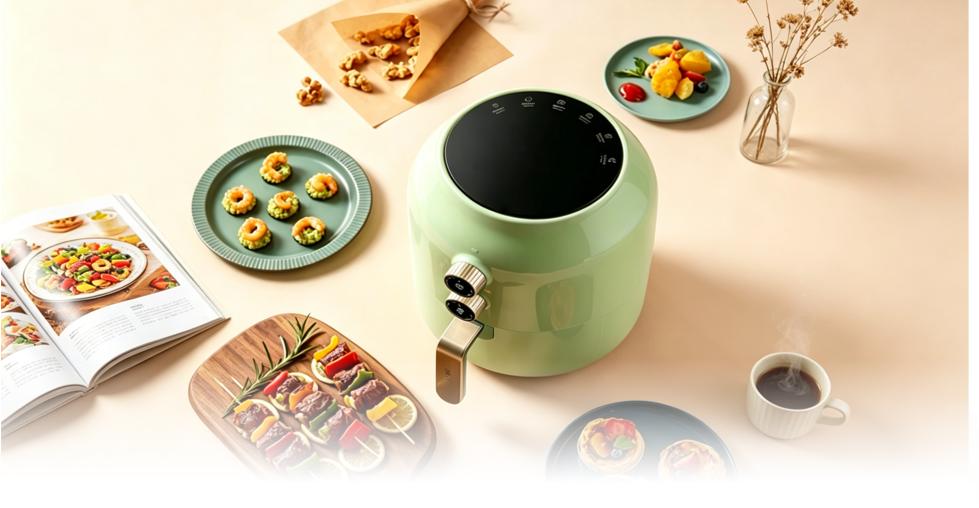
Take Gaabor as an example. Its success in breaking into the market within a year is due to its extreme "localization" in product design, marketing strategies, and even team management. For just one product, the air fryer, it produces multiple versions according to local conditions. Facing multi - generation families in Thailand and the Philippines, it launched a 6.5 - liter jumbo - sized version. To address the pain points of small - sized apartments in Vietnam, it focuses on the 3 - 4.5 - liter compact models. Not to mention the low - temperature freshness - locking and steam - frying functions optimized according to local eating preferences.

▲ Image/Gaabor
On the marketing side, Gaabor also rejects a one - size - fits - all approach. For core markets such as the Philippines, Indonesia, Vietnam, Thailand, and Malaysia, it has established independent local accounts one by one and formulated differentiated content. This "one - country - one - strategy" refined operation is not only a test of patience but also an ultimate screening of cultural insight.
Han River provides another way of thinking. Instead of rushing to expand across the board, it first focused on the Indonesian market and became a top seller. Then it gradually expanded to Malaysia, Vietnam, and Thailand. At the same time, it expanded from cleaning appliances to multiple categories such as kitchen and personal care products to build a brand matrix.
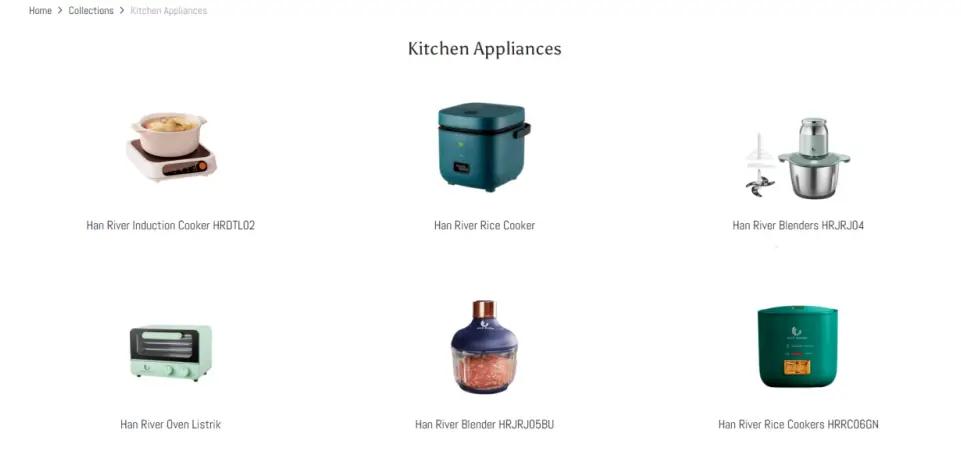
▲ Image/Han River
The second is to break out of the low - price quagmire. In the Southeast Asian market, a large number of white - label products are sold at a crazy volume with a 9.9 - dollar free - shipping offer, compressing the average gross profit margin of the industry to below 10%. Coupled with the highly developed industrial belts in China, product functions are easily replicated, and simply stacking functions is no longer a winning strategy. If brands do not break out of the price - war quagmire, they will soon repeat the cruel cut - throat competition in the domestic market.
The third is to cross the brand gap. Under the fast - moving consumer goods model, the brand loyalty of Southeast Asian consumers is less than 15%, and more than 70% of purchases are impulse buys. Traffic comes and goes quickly, which also causes most brands to still stay in the cross - border bulk - selling model, lacking local after - sales, warehousing, and operation and maintenance systems. In addition, due to the scattered logistics and inconsistent after - sales standards in multiple Southeast Asian countries, the efficiency of product fault repair and return and exchange is low, resulting in uneven consumer experiences and difficulty in improving repurchase rates and brand reputation.
It is worth noting that some leading enterprises have begun to seek a breakthrough by expanding production capacity overseas. Midea and Haier have invested in building production bases in Thailand and Indonesia. Leading OEM manufacturers such as Xinbao Co., Ltd. and Biyi Co., Ltd. have also followed suit. This is not only to shorten the delivery cycle but also to establish brand trust through local production, avoid trade barriers, and truly transform from foreign players to local ones.
The rise of domestic small home appliances in Southeast Asia is essentially a "mismatched - dimension competition".
In the domestic market, they are the disadvantaged parties squeezed by the giant ecosystems. In Southeast Asia, however, they become the advantaged parties with mature supply chains, advanced e - commerce operation experience, and agile product iteration capabilities. Those things that are regarded as "basic skills" in the domestic market have become powerful weapons