Former DJI employee develops a consumer-grade textile machine, securing hundreds of millions in financing from HSG, Shunwei, miHoYo and others | Product Watch
Author | Huang Nan
Editor | Yuan Silai
Hu Wenxin, founder of CLAWLAB, is a maverick player in today's hardware track.
With an engineering background, he previously worked at leading tech giants including DJI and Meituan, and secured funding from top-tier institutions. His resume would have easily allowed him to choose any market-proven popular track, launch products, tell compelling stories, and secure successive rounds of financing in the shortest time possible.
Yet Hu Wenxin dived into a product category that has been largely ignored over the past three decades: home textile machines.
Few people know exactly what Hu Wenxin is working on. Founded in December 2022, CLAWLAB has deliberately kept a low profile in recent years — its business plans are never distributed externally, it has not participated in active roadshows or corporate promotions, and investors interested in the product direction are invited directly to the office to view demos.
36Kr has exclusively learned that over the past few years, CLAWLAB has completed several consecutive rounds of financing totaling over 100 million RMB. Its Pre-A2 round was led by Yuanjing Capital with over-subscribed participation from existing investor Shunwei Capital, while the Pre-A3 round was led by miHoYo with significant over-subscribed investment from backers Yuanjing and Shunwei. Previous investors also include Sequoia China.
The choice to focus on textiles stems from a very simple insight. "Textiles naturally top the list of 'basic necessities of daily life', representing a sufficiently large and genuine demand. Customized DIY is a natural extension where users explore self-expression inwardly and showcase their individuality outwardly after their rigid needs are met." In the early days of starting the business, Hu Wenxin judged that this track had a high enough ceiling to merit long-term exploration.
The textile DIY sector has hundreds of millions of potential users worldwide, yet there has long been a lack of complete integrated hardware and software solutions. Unlike the 3D printing track, home smart knitting machines have no reusable components or open-source algorithms to draw from — their only reference points are vintage knitting machines. This means Hu Wenxin had to define an entirely new device from scratch.
In 2024, CLAWLAB launched its first product: an automatic tufting gun, which served only as a small-scale overseas market validation tool, generating nearly 100 million RMB in cumulative revenue over two years.
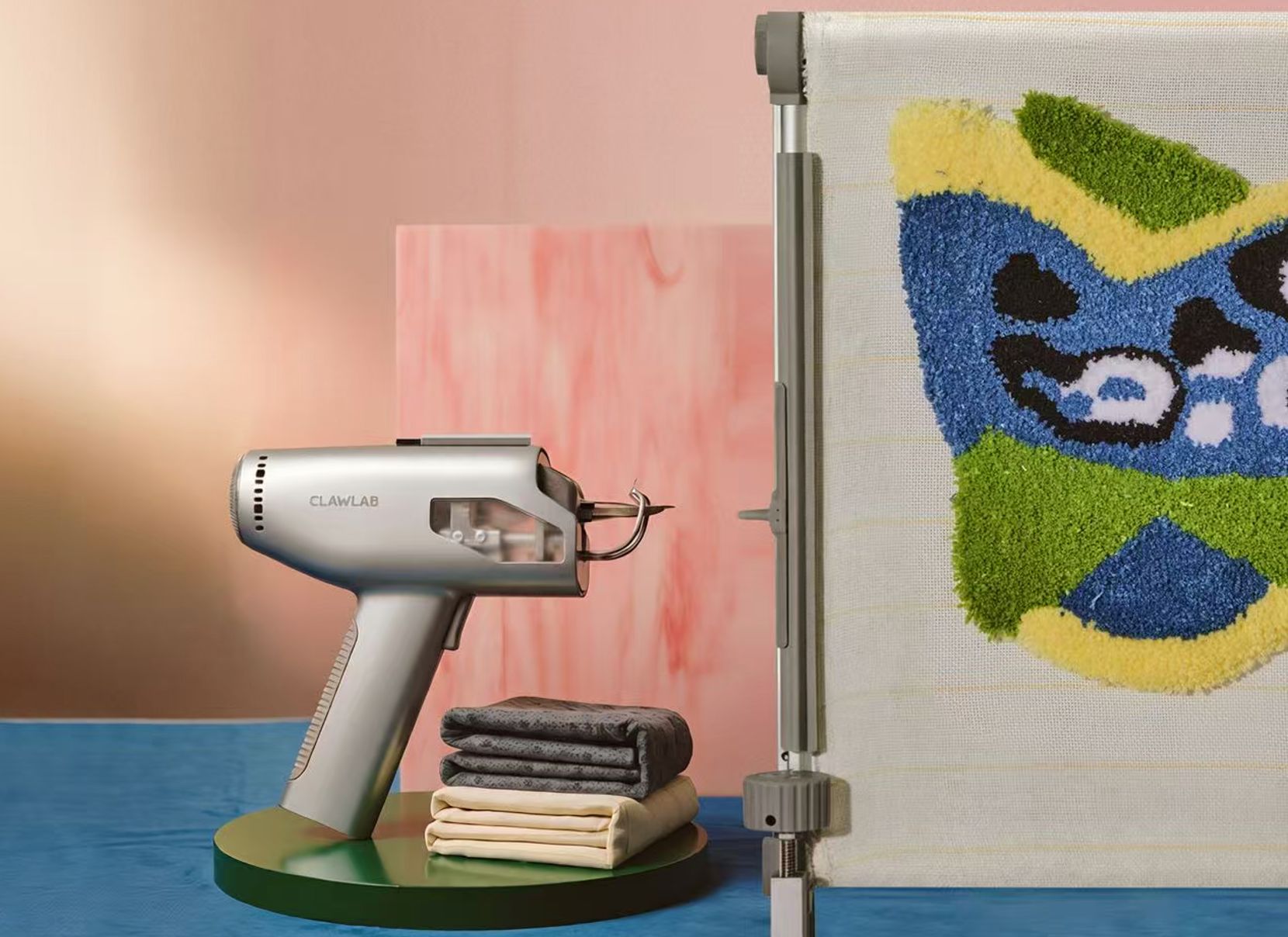
CLAWLAB's automatic tufting gun (Source / Enterprise)
Beyond hardware, what Hu Wenxin has spent extensive time refining is a consumer-grade textile Station platform. This is a new form of physical computing terminal that requires no professional pattern-making: users can generate knitting patterns through simple drawing or photo capture, and complete the production of various textiles such as scarves, doll clothes, pet accessories, and small plush products.
In Shenzhen, producing a 90-point hardware product is simply not enough to survive in the fiercely competitive landscape. The ceiling for startups today actually lies in their software and ecosystem capabilities, and this Station platform has become CLAWLAB's deepest moat. The company is about to launch a new lightweight desktop knitting product and build a content sharing community to cater to hobbyists' needs for stress-relieving creation and small-scale custom orders.
Textiles are one of the oldest crafts. While the market is still chasing new categories that can be intelligized, Hu Wenxin has already set his sights on a massive blue ocean that has yet to be touched by modern computing technology.
Home Smart Weaving Workstation
Hu Wenxin's decision to anchor on the "knitting" tool category was not based on intuition. Back in the product definition stage, he and his R&D team systematically investigated the four major textile processes — piercing, hooking, sewing, and knitting.
They found that the first three processes (piercing, hooking, sewing) are inherently fragmented in their workflows, only allowing "addition" or "splicing" on existing fabrics, and cannot independently produce a complete textile. Knitting, by contrast, can directly use yarn as raw material to form various three-dimensional finished products such as clothing, scarves, accessories, and plush dolls. Its highly closed workflow is more suitable for integration into an all-in-one intelligent device, aligning with the desktop creation logic of "input raw materials, output finished products".
This difference determines the feasibility of home scenarios. Although the knitting process is challenging, it is a complete system that can be deconstructed using intelligent engineering methods.
Yet over the past three decades, almost no company has made systematic attempts in this direction. In the 1990s, home knitting machines experienced a brief heyday, with long-established brands such as Singer and Brother dominating the mainstream market share of knitting equipment, later followed by the launch of multiple domestic hand-cranked knitting machine products. These devices rely entirely on pure mechanical structures and require full manual operation.
The seemingly simple knitting action is actually a highly time-sequenced dynamic process — different pattern colors, different knitting needles, and the interlocking of rows of textures: any deviation in tension or movement path will cause the entire textile to be scrapped.
Therefore, to build an automated knitting device, the primary challenge is not material stacking or fixed-point processing, but how to construct a dynamic control system that enables real-time perception, adjustment, and compensation.
"Many people think knitting is nothing more than turning yarn into fabric. It was only after we started that we realized every single link presents an independent technical challenge," Hu Wenxin told 36Kr. "The mechanical action combinations for plain stitch and cable stitch are completely different, the tension control curves for thick wool and thin cotton thread are entirely different, and the contour forming logic for a sweater and a hat is totally different. These discrepancies cannot be resolved through debugging alone — they must be clearly defined at the very beginning of system design."
The first hurdle facing CLAWLAB was the dual lack of technology and data. There were no open-source algorithms to reference, no ready datasets for training, and no mature supply chain to reuse. Even the most fundamental question of "how knitting actions should be digitally defined" had never been answered before.
Hu Wenxin and his team spent nearly three years breaking down the knitting process step by step into programmable control algorithms, building their own technological barriers.
The team's solution was to transfer AI hardware capabilities from robot control, motion planning, to computer graphics into product R&D. After a year and a half of work, they finally achieved a reliable first version of the knitting workflow.
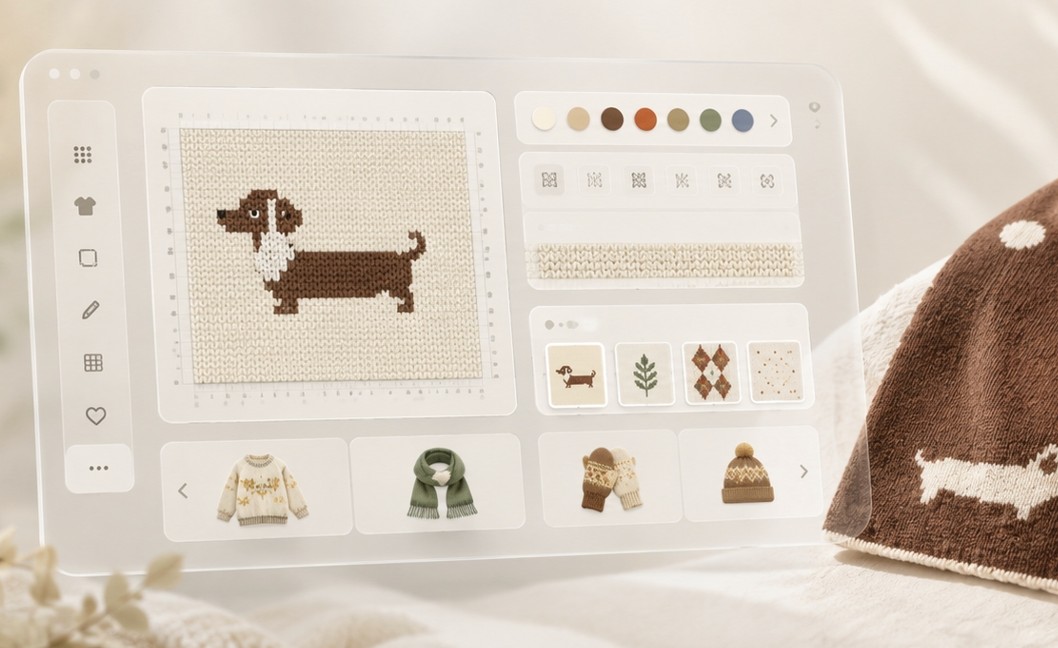
CLAWLAB's programmable control algorithm (Source / Enterprise)
But for a device to transition from being a "tool-type" product to entering households, the real challenge lies in the user interaction layer. They must lower the design threshold sufficiently so that even someone with no knitting experience can get started — otherwise the product will remain confined to professional circles.
Traditional knitting pattern-making relies heavily on experience. A qualified pattern maker needs 5 to 10 years of training to be able to read charts, understand stitch logic, and adjust yarn parameters.
The CLAWLAB team is also independently developing a textile AI Agent, a domain knowledge-enhanced vertical model with built-in pattern-making algorithms and compilation capabilities accumulated by the team. Once in the knitting scenario, users do not need to understand complex stitchwork or pattern parameters. After uploading an image, a design Agent that comprehends what the user wants can automatically analyze the textile style, extract features, and generate a design solution that can be directly sent to the machine for knitting.
Users only need to describe their design intentions in natural language, and the AI Agent will handle all subsequent knitting work. Tasks that traditional pattern makers would take days to complete are compressed into minutes in this all-in-one textile Station, forming a complete closed loop from "user intention" to "physical finished product".
This is perhaps the most fascinating aspect of this category. On one hand, it is an unvalidated but high-potential blue ocean market, while on the other hand, it has long lacked systematic intervention from modern technology, leaving a huge technological gap. But precisely because it is a niche field, once the full-stack system is established, the width of this moat will far exceed what single-product hardware logic can comprehend.
An even deeper layer of appeal comes from the track itself. In Hu Wenxin's view, this is not just a single-product story — it carries the potential for platformization. "With the knitting machine alone, based on its underlying technological foundation, we can derive multiple differentiated product definitions for different segmented scenarios. We believe there are still a large number of untapped scenarios and categories in the textile track waiting to be discovered."
A Hidden Market with Over 100 Million Users
Currently, on a global scale, the popularity of knitting continues to rise in markets such as Europe, America, and East Asia, with the core active hobbyist group reaching tens of millions, and the broad potential coverage exceeding 100 million people.
Public social media platform data shows that on Xiaohongshu, the total views of topics related to "knitting girls" have reached nearly 900 million, while the total traffic of topics such as crochet knitting and handcraft knitting exceeds 3 billion. On TikTok, views for the hashtag "crochet" have surpassed 200 billion.
A sufficiently large user base is just the first step. More importantly, there is no need to educate consumers on the end products of knitting. The warmth of a scarf, the comfort of a hat, the softness of a sweater, and the healing quality of plush toys — people's natural desire for these emotionally resonant products is self-explanatory.
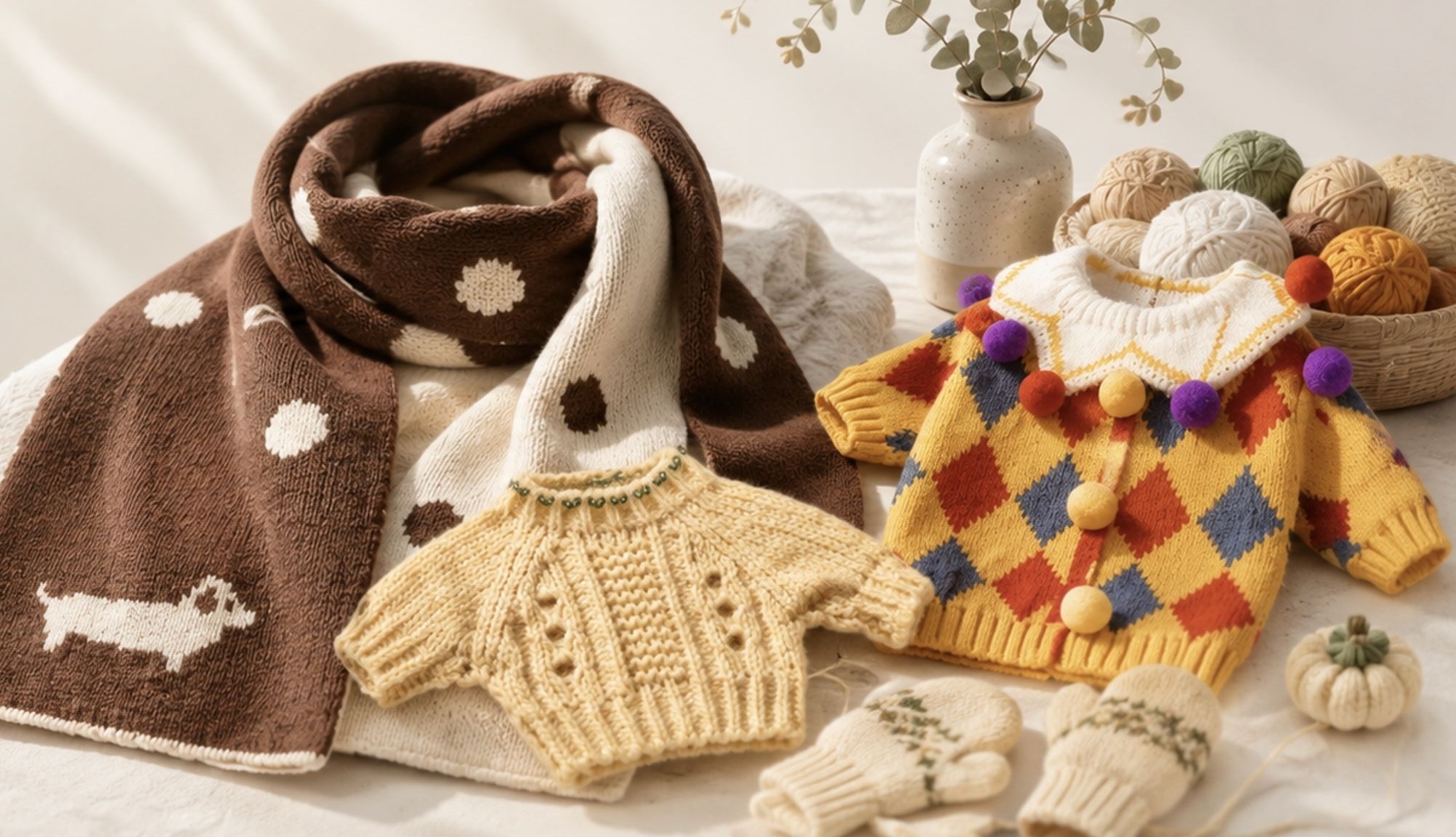
Knitted products produced using the CLAWLAB weaving workstation (Source / Enterprise)
"The knitting works users showcase on the platform are just the tip of the iceberg. The comments saying 'it looks nice', 'I want one too', 'is there a tutorial?' — those represent the real hidden demand," Hu Wenxin said. "We are not creating a new need. Currently, there is no product that can satisfy people's desire for a custom sweater or a pillow with a specific pattern. That is exactly our entry point."
The breakthrough lies in delegating the weeks of repetitive labor, pattern-making, and weaving processes to machines, while allowing users to retain the emotional value of design, selection, and hands-on creation, drastically reducing the time and threshold between a user's desire and possession.
Hu Wenxin told 36Kr that this approach can foster a unique user evolution path. A large number of textile DIY users initially enter this field driven by emotions: to relieve stress, kill time, and enjoy the satisfaction of making something with their own hands. As their skills accumulate and they are influenced by the community, some users begin to extend from hobbies to a light commercial stage, taking on small-batch orders.
Around this evolution path from emotional consumption to light commercialization, CLAWLAB divides its user profiles into four penetration directions.
The first batch of seed users are heavy users of existing knitting equipment. They are either long-time enthusiasts of vintage knitting machines or individual creators who generate stable income through hand knitting, with a foundational understanding of product tools and direct, specific pain points: low efficiency in manual pattern arrangement, difficulty in realizing complex patterns, and unstable yield rates. These users do not need to be educated on "what knitting machines can do" — they need products that can truly solve their daily problems.
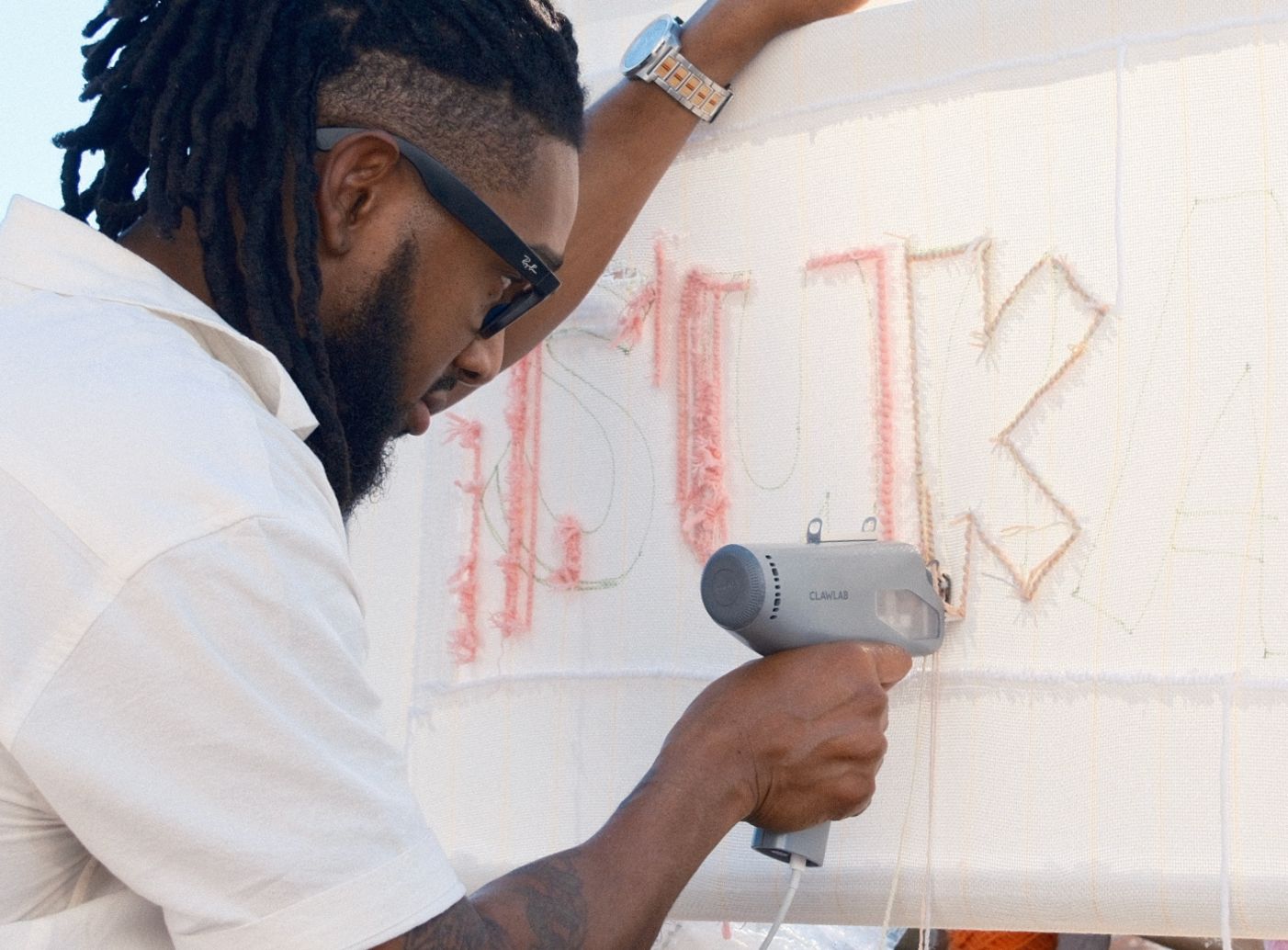
CLAWLAB's automatic tufting gun (Source / Enterprise)
The second category of target users are small B-end operators, such as those who make doll clothes, knit pet clothing, or take on custom holiday orders. Their core demands revolve around efficiency and customization capabilities, and one device can effectively shorten the creation cycle of individual pieces. The value of this group goes beyond purchasing equipment — the finished products they produce will naturally attract the attention of C-end users, forming penetration from B-end to C-end.
Ultimately, CLAWLAB's goal is to cover ordinary mass consumers: people who have no DIY creation needs and do not care about knitting processes, but simply want to quickly obtain the textiles they desire. At this stage, its products will move beyond the positioning of creation tools and truly land as a small-scale flexible supply chain for home scenarios, enabling instant custom textile delivery.
"Essentially, this group is experiencing a continuous upward shift in their hierarchy of needs. The first-stage users solve pain points, the second stage solves efficiency, the third stage focuses on aesthetics, and the fourth stage truly enables users to get exactly what they want," Hu Wenxin analyzed.
Over the past three decades, home knitting has gradually faded out of people's daily lives, shifting from a productivity need where "every household had a sewing machine" to a pastime most people abandoned in fast-paced lifestyles, such as spending weeks crocheting a blanket. The industrial era moved knitting into factory assembly lines, where standardized scarves and sweaters flowed to every shelf at the lowest cost. While efficiency was greatly improved, there was a trade-off: the individual attributes inherent in knitting were completely compressed. The specific person, specific aesthetic choices, and specific expressive intent behind each textile were all reduced to "the same style".
Yet the emotional need to create with one's own hands has never disappeared. The maturity of the hardware supply chain, the declining cost of motors and sensors, and the transferability of AI capabilities have made it feasible for the first time to "turn a complex knitting device into a consumer-grade product".
"Everyone has something they want to express. A favorite pattern, a preferred color, a unique tactile experience, along with attached memories and emotions. These ideas should not be blocked by 'mass production'. That's why CLAWLAB built a knitting machine that can sit on your desk. It's not a toy, not a concept — it's a machine that can truly knit finished products," Hu Wenxin said.
Users' designs emerge from the screen, turning into tangible textures, the warmth of a scarf around the shoulders, and unique gifts to share with others. The problem this machine solves is not to be faster or cheaper — it is to make textiles belong to specific individuals once again.