Qiu Sheng | 31-year-old top student charges for Hong Kong stock IPO, Li Zexiang becomes the biggest winner
This article is approximately 2,500 words long. It is recommended that you spend 5 minutes reading it.
Author | Peng Xiaoqiu
Editor's note: Amid the AI boom, more and more companies are entering the capital market. Every page turn of a prospectus holds all that a company wants to say and what it has left unsaid.
In view of this, 36Kr has launched the "Autumn Sounds" column. "Autumn Sounds" is taken from Ouyang Xiu's "Ode to the Sound of Autumn". By borrowing the meaning of "listening to the sound of autumn", we aim to sense the trends in the industry, evaluate the quality of companies, and record the truths written and hidden during a company's dash to IPO. This is our fifth issue, Benmo Dynamics.
In the last week of June, Benmo Dynamics (Beijing) Technology Co., Ltd. passed the Hong Kong Stock Exchange's hearing.
For this IPO, Benmo is dashing for the main board of the Hong Kong Stock Exchange as a Specialized Technology Company under Rule 18C. The exclusive sponsor is CITIC Securities (Hong Kong). The prospectus shows that Benmo plans to issue no more than approximately 122 million H shares.
Benmo is in the business of "selling motor modules". Different from robot companies that produce complete machines, Benmo's core competitive edge lies in robot joints, namely direct-drive power modules for robots. It is equivalent to an integrated motion unit that can directly output torque without an external reducer. According to Frost & Sullivan, Benmo is the world's first and only company with a shipment volume of direct-drive power modules for consumer robots exceeding 5 million sets. In 2025, it ranked first in the China consumer robot direct-drive power module segment, with a market share of 61.1%.
However, in the entire Chinese consumer robot power module market, Benmo only ranks eighth, with a market share of 2.4%. The reason is that direct-drive technology only accounts for 3.9% of the market. The top ten competitors in the prospectus are anonymized as Company A to Company I. Among them, the leading Company A is a micro-motor company established in Dongguan in 2000, with a market share of 12.9%, more than five times that of Benmo, and it is not yet listed.

Sold 8.5 million sets of modules, but the gross profit margin is only 21.5%
In terms of performance, Benmo's revenue increased from 17.54 million yuan in 2023 to 79.8 million yuan in 2024, and then to 282 million yuan in 2025, with a three-year compound growth rate of 300.8%. It has increased about 16 times in three years, which is quite rare among hardware companies. The driving force behind this sharp increase is the direct-drive modules for consumer robots. Its revenue increased from 3.2 million yuan in 2023 to 63.99 million yuan in 2024, and then to 248 million yuan in 2025.
Behind the rapid growth, Benmo has sold its products to 4 out of the top ten global consumer robot manufacturers. Popular product categories such as household vacuum cleaners and lawn mowers have started to use direct-drive technology on a large scale, and Benmo has caught this wave of procurement.
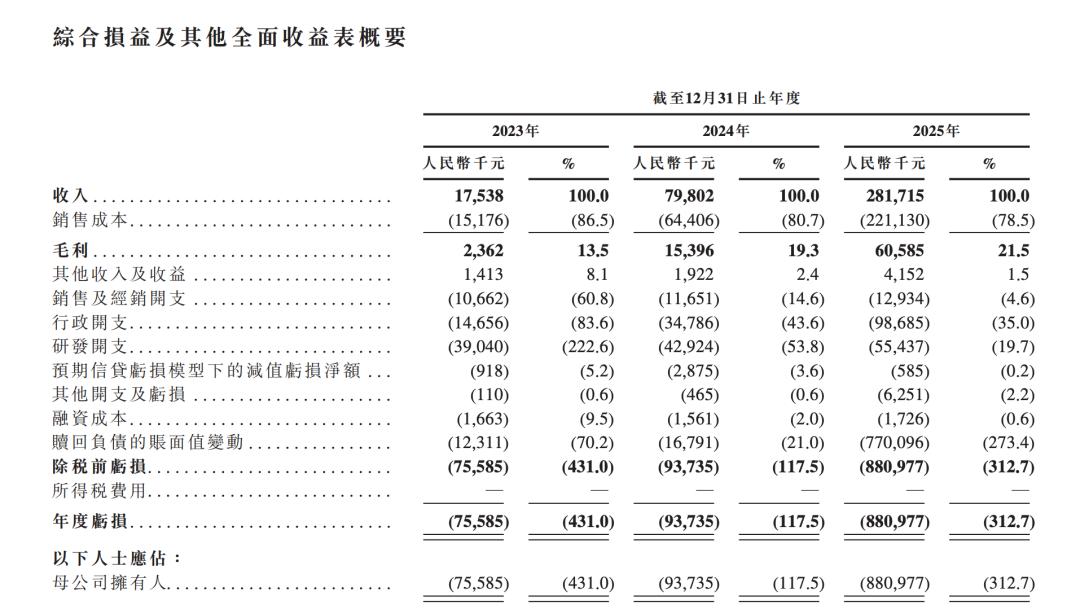
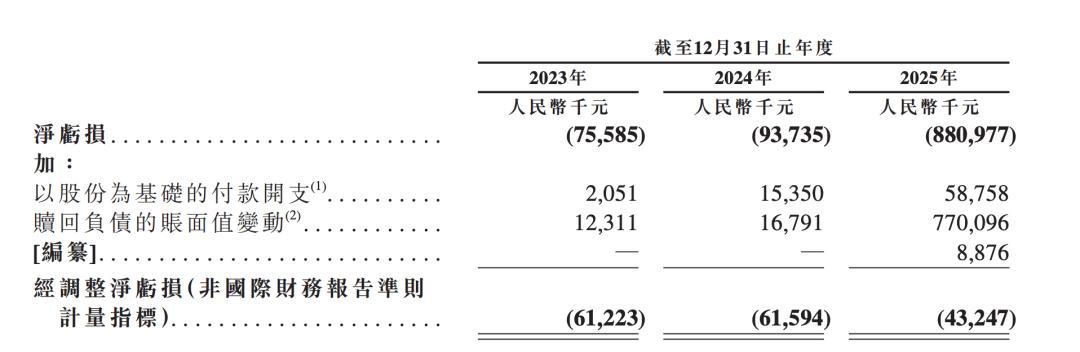
In the income statement, the adjusted net loss rate (non-IFRS) narrowed from 349.1% in 2023 to 15.4% in 2025. If items such as share-based payments and changes in redeemable liabilities are added back, Benmo's net losses in the past three years were 75.585 million yuan, 93.735 million yuan, and 881 million yuan (i.e., the put option bet) respectively.
It is worth mentioning that Benmo had negative cash flows from operating activities for three consecutive years. From 2023 to 2025, the outflows were 52.96 million yuan, 66.687 million yuan, and 69.563 million yuan respectively. At the end of 2025, the cash and cash equivalents on the books were 354 million yuan, which came from the Series C financing at the end of last year and bank loans. The net inflow from financing activities was 424 million yuan.
Why is the revenue soaring but the company still in the red? The answer lies in breaking down the business.
In Benmo's 2025 revenue, power modules accounted for 97.4%, corresponding to 274 million yuan; complete robot machines only accounted for 2.6%, that is, 7.307 million yuan. In other words, Benmo is a supplier of modules/components, and the complete machines are more like a showcase for technology verification.
The comprehensive gross profit margin of the modules in 2025 was only 21.5%, which climbed from 13.5% in 2023, but the absolute level is still relatively thin. Looking at different products: the gross profit margin of the direct-drive power modules, which account for the majority, is only 20%; the gross profit margin of the embodied joint modules is 35.6%; on the contrary, the complete robot machines, which account for a very small proportion, have the highest gross profit margin, reaching 64.3%.
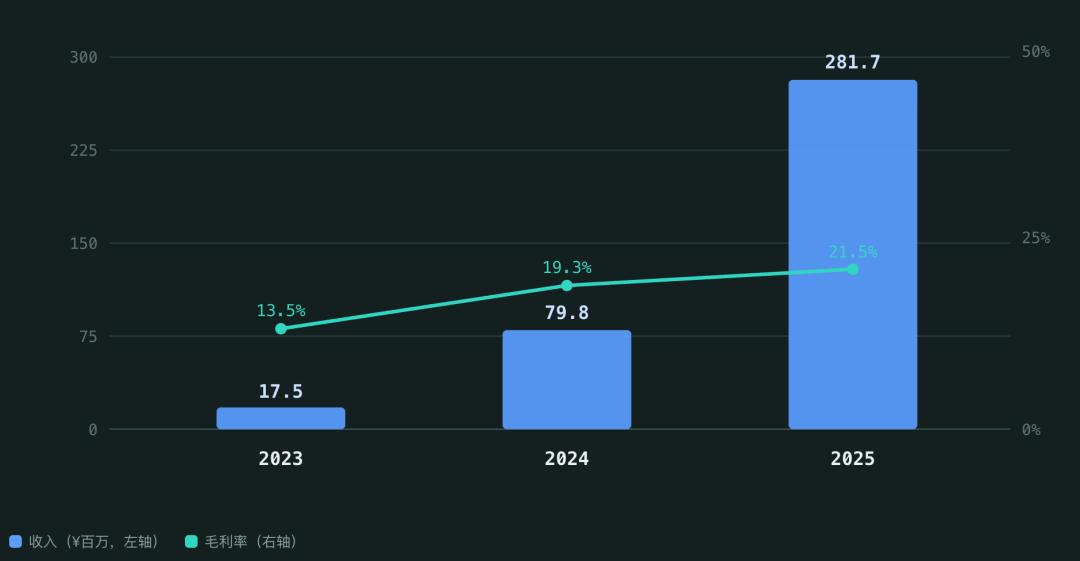
(Image source/Compiled by 36Kr)
The unit economics can better illustrate the problem. In 2025, Benmo sold 8.5 million sets of direct-drive power modules, but the average selling price of the consumer direct-drive modules was only 29 yuan per set. From 2023 to 2025, the prices were 28 yuan, 30 yuan, and 29 yuan respectively. It is almost a business of selling components piece by piece, competing on scale and cost, rather than a high-premium software or system business. The prospectus also shows that the average price of the modules has been decreasing in recent years, relying on the scale effect brought by the increase in production volume from 200,000 sets in 2023 to 8.5 million sets in 2025 and the bargaining power with the supply chain.
The advantage of this hardware approach is that the barriers are solid and customer stickiness is strong. However, the hidden danger is that as long as the growth rate or scale effect slows down, the 21.5% gross profit margin cannot withstand much change.
In addition, Benmo also faces two concentration risks. One is customer concentration: in 2025, the top five customers contributed 85.7% of the revenue, and the largest single customer accounted for 42.8%; the other is high geographical concentration: in 2025, 99.4% of the revenue came from the Chinese mainland, and the overseas market was almost negligible. In terms of supply, the top five suppliers accounted for 40.1% of the procurement amount. The core raw materials are enameled copper wire, magnets, iron cores, and other strong-cycle bulk commodities.

12 rounds of financing, Li Zexiang becomes the biggest winner
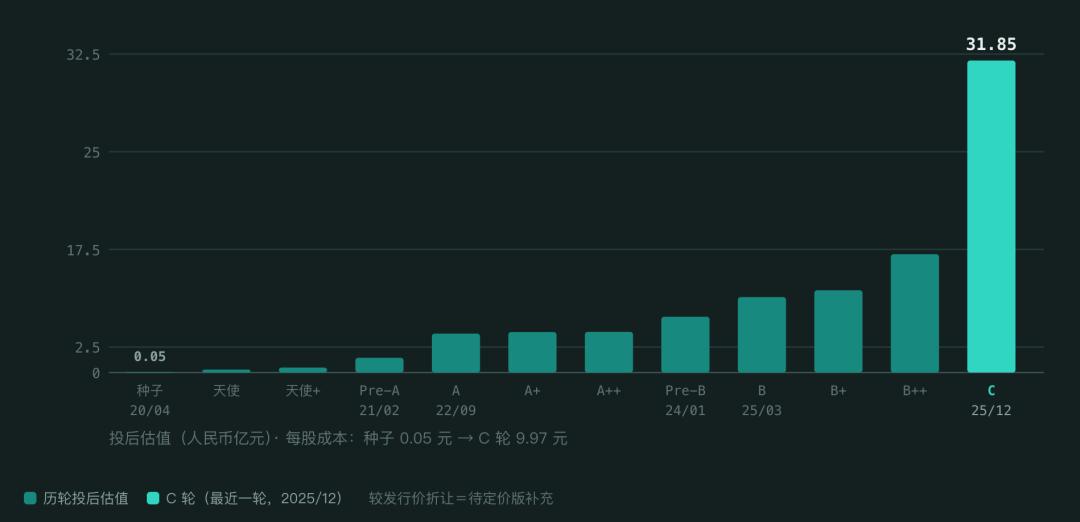
From April 2020 to December 2025, Benmo conducted 12 rounds of financing: including seed, angel, angel plus, pre-A, A, A plus, A plus plus, pre-B, B, B plus, B plus plus, and C. The total amount raised was approximately 648 million yuan.
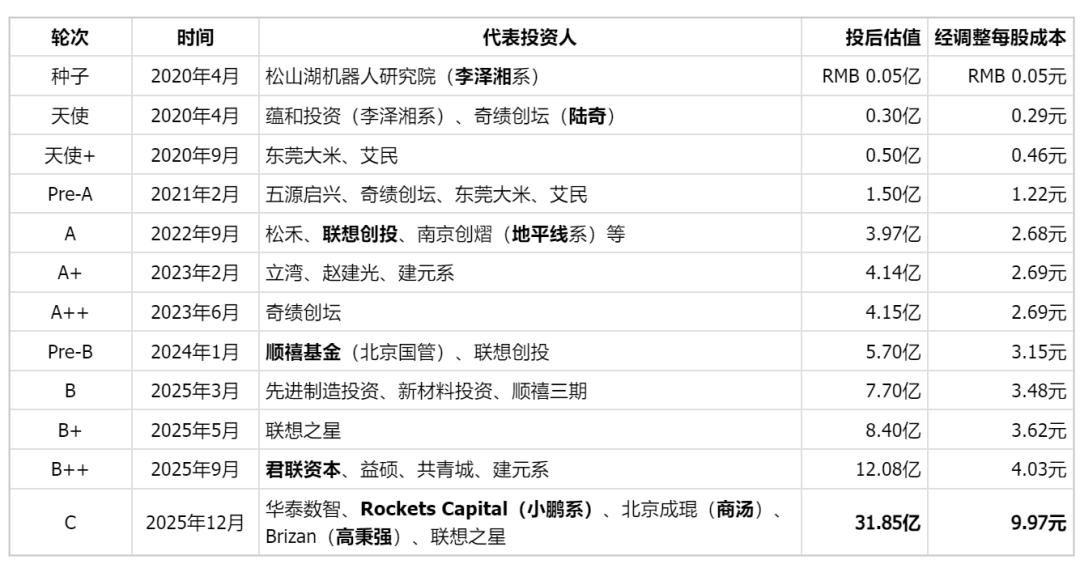
Who is the earliest and biggest winner in this IPO? You can tell by looking at the investment cost: it is the Songshan Lake Robotics Research Institute in the seed round in 2020. The adjusted cost per share was only 0.05 yuan; by the Series C round in December 2025, the cost per share was already 9.97 yuan. In five years, the cost increased by about 200 times. The Songshan Lake Robotics Research Institute is an entity ultimately controlled by Professor Li Zexiang; Yunhe Investment, which entered in the angel round, is also part of the Li Zexiang ecosystem. This once again proves that the earlier you enter, the lower the cost, and the thicker the paper profit.
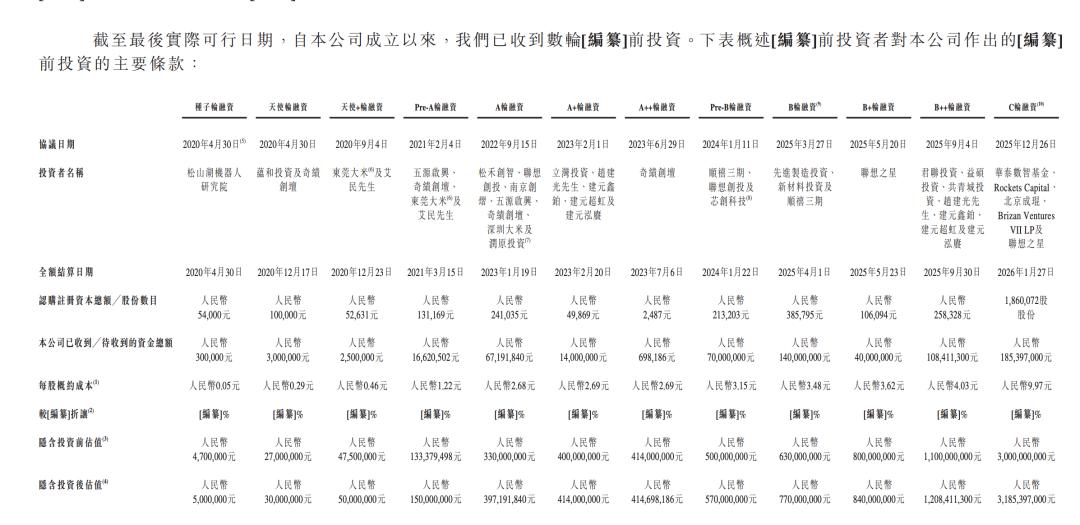
The shareholder list includes three Lenovo-affiliated funds (Lenovo Capital, Lenovo Star, and Legend Capital); in the Series C round, Rockets Capital, which is affiliated with XPeng Motors (XPeng is its largest LP, holding approximately 60.73%), Beijing Chengkun under SenseTime, and Nanjing Chuangyi, which is affiliated with Horizon Robotics (Series A) joined; Beijing state-owned assets (Shunxi, Advanced Manufacturing, and Beijing State-owned Assets Management) hold a total of approximately 21%, making them the second-largest shareholder after the founder.
According to the requirements of Rule 18C, the valuation of a commercialized company needs to reach HK$4 billion, and the annual revenue should be ≥ HK$250 million. Benmo just meets these criteria. Based on the static calculation of the 2025 revenue of 282 million yuan, the valuation of this Series C round corresponds to approximately 12 times the price-to-sales ratio.
(Image source/Compiled by 36Kr)
Currently, the market values of several listed robot companies in the Hong Kong stock market are as follows: Yuejiang (2432.HK) has a price-to-sales ratio of approximately 17 - 19 times; Ubtech (9880.HK) has a price-to-sales ratio of over 30 times; Estun has a price-to-sales ratio of approximately 4 - 5 times. However, these companies are robot complete machine manufacturers, while Benmo is an upstream power module/component supplier. Theoretically, it is difficult for Benmo to have the same valuation premium as complete machine manufacturers.
Benmo's founder, chairman, and CEO Zhang Di is only 31 years old this year. He obtained a bachelor's degree in mechanical engineering from Beijing Institute of Technology in 2016 and then studied robot system and control engineering at the Hong Kong University of Science and Technology. Professor Li Zexiang is also the key figure in the field of robotics at HKUST and the key figure behind the incubation systems of DJI and Songshan Lake XbotPark.
Therefore, in addition to being the investor in the seed round and the angel round, Professor Li Zexiang once served as a director of Benmo and later resigned. The registered address of Benmo and the place where the founding team is usually located, Building H3, Songshan Lake International Innovation and Entrepreneurship Community, Dongguan, is exactly the hardware incubation ecosystem of XbotPark.
Before the issuance, Zhang Di controls 41.30% of the voting rights through Worang Zhonghe (21.96%), Worang Zhongchuang (15.92%), and Guyuan Investment (3.42%) in total.
The president, Dr. Liu Xuyang, is 33 years old this year. He graduated with a bachelor's degree in new energy materials from the University of Electronic Science and Technology of China and a doctorate in electrical and electronic engineering from the University of Hong Kong. Before joining Benmo, he was the general manager of Shenzhen Tiemeizhong (a provider of integrated motor and drive control solutions). Since 2022, he has led the core technology team of Tiemeizhong to join Benmo. CFO Zhang Hongbo is an experienced capital market professional who joined in May 2025 to handle the financial and capital operations for this IPO.
Benmo is a story of a 31-year-old HKUST top student who, in six years, has brought a direct-drive module to the Hong Kong stock market. At the same time, it is in the track dividend period of direct-drive technology replacing traditional modules. The compound growth rate of the Chinese direct-drive module market is expected to be 48.6% from 2026 to 2030. The next crucial step is the pricing of the prospectus.