Tumor Genetic Testing: Industry Chaos, Technical Obsession and Future Reflections
Recently, CCTV.com exposed the chaotic charging situation in tumor gene testing, which has attracted wide social attention.
We systematically analyzed the charging policy frameworks and objective industry facts of tumor gene testing in regions such as Beijing, Fujian, and Guangdong, and formed the following preliminary conclusion:
The charging framework on the policy side, with a decreasing marginal charging space and a capped price, is designed from the perspective of people's livelihood. The core logic behind it is to suppress inefficient medical expenditures and follow the cost - benefit principle of health economics. However, some tumor gene testing companies still adhere to the high - cost technical route of "the more tests, the better", which continuously deviates from the policy orientation and actual clinical needs. This is one of the deep - seated industrial roots of the industry chaos.
Finally, we also tried to explore the sustainable and healthy development paths for tumor NGS companies from three directions: pharmaceutical company services, cost control, and the sinking market.
CCTV.com Exposes "How Deep the Water Is in Cancer Gene Testing"
In late May 2026, CCTV.com exposed "how deep the water is in cancer gene testing" through an anonymous case:
The doctor told the patient that a cancer gene test was needed, but the hospital did not have the equipment for this test. The sample had to be sent to an external testing institution. "In less than 10 minutes", the doctor called the salesperson from the testing institution. "The first - tier (package) charges were close to 6,000 yuan, and the second - tier reached 9,000 yuan." "It's not covered by medical insurance. As long as the patients are willing to pay for the test, and the doctors also get a share."
"The payment process was also a bit 'weird': instead of the regular way of the doctor issuing the order in the background and the patient paying at the self - service machine, the patient was asked to go to the manual window and orally say 'I want to do this test'. The window printed out a payment slip, and then the patient took the slip to the machine to pay. The money finally went through the hospital account, but the doctor didn't give the patient any paper medical advice or order records."

Picture: CCTV.com exposes the non - compliant charging situation in cancer gene testing. Source: CCTV.com video account
The Policy Has Long Defined the Standard Charging Method for Cancer Gene Testing
As a disease mainly caused by gene mutations, the policy basically determined that gene testing should be a "standard" for patients during hospital admission diagnosis at an earlier stage. Since 2018, the National Health Commission has continuously updated and released the "Guidelines for the Clinical Application of New Antitumor Drugs", clearly stating that "only patients with malignant tumors diagnosed by histological or cytological pathology or special molecular pathological diagnosis are indicated to use antitumor drugs."
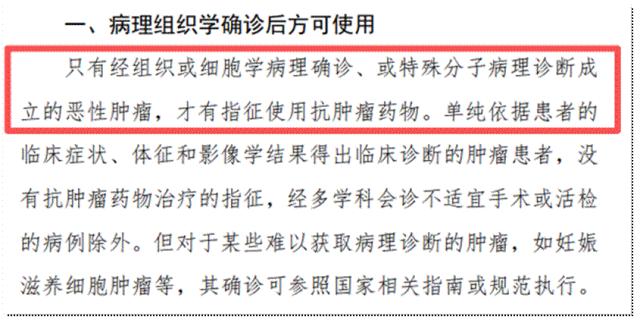
Picture: Excerpt from the "Guidelines for the Clinical Application of New Antitumor Drugs" (2025 edition). Source: National Health Commission
On the one hand, the policy clarifies the "necessity" of gene testing in most cancer cases from a medical perspective; on the other hand, it also standardizes the charging mechanism. The core of the charging mechanism includes the specific charging calculation method, charging level, and whether it is covered by medical insurance, with certain differences among provinces/cities:
(1) The charging method is calculated based on the number of genes or the number of tests. Most provinces charge according to the number of genes (or loci). The more genes (or loci) that can be detected in a single test, the higher the charging level, but a capped price is set. A few provinces charge according to the number of tests, without distinguishing the number of genes that can be detected in a single test.
(2) Charging level. The charging level for gene testing using PCR technology is generally lower than that using NGS technology.
(3) Whether it is included in medical insurance. Currently, Fujian Province has included PCR and NGS cancer gene testing in medical insurance (Class B, with a 10% out - of - pocket payment), while Beijing only includes PCR in medical insurance. Other provinces are either in the stage of soliciting opinions on centralized procurement or in the stage of soliciting opinions on price guidelines, and are gradually promoting inclusion in medical insurance.

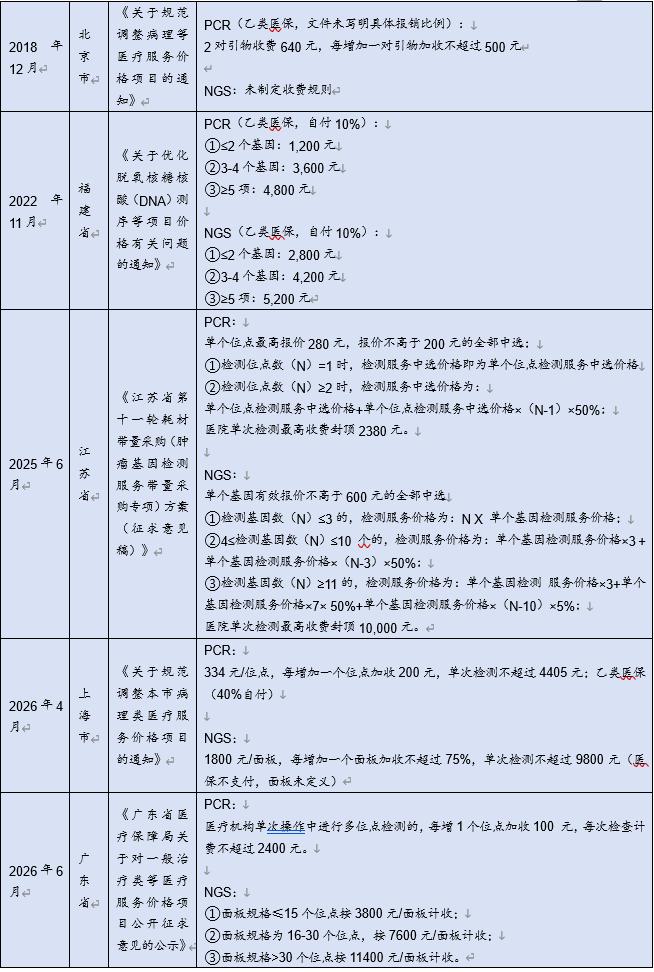
Picture: Summary of price guidance policies for cancer gene testing in key provincial/city regions over the years. Source: Public information
The Industrial Cause of Market Chaos Is the Technical Obsession and the Unwillingness/Difficulty to Adapt to Policy Changes
From the charging policy information of provinces/cities with a concentration of top - tier tumor hospitals, it is not difficult to see that the policy always restricts the "amount of genes to be tested" in gene testing. Although the policy allows the charging price to increase with the increase in the number of genes (or loci) that can be detected in a single test, the marginal charging price gradually decreases. For both PCR technology and NGS technology, the price generally reaches the maximum limit when the number of genes reaches 5 and 10 respectively.
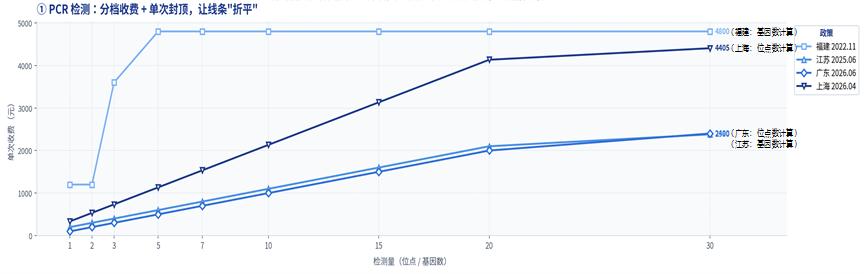
Picture: Schematic diagram of the price increase gradient for PCR cancer gene testing in key provincial/city regions. Source: Drawn based on public information
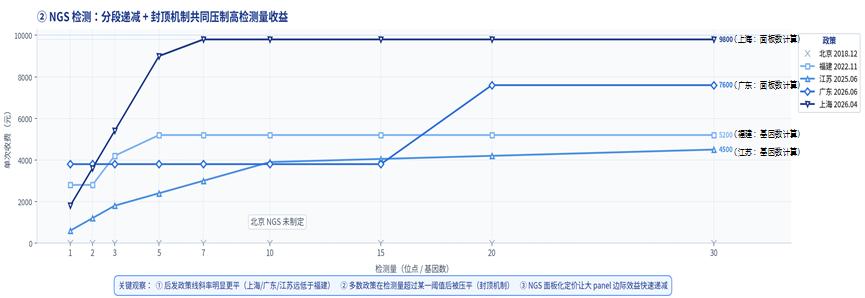
Picture: Schematic diagram of the price increase gradient for NGS cancer gene testing in key provincial/city regions. Source: Drawn based on public information
The policy starts to cap the price from a single - digit number of genes, which in essence rationally limits inefficient medical expenditures from the perspective of people's livelihood.
Expanding the detection scope can indeed provide more abundant molecular information. However, after exceeding the core driver genes, the change rate of incremental loci to the actual diagnosis and treatment plan significantly decreases, and the information value shows an obvious marginal decline. When the detection cost linearly increases with the number of genes while the clinical benefit growth slows down or even stagnates, this "wide - net" model violates the basic principle of optimal cost - benefit in health economics. The decreasing marginal charging and capped pricing are institutional corrections for this risk of resource misallocation.
On the other hand, from the perspective of clinical practical operability, the treatment of advanced - stage tumors still mainly depends on tumor drugs. Currently, effective tumor drugs can only target a limited number of core target genes. According to the latest "Guidelines for the Clinical Application of New Antitumor Drugs (2025 edition)" issued by the National Health Commission, there are currently about 36 target genes with corresponding drug interventions (14 for hematological tumors and 22 for solid tumors). That is, at the practical level of clinical treatment, even if other target genes are detected, they have little significance for patients due to the lack of targeted drugs or intervention means.
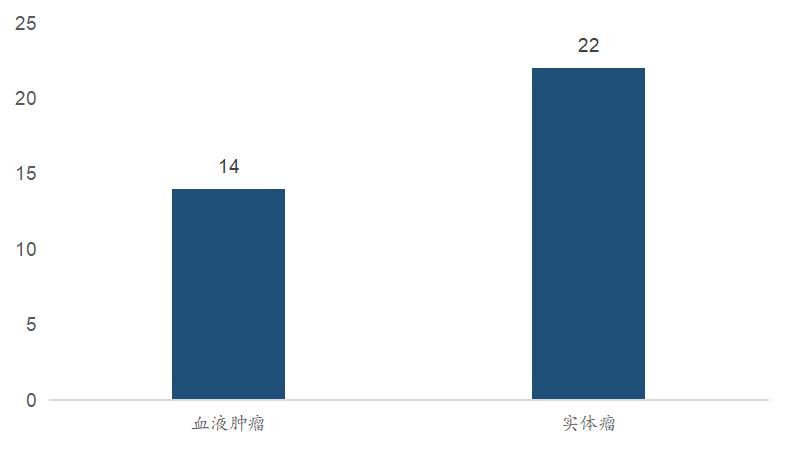
Picture: Statistics of the number of target genes with corresponding drugs in the "Guidelines for the Clinical Application of New Antitumor Drugs (2025 edition)". Data source: National Health Commission
In the current business environment, PCR technology adapts to the current policy environment and has a stable commercial profit return, while the comparative advantage of NGS technology has instead become a driving force for deviating from the policy trend and continuous losses. In tumor gene testing, PCR and NGS, as the mainstream technical means, each have their own comparative advantages. NGS technology can scan and detect hundreds of loci/genes at one time, while PCR has a limited detection volume but a lower cost. In terms of gross profit margin, the gross profit margin of AmoyDx (a PCR - related company) is significantly higher than that of Burning Rock Biotech and Geneplus (NGS - related companies).
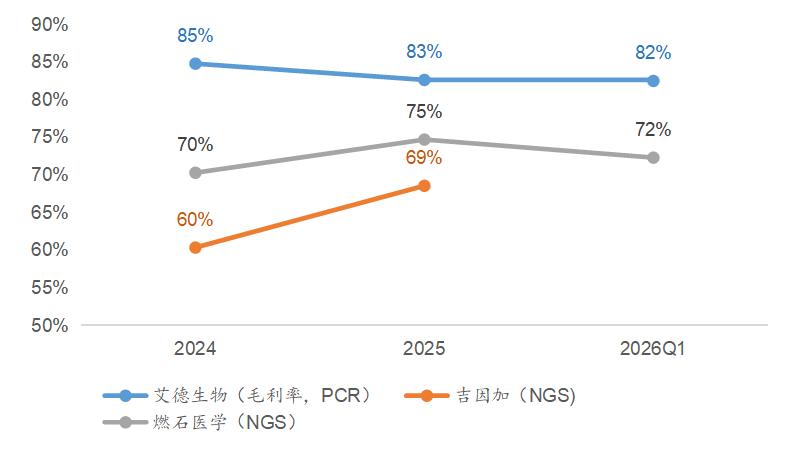
Picture: Comparison of the gross profit margins of representative tumor gene testing companies. Data source: Flush
In terms of profit results, there is a significant profit gap between AmoyDx, a representative PCR company in the tumor field, and Burning Rock Biotech and Geneplus, representative NGS companies in the tumor field. PCR companies maintain a net profit margin of 20% - 30% every year, while NGS companies generally suffer continuous and significant losses.
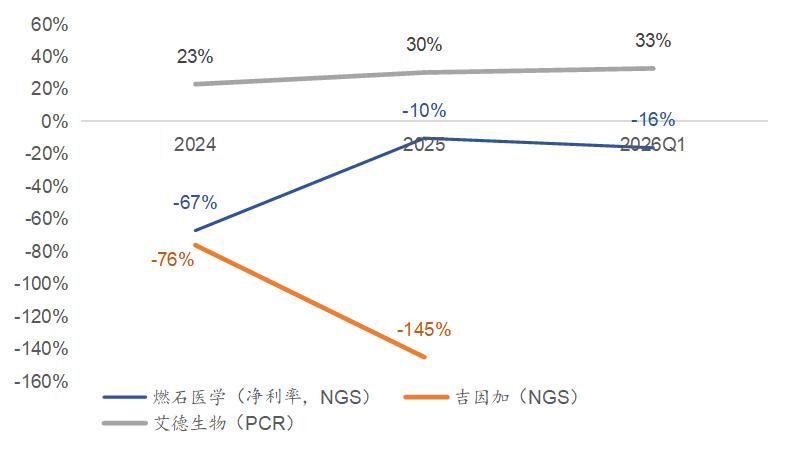
Picture: Comparison of the net profit margins of representative tumor gene testing companies. Data source: Flush
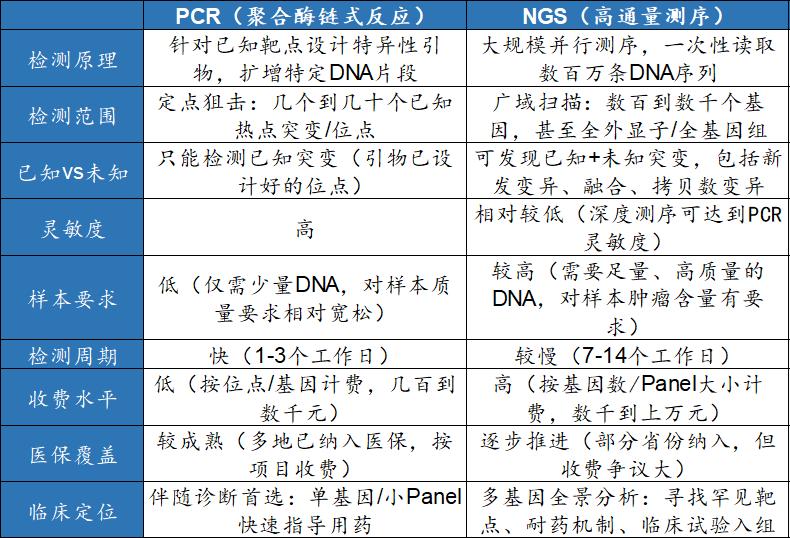
Picture: Comparison of tumor PCR and NGS gene testing technologies. Source: Public information
When the current policy and business competition environment are not advantageous, medical companies are prone to take opportunistic actions for survival, which leads to market chaos. We won't elaborate too much here. In the medical industry, the sales expense ratio of a company is a relatively direct indicator. The sales expense ratio of NGS companies is significantly higher than that of PCR companies.
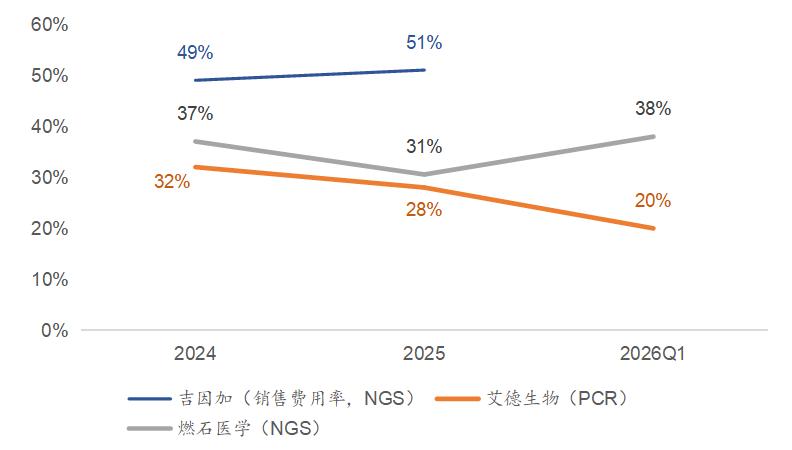
Picture: Comparison of the sales expense ratios of representative tumor gene testing companies. Data source: Flush
Thoughts on the Future Path of Tumor NGS Companies
Currently, in the hospital market, tumor NGS companies seem to have gone too far on the path of "obsession with large - panel technology". From the early years (2020) when the news media and companies shouted that "large - panel technology is the general trend" to August 2025 when Burning Rock Biotech introduced its 168 - panel (Langqing) liquid biopsy product at the "2025 Academic Conference of the Chinese Society of Pathology" - a product that can cover 168 genes and perform ultra - deep sequencing at 35,000X.

Picture: Reported views of well - known media on cancer NGS gene testing in 2020. Source: Public information
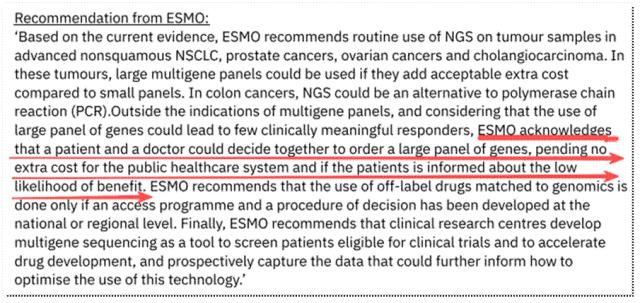
However, the health inefficiency of large - panel NGS has always been a major risk continuously pointed out by clinical experts. The European Society for Medical Oncology (ESMO), one of the "two major forces" in global oncology, released the "Recommendations for the use of next - generation sequencing (NGS) for patients with metastatic cancers" in 2021, clearly stating that doctors and patients can only use the large - panel NGS when it does not incur additional costs and patients are clearly informed that the possibility of benefiting from NGS is low. In the updated medical guidelines in 2024, ESMO still emphasizes that "cost - benefit factors must be considered in the decision - making process of whether to recommend the use of NGS."