It's university application season. Let's first take a look at how universities in major cities generate revenue.
Recently, the college entrance examination scores have been released in various provinces and cities, and many families have started to struggle with filling out the college application forms. Not to mention that there are many new majors this year, which makes filling out the application forms even more difficult. Choosing a city, a major, aiming for a prestigious university, or ensuring employment - behind each option is a family's bet on the next four years, or even a longer life path.
However, when filling out the application forms, few people pay attention to one question: How does a university actually make money? Because a well - funded university offers students a different density of opportunities. Whether a school can maintain a relatively high budget continuously determines the resources and opportunities that students can access in the long run. After checking the budget revenues of the "985" and "211" universities across the country in 2026, I found a more noteworthy change: The money of Chinese universities is flowing from the traditional prestige logic to industrial capabilities, national strategies, and urban high - tech industries.
Looking deeper, this is a re - ranking of the industrial pattern of Chinese cities. Where the money goes, the research projects will follow; where the research projects go, the industrial talents will follow; where the talents continuously go, the value of a city in the next ten or twenty years will gradually take shape. Therefore, understanding the money - making channels of universities can tell us how strong a school's continuous combat effectiveness can be.
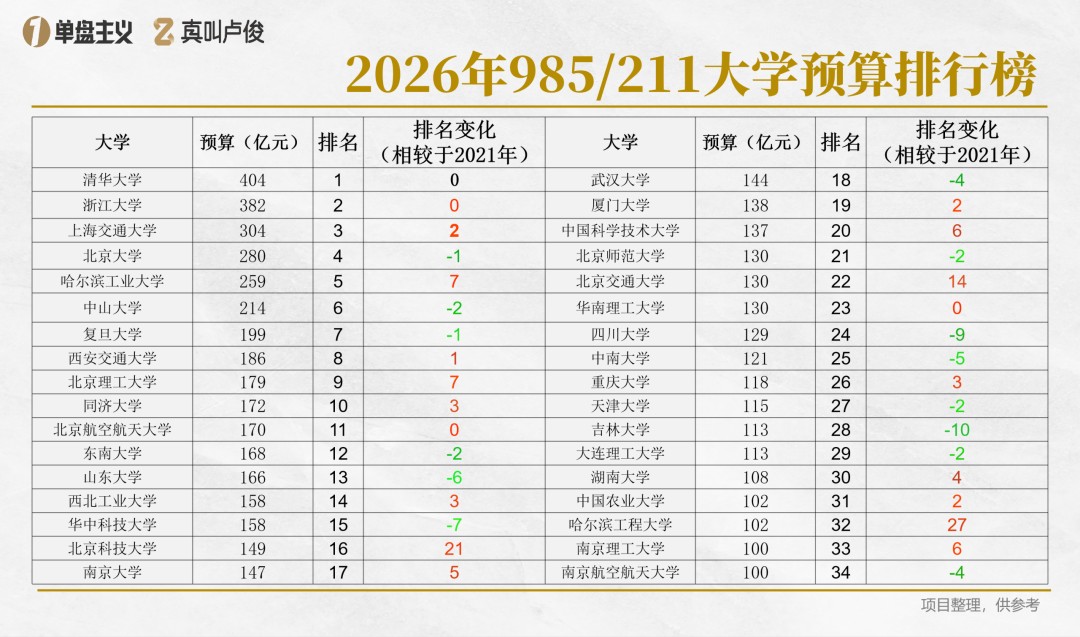
Universities with a budget of over 10 billion yuan are becoming the new threshold for top - tier cities. Let's first look at a set of the most intuitive data: In 2026, 34 universities across the country have had their budget revenues exceed 10 billion yuan, and the number has been increasing year by year since 2022. A budget of 10 billion yuan is no small amount, which means that a university has a large enough resource pool to support discipline construction, research projects, talent introduction, platform updates, and campus operations.
What's really interesting this year is that there are more universities with a budget of over 10 billion yuan, and their rankings have also changed. Zhejiang University has a budget of 38.2 billion yuan, and Shanghai Jiao Tong University has 30.4 billion yuan, both ranking ahead of Peking University with 28 billion yuan. Of course, this does not affect the value of Peking University, but the budget reveals another set of national investment logic: Engineering, medicine, research platforms, and industrial connections are becoming increasingly important. In the same city, schools with a higher proportion of science subjects receive significantly more national research investment. In Beijing, Tsinghua University is ahead of Peking University; in Shanghai, Shanghai Jiao Tong University is ahead of Fudan University; in Nanjing, Southeast University is ahead of Nanjing University.
Then, let's look at the rising stars in the rankings: The ranking of the University of Science and Technology Beijing has risen by 21 places, and that of Harbin Engineering University has risen by 27 places. They may not be the most well - known schools in mass communication, but they are in the fields of high - end equipment, materials, national defense technology, shipbuilding and ocean engineering, and advanced manufacturing. When the trend arrives, the money will follow.
If we break down these "985" and "211" universities by major, the trend will be more obvious. Compared with the cumulative average growth rate of 57.59% in the overall budget revenue in the past five years, the average growth rate of science and engineering universities has reached 73.06%; that of agriculture and forestry universities is even higher, reaching 92.08%. The money of universities has basically decoupled from traditional fame. The primary flow of money has become industrial demand. Advanced manufacturing, artificial intelligence, high - end equipment, new materials, national defense technology, seed industry revitalization, food security, and life health are all areas that require continuous investment in the next few years.
Therefore, this round of changes in the wealth of universities is essentially a projection of national strategies in the university system. There is a common underlying thread behind the budget increase in engineering: China needs stronger engineering technology, stronger manufacturing capabilities, stronger material systems, stronger national defense technology, and a more stable industrial chain. The money of universities will ultimately flow to places that can solve these problems.
By now, we can actually make a judgment: The university budget does not directly equal the amount of money each student can get, but it can reflect the resource scale, project density, and strategic support of a university in a given year. In the context of urban competition, it can also be a leading indicator for observing the future industrial vitality of a city.
With the same high - level budget, the situations can be divided into three types. Many people assume that all the money in the university budget comes from fiscal allocations when they see it. In fact, the situation is much more complex. The money of universities generally comes from four categories: First, fiscal allocations, which are the basic funds provided by the state; second, institutional revenues, which are the money obtained by the school through education, scientific research, training, and technical services; third, the carry - over and balance from the previous year, mostly from unfinished research projects and special funds; fourth, there are also revenues from affiliated units, operating revenues, investment returns, donation revenues, etc. Comparing it with family assets, it is like the difference between basic salary, performance, savings, and other incomes. Different source structures definitely lead to different living states. Therefore, to see if a university has money, we cannot just look at the total amount but also where the money comes from.
According to the current situation of universities, they can be roughly divided into three types:
The first type is the resource - pool type. A typical representative is Tsinghua University. Looking at the total budget table, we can find that there are quite a lot of revenues from various sources. In 2026, Tsinghua's total revenue budget was 40.393 billion yuan, including 10.633 billion yuan carried over from the previous year and about 5.912 billion yuan in fiscal allocations. This shows that Tsinghua has continuous support from the state, as well as a large number of research projects, social cooperation, foundation resources, and long - term capital precipitation. The strongest aspect of this type of school is that the money does not come from a single source. Research projects, corporate cooperation, alumni donations, foundation investments, and social resources can all continuously inject funds. It has a deep resource pool and strong anti - cyclical ability.
The second type is research - led. A typical representative is Harbin Institute of Technology. In the budget table of this type of school, the institutional revenue obviously accounts for a very high proportion. In 2026, Harbin Institute of Technology's total revenue budget was 25.884 billion yuan, with 3.77 billion yuan in fiscal allocations and 9.04 billion yuan in institutional revenues. The institutional revenue is 2.4 times that of the fiscal allocations. The key to the rapid increase in Harbin Institute of Technology's budget in recent years is that it can connect its research capabilities, engineering capabilities, and industrial needs. The strength of this type of school is more easily felt by students: Whether the tutors have many horizontal research projects, whether the quality of the joint corporate projects in the laboratory is high, whether the research group has sufficient funds, how the postgraduate stipends are, and whether undergraduates have the opportunity to participate in real - world R & D - all are related to the school's industrial connection ability.
The third type is the strategic - project type. Typical representatives are the University of Science and Technology Beijing and Harbin Engineering University. In their budget tables, the institutional revenue is obviously on the high side, and in recent years, the key disciplines of these schools have been able to develop rapidly in line with national strategic plans. The budget of the University of Science and Technology Beijing in 2026 was 14.9 billion yuan, including 5 billion yuan in allocation revenues, 2.4 billion yuan in institutional revenues, and 6.3 billion yuan carried over from the previous year, with a five - year increase of 173%. The budget of Harbin Engineering University in 2026 was 10.2 billion yuan, with a five - year increase of 192%, and both the institutional revenue and the carry - over from the previous year were high. These industry - oriented science and engineering universities are in line with national strategic directions. Once the direction is emphasized, and projects continuously come in, the budget growth will be very obvious. The materials, metallurgy, and advanced manufacturing at the University of Science and Technology Beijing, and the shipbuilding and ocean engineering, national defense technology at Harbin Engineering University all fall into this category.
It goes without saying that the main income of universities still comes from fiscal allocations, but other items are also catching up rapidly, revealing the hidden opportunities and development prospects of each school. Fiscal allocations determine the basic income of a university. The ability to obtain this money mainly depends on the school's level - that is, the higher the school level, the more national tasks it undertakes, and the more prosperous the local city's finance, the more stable the support it gets.
Other incomes are the key to reflecting a university's money - making ability. However, what really sets the gap between universities is often the "institutional revenue" and "other income" in the budget table. This item includes tuition fees, accommodation fees, training fees, as well as research project fees, technical consulting fees, technology transfer fees, and even operating revenues, donations, and carry - over funds. Although the items are diverse, they together answer only one question: Can this university continuously earn money through its own disciplines, platforms, teachers and students, and social resources?
First of all, the largest one must be the education institutional revenue. Apart from the relatively small - proportion tuition fees, the main sources are revenues from continuing education, non - degree training, and enterprise - customized courses, which supplement the funds and also reflect whether a school's brand has social purchasing power. For example, the MBA program at Peking University and the "Chief Talent Officer" training program at Zhejiang University charge tens of thousands of yuan per session, but still attract a large number of corporate executives to sign up. The Antai College of Economics and Management at Shanghai Jiao Tong University customizes in - house training courses for enterprises, with an annual income of over 100 million yuan.
The second type sounds much more impressive, which is the scientific research institutional revenue. Scientific research institutional revenue is the income obtained by universities from undertaking horizontal projects from enterprises - when enterprises encounter real - world technical bottlenecks, they are willing to pay universities to solve them. For example, when CATL encountered problems in battery safety testing, it came to the battery laboratory at Shanghai Jiao Tong University with real money; Mindray Medical directly entrusted the School of Life Science and Technology at Huazhong University of Science and Technology to jointly tackle the pre - clinical verification. The most far - reaching impact of this kind of cooperation is on students: When the research group needs to reverse - plan the R & D progress according to the product launch time, students in their sophomore and junior years can participate in real - world product testing, data analysis, and patent application. The density of opportunities is vastly different - some students only complete their training in textbooks in four years, while some students have "participated in a certain battery safety testing project" written on their resumes when they graduate.
The above are the on - paper incomes. Universities also have four invisible assets that are not on the budget table but are long - term sources of cash flow, determining whether the economic vitality of a city is supported by short - term policies or developed from real industries.
The first type is affiliated hospitals, which are also the most easily underestimated university resources. The budget of the main campus of Shanghai Jiao Tong University is 30.4 billion yuan. After adding affiliated hospitals such as Ruijin Hospital, Renji Hospital, and the Ninth People's Hospital, the total financial resources exceed 111.6 billion yuan; the main campus of Fudan University has a budget of 19.9 billion yuan. After adding affiliated hospitals such as Zhongshan Hospital and Huashan Hospital, it exceeds 78 billion yuan; the main campus of Zhejiang University has a budget of 38.2 billion yuan. After adding affiliated hospitals such as the First Affiliated Hospital, the Second Affiliated Hospital, and Sir Run Run Shaw Hospital, it exceeds 85 billion yuan. For a city, a strong affiliated hospital means a top - level doctor group, a national - level research platform, high - net - worth patients, and an industrial chain of medical devices, health care, and pharmaceutical distribution growing around the hospital. Medical device and pharmaceutical industry clusters are all rooted in cities with good hospitals. Once formed, they will not be easily relocated and will continuously accumulate the advantages of a medical high - ground. This is also the reason why Chengdu is continuously increasing its investment in the expansion of West China Hospital of Sichuan University. The annual economic activities and population - attracting ability brought by a top - level hospital are no less than those of a large - scale industrial park.
The second type is technology transfer. More and more universities are turning patents into products and technologies into contracts. The Jiageng Innovation Laboratory at Xiamen University has incubated several hydrogen - energy and semiconductor - material transfer projects worth tens of millions of yuan in recent years. Huaxia Hydrogen Energy, a company jointly established by the Jiageng Laboratory and Huashang Hydrogen Energy, recently exported 600 - standard - cubic - meter alkaline electrolysers to Indonesia, winning the "first order" for hydrogen - production equipment made in Xiamen. Huazhong Numerical Control, incubated by Huazhong University of Science and Technology, is now a core supplier of domestic high - end CNC machine tools, competing with world - class CNC companies like Siemens. The gross profit margin of Huazhong Numerical Control in the first three quarters of 2025 has also reached 5.89%.
In addition, there are university - run enterprises and industrial platforms. Neusoft Group, incubated by Northeastern University, started from the campus computer room and now has an annual revenue in the tens of billions. Neusoft has a joint laboratory on campus, and students can directly participate in the development of real - world projects in medical IT, automotive electronics, etc. The Asset Management Company of Ningbo University has an architectural design institute, a foundation treatment company, and an engineering supervision company under its umbrella. The average annual revenue of the university - run enterprises in the past three years has been about 250 million yuan, and at the same time, it has become a practical training base for civil engineering and architecture majors. For engineering and applied - science disciplines, the biggest fear is not that the school is not well - known, but that students have not touched real reinforced concrete and code production lines in four years.
Moreover, what many people overlook are foundations and alumni networks. The education foundations of Tsinghua University, Peking University, and Zhejiang University are equipped with professional asset - allocation teams, which make the "principal" of alumni donations generate continuous interest through investment. A considerable proportion of the expenditures of the Peking University Education Foundation is used for the "Weiming Scholars Program" and overseas exchange scholarships. This money may not be directly distributed to each student, but it is converted into free academic databases, travel expenses for students to defend their theses abroad, and start - up funds for innovation and entrepreneurship laboratories, which support the underlying foundation of discipline construction in the long run.
Generally speaking, when looking at the university budget, we cannot just look at the total amount. The key is to look at the structure. A high fiscal allocation indicates that the university undertakes more national strategic tasks; a high income from scientific research and technology services indicates strong social connection ability. If a university can have strong fiscal support, strong scientific research income, strong technology transfer, and strong corporate cooperation, it is no longer just an educational institution but should be called an industrial engine of a city.
What really deserves attention is where the money and people are continuously flowing. Therefore, the issue of university budgets, which seems to be an educational problem, will ultimately boil down to an urban problem. An increase in a university's budget means that the city is getting more research projects, hospital resources, corporate cooperation, innovation platforms, and talent inflows. In a ten - year perspective, these things will change a city's population structure, industrial thickness, and asset consensus.
There is a saying that has become a consensus for judging housing prices: In the short term, housing prices depend on policies; in the medium term, they depend on land; in the long term, they depend on the population. Behind the population, apart from the birth rate, the biggest influencing factor is the industry. And a large part of the origin of the industry comes from universities. The truly remarkable thing is that a cycle is formed among universities, supporting facilities such as hospitals, enterprises, laboratories, and industrial parks. Once this cycle starts, the city will have its own sustainable system.
This is why the university budget tables are worth being re - examined by more families. It is not a decisive indicator in college application but a good auxiliary reference: For students, it can help you judge the resource density of a school; for parents, it can help you judge whether your child can access real - world opportunities in the next four years; for urban observers, it can help you judge which cities are being continuously strengthened by national strategies, industrial projects, and talent resources; for those who do family asset allocation, it can also provide a more fundamental perspective - where are the money and people really flowing?
Finally, I also wish all students to be successfully admitted to their dream schools. If the school happens to be well - funded, it will be the biggest bonus from the four - year platform.