Elon Musk has delivered a benefit to nearly 4 million car owners: older vehicles can now use the latest FSD, sending Tesla's stock price surging.
Tesla HW3 owners have finally awaited the FSD upgrade.
According to CheDongXi on June 30th, recently, Tesla officially announced that it has started pushing the lightweight version of FSD V14 Lite to models equipped with Hardware 3 (HW3).
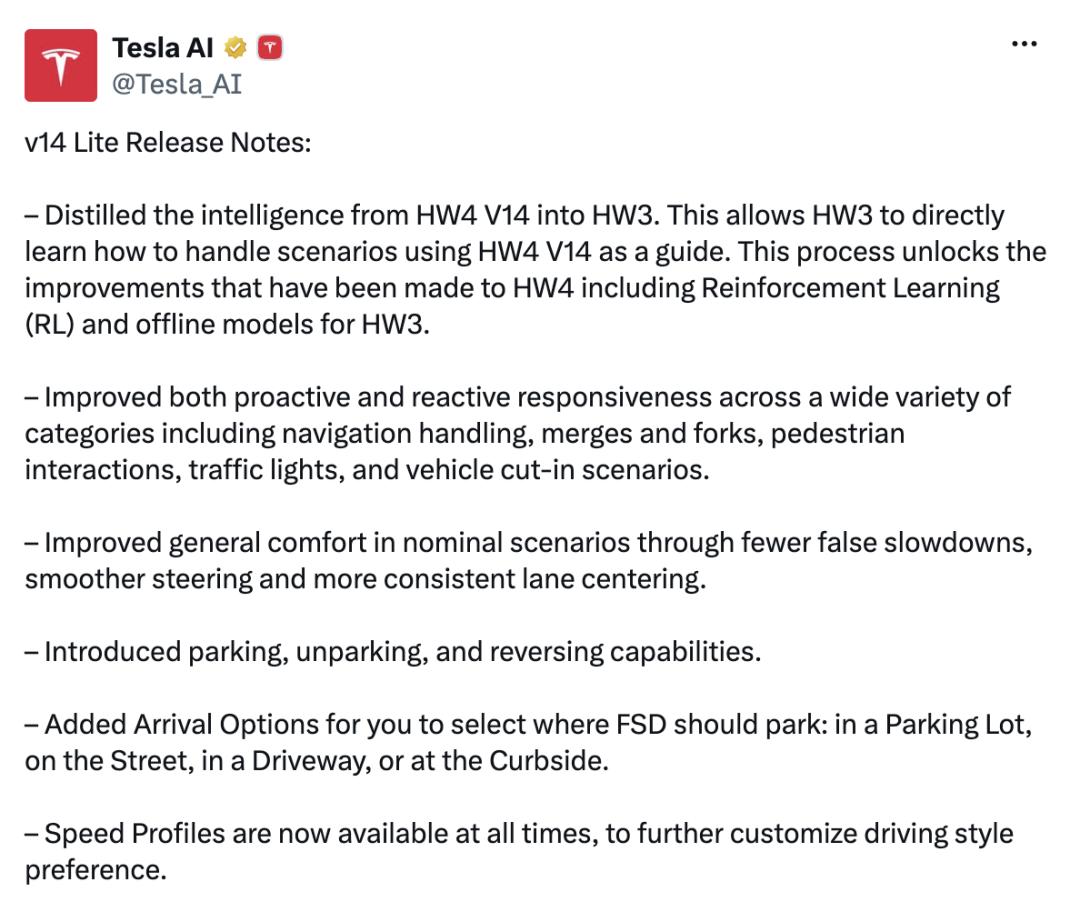
Tesla officially announced the release of FSD V14 Lite on social platform X.
Ashok Elluswamy, the Vice President of AI/Autopilot Software at Tesla, confirmed on social platform X that this installation package will be first pushed to users in the Early Access Program, and the push scope will be gradually expanded in the next few weeks.
This is the first major version update for HW3 since the release of FSD V12.6.4 in February 2025. It is also the first solution provided to old owners by Tesla after publicly admitting in April this year that "HW3 cannot support future Unsupervised FSD."
After the news was announced, Tesla's stock price rose 8.46% on the day, closing at $411.84 (approximately RMB 2,795.7), marking its largest single - day increase in nearly a year.
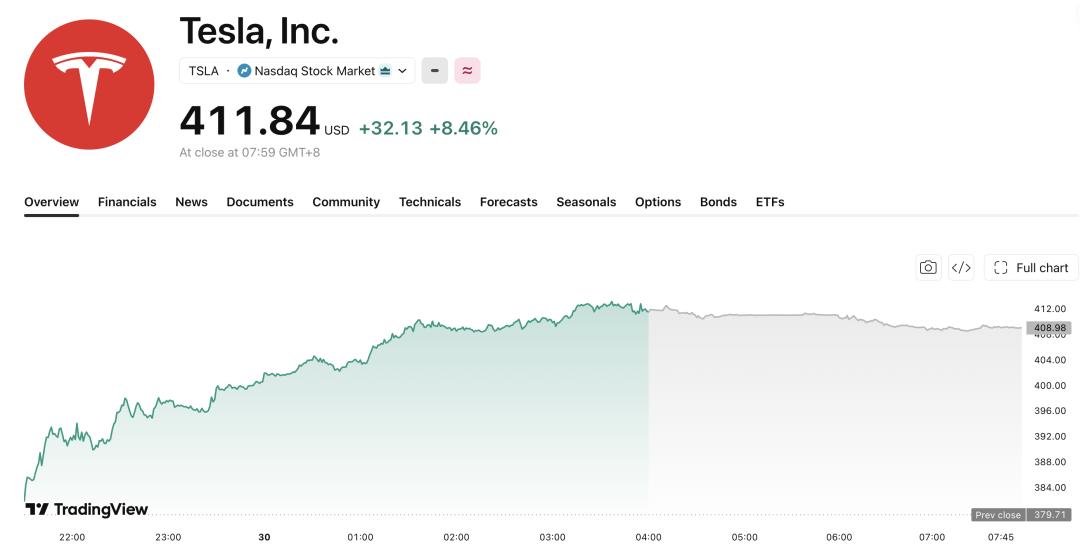
Tesla's stock price trend chart
01. HW3 Finally Gets a Major Upgrade, Adding Multiple Functions Such as Parking and Reversing
According to the official announcement, the version of the installation package being pushed this time is 2026.20.5.1, which updates many new functions previously only available on HW4 models, including Reinforcement Learning (RL) and offline models. It adds features such as automatic parking, exiting parking spaces, and reversing. It also optimizes navigation decision - making, following and lane - changing on urban roads, pedestrian avoidance, and intersection passing logic, improves issues of sudden braking without reason and rigid steering, achieves smoother steering, more stable lane centering, and smoother speed curve adjustment. Users can also customize their driving style preferences at any time using the speed mode.
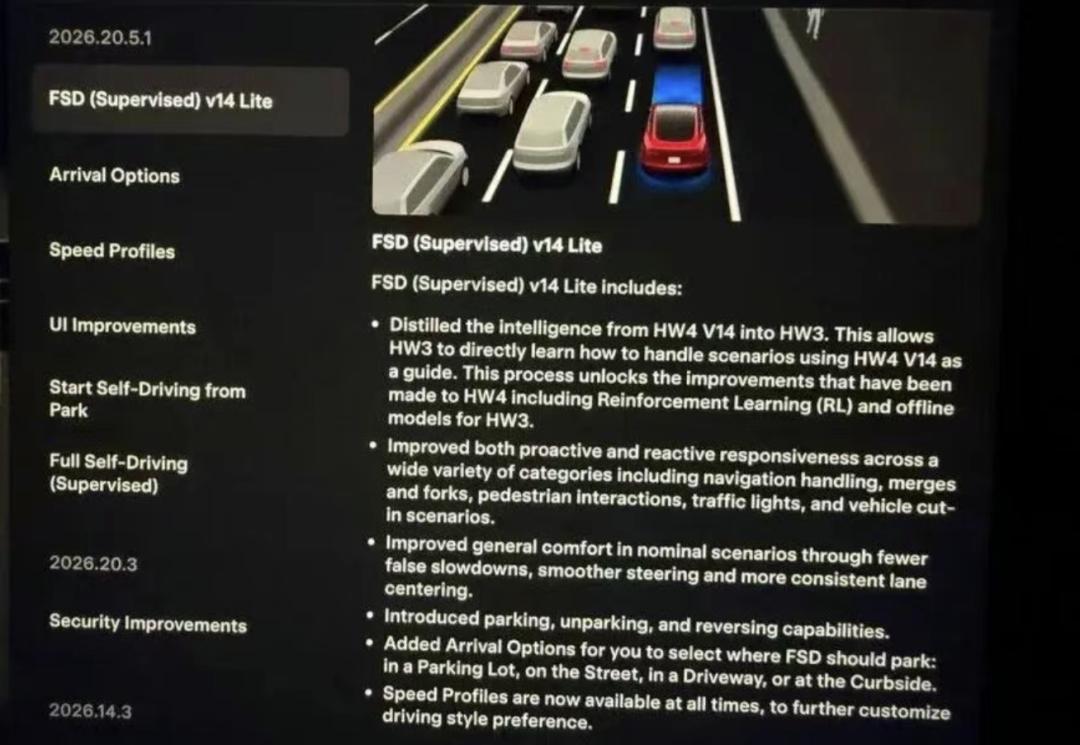
Tesla FSD V14 Lite system interface (Image source: Internet)
Ashok said, "The new version distills the driving behaviors of the HW4 (AI4) V14 series into the camera and computing configuration of HW3 (AI3), including destination options and urban road speed curves. More importantly, safety has been significantly improved."
It's worth noting that this update is not pushed to all models equipped with HW3 at once. Ashok said that currently, the new version is only available to users in the Early Access Program, and the push scope will be gradually expanded in the next few weeks based on feedback.
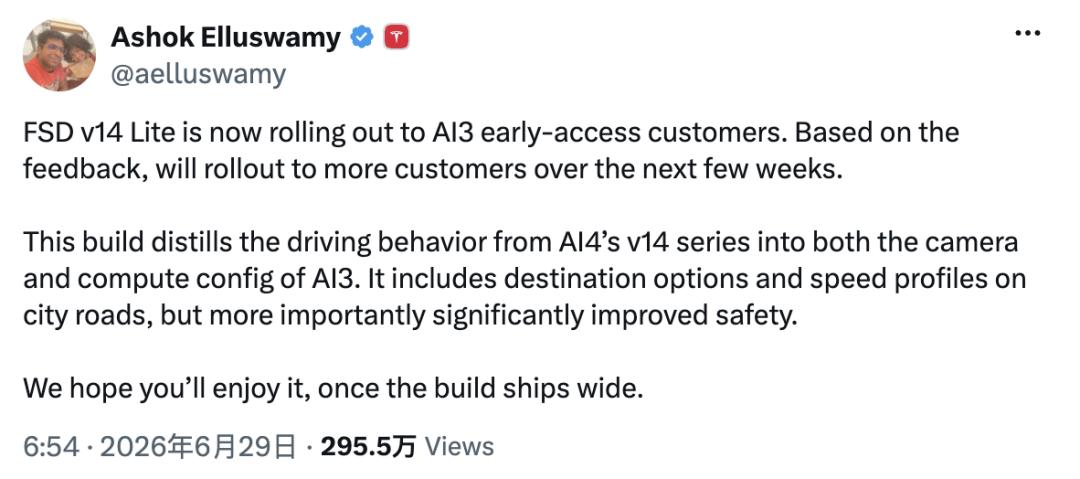
Ashok Elluswamy responded to the push scope on social platform X.
02. FSD V14 Lite Adopts Knowledge Distillation to Enable Old Chips to Learn New Driving Abilities
Tesla used a key term - Distillation when introducing FSD V14 Lite.
Knowledge distillation refers to a large - model compression technology widely used in the current AI field. The basic idea is to first use a large model with stronger computing power to complete the training, and then transfer the learned knowledge to a model with a smaller parameter scale.
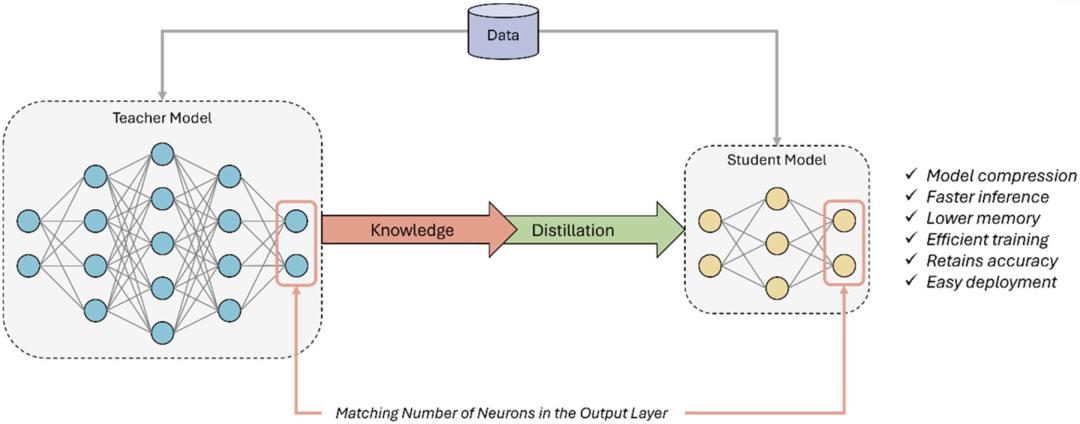
Schematic diagram of the Knowledge Distillation process (Image source: Internet)
In the context of this upgrade, the V14 model on HW4, as a large model with stronger computing power, first completes the training, and then transfers its driving capabilities to the small model running on HW3. The small model needs to retain as much of the driving capabilities of V14 as possible with limited computing power.
To give an easy - to - understand example, if we consider HW4 as a doctor, then HW3 is more like a high - school student. The doctor summarizes the problem - solving experience and teaches it to the high - school student. Although the high - school student cannot reach the doctor's level, their performance can be significantly improved.
That is to say, FSD V14 Lite is not a stripped - down version of the full - fledged FSD V14 after deleting some functions. Instead, it is a set of models retrained specifically for the HW3 hardware.
Tesla adopted this approach because there is a significant gap in memory bandwidth between HW3 and HW4.
During Tesla's Q1 2026 earnings conference call, Elon Musk pointed out that the memory bandwidth of the HW3 chip is only one - eighth of that of the new - generation HW4. In terms of data, the new - generation HW4 uses GDDR6 memory with a bandwidth of up to 384GB/s, while HW3 is only equipped with LPDDR4 memory with a bandwidth of only about 48GB/s, an eight - fold difference.
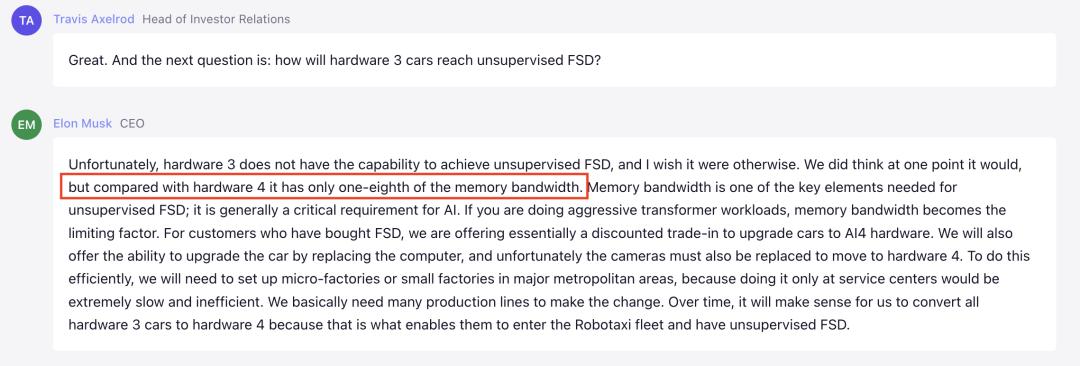
Record of Elon Musk's speech during Tesla's Q1 2026 earnings conference call
Both Tesla's FSD V13 and V14 generations of systems rely on ultra - large - scale end - to - end Transformer neural networks. For such systems, the bottleneck of autonomous driving AI chips is no longer the computing speed but the data transfer speed. The massive visual images collected in real - time by the vehicle's cameras and the neural network weight parameters all need to be transported from the memory to the computing core at high speed. If the transfer speed cannot keep up, even the most powerful computing power can only idle and wait for data.
Therefore, Tesla chose to compress the HW4 model before deploying it on HW3, enabling the old hardware on HW3 to gain some of the capabilities brought by the new HW4 model.
03. A Late Update, Also Tesla's Response to HW3 Owners
The reason why FSD V14 Lite has attracted so much attention is two - fold. Firstly, HW3 has not been updated for more than a year. HW3 began mass - production in 2019 and was first installed in models such as the Model 3. In January 2023, Tesla installed the new - generation HW4 hardware platform in the new versions of the Model S and Model X. Subsequently, new versions such as FSD V13 and V14 were preferentially deployed on the HW4 platform. After the release of V12.6.4 in February 2025, there were no more software updates for HW3 until the arrival of FSD V14 Lite this time.
Secondly, in April this year, Elon Musk publicly admitted during Tesla's Q1 earnings conference call that "HW3 simply does not have the ability to support future Unsupervised FSD." However, when Tesla first launched HW3 in 2019, it stated that this set of hardware had the capabilities required for future Unsupervised FSD. At that time, many users spent at least $5,000 (approximately RMB 34,000) to purchase the FSD software based on this promise.
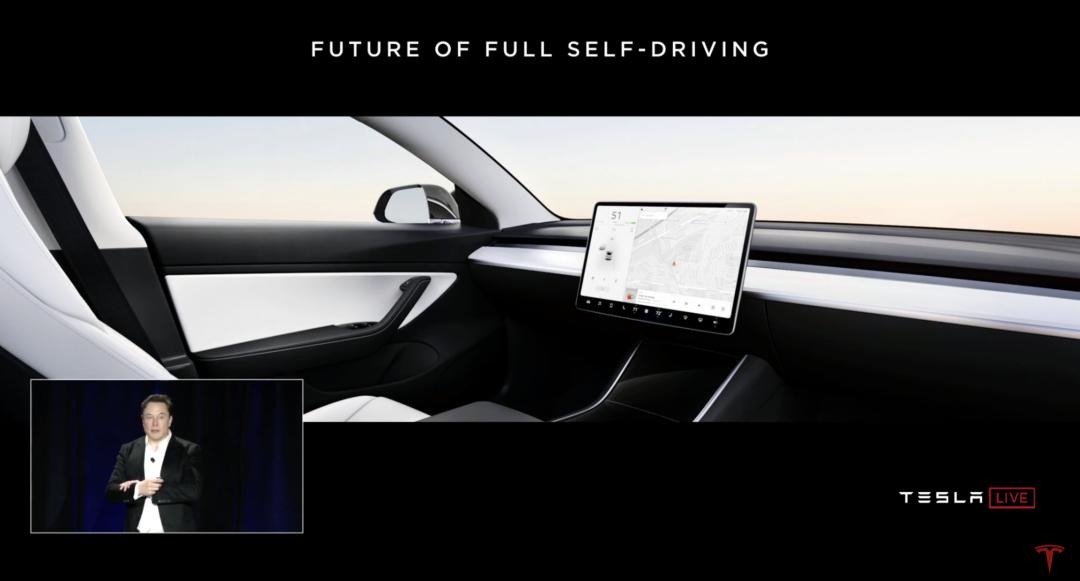
Elon Musk introduced the hardware foundation of HW3's ability to support future Unsupervised FSD at Tesla's 2019 Autonomy Day.
As HW4 continued to roll out new versions such as V13 and V14, while HW3 remained stuck on the V12 series for a long time, some HW3 owners began to worry whether their models had been abandoned by Tesla.
According to Andrew Percoco, an automotive analyst at Morgan Stanley, a comprehensive financial services company in the United States, as of April 2026, there were approximately 3.5 million Tesla vehicles equipped with HW3 hardware globally. The US technology media The Verge estimated this number to be around 4 million based on Tesla's annual sales. However, Tesla has not officially disclosed the specific number of HW3 models in use.
The launch of FSD V14 Lite this time can perhaps be seen as Tesla's response to the millions of existing users.
Although HW3 cannot support future Unsupervised FSD, Tesla is trying to extend the lifespan of these models as much as possible through software upgrades and continue to improve the experience of the supervised FSD.
Tesla FSD
04. Conclusion: Tesla Fulfills Its Promise to Old Owners
On the surface, FSD V14 Lite is just an OTA upgrade.
But in fact, it answers two questions that people have been concerned about for several months: whether HW3 will continue to be upgraded and how Tesla will handle its large number of existing FSD users.
Based on the information currently announced by the official, Tesla's answer is that it will not abandon millions of HW3 models. Through technologies such as knowledge distillation, it will transfer some of the capabilities trained on HW4 to the old hardware, allowing HW3 to continue to receive upgrades for the supervised FSD to serve existing owners. Unsupervised FSD and Robotaxi will be handled by HW4 and subsequent platforms.
For HW3 owners, this is a late explanation. For Tesla, this may be a balance found between fulfilling historical promises, maintaining existing users, and promoting the Robotaxi strategy.
This article is from the WeChat official account "CheDongXi". Author: Zhao Jingchu, Editor: Guo Zhihao. Republished by 36Kr with permission.