Bonus Depth | Mi Liangchuan Resigns: Unveiling the Departure of the Core "Iron Triangle" Team of XPENG Robotics' Previous Generation
36Kr "Career Bonus" (ID: ZhiChangHongLi)
The robot business has become the most pressing concern for He Xiaopeng in the second half of the year.
On June 5, 2026, "Career Bonus" exclusively reported that Shi Xiaoxin, the person in charge of the core products of XPeng Robotics, had left the company. Just five days later, He Xiaopeng issued an internal letter to all employees, announcing that he would personally serve as the CEO of XPeng Robotics. He decided to step in at this critical moment, on the eve of the robot's mass production and commercialization.
Part of the pressure comes from the goals that have already been set. Just last month, He Xiaopeng, together with Vice President Gu Jie and Mi Liangchuan (LC Mi), the head of the Robotics Center, held a mobilization meeting for the mass production of robots with over a thousand participants. In addition to clearly stating that "humanoid robots will be mass-produced by the end of 2026," he also emphasized XPeng's position as "the only company in China with full-stack self-research" in areas such as chips, operating systems, joints, and dexterous hands.
For the team, this means much greater difficulty and pressure compared to their peers.
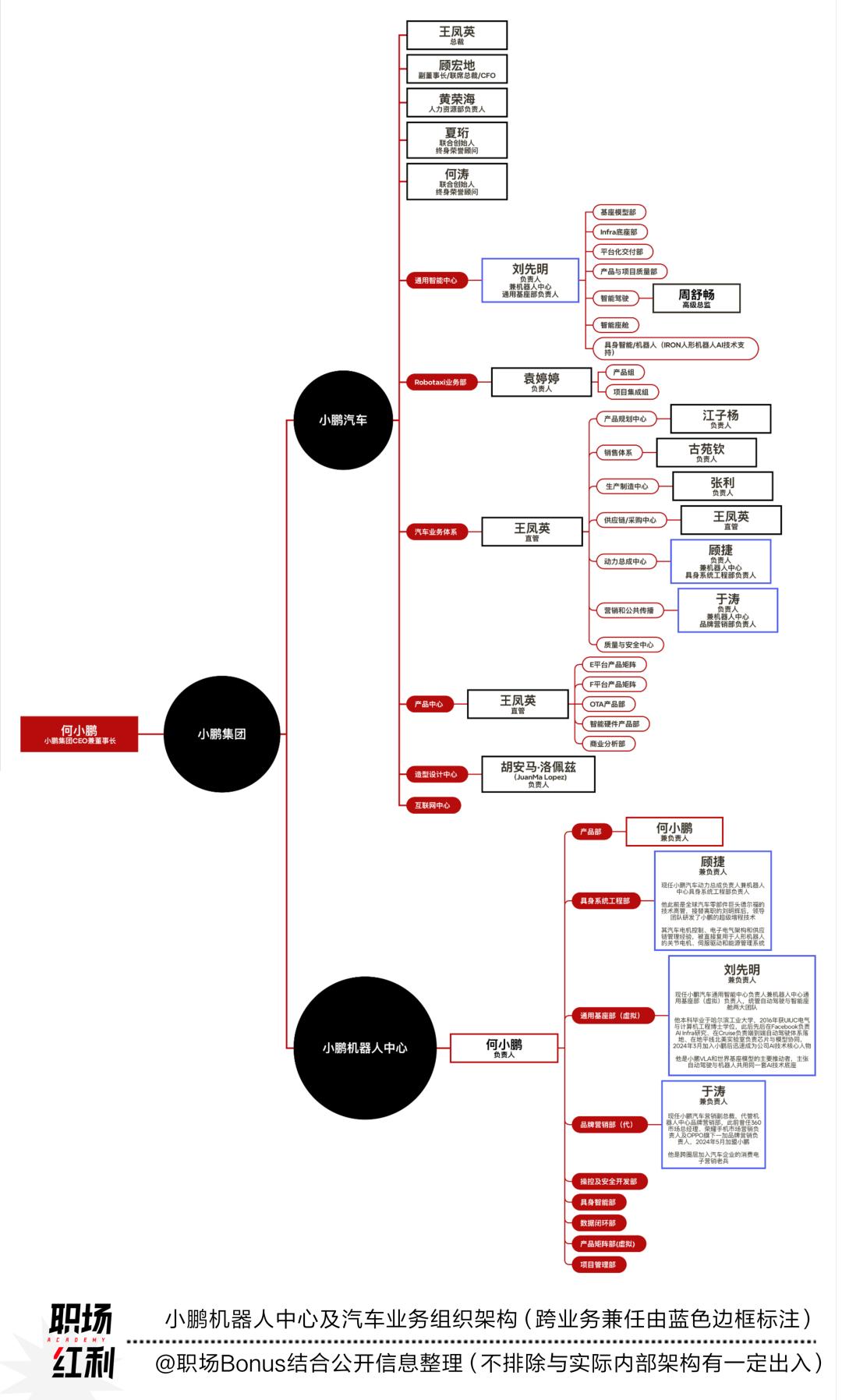
He Xiaopeng acted quickly. Last Friday, "Yijian Auto" reported on the new organizational structure of the XPeng Robotics Center, which includes nine second-level departments (see the figure below). Gu Jie, Liu Xianming, and Yu Tao are the heads of three departments. He Xiaopeng, who has a background as a product manager, filled the vacancy in the product department left by Shi Xiaoxin.
●
However, Mi Liangchuan's name disappeared from the internal letter and the information about the organizational structure adjustment. An internal source told "Career Bonus" that Mi Liangchuan also had the idea of leaving the company after Shi Xiaoxin announced his departure. "Although his Feishu status doesn't show that he has left, he is actually close to leaving without a new job lined up." "Career Bonus" contacted XPeng's public relations department to verify this information, but did not receive a response by the time of publication. Two hours before this article was published, "Yijian Auto" released an exclusive news flash about Mi Liangchuan's departure.
So far, the signal of a "change of the guard" at the XPeng Robotics Center has become more and more obvious. Several headhunters told "Career Bonus" that as early as the end of May last year, Zheng Cunyuan (Tyler), another important person in charge of the whole robot body at XPeng Robotics, had quietly left the company to start his own business. Before the debut of the IRON robot, which was suspected of having a person inside due to its high degree of realism in November last year, Mi Liangchuan, Shi Xiaoxin, and Zheng Cunyuan formed the "iron triangle" leading the XPeng Robotics team.
So, who will be the new person in charge?
"He Xiaopeng may not have figured it out yet." An informed source told "Career Bonus" that after Shi Xiaoxin announced his departure, He Xiaopeng had contact with a well-known expert in intelligent driving. Although they didn't talk about recruitment, He Xiaopeng's motivation for the meeting might include "wanting to see if he can recruit a person in charge from another field again."
"We don't want to see another leader who has no experience in the robot industry." A front-line employee commented. Looking back at Mi Liangchuan's role and contributions in the team, the employee believes that this should be regarded as a trial and error in XPeng's recruitment strategy.
The ambiguity and indecision in the high-level recruitment decisions have been affecting the recruitment of XPeng Robotics, and this time is no exception. "At first, they were open to candidates from other fields for high-level positions. Then for a while, they preferred candidates with direct experience in the robot industry. Recently, they are open to candidates from other fields again." A headhunter said in confusion. "XPeng is not a company that can attract talents with high salaries. Its biggest selling point is that its embodied scenarios are closer to data feedback."
Several headhunters who have helped XPeng Robotics recruit talents have the feeling that the relevant HR contacts change or leave every few months. "Maybe they just started to understand the industry and then were replaced."
To understand the pressure behind the "year of mass production" for XPeng Robotics, the technical aspect is not the top priority.
Former person in charge leading the team from another field ╱ 01
The "iron triangle" ╱ 02
Mass production ╱ 03
Indecision ╱ 04
Former person in charge leading the team from another field
"Did Mi Liangchuan have any actual achievements?" When talking about Mi Liangchuan's value in XPeng Robotics, a person in the industry questioned.
In previous public exposures and some media articles, Mi Liangchuan (LC Mi) was "undoubtedly the person in charge" of XPeng Robotics [1]. A former executive at NVIDIA, an alumnus of the University of Science and Technology of China, and a researcher at Carnegie Mellon University... Under these halos, he joined XPeng Motors in 2021 as a senior director of autonomous driving. In September 2023, he took over the Robotics Division. Subsequently, he became the chairman of the AI Technology Committee of XPeng Motors and was promoted to vice president of the company. On the surface of his resume, he straddled the business of XPeng Motors and the robot business, and was a representative of the "XPeng Group" in a real sense.
"Mi Liangchuan is a typical 'reporting talent' and hardly participates in substantial business." A former employee commented. An HR who had worked with Mi Liangchuan thought that Mi Liangchuan was good at upward management, understood He Xiaopeng very well, and knew how to communicate with him. "He almost mastered the instruction manual for He Xiaopeng." In 2023, during the special period when XPeng's robot business transformed from an independent company to a group division, Mi Liangchuan helped the organization re-establish its culture, and his cross-business resume also played a certain role in the internal resource coordination between the robot and the automotive business.
The problem is that although "upward management" can help a new business obtain resources and time within the organization, it can also create potential risks during the mass production period - a vacuum in the execution ability of the middle management. "The most feared thing is that the boss thinks everything is fine, but the front-line employees know that nothing has been implemented."
"Leading a robot business with an automotive background is bound to have a gap." An HR from another robot company analyzed her recruitment experience in the past six months to "Career Bonus". She thought that the biggest problem with Mi Liangchuan, as the person in charge of the robot business in a well-known company in the industry, was that "he didn't understand robots well enough." "It's not that he has problems with his basic abilities, but that he may not be in the right position."
In his public resume, after graduating from undergraduate, Mi Liangchuan pursued a master's degree in robotics at Iowa State University in the United States and worked as an electrical engineer at the Robotics Institute of Carnegie Mellon University (CMU), participating in the development of the obstacle avoidance system for medical service robots and the design of the laser navigation scheme for drones.
"Fairly speaking, Mi Liangchuan is not a completely 'nominal' leader. His educational background seems to be close to the robot field, and there is a possibility of leading the team across industries. However, his hands-on experience in his formal work is more in line with the AI-Native (NVIDIA, autonomous driving, deep learning) profile, rather than the Embodied-Native (systematic understanding of the hardware supply chain, mechanical structure, motion control, and manufacturing yield) that investors are most optimistic about now."
Previously, an article introducing Mi Liangchuan said that he "innovatively transferred the 'automotive-grade' standard and data closed-loop system in the automotive industry to the robot track." The problem is that the automotive-grade thinking emphasizes process, standard, and zero tolerance for errors, while the current mass production of robots requires rapid iteration, tolerance for trial and error, and flexible adjustment. It is not yet time to lock in with the automotive-grade standard.
A more vivid way to put it is that the person in charge of the robot business on the eve of mass production is preferably someone who can lead the team from the laboratory to the production line, someone who can monitor the yield in the factory and stand up to the suppliers. Looking back at the XPeng Technology Day at the end of 2025, when Mi Liangchuan explained the implementation path of the IRON's anthropomorphic gait on site, he said: "This is an inflection point of our generative controller. But I can't really say which optimization brought about the change. I can only say that when the data and computing power reached a certain level, a step change occurred."
"The person in charge is preferably someone who is directly knowledgeable in the industry. The people below can come from different industries. If you want to hold a high-level position in a team with a science and engineering background, at least your professional ability should be recognized by the team, and you should have deep knowledge in the vertical field and have spent a lot of time and energy understanding this technology." One analysis suggests that perhaps because He Xiaopeng had the experience of entering the automotive industry from the Internet, he also has more hopes for recruiting people across industries.
[1] "Who is Leading XPeng Robotics: Four Key Figures Behind IRON" by QbitAI
The "iron triangle"
However, under the coordinated leadership of Shi Xiaoxin and Zheng Cunyuan - two "1.5 positions" who were almost invisible in the media before - and Mi Liangchuan, XPeng Robotics still presented the debut of the new generation of IRON robot at the end of last year as scheduled.
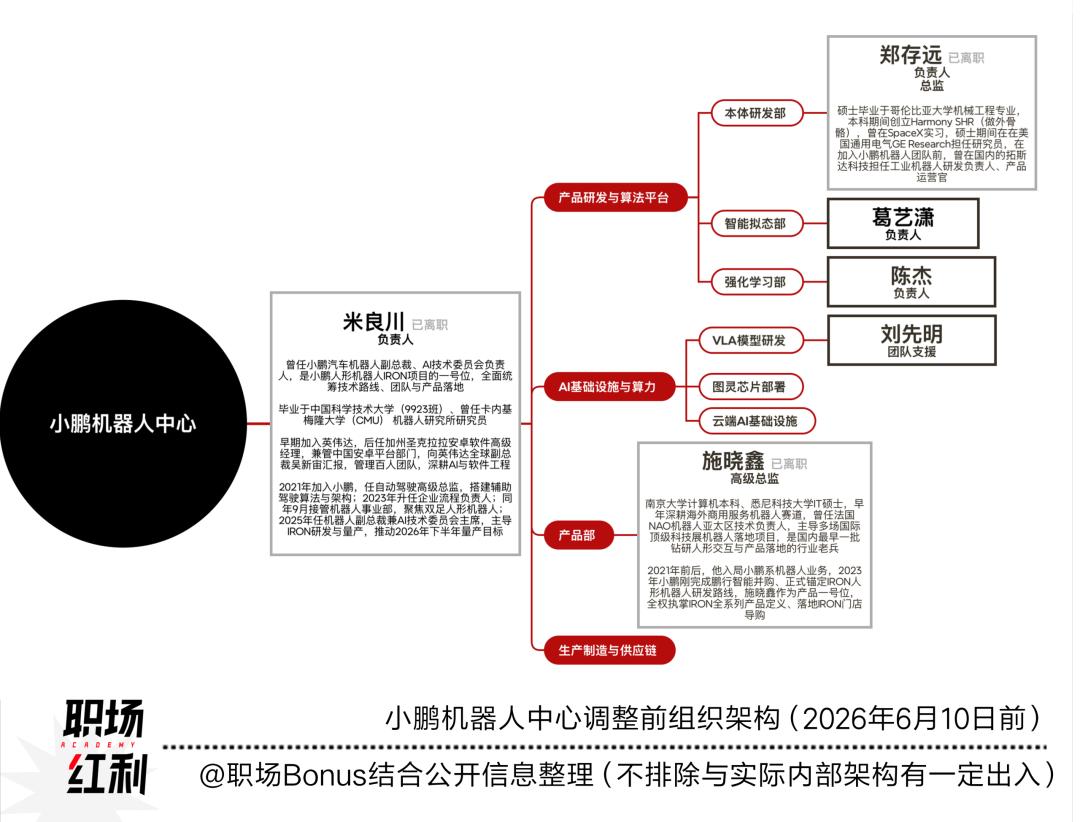
"In terms of administrative relations, Shi Xiaoxin has a higher rank than Zheng Cunyuan, and they both report to Mi Liangchuan." In this "iron triangle" system, Mi Liangchuan is responsible for reporting upwards and dealing with the outside world, Shi Xiaoxin focuses on product management, and Zheng Cunyuan is in charge of the whole machine technology.
As a veteran who has been with the company since the Pengxing Intelligence era, Shi Xiaoxin, the former senior director of product planning, is one of the few people in the team who has been responsible for both technology and productization. He and Zheng Cunyuan went through the transformation from Pengxing Intelligence to the XPeng Robotics Center and survived the layoff period (at that time, only a few dozen people from the old Pengxing team were retained). "They were the only two left in the key leadership positions."
According to "Career Bonus", among the three, Shi Xiaoxin has a low-key and delicate personality and pays more attention to balance. "Mr. He values him very much. If he hadn't chosen to leave, he would have had a chance to stay at XPeng until retirement." Some team members felt sorry. "He is responsible for things like selecting materials and steel gratings in the factory. The drawback is that he doesn't know how to report upwards."
Zheng Cunyuan left the company as quietly as Shi Xiaoxin. According to public information, Zheng Cunyuan graduated from Columbia University with a master's degree in mechanical engineering. He founded Harmony SHR (focusing on exoskeletons) during his undergraduate years, interned at SpaceX, and worked as a researcher at General Electric's GE Research during his master's degree. Before joining the XPeng Robotics team, he served as the R & D director and product operation officer of industrial robots at Tuosida Technology in China.
On Maimai, Zheng Cunyuan's work experience hasn't been updated and still shows his time at XPeng. "The background wallpaper of Tyler's (Zheng Cunyuan's English name) WeChat Moments is still IRON. He even posted a Moments message to congratulate his former employer when IRON made its debut last year." Before leaving the team, he completed the general contracting and integration work of the latest generation of IRON at that time. "Tyler has a more distinct personality and speaks directly. Sometimes he may seem to be bluffing, but he is actually very practical in his work."
Around May this year, a co-founder named "Zheng Tianle" appeared in the press release and announcements of Chaowei Power. After cross-verification by "Career Bonus", "Zheng Tianle (Tyler)" is Zheng Cunyuan.
How did these three people with different personalities cooperate during their work?
"They made the most of their strengths and compensated for each other's weaknesses. They supported XPeng Robotics for two years." A former employee thought that the three had a very similar understanding of the "first - principle" of robots and the future business direction, and there were no major differences in the key decisions regarding the business direction. "They emphasized the first - principle very much, focusing on hardware first, while incubating algorithms and accumulating intelligence." In terms of radicalness, He Xiaopeng once publicly said that Mi Liangchuan was more "radical" than him in building robots, and he himself wanted to "build humans" rather than just "build robots".
● Due to the compression limit of WeChat images, reply "XPJQR1103" in the background of the official account to get the high - definition version.
Mass production
The mass production target has caused differences.
According to an informed source, in the early days when the "iron triangle" worked in harmony, "they could set their own goals, and He Xiaopeng would be very patient." Before the new generation of IRON was launched, after the mass production target was proposed internally, He Xiaopeng began to give more macro - strategic guidance, and all parties could no longer reach a high - level consensus.
He Xiaopeng's position is easy to understand: First, the development of software and hardware cannot always be in the laboratory mode. The maturity of the product ultimately comes from delivery. Second, without large - scale production, the cultivation of the industrial chain will always stay at the level of a few hundred or a few dozen units, making it difficult to reach the automotive - grade or consumer - grade quantity. Third, as a listed company, XPeng needs to align with the external consensus and meet the expectations of investors.
Mass production itself is not a problem. The key lies in "how to mass - produce".
At present, the robots of any company are in a stage of rapid iteration. If the initial mass production quantity is set too high, once the performance of the product fails to meet the market expectations, neither the company itself nor the entire industry can guarantee to bear the consequences. How to control the scale quantity is the core of the problem.
An internal view once held that "the focus of the assessment should be to define what capabilities are achieved behind the quantity, whether a mass - production delivery standard and a good long - term relationship have been established with high - quality suppliers, and whether the stability of the software and hardware integration is infinitely close to the product stage - rather than focusing on the number of ten - thousand - unit shipments."
The essence of the difference is the conflict between two completely different "product genes". XPeng Motors' revenue reached 76.7 billion yuan in 2025. In the thinking of automotive - grade and consumer - grade, revenue is meaningless if it does not reach a certain scale. However, the robot industry is completely different. In 2025, Unit