Storage giants step in to "rescue the market"
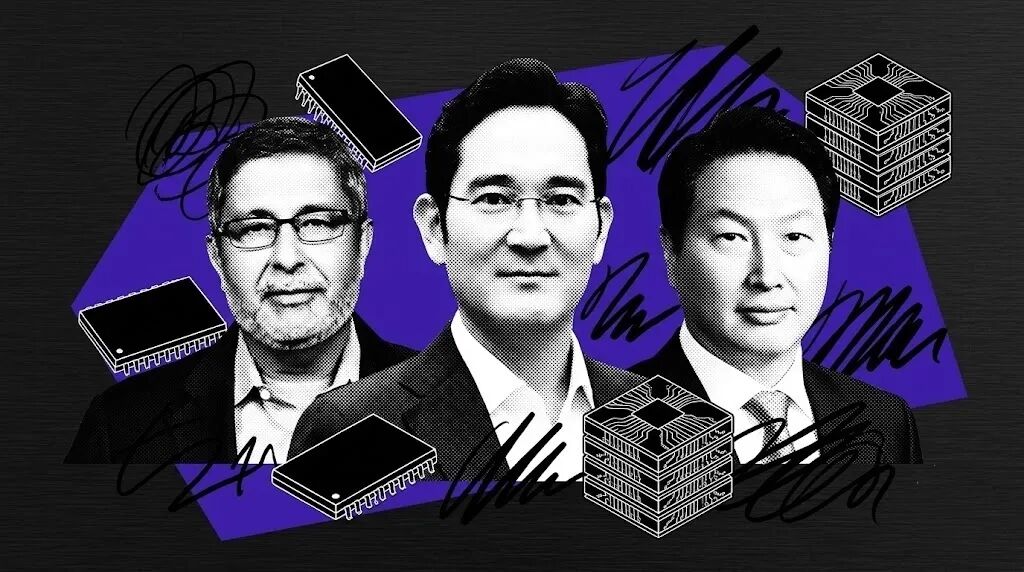
From left to right are Micron CEO Sanjay Mehrotra, Samsung Electronics Chairman Lee Jae-yong, and SK Group Chairman Chey Tae-won. The picture is generated by AI.
The memory price is experiencing a fierce round of increase.
According to the latest forecast of US investment bank Jefferies, the memory price will increase by 40% to 50% quarter-on-quarter in the third quarter of 2026 and another 30% to 40% in the fourth quarter. Subsequently, it will increase by 40% to 45% year-on-year throughout 2027, and the upward trend will not slow down until at least 2028.
On the supply side, the existing production capacities of the world's three major DRAM (Dynamic Random Access Memory) manufacturers, Samsung, SK Hynix, and Micron, are already tight, and half of the current total production capacity is locked by "long-term agreements".
Capacity expansion is also underway during the same period.
Micron has previously invested more than $150 billion in new production capacities in markets such as the United States. Samsung Electronics and SK Group recently jointly announced a ten-year investment plan focusing on semiconductor and artificial intelligence infrastructure: with a total scale of 2000 trillion won, approximately equivalent to $1.3 trillion. The total investment of the three storage original manufacturers is expected to exceed $1.5 trillion.
Coincidentally, since the three giants account for more than 90% of the market share, it has also attracted antitrust lawsuits. US law firm Hagens Berman accused them of colluding to manipulate prices and artificially creating shortages.
01 Storage Original Manufacturers Start "Burning Money"
According to local media reports, the investment projects of Samsung and SK Group's artificial intelligence infrastructure projects are scattered across multiple fields such as semiconductors, displays, batteries, and data centers, with semiconductors being the most important.
Samsung plans to build 4 to 5 front-end (wafer manufacturing) wafer fabs in Gwangju and South Jeolla Province in southwestern South Korea, with an investment of approximately 300 trillion won. Another 6 wafer fabs will be built in the Yongin Semiconductor Cluster, with an investment of 360 trillion won. The original plan was to be completed in 2048, but now it is planned to be advanced to 2034 - 2035. An investment of more than 56 trillion won will be made in the advanced packaging bases in Cheonan and Onyang, South Chungcheong Province, which are positioned as packaging R & D and production centers.
In addition to semiconductors, the investment in AI data centers will exceed 350 trillion won, with the key location selected in Asan, South Chungcheong Province.
SK Hynix plans to build four or five front-end wafer fabs in Gwangju and expand its NAND flash memory factory in Cheongju, North Chungcheong Province. The relevant investment scale is approximately 600 trillion won.
Before this, SK Hynix had already launched some capacity expansion projects, but the company did not clarify whether these projects are included in the newly announced investment plan.
For example, SK Group Chairman Chey Tae-won said on June 11 that the M15X wafer fab in Cheongju is planned to start operation in the second half of 2026, with an initial monthly production capacity of 40,000 wafers, and it is expected to increase to approximately 80,000 wafers in 2027.
In addition, the Yongin Semiconductor Cluster is also accelerating. The first phase is expected to be completed in early 2027 and is divided into 6 clean rooms. Each clean room will gradually increase the monthly production capacity by 60,000 wafers. Only the first factory can increase the monthly production capacity of DRAM by 360,000 wafers before the first half of 2030.
Micron's capacity expansion is being promoted simultaneously in the global market, with the United States being the core.
During the earnings conference call for the third fiscal quarter, CFO Mark Murphy gave the capital expenditure guidance: approximately $10 billion in the fourth fiscal quarter and $27 billion for the entire fiscal year 2026. He also previewed that the quarterly capital expenditure in fiscal year 2027 will be higher than that in the fourth fiscal quarter of 2026, and more than half of the year-on-year increase will come from construction capital expenditure.
Currently, in the headquarters campus in Boise, Idaho, the United States, Micron is building two new wafer fabs, ID1 and ID2, with a total investment of $50 billion. It is one of the largest clean rooms ever built in the United States. ID1 is expected to produce the first batch of DRAM wafers in mid - 2027, including the basic chips for HBM. ID2 is expected to start production before the end of 2028.
The investment in the wafer fab cluster in Syracuse, New York is $100 billion, which is the largest single private investment in the history of New York State. Groundbreaking began in January 2026.
The factory in Manassas, Virginia recently started the production of 1 - alpha DDR4 technology, mainly serving the demand for mature - process products in the automotive, industrial, medical, aerospace, and defense markets.
In Asia, the new DRAM wafer fab in Hiroshima, Japan has an investment of $9.6 billion, and EUV equipment has been introduced. The existing wafer fab acquired in Taiwan, China is expected to achieve mass product shipments in mid - 2027, about a quarter earlier than expected. A second clean room of the same scale nearby has started construction and will support EUV equipment.
Singapore will become Micron's advanced packaging excellence center, focusing on expanding the HBM packaging capacity. It is expected to start contributing revenue in the first half of 2027. The ten - year investment in the new NAND wafer fab locally is approximately $24 billion.
Mehrotra specifically mentioned that Micron recently signed a multi - year EUV supply agreement with ASML to pave the way for the next - generation 1 - delta node and more advanced processes.
The investment arrangements of the three companies have one thing in common: they are all expanding production, but they are all stretching the time and sharing the burden. None of them is gambling on a short - term explosion.
Sanjay explained during Micron's third - fiscal - quarter conference call that the entire industry is working hard to increase supply, but the capacity expansion speed is limited by the following factors: the construction cycle of wafer fabs is too long, equipment delivery is getting slower and slower, there are not enough skilled workers, and the energy and water and electricity infrastructure also cannot keep up.
He collectively referred to these factors as "structural constraints". Under such constraints, the tight supply situation is unlikely to ease in the next two or three years.
02 HBM Becomes a Strategic Chip
Compared with traditional DRAM (Dynamic Random Access Memory), what really keeps downstream manufacturers awake at night is HBM (High - Bandwidth Memory).
The demand logic of this stacked high - bandwidth memory is different from all previous memory categories.
In June, Jensen Huang directly stated during a meeting with SK Group Chairman Chey Tae - won in Seoul that SK Hynix's plan to double the storage wafer production capacity by 2030 is far from enough. "We have been purchasing from SK Hynix, with an annual purchase amount of billions of dollars, and this figure will increase significantly."
According to the calculation logic of analyst fin in "AI Semiconductor End - Game Deduction", the HBM capacity demand per GPU increases by approximately 40% per year, the production capacity increment on the supply side is 14%, and the unit density growth rate of DRAM is only 9%. The gap between demand and supply is getting larger and larger.
This means that the supply growth rate of DRAM is only 24%, and the growth rate difference reaches 16%.
More importantly, traditional DRAM is a standardized product. In a counter - cyclical situation, the demand plummets, followed by a sharp drop in price, and the industry faces huge losses. HBM bypasses this trap.
Fin believes that although the upper layer of HBM is still stacked with DRAM, the Base die has customized attributes. Customers need to sign long - term agreements with storage original manufacturers to lock in production capacity. At the same time, the AI demand is more predictable. A price drop will actually stimulate customers to increase the configuration volume, forming a bottom - support. In addition, due to the fast technology replacement and the rapid depreciation of old goods, storage original manufacturers tend to compete for the next - generation technology qualification certification of fabless customers rather than engage in price wars in the existing market.
According to fin's analysis, HBM has changed from the traditional cycle of "making money for one year and losing money for three years" to a growth cycle of "making more money in the upward phase and not losing much in the downward phase". He believes that as long as the attention mechanism in the Transformer architecture is not subverted, the exponential demand for HBM will not stop.
03 Who Is Competing for South Korean Production Capacity?
In June, Jensen Huang held a "dinner meeting" in South Korea with SK Group Chairman Chey Tae - won, SK Hynix CEO Kwon Oh - joon, etc.
After the dinner, Jensen Huang confirmed to the on - site media that NVIDIA's newly launched Vera CPU will use SK Hynix DRAM; the two sides are preparing for "super - large - scale cooperation" in the second half of this year and next year.
On the same day, NVIDIA and SK Hynix officially announced a multi - year technical cooperation agreement, covering AI supercomputers extending to robotics, digital twins, and semiconductor manufacturing.
Jensen Huang is not the only one eyeing South Korea's memory production capacity.
In March this year, AMD CEO Lisa Su completed her first trip to South Korea since taking office in 2014. Her first stop was Samsung Electronics' campus in Pyeongtaek, Gyeonggi Province.
The memorandum of understanding signed by the two parties covers multiple aspects: Samsung will supply HBM4 memory for AMD's next - generation AI accelerator MI455X and develop a customized DRAM solution for the sixth - generation EPYC processor codenamed "Venice".
The fact that giants flock to Seoul is essentially because memory is changing from a general - purpose component that can be purchased on demand to a strategic resource that requires the CEO to personally step in to compete for.
04 Micron Upsets the Applecart, and Apple Gets Bitten Back
In this round of price increase tide, Micron's attitude is tougher than that of Samsung and SK Hynix.
After releasing record - breaking third - fiscal - quarter results, Micron's Chief Commercial Officer Sumit Sadana, in an interview with the Wall Street Journal, rarely brought up old scores.
He revealed that Micron was unable to invest in capacity expansion during the previous industry downturn, partly because some customers were "very aggressive in pricing" and "purchased at the lowest price", pressing the suppliers' gross profit margin into negative territory. He said that Micron had told those customers at that time that "such a practice is not constructive". Due to extremely poor pricing and profit margins, many industry investments were directly stopped in 2023.
Although not named, the customers that Micron "complained" about are considered to be Apple Inc.
Apple has long been known for its tough bargaining with suppliers. It locks in low prices through long - term procurement contracts, presses its own costs to the lowest, and at the same time raises the prices of terminal products.
However, Apple's tough supply - chain stance, which indirectly induced the storage shortage, is also biting back at itself.
Apple CEO Tim Cook recently admitted that this round of memory shortage is a "once - in - a - century flood", and the price increase is "inevitable". Soon after he said that, Apple implemented a comprehensive price increase for product lines such as MacBook, iPad, Apple TV, and Vision Pro. On that day, Apple's market value evaporated by $265 billion.
According to the Financial Times, the company is quietly lobbying Washington to obtain permission to purchase memory from ChangXin, a Chinese storage chip manufacturer. In Apple's view, ChangXin is not deeply involved in the supply competition of HBM for AI, and theoretically can provide cheaper memory.
Market research firm Gartner analyst Ranjit Atwal commented on this: "Even Apple is not immune. Although they have all the expertise and long - term planning, this is beyond their ability to limit the impact."
Now, everyone is predicting that the storage shortage will end as early as after 2028. However, once the power structure flips, it is difficult to return to the original state. In the storage market, buyers can no longer get back the "take - what - you - want" chips they had in the past - the "commodity era" of memory is coming to an end, and terminal manufacturers have not fully adapted to this trend.
This article is from the WeChat public account "Tencent Technology". Author: Worth Paying Attention To. Republished by 36Kr with permission.