The storage trend has swept over major tech giants.
The matter of Apple lobbying the US Department of Commerce happened more than a month ago. Regarding the attempt to obtain DRAM memory from ChangXin, neither party has responded.
01
Then, on June 29th, last night, Reuters released another piece of news, according to three people familiar with the matter. ChangXin has signed a long - term supply agreement worth over 20 billion yuan with Tencent for server DRAM chips for a period of three to five years.
As of now, neither Tencent nor ChangXin has made a statement.
I think this is quite normal. For such unannounced business agreements, responding means taking a stance. Confirming it will stir the market, and denying it will also stir the market. The smartest thing to do is to keep silent.
The same Reuters report also mentioned that, according to two other people familiar with the matter, ChangXin is in talks with several other large Internet companies for similar cooperation.
I checked ChangXin's prospectus. The customer list includes Alibaba Cloud, ByteDance, Lenovo, and Xiaomi. All are well - known names.
The Internet companies are busy, and PC manufacturers are not idle either. HP has confirmed with Bank of America that it is conducting qualification certification for Chinese storage suppliers. Although no name was mentioned, the industry knows it's referring to ChangXin.
Dell and Lenovo are also conducting similar supply - chain assessments. To be honest, these sources of information are not very reliable, and we need to wait and see.
The automotive industry took action earlier. Volkswagen signed direct - supply agreements with Samsung and SK Hynix. Hyundai Motor went even further, breaking the old rule of no direct transactions among South Korean chaebols by signing directly with Samsung. Li Auto and Zeekr are sourcing directly from Micron.
Have you noticed that these automakers are doing the same thing: bypassing first - tier suppliers and directly locking in supplies from storage manufacturers.
There is a time point that cannot be ignored. These news items emerged during the window period when ChangXin is striving for its IPO on the STAR Market, which Reuters itself also mentioned.
My attitude towards these domestic news is clear. We should be cautious. The emergence of large orders before an IPO leaves too much room for storytelling. It may not sound nice, but you need to know this.
However, it's unlikely that Apple's lobbying of the US government and Volkswagen's signing of direct - supply agreements in Germany are meant to coordinate with the listing schedule of a Chinese company.
But when we put these things together, it becomes interesting.
Apple in the US, HP in the US, Tencent in China, Li Auto in China, Volkswagen in Germany, and Hyundai in South Korea; from three continents, in the consumer electronics, cloud - computing, and automotive industries, within the same time window, are all doing the same thing: locking in storage supplies.
One news item is just one piece of news. When a series of companies do the same thing at the same time, it's a signal.
02
There must be a driving force behind this signal. Think about it, the force that can make companies from three continents take action must be significant.
When it comes to this, many people's first reaction is natural: AI is so popular that everyone is scrambling for chips.
This is only half - right. Has AI boosted the demand? Yes. But demand alone cannot drive this situation. I believe the main reason lies in the supply side, as the supply structure has been reallocated.
I checked the data:
The DRAM usage of an AI server is eight times that of an ordinary server. NVIDIA's GB200 alone requires 640GB of HBM and an additional 2 to 4TB of DDR5.
In 2026, the global shipment of AI servers is expected to exceed 3.7 million units, directly consuming more than half of the global monthly memory production capacity. Half.
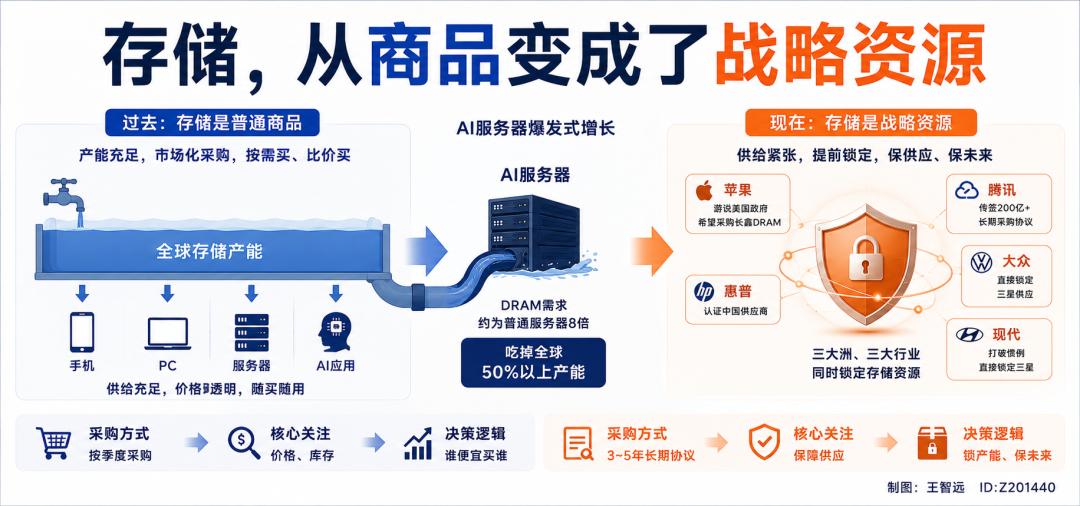
Let me give you an analogy:
Previously, the global memory production capacity was like a river. Mobile phones, computers, and cloud servers each took a share, and the water was sufficient. Now, with the arrival of AI, like Zhu Bajie, it brings a water pump and drains half of the water at once. Although the river remains the same, the water is no longer enough.
Where does the consumed production capacity come from? It is squeezed out of your mobile phones, computers, and cloud servers. Yes, squeezed.
There are only three major global DRAM suppliers: Samsung, SK Hynix, and Micron. Together, they account for over 95% of the global market share.
In the past two years, these three companies have made the same choice: moving their production capacity towards the most profitable direction.
Samsung is the most conservative. It does not expand production but focuses on high - end processes and gradually shrinks its mid - and low - end product lines. SK Hynix is the most aggressive, shifting 35% of its HBM production capacity to general DRAM. Does it sound like it's filling the gap in the consumer market? Don't be deceived. It's targeting the market with the sharpest price increases.
Micron is the most radical. It has directly exited the consumer - grade storage brand Crucial and allocated all its resources to data centers.
Although the three companies have different strategies, their directions are the same: focusing on high - end products and abandoning the low - end market. The result is two words: squeezing. AI has attracted high - end production capacity, and the supply of general DRAM has been increasingly squeezed.
I also checked the price data. In the first quarter of this year, Samsung quoted a price for LPDDR to Apple, with a single - quarter increase of over 80%.
SK Hynix was even more extreme, with an almost doubling of prices. The global DRAM contract price nearly doubled quarter - on - quarter in the first quarter, and the cumulative increase in the spot price of DDR5 has exceeded 300%.
As you can see, the word "price increase" can no longer describe this situation. This is called restructuring.
One more thing. The storage market currently has two trends running simultaneously. The price of consumer - grade DDR5 is actually decreasing, as the supply in the mobile phone and PC markets exceeds demand, and prices are weakening. What is really in short supply? Server DRAM and automotive - grade DRAM, which are enterprise - level products.
Looking back, the large companies locked in this very segment in the first quarter.
How tight is the supply? I checked the inventory data of global storage channels. It's only four weeks' worth, while the normal level is 12 to 16 weeks. What does four weeks mean? It's the lowest value in the past 15 years.
TrendForce predicts that the global DRAM supply - demand gap will be about 5% in 2026, and about 4% for NAND. Doesn't sound like much, right? In a market worth hundreds of billions of dollars, a 5% gap is enough to change the behavior patterns of the entire industry chain.
So, let's go back to the previous scenario. Companies from three continents, in three industries, within the same time window, are all locking in storage supplies.
Do you think these companies suddenly became interested in memory chips? Of course not. The supply - side structure has been reallocated by AI. If you lock in supplies in advance, you'll have them; if not, you won't. It's that simple.
Apple has provided the most direct evidence. On June 25th, the prices of Mac and iPad increased by about 20%. Tim Cook said something honest during a conference call: I've been in this business for forty years, and I've never seen the price of a component increase so quickly and so much.
He didn't say it exactly like that, but that's the gist. After he said that, Apple's market value evaporated by $263 billion. It was the second - largest single - day decline in history.
A single memory chip can wipe out over $200 billion in market value. Clearly, this is not something the procurement department can handle.
03
If the procurement department can't handle it, then who can? Take a look at the way these companies are signing contracts, and you'll understand.
In the semiconductor industry, the old rule is to sign a contract every quarter. Negotiate the price based on the quantity, deliver the goods after the negotiation, and start over again next quarter. This has been the way for twenty years.
This time, the way of signing contracts has changed.
I checked Micron's latest quarterly financial report. There is a set of data that not many people noticed.
Micron currently holds 16 long - term strategic cooperation agreements, all for three to five years. Fourteen of them guarantee revenues of over $100 billion, and it has received $22 billion in advance deposits.
With a $22 - billion deposit, the money is paid before the goods are received. What are they buying? A promise: "You must supply me first."
For items negotiated on a quarterly basis, there is no need to pay a deposit.
Any one of the actions mentioned earlier, such as signing a three - to five - year long - term contract, the CEO personally lobbying the government for approval, or automakers bypassing first - tier suppliers to sign directly with manufacturers, would have been abnormal three years ago. When three such things happen simultaneously, it's not a coincidence.
Wu Yating, the senior vice - president of research at TrendForce, who has been in the storage industry for twenty years, recently said something like this: The model where customers pay to help suppliers expand production and then lock in the production capacity has never appeared before.
To put it another way:
Cloud providers directly pay to help storage manufacturers build production lines in exchange for priority access to production capacity in the next few years. What is this? Investing in production capacity. It's no longer just about buying goods.
UBS estimates that long - term agreements will account for 30% of the total DRAM shipments next year. That is to say, one - third of the DRAM in the market will be locked in before it is even produced. The rest will flow into the open market.
This is a completely different game from before.
Previously, buying storage chips was similar to buying commodities. You looked at the price, inventory, and quarterly trends, and bought from the cheapest supplier. Now, the first priority is to ensure you can get the goods, and price comes second.
I checked and found that on June 3rd, nine US trade associations jointly wrote a letter to Treasury Secretary Bessent and Commerce Secretary Lutnick, asking the government to intervene to ease the shortage of storage chips. The signatories cover the telecommunications, automotive, medical device, and retail industries.
The original text of the letter is publicly available on the NCTA website. The wording specifically emphasizes that "other non - AI real - world industries should not be negatively impacted."
The last time we saw trade associations asking the government to intervene in the supply chain was during the COVID - 19 pandemic. Think about what this means.
The CEO personally lobbying the government for procurement, customers paying to help suppliers build factories, industry associations asking the government to intervene in the supply, and one - third of the production capacity being locked in before it leaves the factory.
Putting these things together, it points to a conclusion: Storage chips are changing from commodities negotiated on a quarterly basis to key resources that need to be strategically locked in. When the behavior changes, the nature changes.
04
Since the nature has changed, the question becomes: Who holds the cards in this new game?
You've probably heard the most popular saying outside: "A great victory for domestic substitution." Apple is buying chips from ChangXin, and Tencent has placed a $20 - billion order. Domestic storage has finally been recognized.
Is this true? Well, it's only half - right. It has the cause - and - effect relationship backwards.
Why does Apple approach ChangXin? It's not that ChangXin is better than Samsung. The three major suppliers are all busy catering to AI, leaving less and less production capacity for consumer electronics, and asking for higher and higher prices.
If it doesn't find alternative suppliers, it will have to pass on the costs to consumers round after round. It has done so once, and consumers have voted with their feet, as has the capital market.
Is Tencent signing a long - term contract out of charity? Come on. The supply of server DRAM is tightening across the board. If you don't lock in supplies in advance, you won't even be able to gather enough memory modules for next year's computing - power expansion. How can you compete with your peers in the AI field?
Guo Ming - chi summed up this relationship in six words.
In 2022, Apple evaluated YMTC to lower the cost of NAND. That was a bonus. This time, approaching ChangXin is to manage the supply risk of DRAM. It's a necessity.
From a bonus to a necessity, it's clear who is the one asking for help. The answer is the opposite of what it was three years ago.
Three years ago, ChangXin needed Apple's endorsement. Now, Apple needs ChangXin's production capacity. Three years ago, ChangXin needed Tencent's large order to boost its valuation. Now, large companies need ChangXin's products to ensure the continuous supply of their computing - power infrastructure.
You need to reverse your view of who is the client and who is the supplier.
Having said that, I also need to be cautious. Can ChangXin's production capacity really meet the demand? I checked the prospectus, and it admits that its production capacity is far lower than the domestic demand.
Guo Ming - chi also said that Apple's procurement from ChangXin will neither significantly reduce costs nor fill the supply gap. Even if Apple opens up the procurement channel, ChangXin will be hard - pressed to become the main supplier.
Then why are large companies still approaching ChangXin?
Because the supply - demand imbalance is continuously expanding. Having an additional source means having an extra layer of security. It can't completely solve the problem, but it can prevent a vital link from being controlled by others.
This is strategic thinking. When buying commodities, you look at cost - effectiveness. When buying strategic resources, you look at "availability."
How long will this shortage last? There is no consensus in the industry.
TrendForce says the gap will shrink to 5% in the fourth quarter of 2026, and supply and demand may be balanced in the first quarter of 2027. Micron's management says the tight situation will last until after fiscal year 2027 and will gradually improve in 2028. Samsung's internal forecast is even further out, saying that the AI - driven super - cycle will not end until around 2028.
There are three predictions and three time points, and no one can be sure. That's why large companies with deep pockets don't dare to wait.
The shift from "wait and see if the price will drop" to "lock in the supplies first" is in itself the most convincing signal.
In the future, when you see news related to storage, whether it's a company signing a contract, a chip price increase, or a CEO making tough statements, don't rush to ask who will benefit.
First, ask: Is there one more step in the process of storage changing from a commodity to a strategic resource?
Reference sources:
[1]. The key information in this article is mainly sourced from Reuters, the UK's Financial Times, Micron's Q3 financial report for fiscal year 2026, TrendForce, UBS research reports, Guo Ming - chi's analysis, the original text of the public letter on the NCTA website, and ChangXin's prospectus.
