Why do white-collar workers who can take the subway or own a car also quietly choose to ride electric scooters
When white-collar workers who shuttle through office buildings every day decide to give up air-conditioned private cars and stop squeezing into the morning rush-hour subways, but instead spend thousands or even tens of thousands of yuan to buy a smart electric vehicle, they usually do so not for the sake of experiencing life, but for the sake of convenience and pleasure.
In this daily commuting drama that unfolds on schedule, they are trying to regain a sense of control over time and life during these dozens of minutes on the bike.
The Workplace Anthropology Laboratory conducted an online questionnaire survey among 1,050 working people across the country and released the "Workplace Commuting Experience 2026" report based on the results. From it, we can see the change in travel modes: buses have taken a secondary position, and the "Two-wheel +" era of urban workplace commuting is coming. It could be two-wheel + subway, or two-wheel + car.
Whether we like electric scooters or not, this is a reality we must face: two-wheelers have become the main players, rather than supplementary travel tools. Urban non-motorized lane planning and traffic management need to take actions according to local conditions.
1. Young People's Commuting: Willing to Live in Shabby Old Apartments to Save Time
At 7:15 in the morning, at the Xierqi Station of Beijing Subway Line 13, a worker was pushed into the carriage by the crowd behind. Her left shoulder was pressed against a stranger's backpack, and her right hand still held half a cup of unfinished soy milk. It takes 40 minutes from her rental apartment to the company. This is the commuting radius she settled on after moving three times. "If it's farther, I won't be able to get up. If it's closer, I can't afford it."
The life of driving out and living in a mansion only exists in domineering CEO novels. Most young people still live in the real world. But being unburdened has become the confidence for young people to live. They are not yet bound by school district policies and not anchored by their children's wake-up times. There is only one logic in their commuting modes: to make themselves more comfortable.
We analyzed the surveyed working people according to three age groups: under 30, 31 - 40, and over 40. The data shows that among the young surveyed group under 30, 44.39% have a one-way commute within 30 minutes, and nearly 90% within an hour.
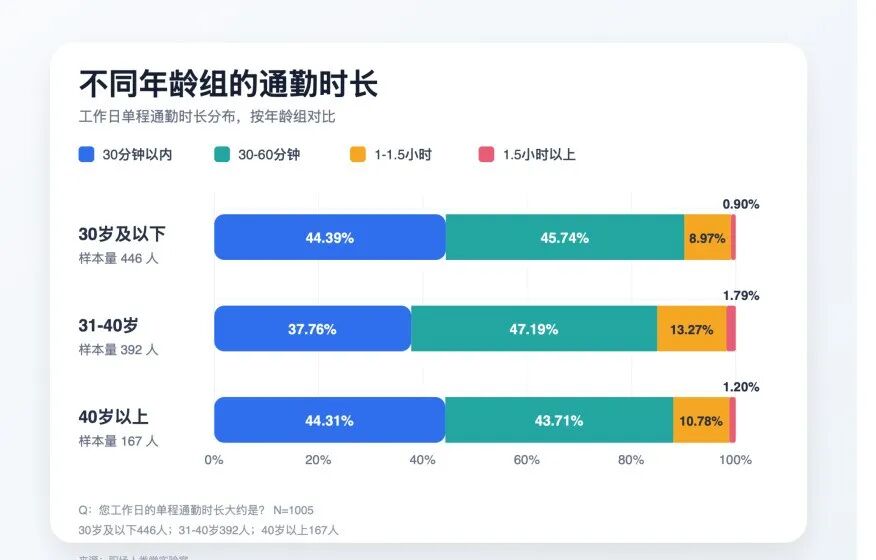
A large villa in the suburbs that takes more than an hour to reach is not very attractive to young workers. To be closer to the company and sleep for an extra half an hour, young people would rather accept a small secondary bedroom in a shared apartment.
Of course, the rise of two-wheel electric vehicles has also rewritten the young people's definition of "close".
A post-2000 worker who works near Xierqi in Beijing said that if he chooses to live a few kilometers away from the subway station instead of near it, for the same type of housing, the rent can be more than 1,000 yuan lower. Now he sometimes rides an electric vehicle directly to the company, and sometimes rides an electric vehicle to the subway station and then transfers. But the living environment and comfort have both improved.
In contrast, the world of middle-aged people is quite different. A 38-year-old product manager is leaving his home in the suburbs. He needs to first ride an electric vehicle to the subway station, transfer twice, and then walk for 15 minutes after getting off the subway. The whole process takes more than an hour.
The report shows that in the extreme commuting intervals of 1 - 1.5 hours or even more than 1.5 hours, the 31 - 40 age group has the highest proportion. For the sake of school districts, larger living spaces, or due to the high housing prices in the core areas, this group of middle - aged working people is forced to move to the outskirts of the city. Marriage, child - rearing, school districts, and high housing prices form an airtight triangle that locks in the commuting of middle - aged people.
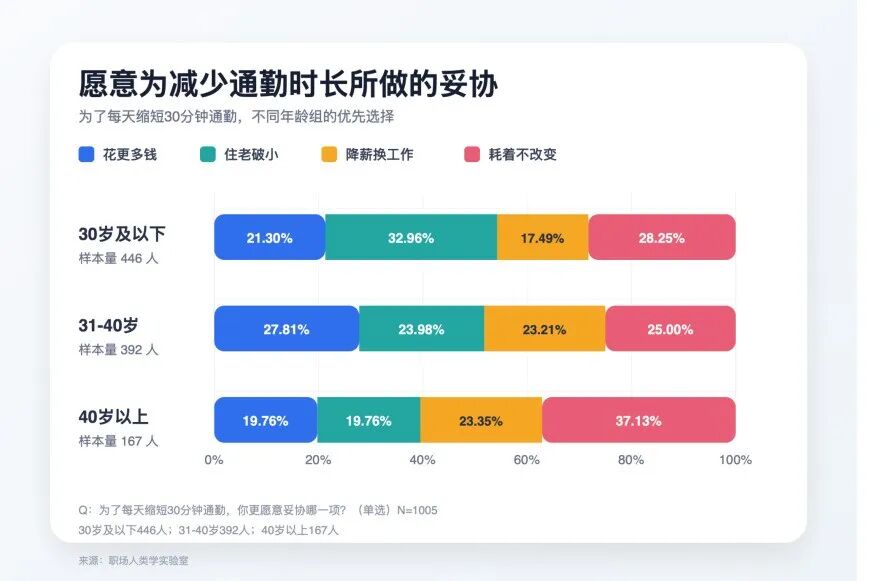
The report data also confirms this. If you could reduce your commuting time by 30 minutes, what kind of price would you be willing to pay? The answers vary by age. Young people are most willing to sacrifice living quality (32.96%) and least willing to sacrifice income (17.49%). Middle - aged people aged 31 - 40 are most willing to spend money to save time, and the proportion of those who are willing to live in shabby old apartments has decreased significantly compared to young people.
The ideal life of an urban beauty is to climb the career ladder and have a better quality of life as a working person. But the data reveals the reality of the middle - age commuting penalty: the older you are, the farther you live and the longer your commute is.
People over 40 become more laid - back. The proportion of those who "would rather waste time on the road" is as high as 37%, significantly higher than the other two groups. This group is more satisfied with their current living status, has the lowest willingness to change, and also has the lowest willingness to "sacrifice living quality" (20%).
2. Office Workers Don't Love Subways That Much, and "Four - wheeled Middle - class" Also Have Vulnerable Moments
In 2026, what is the popular commuting tool for everyone? The answer is not buses or subways, but two - wheel electric vehicles.
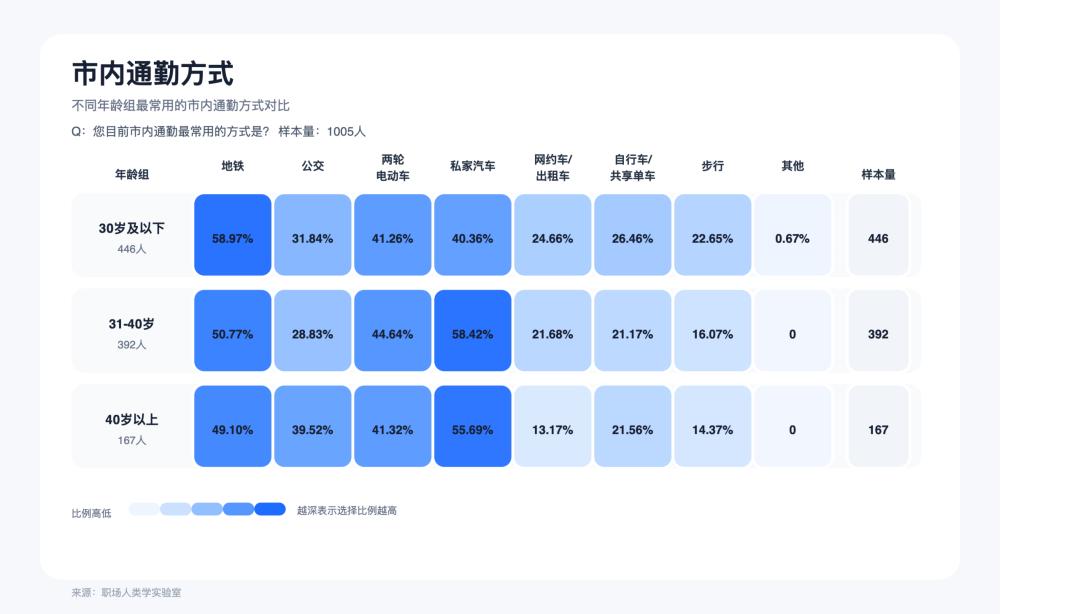
The survey data shows that two - wheel electric vehicles have a high usage rate in all age groups, with the three groups being basically the same (41 - 45%). It is the only commuting mode with no significant difference across age groups, far higher than buses and bicycles, verifying the positioning of electric two - wheelers as an emerging "national infrastructure".
The subway usage rate among young people reaches 59%, which is the highest among the three age groups. Followed closely by two - wheel electric vehicles, which have become the "second most popular travel mode" after the subway. The usage rate of buses is generally not high.
Electric vehicle manufacturers have started to compete for customers at subway stations. Recently, when going to a large subway station in Bao'an, Shenzhen, there are advertisements for Ninebot electric vehicles everywhere. A person inside Ninebot also said that commuting has become an important scenario for two - wheel electric vehicle manufacturers to focus on.
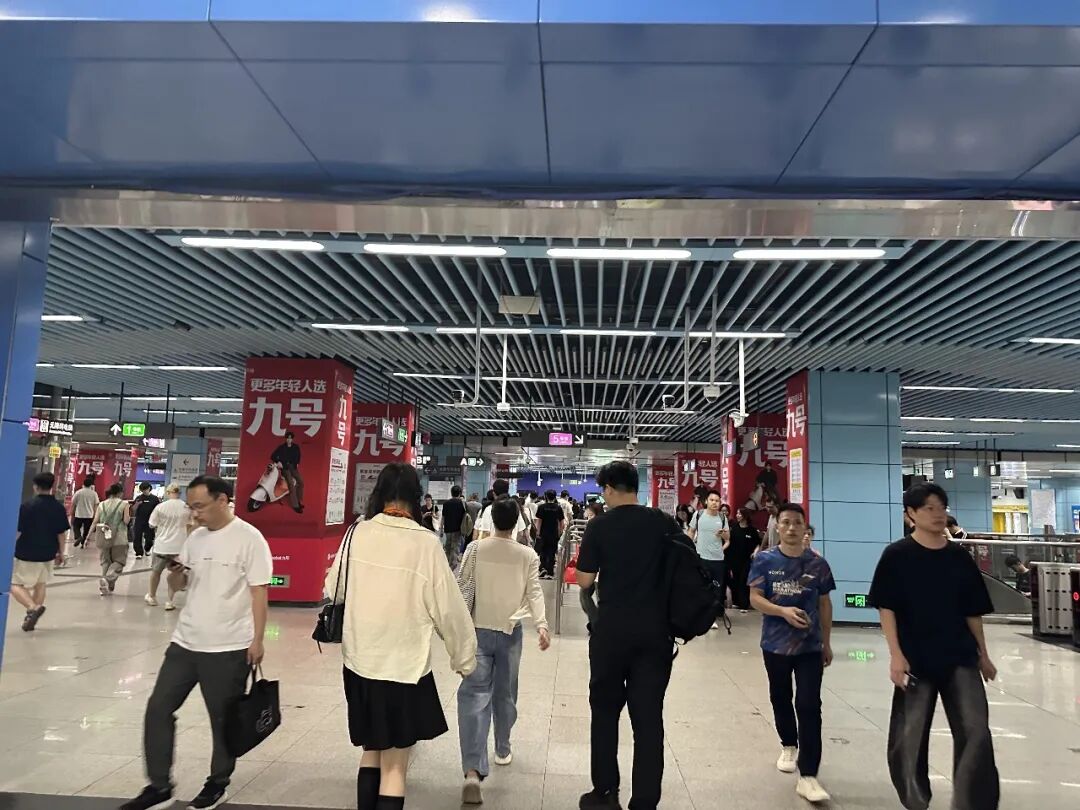
(Advertisements for electric two - wheelers in Shenzhen subway stations)
Looking at different cities, Shenzhen has the highest subway usage rate, while Hangzhou has the highest usage rate of two - wheel electric vehicles, and Shanghai has the lowest usage rate of two - wheel electric vehicles.
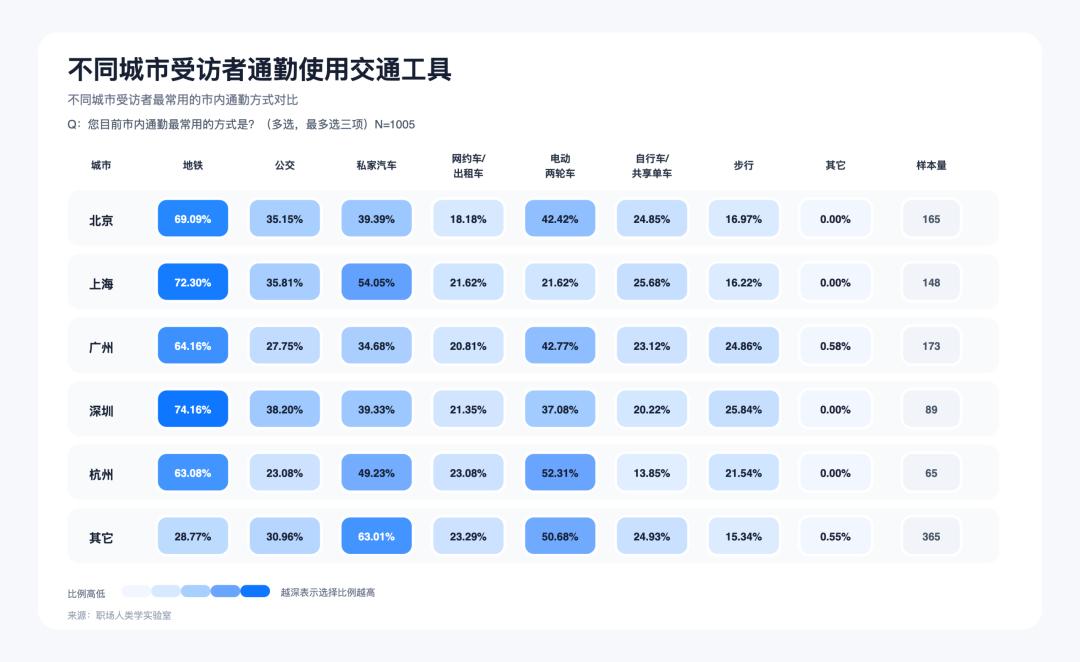
In non - first - tier cities (referred to as "others" in the above table), the usage rate of two - wheel electric vehicles exceeds 50%. The subway network density in non - first - tier cities is far lower than that in first - tier cities, and the coverage and frequency of the bus system are also difficult to meet the needs. At the same time, the road congestion level is increasing year by year. Against this background, electric vehicles, with their characteristics of being unrestricted by routes, not limited by schedules, and having low costs, have become a rational choice for working people in small and medium - sized cities.
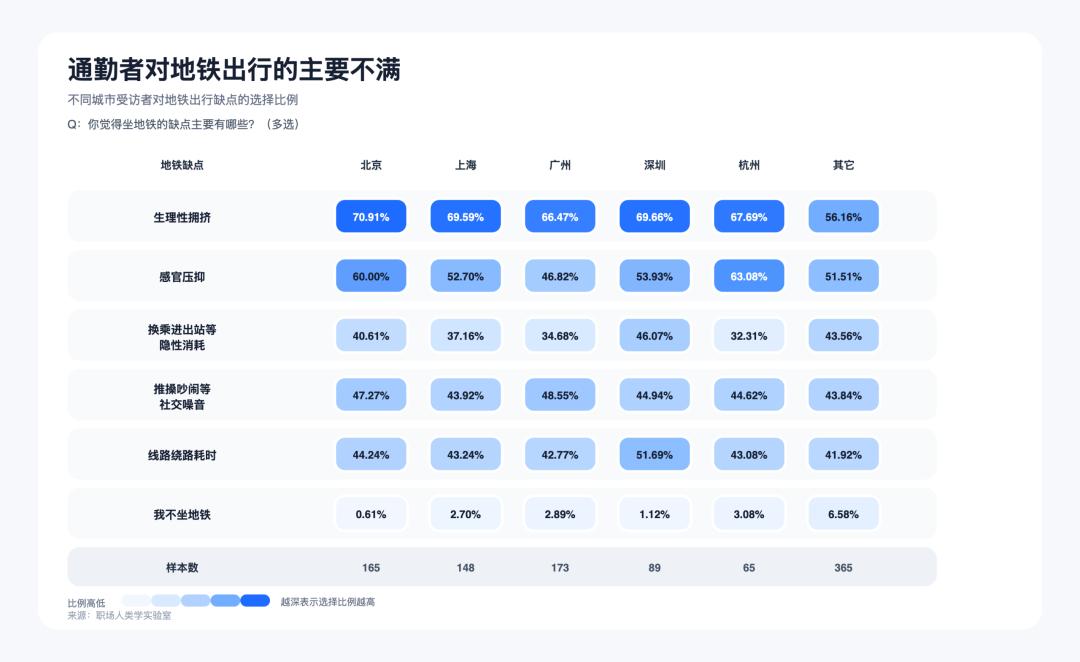
Once, people thought that subways represented an efficient and convenient urban life. But why do people still ride electric scooters when they have subways?
Physical overcrowding is the most important reason affecting people's subway rides. The subway is approaching its carrying limit during peak hours. It is worth noting that among the five cities, Shenzhen leads in all three indicators (crowding, detours, and hidden time consumption), and can be called the "most torturous subway". The shortest distance between two points is a straight line, but the subway has to make various detours and transfers. Coupled with time consumption such as security checks, entering the station, and walking during transfers, the efficiency of the subway is not as high as people once expected.
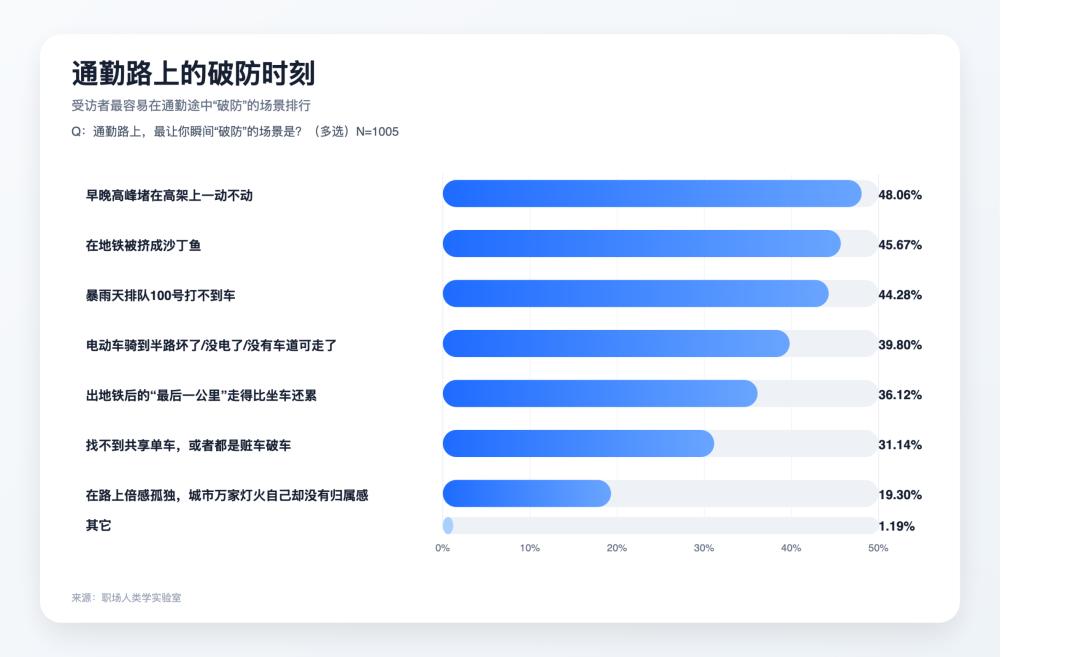
So, is taking a taxi or sitting in a privately - owned car with the air - conditioner on a sign of dignity?
Unfortunately, it's not. Among all the "breaking - down" scenarios on the commuting road, the top one is "being stuck on the overpass during the morning and evening rush hours and not moving at all". The congested surface road network often shatters the good mood of the "four - wheeled middle - class". Being stuck in a car, being crowded on the subway, and having to wait in a long queue when you want to take a taxi. Then, just ride a two - wheeler, but just hope not to encounter the situation where the vehicle runs out of power or breaks down halfway.
3. Two - wheelers Are No Longer Sidekicks, Welcome the "Dual - vehicle Travel" Era
In the past, the users of two - wheel electric vehicles might be a primary school teacher in a third - tier city, riding back and forth between home and school every day; or a repairman in a first - tier city, needing to shuttle between the warehouse, customers, and his residence.
For them, electric vehicles are not a "substitute" for subways. Electric vehicles fill a more basic gap: allowing ordinary people to have a controllable, affordable, and dignified commuting mode.
But it's not just that now.
A friend has two vehicles parked in his garage. One is an electric car bought three years ago, used for long - distance travel or taking the family to the suburbs for camping on weekends. The other is a two - wheel electric vehicle purchased last year, used for going to the company five kilometers away every day.
This combination is not uncommon in today's cities. The survey data shows that "two - wheel + four - wheel" has become a typical family travel configuration. People don't "buy two vehicles because they are rich", but because there has never been an either - or relationship between cars and electric vehicles.
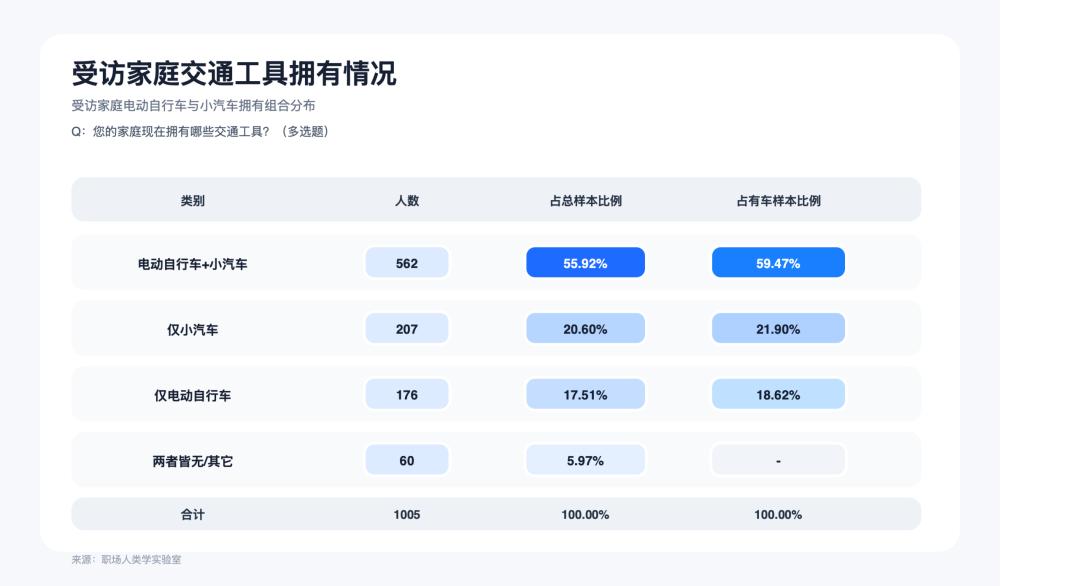
Normally, after buying a car, the commuting problem should be solved. But the data gives a completely different answer: The dual - vehicle ownership rate among people with cars reaches 60% (the number of people with two vehicles / the sample of people with cars), and the proportion of the 30 - 39 age group even climbs to 67%. This age group is in the "peak of heavy burdens" in life: having to take care of both the elderly and children, with the fastest work rhythm, and the highest sensitivity to time and efficiency.
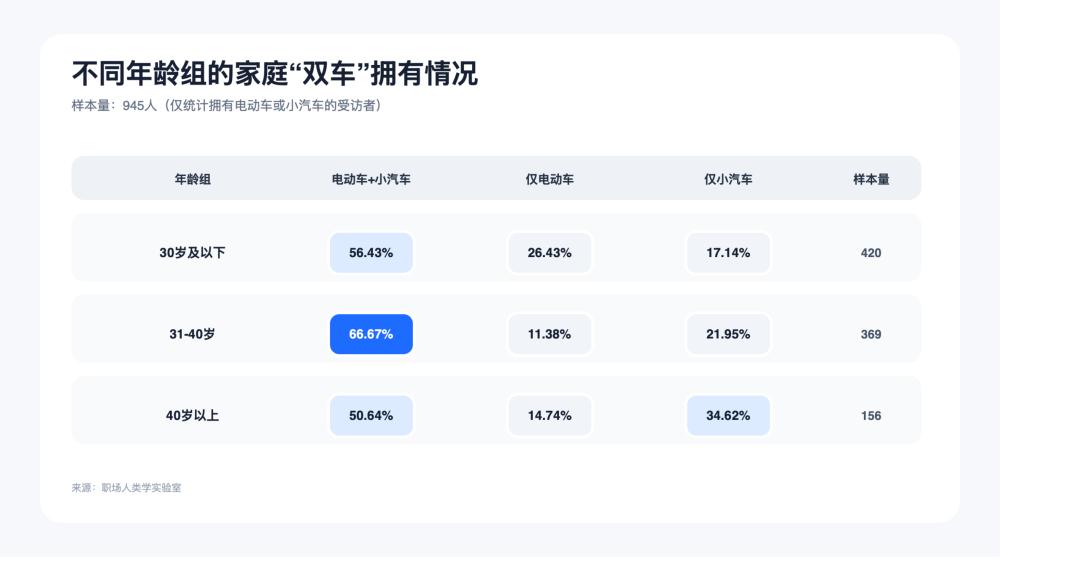
They need cars to ensure the dignity and safety of family travel, such as picking up and dropping off children, weekend shopping, and returning to their hometowns during holidays. These scenarios are beyond the capabilities of electric vehicles. But they also need electric vehicles to handle the trivial and high - frequency daily commuting, short - distance social activities in the evening, and even picking up and dropping off children in congested roads. Driving a car can be a burden instead. When calculating the comprehensive costs of oil prices, parking fees, and congestion, the cost - effectiveness advantage of electric two - wheelers is undeniable.
We must admit that in the past five years, electric two - wheelers have gradually risen from being sidekicks in transportation to being the main players, and have supplemented the deficiencies of private cars and public transportation. A "Two - wheel +" road scenario is taking shape.
4. Straddle the "Two - wheel Buddy" and Live a Concrete and Tangible Life, but with Order
In addition to practicality, cycling also has unexpected emotional value. A two - wheel journey after work has become a way to relieve workplace stress.
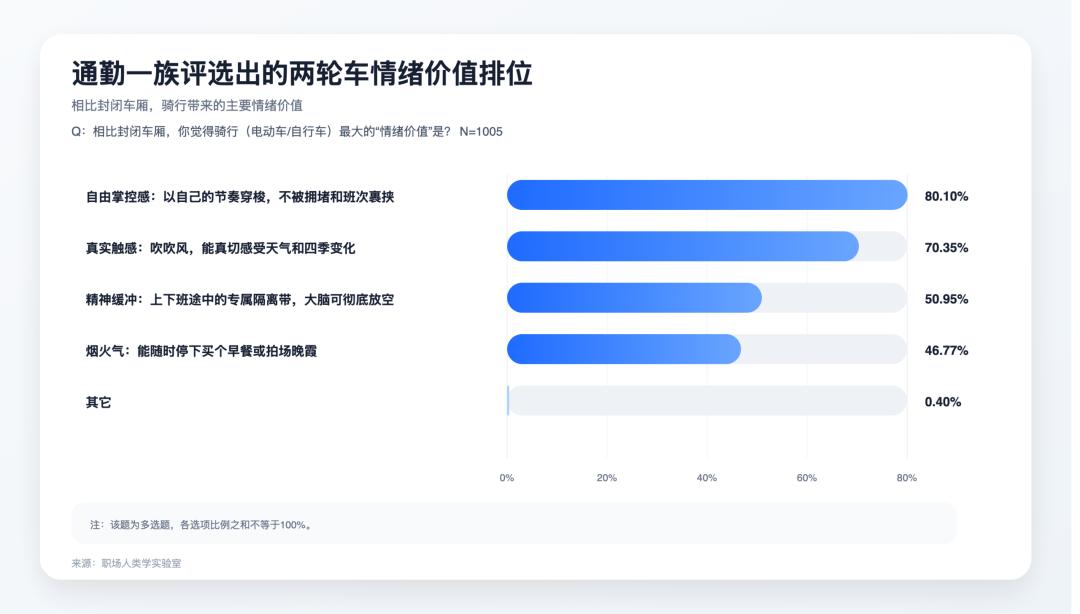
Why is cycling so addictive? Up to 80% of the respondents think that the greatest emotional value of cycling is the "sense of free control", which allows them to travel at their own pace, not restricted by congestion and schedules. Followed by 70% of the respondents who choose the "real feeling of the wind blowing".
After being immersed in