The 30-billion-yuan Chinese-style fried chicken market is seeing regional flavors take the industry by storm.
In recent years, driven by the dual forces of growing consumer demand and social media promotion, and with the advantages of high standardization, relatively lightweight operation models, and mature supply chain systems, the fried chicken market has witnessed strong development momentum. According to the big data of Hongcan, the national fried chicken market scale is expected to exceed 130 billion yuan in 2026.
Among them, as a rapidly emerging niche segment in recent years, Chinese-style fried chicken has explored a differentiated development path by catering to local consumer needs, tapping into local flavors, integrating traditional food culture, and creating lightweight store models. It is gradually becoming an important driving force for the growth of the fried chicken market.
So, what is the current development status of the Chinese-style fried chicken market in China? What are the development trends? And what opportunities and challenges does its future development face?
01. The market scale may exceed 30 billion yuan, and the market is shifting from "speed-up" to "quality-improvement"
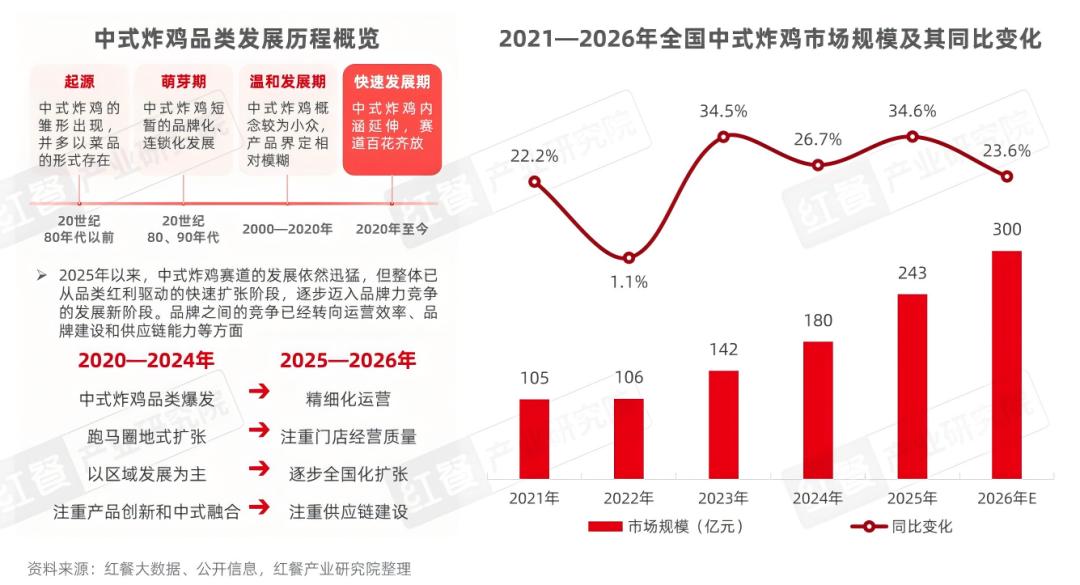
The development of the Chinese-style fried chicken market in China has generally gone through four main stages and entered a period of rapid development around 2020. Different from the early stage of the rapid development period, which was mainly characterized by store expansion and market education, since 2025, while maintaining a relatively fast growth momentum, the competition in the Chinese-style fried chicken market has gradually shifted from being driven by "category dividends" to being driven by "comprehensive capabilities." Brand power, operational efficiency, and supply chain capabilities are becoming the key factors determining brand competitiveness.
Against this backdrop, the Chinese-style fried chicken market as a whole maintains strong development vitality. According to the calculations of the Hongcan Industry Research Institute, the national Chinese-style fried chicken market scale will reach 30 billion yuan in 2026.
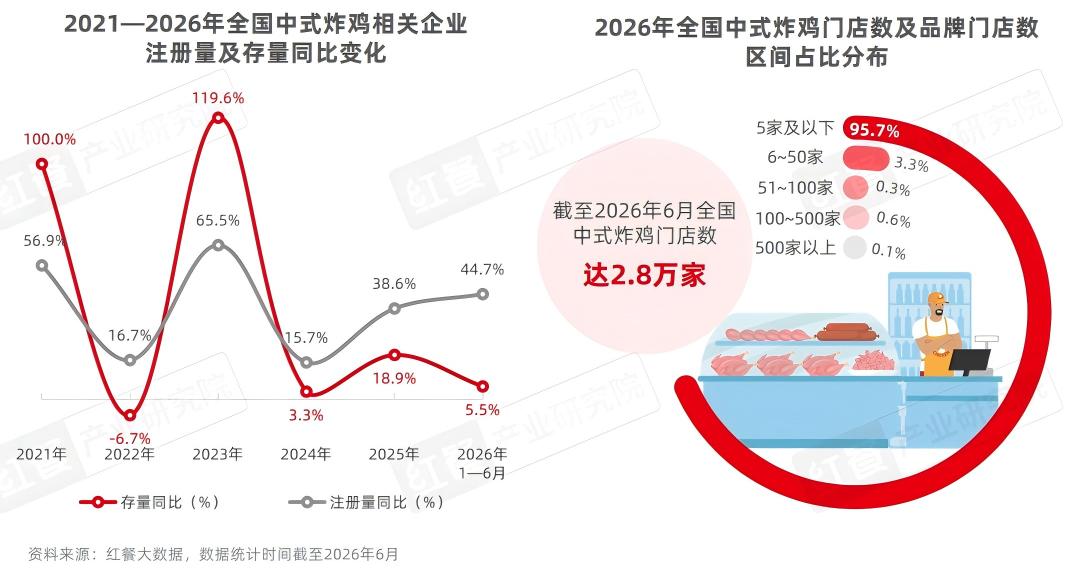
Looking at the development of market players, the number of Chinese-style fried chicken-related enterprises and stores has maintained a steady growth trend in recent years. According to Qichacha data, in 2025, the registration and existing numbers of Chinese-style fried chicken-related enterprises nationwide increased by 38.6% and 18.9% year-on-year respectively; from January to June 2026, the registration and existing numbers of related enterprises increased by 44.7% and 5.5% year-on-year respectively, indicating that the enthusiasm for starting a business in Chinese-style fried chicken remains high.
In terms of the number of stores, according to Hongcan big data, as of June 2026, there were 28,000 Chinese-style fried chicken stores nationwide. However, from the perspective of the overall market, the current Chinese-style fried chicken market is still in a relatively fragmented development stage, with brands having 5 or fewer stores accounting for 95.7%. There is still much room for improvement in the chain rate and market concentration.
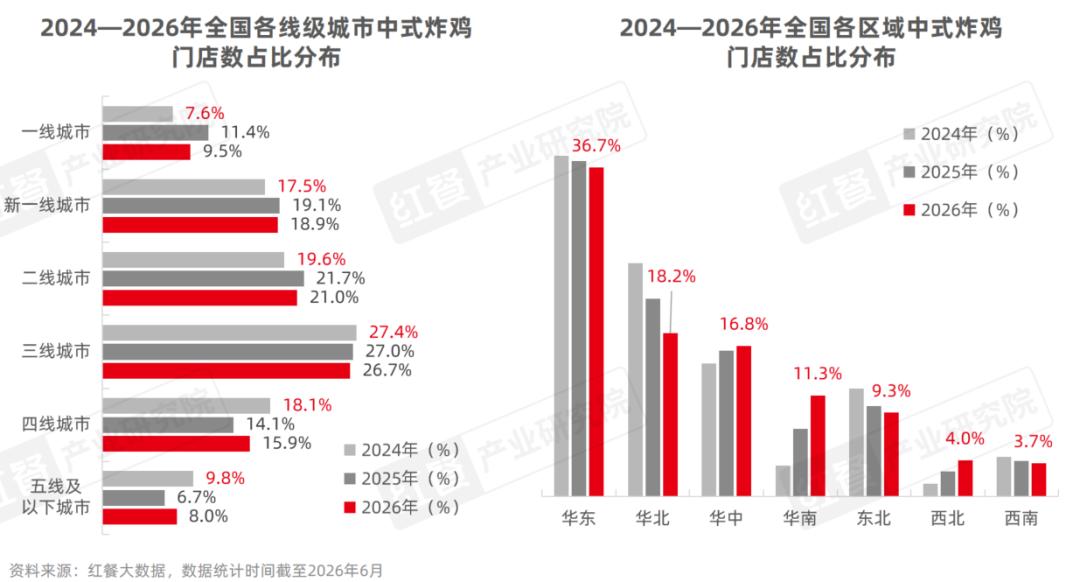
Looking at the distribution across different tiers of cities, the focus of the expansion of Chinese-style fried chicken stores has undergone a phased change. In 2025, the expansion of Chinese-style fried chicken stores favored first-tier, new first-tier, and second-tier cities, and the proportion of Chinese-style fried chicken stores in these three tiers of cities increased significantly compared to 2024. In 2026, this development trend reversed, and the proportion of Chinese-style fried chicken stores in fourth-tier, fifth-tier, and lower-tier cities increased to varying degrees.
Looking at the regional distribution, East China remains the region with the most concentrated Chinese-style fried chicken stores. However, in recent years, the proportion of stores in Central China, South China, and Northwest China has continued to increase, and the regional coverage of Chinese-style fried chicken is constantly expanding, with the market penetration further deepening.
As the coverage of Chinese-style fried chicken stores in cities and regions continues to expand, brand competition in the Chinese-style fried chicken market is intensifying, and a multi-tiered development pattern is gradually taking shape. According to Hongcan big data, as of June 2026, the number of national stores of "thousand-store brand" Linyu Fried Chicken Drumsticks has exceeded 5,100; the number of stores of Manweiming Raw Fried Chicken Frames, which focuses on raw fried chicken frames, has reached more than 840; Laohan Stir-Fried Chicken and Hutou Fried - Chaoshan Fermented Bean Curd Fried Chicken have become outstanding in their respective niche segments, with the number of stores exceeding 400 as of June 2026.
Meanwhile, brands such as Baozhanggui Raw Fried Chicken Frames, Yongxiang Fried Chicken, Guli Fried Chicken, Jingjin Fried Chicken, and Bafu Garlic-Flavored Fried Chicken have also maintained steady expansion, with more than 100 stores opened as of June 2026. However, some brands have experienced store contractions due to factors such as insufficient product innovation, brand aging, and lagging adjustment of business strategies.
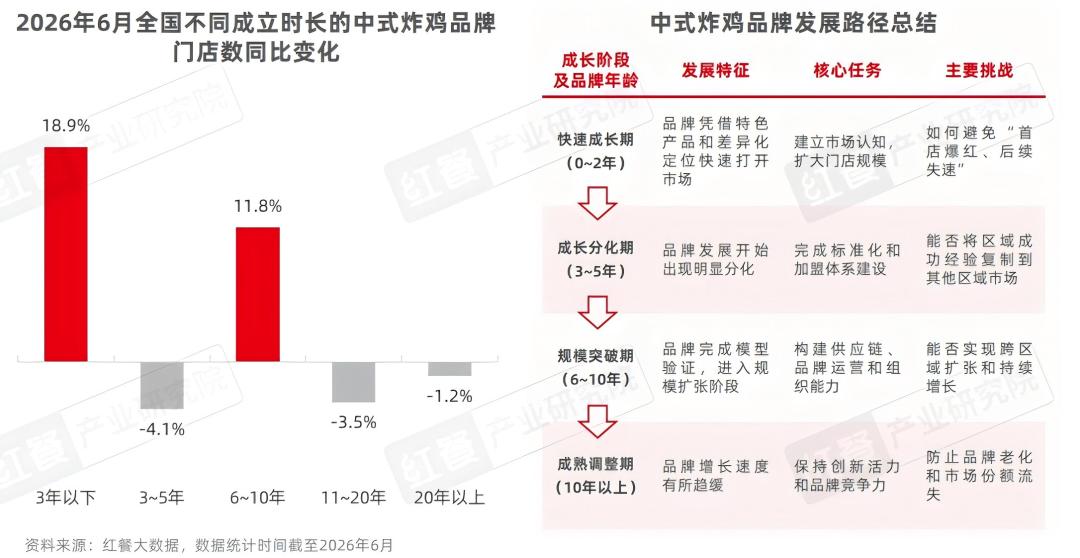
Behind the development performance of these different brands, there is an obvious differentiation in the growth rhythm of Chinese-style fried chicken brands. According to Hongcan big data, as of June 2026, among the sample brands, the number of stores of Chinese-style fried chicken brands established for less than 3 years and 6 - 10 years increased by 18.9% and 11.8% year-on-year on average, while the number of stores of Chinese-style fried chicken brands established for 3 - 5 years, 11 - 20 years, and more than 20 years decreased by 4.1%, 3.5%, and 1.2% year-on-year on average.
Overall, the Chinese-style fried chicken market is entering a stage of "the strong grow and the weak are cleared out." The growth dividends of the market are accelerating to concentrate on two types of brands: one is the emerging brands that have completed product market verification and entered the rapid growth stage; the other is the mature brands that have established a standardized store model and are gradually entering the scale expansion stage. In contrast, brands in the transformation and adjustment period or those that have not yet formed a mature business model face greater operational pressure and the risk of being eliminated.
In this process, a number of brands with both product features, operational capabilities, and large-scale expansion capabilities have gradually stood out and become representatives of the high-quality development of the Chinese-style fried chicken market.
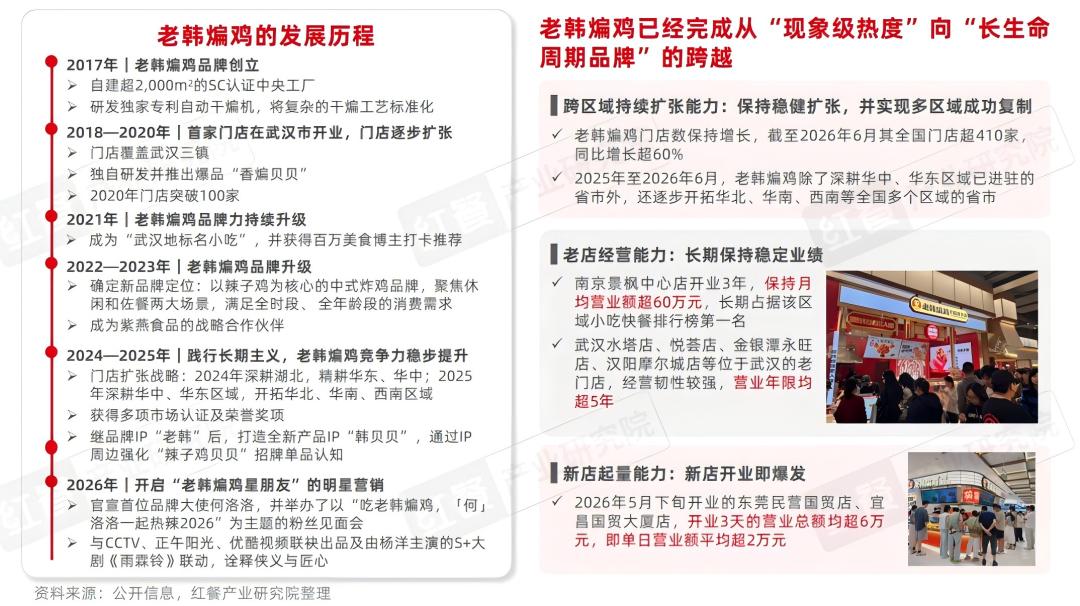
For example, Laohan Stir-Fried Chicken has made the classic Sichuan dish, stir-fried spicy chicken, a popular snack suitable for multiple consumption scenarios based on the "triple-frying and one-stirring" process, which is widely welcomed by the market. After an early stage of rapid growth, Laohan Stir-Fried Chicken now adheres to long-termism, continuously strengthens brand power, supply chain strength, and optimizes the store model to achieve continuous store growth.
From the perspectives of the operating performance of old stores, the ability to boost the performance of new stores, the cross-regional replication ability, and the continuous expansion ability, Laohan Stir-Fried Chicken has gradually got rid of its dependence on short-term traffic and the first-store bonus, demonstrating strong long-term operating ability and development resilience. It is evolving from a growth brand relying on a single popular product to a long-life-cycle brand with continuous growth ability.
02. Product refinement and interactive marketing: Chinese-style fried chicken enters a stage of systematic upgrading
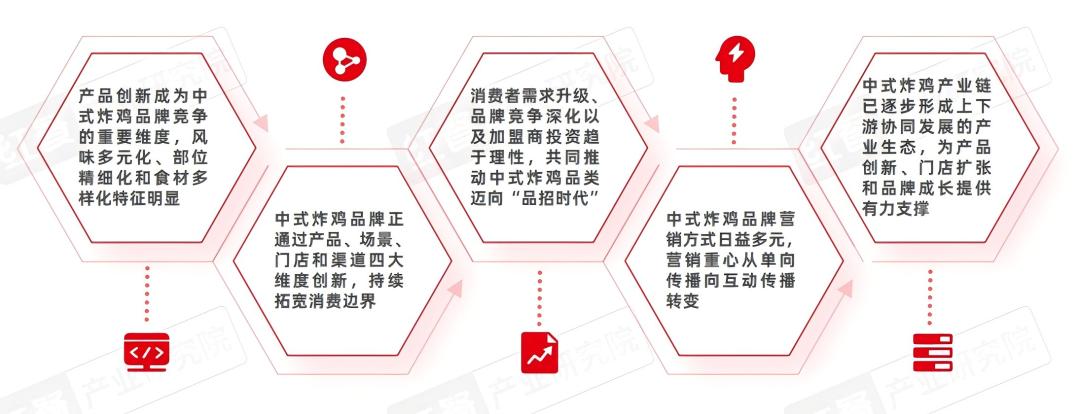
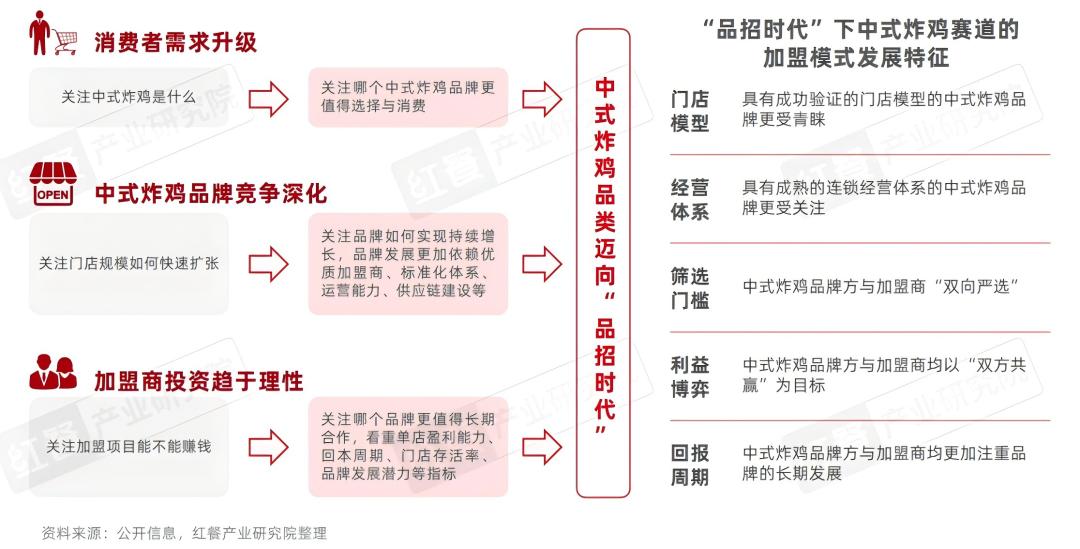
Driven by factors such as the upgrading of consumer demand, the deepening of industry competition, and the rationalization of franchisee investment, the Chinese-style fried chicken market presents five development characteristics: First, product innovation continues to be refined, with flavors, chicken parts, and ingredient structures becoming more diverse; second, brands continuously expand the consumption boundary through multi-dimensional innovation in products, scenarios, stores, and channels; third, the Chinese-style fried chicken market as a whole has entered the "franchise recruitment era"; fourth, brand marketing has shifted from one-way communication to two-way interaction and co-creation with users; fifth, the collaborative ability of the upstream and downstream industrial chains continues to improve, providing systematic support for product iteration and store expansion.
1. Product innovation of Chinese-style fried chicken brands continues to deepen, with obvious characteristics of diversified flavors, refined parts, and diverse ingredients
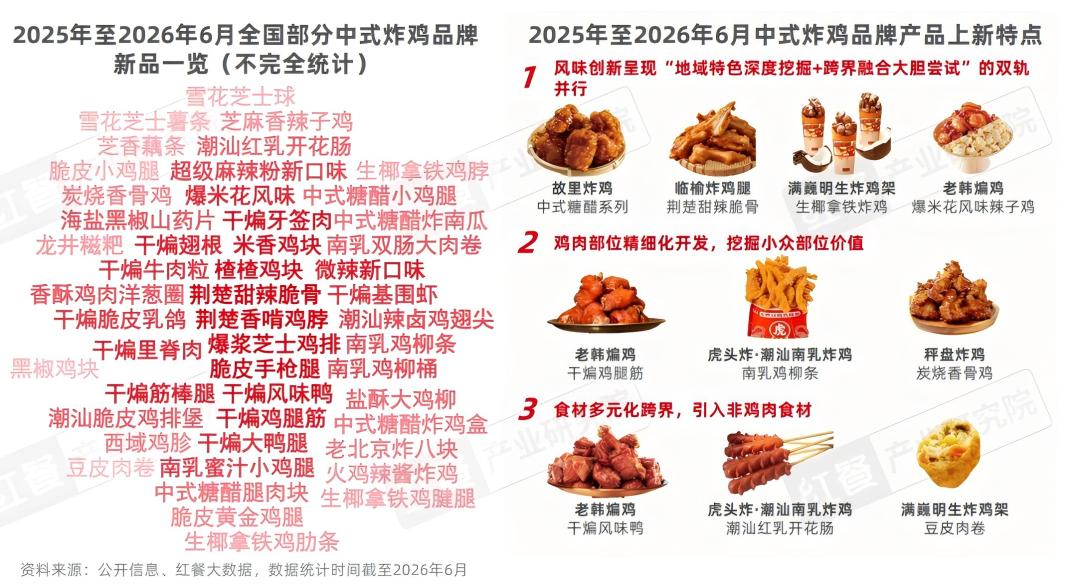
In recent years, product innovation has become an important strategy for Chinese-style fried chicken brands to enhance market competitiveness. According to the observation of the Hongcan Industry Research Institute, from 2025 to June 2026, several Chinese-style fried chicken brands, such as Laohan Stir-Fried Chicken, Hutou Fried - Chaoshan Fermented Bean Curd Fried Chicken, and Manweiming Raw Fried Chicken Frames, have maintained a stable product innovation rhythm.
From 2025 to June 2026, the new products of Chinese-style fried chicken sample brands presented three major characteristics. First, flavor innovation not only delved into local regional characteristic flavors such as those of Jingchu, Chaoshan, and Old Beijing but also integrated cross-border novel flavors such as coconut latte and popcorn. Second, there was a refined exploration of chicken parts, focusing on niche parts such as chicken tendon, chicken strips, and chicken cartilage to create characteristic single products. Third, the ingredient boundary continued to expand, introducing non-chicken ingredients such as duck meat, sausage, and bean curd roll to enrich the product matrix.
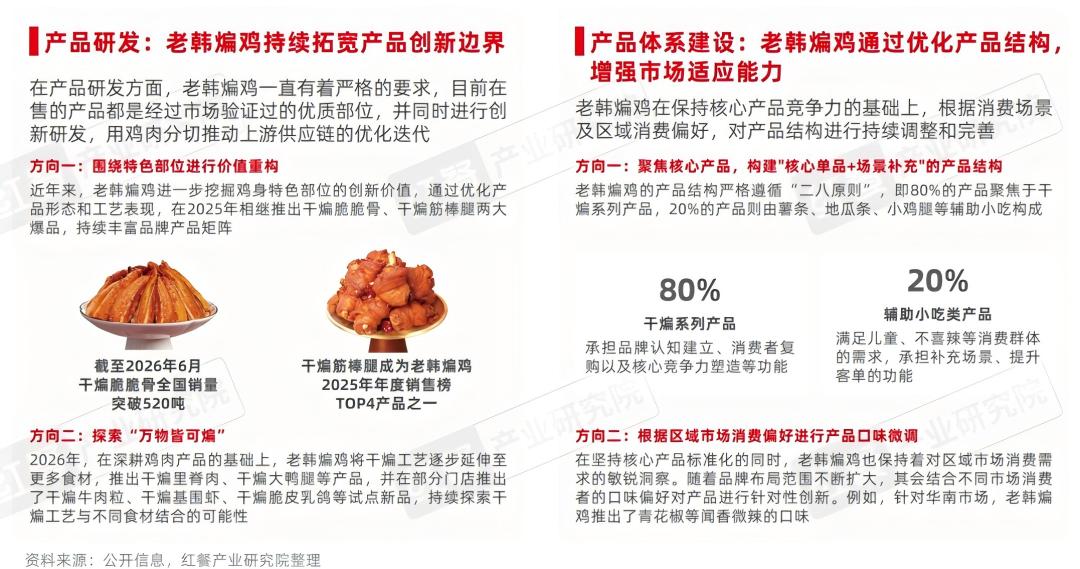
Taking Laohan Stir-Fried Chicken as an example, its product innovation has been upgraded from simple new product development to category innovation centered around the stir-frying process. Specifically, in recent years, Laohan Stir-Fried Chicken has gradually built a product innovation system of "everything can be stir-fried" by exploring the characteristic parts of the chicken, expanding the value development of the whole chicken, and extending the stir-frying process to more ingredients such as duck meat, beef, and seafood, providing new development ideas for product innovation in Chinese-style fried chicken.
Meanwhile, in terms of product system construction, Laohan Stir-Fried Chicken adheres to the development idea of focusing on core products. By constructing a product structure of "core single product + scenario supplement" and making appropriate local adjustments according to the taste preferences of consumers in different regions, it maintains brand characteristics and product focus while taking into account market adaptability and store profitability, achieving a balance between standardized replication and regional operation.
2. The upgrading of demand, the intensification of competition, and the rationalization of franchisee investment jointly drive the market towards the "franchise recruitment era"
According to the observation of the Hongcan Industry Research Institute, currently, Chinese-style fried chicken brands generally adopt a development model of "mainly franchise, supplemented by self-operation." They use the franchise system to quickly achieve market coverage and scale expansion, while self-operated stores mainly undertake functions such as brand display, operation verification, and model optimization.
As the Chinese-style fried chicken market gradually shifts from being driven by category dividends to being driven by brand competition, the expansion logic of brands is also changing. Compared with the past, which focused more on the number of franchisees and the speed of opening stores, more and more brands are now focusing on franchisee screening, the cultivation of multi-store operation capabilities, and the improvement of long-term store profitability, promoting the franchise system to shift from "emphasizing quantity" to "emphasizing quality." The Chinese-style fried chicken market is gradually entering the "franchise recruitment era" centered around the competition for high-quality franchisees.
In the context of the "franchise recruitment era," Chinese-style fried chicken brands are continuously optimizing the construction of the franchise system to promote higher-quality brand expansion. Taking Laohan Stir-Fried Chicken as an example, it has now formed a diversified store matrix including flagship stores, standard stores, image stores, island stores, and theme experience stores. Among them, standard stores have lower investment and operation thresholds due to their small area, flexible location selection, and streamlined staff configuration. They can achieve rapid replication while ensuring operational efficiency, providing support for brand regional expansion.
Meanwhile, Laohan Stir-Fried Chicken is promoting a new round of store image upgrading. Guided by the brand strategy, by optimizing the store visual image and customer experience, it further strengthens the value expression of the core product, "stir-fried spicy chicken," and continuously consolidates its leading position in the Chinese-style fried chicken market. The Hongcan Industry Research Institute learned that its new store image is expected to be officially launched in September 2026.
In terms of franchisee management, Laohan Stir-Fried Chicken has set up a relatively complete franchisee screening mechanism to improve the quality of franchisees through multiple access standards. Currently, the franchisees of Laohan Stir-Fried Chicken are mainly professional franchisees and multi-store franchisees. 35% of the franchisees have 2 - 3 stores, and some franchisees have 8 - 10 stores, reflecting strong franchisee recognition and store replication ability.
