AI voice giant hits IPO hurdles, accused by distributors of "overpromising"
"They painted a very grand blueprint for us... but after the goods arrived, there were endless quality control problems." Just as the AI voice giant SmartGen is making a second attempt to IPO, multiple distributors have "turned against" the company.
According to media reports, recently, some distributors have reported that SmartGen deliberately exaggerated the market prospects to induce them to stock up large quantities of goods in order to boost its revenue scale. Moreover, it recognized sales revenue in advance without completing the full product delivery cycle.
Some distributors directly stated that the aforementioned actions have brought them huge inventory pressure and sunk costs. Currently, some distributors have formally submitted reporting materials to the regulatory review authorities.
Beyond the storm, as a leading domestic conversational artificial intelligence enterprise, SmartGen achieved a revenue of 688 million yuan last year, a year-on-year increase of 14.47%. In the same period, the net profit attributable to the parent company recorded a loss of 57 million yuan, and the loss scale narrowed by 59.42% year-on-year. However, in the past seven years, the company has never achieved profitability, and the cumulative loss has exceeded 1.3 billion yuan.
Encountered "Backlash" from Distributors at a Crucial Time for the Second Listing
Tianyancha shows that SmartGen Technology Co., Ltd. was registered and established in October 2007. It is a professional domestic large - model conversational artificial intelligence platform enterprise, focusing on the R & D and application of intelligent human - machine interaction technology.
In 2022, SmartGen made its first attempt to list on the Science and Technology Innovation Board. However, after multiple rounds of inquiries, the listing review committee finally considered that the company failed to fully explain the rationality of the forecast of the compound annual growth rate of operating income for the next four years and failed to fully disclose the risk of negative net assets before listing. Therefore, the review of the company's listing application was terminated.
At the beginning of this year, SmartGen completed the tutoring record filing with the Jiangsu Securities Regulatory Bureau and intends to make a second attempt to IPO. On May 25, the company submitted an IPO application to the Science and Technology Innovation Board and it was accepted. Currently, the review status is "Inquired".
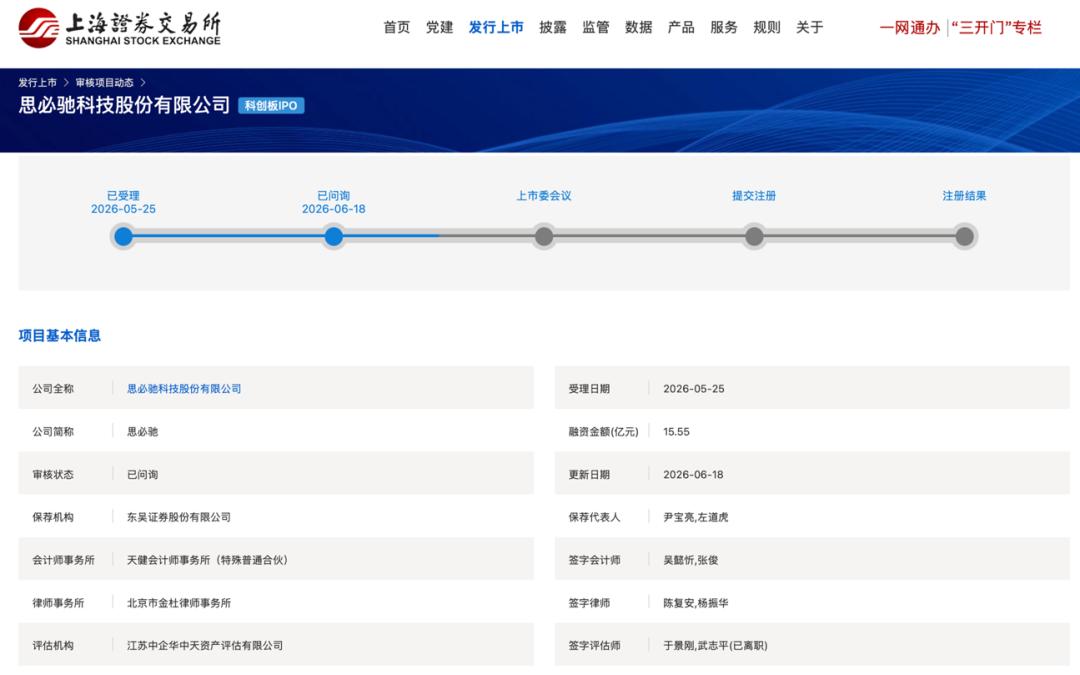
In this IPO, SmartGen plans to raise 1.555 billion yuan. Among them, 680 million yuan will be used for the "AI Software and Hardware - Software Integrated Solution Project", 325 million yuan for the "R & D and Upgrade Project of AI Intelligent Terminal Products", and 550 million yuan for the "R & D Center Construction Project".
However, just at a crucial stage when the company is preparing for the IPO, SmartGen has been involved in a dispute with its distributors.
According to a report by Yicai on June 25, three chip distributors of SmartGen reported in their real names that SmartGen and its holding subsidiary, Shencong Semiconductor (Jiangsu) Co., Ltd. (hereinafter referred to as "Shencong Semiconductor") had non - compliant and unethical business operations.
It is reported that these three distributors are Shenzhen Weihefeng Semiconductor Co., Ltd. (hereinafter referred to as "Weihefeng"), Lianxin Semiconductor (Shenzhen) Co., Ltd. (hereinafter referred to as "Lianxin Semiconductor"), and Shenzhen Donghengsheng Technology Co., Ltd. (hereinafter referred to as "Donghengsheng").
Among them, Weihefeng said that it has formally submitted reporting materials to the regulatory review authorities.
According to the recollections of several distributor managers, in the early stage of cooperation, the business personnel of Shencong Semiconductor claimed that the annual shipment volume of a single voice chip could reach tens of millions. At the same time, they detailed three implementation scenarios: after - sales remote controls, operator intelligent terminals, and leading household appliance brands to persuade distributors to use their own funds to stock up in large quantities.
However, the subsequent reality was that almost none of the cooperation with major communication customers promised orally by the company was realized. The actual demand in the household appliance terminal market was dismal. The chips purchased in large quantities by multiple distributors were finally overstocked in the warehouse and difficult to sell.
Specifically, the chips purchased by Lianxin Semiconductor in 2022 are still overstocked to this day and cannot be digested in four years, with the idle inventory cost approaching 860,000 yuan.
From 2022 to 2024, Donghengsheng purchased and fully paid for SmartGen's chip products with a total amount of more than 15 million yuan. However, SmartGen obstructed Donghengsheng from shipping chips worth nearly 7 million yuan by not providing the key (key), resulting in a large number of chips overstocked in the warehouse.
As for Weihefeng, it invested a large amount of manpower, R & D, and venue costs in the cooperation project, but finally incurred millions of yuan in sunk costs.
Wang Yu (pseudonym), the person in charge of Weihefeng, said, "At the beginning, they painted a very grand blueprint for us, claiming that the technology was mature and the chips would have no problem with sales. We placed an order for 5 million yuan of goods for the first time. But after the goods arrived, there were endless quality control problems."
Wang Yu revealed that the original distribution agreement between the two parties stipulated that the two sides would jointly build a technical team to complete the adaptation and development of Bluetooth chips and remote control products. However, by mid - 2024, SmartGen unilaterally withdrew all its technical personnel.
In order to digest the overstocked inventory and promote the implementation of products, Weihefeng had to pay out of its own pocket to build a dedicated R & D and operation team, bearing considerable expenses such as personnel salaries, venue costs, and travel expenses. Even for the chips for which the full payment had been settled, SmartGen still did not complete the full delivery. "We have millions of yuan worth of chips in our hands, but they refuse to provide the supporting keys," Wang Yu said.
Wang Yu believes that the root cause of the contradiction between the two sides lies in SmartGen's insufficient delivery ability and excessive exaggeration of the business prospects. "Their technology is not mature, they seriously underestimated the difficulty of chip implementation and delivery, and they fabricated cooperation resources. None of the mobile and radio and television operators, as well as leading household appliance customers such as Changhong and Konka, which were promised at the beginning, were finally realized."
As of now, SmartGen's official has not yet responded to this incident.
Leida Finance noticed that SmartGen disclosed in its prospectus that at the end of 2025, the company provisioned 3.4133 million yuan for bad debts against Weihefeng, with a provision ratio of 100%. The basis for the provision was "poor business conditions of the customer and the expected inability to recover the debt".
However, this statement was denied by Weihefeng. Wang Yu clarified that the company's unpaid balance was only more than 1.4 million yuan, and it was not because of its poor business conditions that it was unable to pay. Instead, there were major cooperation disputes between the two sides, so the settlement was postponed.
Wang Yu said, "The other party has made false descriptions of our business conditions in the public IPO materials. We have prepared to file a civil lawsuit for reputation rights to safeguard our rights in accordance with the law."
Loss of Over 1.3 Billion in Seven Years, Asset - Liability Ratio Exceeds 67%
As a leading domestic conversational artificial intelligence enterprise, SmartGen's revenue has maintained stable growth in recent years.
According to Flush iFinD, from 2019 to 2025, SmartGen's revenue increased from 115 million yuan to 688 million yuan. However, in the past two years, the company's revenue growth rate has been less than 15%, significantly slower than before.
As for the profit indicator, from 2019 to 2025, SmartGen's cumulative net profit attributable to the parent company recorded a loss of 1.302 billion yuan. Among them, the net profit attributable to the parent company last year was a loss of 57 million yuan, and the loss scale narrowed by nearly 60% year - on - year.
Last year, SmartGen's gross profit margin reached as high as 63.24%, a year - on - year increase of 5.43 percentage points, setting the highest record since 2021.
In this regard, SmartGen explained in its prospectus that during the reporting period, in terms of AI software and technical services, the company reduced the integrated customized development business with a relatively low gross profit margin. In terms of AI hardware, the company strengthened the R & D and promotion of its own brand products. With the adjustment of the company's business strategy and product structure, the overall gross profit margin showed an upward trend.
It is worth noting that last year, the company's R & D expenses were 254 million yuan, a year - on - year decrease of 4.08%. The proportion of R & D investment in operating income decreased by more than 7 percentage points to 36.86%.
In the same period, the company's business promotion expenses increased by 162.41% year - on - year to 23 million yuan, mainly because the company increased the promotion efforts on e - commerce platforms such as Douyin and JD.com. However, SmartGen emphasized that the company's relevant e - commerce revenue also increased.
As of the end of 2025, SmartGen's asset - liability ratio was as high as 67.36%. Although it has narrowed significantly compared with 105.52% at the end of 2023, it is still at a relatively high level.
As of the end of 2025, the company's total current assets were 733 million yuan, a year - on - year increase of 23.77%.
Among them, accounts receivable increased by 20.83% to 325 million yuan, inventory doubled to 103 million yuan, and the book monetary funds were almost the same as last year, at 198 million yuan.
As of the end of 2025, the net book value of accounts receivable accounted for 44.42% of current assets, and the book value of inventory accounted for 14.04% of current assets.
Regarding the former, SmartGen said that as the company's business scale expands, accounts receivable may continue to increase. Although the company's customers have good creditworthiness, accounts receivable with a relatively high amount still carry the risk of bad debt losses for the company due to the inability to collect them in a timely manner. If the financial conditions of downstream customers change, it may lead to the failure to fully collect accounts receivable, which in turn will have an adverse impact on the company's future performance.
Regarding the latter, SmartGen said that in recent years, the sales volume of the company's own brand products has been continuously increasing, and the company's ending inventory balance has continued to rise. If the company fails to accurately predict changes in market demand in the future or improper production management leads to product overstock and raw material overstock, it may lead to the risk of an increase in inventory write - down provisions.
Meanwhile, the company's current liabilities increased by 19.88% to 560 million yuan. Among them, short - term borrowings increased by 59.17% to 321 million yuan, and non - current liabilities due within one year decreased by 9.69% to 45 million yuan.
Focusing on Three Major Fields, the Chip Business Subsidiary Continues to Lose Money
Leida Finance learned from the prospectus that currently, SmartGen's business system consists of two parts: the "Intelligent Customization Middle Platform DUI" and the "Vertical Domain Business Product Service System", which work together to achieve large - scale delivery of standardized software and hardware products and services in the three vertical domains of smart travel, smart office, and smart IoT.
In the field of smart travel, the company's products have been installed in more than 25 million vehicles in total, and are installed in nearly 300 mass - produced models of automobile companies such as BYD, Mercedes - Benz, SAIC Group, and Geely Group.
According to the on - board voice supplier installation volume ranking released by the Gasgoo Automotive Research Institute, based on domestic vehicle terminal sales data, the company's domestic market share reached 22% in 2025, ranking second in the industry, an increase of more than 15 percentage points compared with 6.8% in 2023.
In the fields of smart office and smart IoT, SmartGen also has many partners such as Huawei, Alibaba, Xiaomi, Midea, Hisense, ZHIYUAN, Galaxy General, Ecovacs, and Dreame.
According to SmartGen, the company has full - stack capabilities from underlying chips, end - side intelligence to upper - layer application scenarios, and can empower various intelligent terminals on a large scale, mainly manifested in the full - link end - cloud collaborative dialogue system capability, the hardware - software integrated system construction capability, and the large - scale personalized customization capability.
The prospectus shows that the company's self - developed AI chips have an average annual shipment volume of more than 60 million, and typical customers include companies such as Midea and Haier.
Leida Finance noticed that in recent years, SmartGen's total hardware procurement volume has continued to rise. In 2025, the company spent nearly half of its procurement budget on hardware procurement, with a total amount of 192 million yuan, about 2.34 times that in 2023.
Among them, the company's procurement amount for chips last year was 67 million yuan, almost doubling compared with 2023, accounting for 15.63% of the total procurement amount.
It is worth mentioning that Shencong Semiconductor mentioned above is SmartGen's chip business subsidiary, mainly responsible for the R & D and sales of artificial intelligence chips.
As of the signing date of the prospectus, SmartGen directly holds 40.49% of the equity of Shencong Semiconductor and is the latter's largest shareholder.
In 2025, Shencong Semiconductor achieved a revenue of 37 million yuan and recorded a net loss of 32 million yuan. As of the end of 2025, Shencong Semiconductor's net assets were - 122 million yuan.
SmartGen admitted that Shencong Semiconductor is expected to remain in a loss - making state in the short term, which will have an adverse impact on the company's profitability. Therefore, the company faces the risk of continuous losses in the coming period.
How will SmartGen officially respond to this distributor incident in the future? Leida Finance will continue to pay attention.
This article is from the WeChat public account "Leida Finance", author: Ding Yu, editor: Meng Shuai. Republished by 36Kr with authorization.