Shenzhen's "little giant" semiconductor memory firm gears up for IPO, serving clients including Micron and YMTC
Since the second half of 2025, the memory chip industry has been entering a "super cycle".
As AI increases the demand for computing power, storage performance will directly determine the implementation efficiency of AI applications. Memory chips have become a strategic resource for the development of the AI industry. Against this backdrop, leading manufacturers such as Micron have witnessed a surge in performance.
As one of the world's largest consumer markets for memory chips, China's domestic supply capacity remains weak, and there is an urgent need for self - control in core areas. Recently, a semiconductor memory company from Shenzhen has applied for an IPO.
According to Gelonghui, on June 25, the Shenzhen Stock Exchange accepted the IPO application of Shenzhen Shichuangyi Electronic Co., Ltd. (referred to as "Shichuangyi"), which plans to list on the Growth Enterprise Market. The sponsor is CITIC Securities.
Shichuangyi is a national key "little giant" enterprise specializing in specialized and sophisticated technologies. It is mainly engaged in the R & D, packaging, testing, production, and sales of semiconductor memories. Its products are mainly used in fields such as AI intelligent terminals, intelligent robots, intelligent vehicles, industrial and medical equipment, and it has actively deployed products for AI data center storage and automotive - grade storage.
01 A Memory Company in Bao'an District, Shenzhen, Aims for IPO with a Valuation of 6.38 Billion Yuan
Shichuangyi is registered in Xinqiao Street, Bao'an District, Shenzhen. Its predecessor, Shenzhen Shichuangyi Co., Ltd., was established in 2008 by Ni Huangzhong and Jiang Chunyuan. In 2024, it was transformed into a joint - stock company.
As one of the few independent memory chip module manufacturers in China with the ability to cover from memory chip packaging to product manufacturing, Shichuangyi's main products are divided into two categories: embedded memory chips and memory modules. In 2025, the revenue shares of these two products were 59.53% and 40.47% respectively.
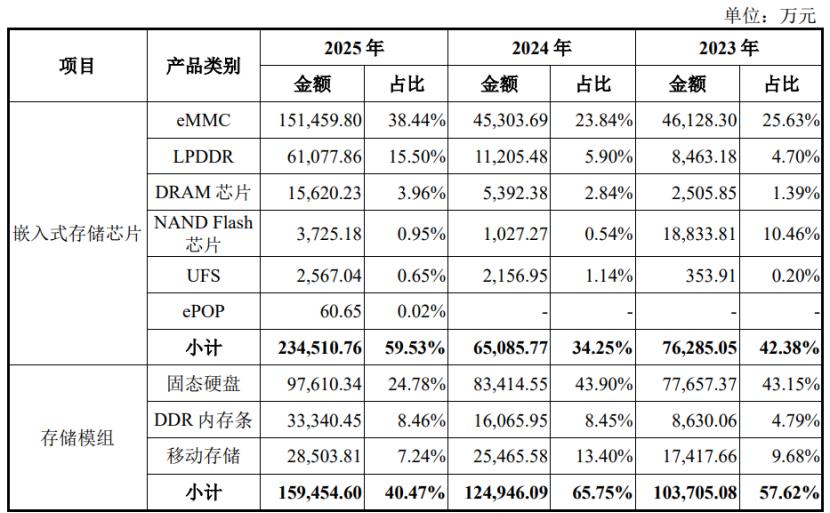

The composition of the company's main business revenue classified by business type. The picture is from the prospectus.
Among them, the company's embedded memory chip product types cover eMMC, UFS, LPDDR5X/4X, ePOP, etc., and are widely used in fields such as smartphones, AIPC, smart tablets, smart TVs, smart wearables, automotive applications, panoramic cameras, educational electronics, drones, robots, and 5G modules;
The memory module products include solid - state drives, memory modules, and mobile storage, and are mainly used in fields such as AIPC, monitoring equipment, intelligent educational equipment, e - sports equipment, and in - vehicle applications.
Shichuangyi's subsidiaries include Shutiuxin, Hong Kong Shichuangyi, Huiyi Semiconductor, Hefei Shichuangyi, etc. Its registered capital at the time of establishment was 100,000 yuan. After years of development, its valuation reached 6.38 billion yuan when the last round of capital increase was completed in December 2025.
Before this issuance, the couple Ni Huangzhong and Li Mufei jointly controlled about 60.49% of Shichuangyi's shares and are the controlling shareholders and actual controllers. At the same time, Guotong Zhaoxin, Xiaomi Zhizao, Zibo Ruiye, Jiaxing No. 1, etc. are all shareholders of the company.
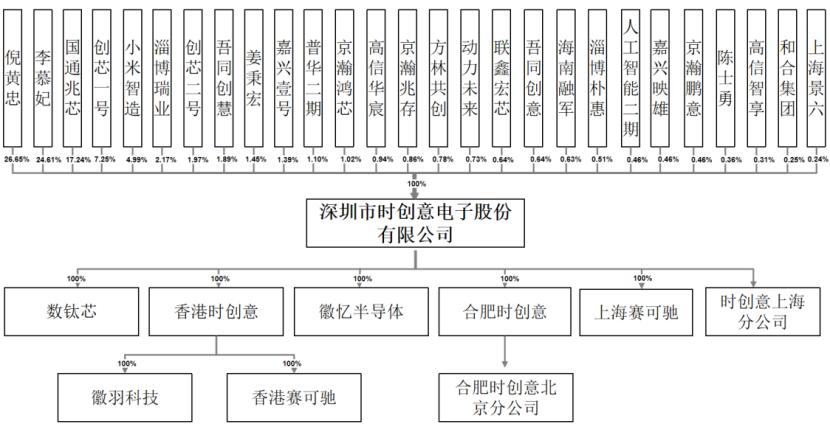
The company's equity structure. The picture is from the prospectus.
Currently, Ni Huangzhong serves as the chairman and general manager of Shichuangyi. He was born in 1979 and has a bachelor's degree. Ni Huangzhong has served as an engineer, engineering supervisor, and engineering manager at Shenzhen Yongjiabao Industrial Co., Ltd. Later, he founded Shenzhen Shichuangyi Co., Ltd. and served as the executive director, chairman, and general manager.
Li Mufei was born in 1978 and has a master's degree. She has served as the PMC supervisor at Shenzhen Yongjiabao Industrial Co., Ltd., managed Shenzhen Bao'an Shajing Shichuang Electronics Factory, and also served as the deputy general manager, supervisor, and director of Shenzhen Shichuangyi Co., Ltd. Now she serves as a director and the person in charge of risk control and compliance at Shichuangyi.
In this IPO, Shichuangyi plans to raise 1.842 billion yuan for the semiconductor memory expansion project, the Shichuangyi R & D center expansion project, and to supplement working capital.
02 Performance Soars Amid High - Growth in the Memory Industry, Turning a Profit in 2024
In the past two years, affected by the rising market of the memory industry, the optimization of the company's product structure, the completion of the storage integrated circuit industrial base, and the implementation of advanced production capacity, Shichuangyi's performance has increased significantly.
During 2023, 2024, and 2025 (referred to as the "reporting period"), Shichuangyi's operating revenues were approximately 1.977 billion yuan, 2.218 billion yuan, and 4.271 billion yuan respectively, and the corresponding net profits were - 23.8903 million yuan, 29.7082 million yuan, and 577 million yuan respectively.
During the reporting period, the company's comprehensive gross profit margins were 11.88%, 15.42%, and 24.26% respectively, showing an increasing trend. This is mainly due to the recovery of terminal application demand in consumer electronics and other fields, the warming of the memory industry, and the rising prices of memory products.
In 2025, Shichuangyi's comprehensive gross profit margin was higher than that of comparable companies in the same industry such as Jiangbolong, Baiwei Storage, and Demingli.
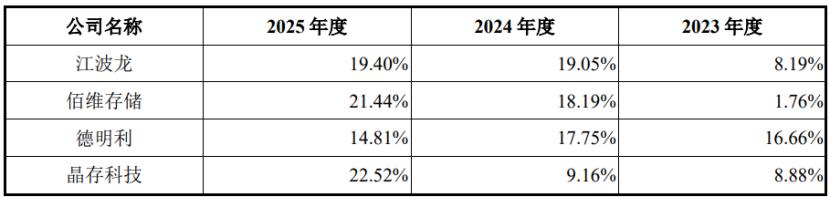

The comparison of the company's gross profit margin with that of comparable companies in the same industry. The picture is from the prospectus.
Currently, the semiconductor memory industry is in a period of rapid technological evolution. Memory design and manufacturing enterprises need to continuously invest in R & D to promote product upgrading and new technology development to adapt to the changes in downstream applications and the evolution of industry technology routes.
During the reporting period, Shichuangyi's R & D expenses were approximately 83 million yuan, 110 million yuan, and 145 million yuan respectively, accounting for 4.18%, 4.94%, and 3.39% of the operating revenues respectively.
The upstream of the memory product industry chain focuses on the supply of basic resources, mainly including memory wafer manufacturing and main - control chip design;
The mid - stream is the core manufacturing and integration link, responsible for the R & D, design, packaging, testing, and manufacturing of memory solutions;
The downstream covers a diverse range of terminal application markets, including AI edge devices, consumer electronics, automotive electronics, servers, etc.
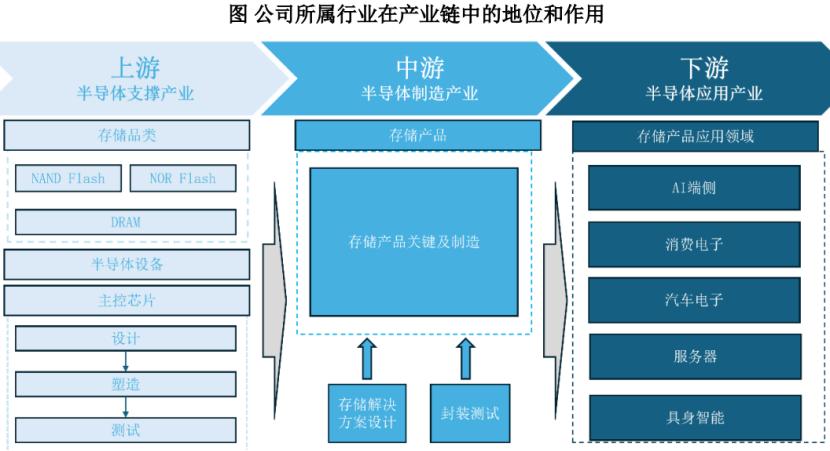
The picture is from the prospectus.
Shichuangyi's core raw materials are NAND Flash wafers and chips, DRAM wafers and chips, and the global memory wafer production capacity is highly concentrated among a few leading manufacturers.
The company has established cooperative relationships with well - known international memory wafer manufacturers such as Samsung, Micron, SK Hynix, Kioxia, and SanDisk, as well as domestic leading memory wafer manufacturers such as YMTC and CXMT.
During the reporting period, the procurement proportion of the company's top five suppliers was 66.61%, 70.1%, and 65.69% respectively, indicating a high degree of concentration. At the same time, when there is a temporary mismatch between supply and demand in memory wafers, the price will fluctuate continuously, and Shichuangyi faces the risk of raw material price fluctuations.
In terms of downstream customers, in the smartphone field, Shichuangyi's products have been applied to brands such as ZTE, TCL, Honor, Nokia, and Transsion; in the PC field, the company's products have been applied to brands such as HP, Lenovo, ASUS, Acer, Dell, Xiaomi, Sugon, Unis, iSoftStone, and Inspur Information.
It is worth noting that the semiconductor memory industry in which Shichuangyi operates is affected by global macro - economic fluctuations, changes in downstream application market demand, production capacity, and inventory cycles, and has a strong cyclical nature.
The memory chip industry also has a significant cyclical nature. The supply side of the industry is highly concentrated, and the expansion progress of major wafer manufacturers is often lagging. The production capacity release cycle is long. It is easy to form a situation of tight supply and rapid price increases during the period of rising demand. After the concentrated release of production capacity, it may quickly turn to oversupply and price decline.
In the future, if the macro - economic outlook is less than expected, the memory industry's prosperity declines, or market competition intensifies, it may lead to a decline in Shichuangyi's product gross profit margin, thereby affecting its operating performance.
At the end of each period in the reporting period, Shichuangyi's inventory book value soared from 1.067 billion yuan to 2.358 billion yuan, and the proportion of inventory in the company's total assets also increased from 57.28% to 58.09%. The company has a large inventory scale and faces the risk of inventory write - down.
Due to the company's strategic procurement strategy for key raw materials such as memory wafers, the cash expenditure for raw material procurement was relatively high during the reporting period, and there was a situation where the net cash flow from operating activities was negative.
03 China's Memory Chip Market is Huge, but the Self - Sufficiency Rate is Low
In terms of technical composition, memories can be divided into two major categories: volatile memories and non - volatile memories.
Volatile memories are represented by random - access memory (RAM), mainly including dynamic random - access memory (DRAM) and static random - access memory (SRAM). Data in this type of memory will be lost when the power is cut off.
Non - volatile memories can still store information for a long time after the power is cut off. Common types include programmable read - only memory (PROM), erasable programmable read - only memory (EPROM/EEPROM), and flash memory (Flash).
Among them, the DRAM and NAND Flash memory fields in which Shichuangyi is mainly engaged are the mainstream markets for memories.
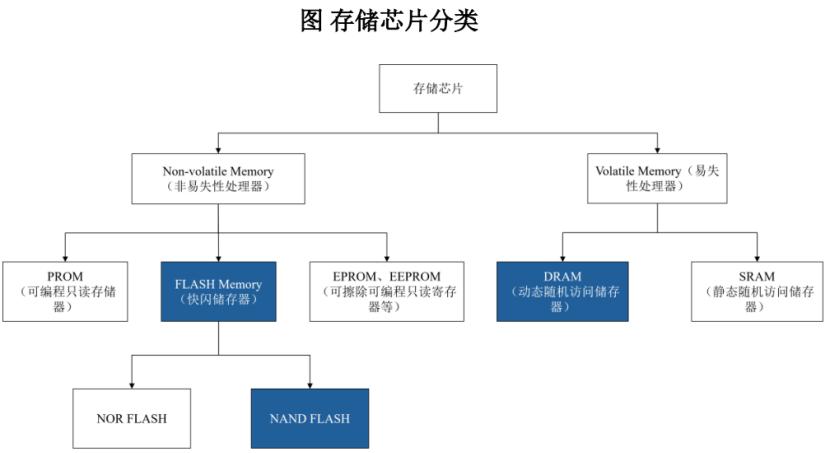
The picture is from the prospectus.
In the past two years, driven by the strong demand of AI, the global market scale of DRAM and NAND Flash has continued to rise.
According to CFM Flash Market data, in 2025, the global DRAM market scale reached 150.8 billion US dollars, a year - on - year increase of 54.87%; during the same period, the global NAND Flash market scale was 70.7 billion US dollars. Driven by these two segments, the global memory market scale has risen for four consecutive quarters.
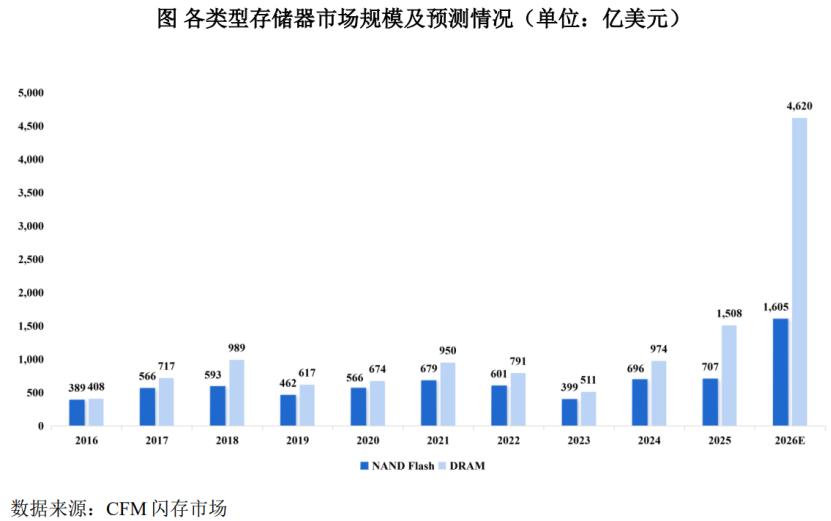
The picture is from the prospectus.
According to data from the China Business Industry Research Institute, in 2025, the market scale of China's semiconductor memory was approximately 458 billion yuan, a year - on - year increase of 7.34%, and it is expected to reach 488.8 billion yuan in 2026.
In 2025, the Chinese mainland was the world's largest single consumer market for memory chips. According to TrendForce data, the Chinese mainland's shares in the DRAM and NAND markets were 26% and 30.72% respectively.
The global memory market share is highly concentrated, mainly held by international memory manufacturers such as Samsung, SK Hynix, Micron, Kioxia, and SanDisk, as well as domestic memory manufacturers such as YMTC and CXMT. China's memory chip market is huge, but the self - sufficiency rate is low, and there is still much room for improvement.
Among them, the DRAM memory market is mainly monopolized by Samsung, SK Hynix, and Micron. According to Omdia data, in 2025, the market shares of the three companies were 33.96%, 34.48%, and 23.41% respectively, and CXMT's market share rose to 7.67%.
According to CFM Flash Market data, in 2025, the market shares of the top