The world's first "global standard" for autonomous driving has been officially implemented: led by China, L3 and L4 autonomous driving are entering a new phase of road application.
From June 22nd to 26th, 2026, the 199th Plenary Session of the United Nations World Forum for Harmonization of Vehicle Regulations was held in Geneva, Switzerland. At the meeting, the United Nations Global Technical Regulations for Automated Driving Systems, jointly led by China, the European Union, the United Kingdom, the United States, Canada, and Japan, were officially approved and released after a vote by all contracting parties.
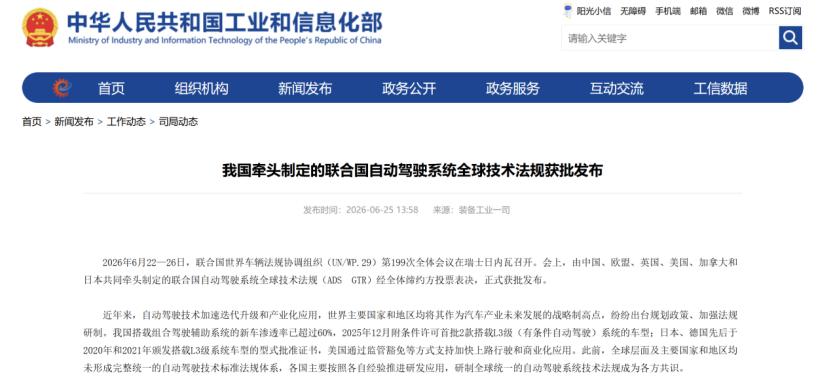
The Ministry of Industry and Information Technology stated that this is the world's first technical regulation for automated driving, providing a unified guideline for the orderly and safe implementation of automated driving technology. The United Nations Economic Commission for Europe confirmed that the relevant contents included in the regulation will come into effect successively in about a month.
▍From "Fragmented" Regulation to a Global Unified Framework
Before this, the global automated driving was in a state of "fragmented" standards. Countries advanced R & D and application based on their own experiences. Japan issued a type - approval certificate for L3 - level automated driving to Honda Legend in 2020, Germany followed in 2021, and the United States gave the green light to enterprises through regulatory exemptions. In December 2025, China conditionally permitted the first two models, Changan Shenlan and BAIC ARCFOX, equipped with L3 - level systems. The consequence of the non - unified regulatory rules is straightforward. To sell a car in different countries, it has to be adapted to different standard systems. The European Union, the United States, Japan, and South Korea have each established their own access systems, forcing car manufacturers to conduct repeated tests.
In 2018, WP.29 newly established the Working Party on Automated and Connected Vehicles (GRVA), with China serving as the vice - chair country. After five years, a series of achievements such as safety requirements for automated driving systems and guidelines for test and evaluation methods were formed. Subsequently, the Working Group on Automated Driving Systems was officially established to be responsible for the compilation of global technical regulations.
China's role in these eight years is more than just a simple "participant". As the vice - chair country of GRVA and the co - chair country of ADS IWG, the Ministry of Industry and Information Technology organized institutions such as the China Automotive Technology and Research Center and the China Academy of Information and Communications Technology to participate in all previous meetings. China took the lead in compiling the core contents of the regulation, such as the technical background, formulation principles, and technical basis. Dozens of technical proposals were put forward regarding dynamic driving tasks, human - machine interaction, test and verification methods, etc.
The confidence behind this in - depth participation comes from the industrial scale. As of mid - 2026, the penetration rate of new cars equipped with combined driving assistance systems in China has exceeded 60%. Cui Dongshu, the secretary - general of the Passenger Car Association, made a judgment: "China is the world's largest intelligent electric vehicle market with extremely large production and sales scales. If the global standards are divorced from the Chinese market, they will lose the most important application scenarios and implementation basis."
The ADS GTR released this time clarifies the core technical indicators of automated driving system products and simultaneously puts forward requirements at the manufacturer level, including the guarantee of the safety management process, product safety archives, the whole - process test and verification system, and post - vehicle deployment safety. The regulation also clarifies the supporting review and evaluation methods. The entire framework covers the entire life cycle from product design, R & D, deployment to withdrawal. The United Nations Economic Commission for Europe stated that the new regulation aims to make automated driving systems meet strict safety standards through coercion and eliminate the "fragmentation" of regulatory rules among countries.

Specifically, the regulation requires that the performance of the automated driving system must reach or exceed the level of a qualified human driver. Manufacturers must prove that the system design is robust, can comply with traffic rules, and will not pose unreasonable safety risks. Vehicles also need to be equipped with an automated driving data storage system to record relevant data for evaluation by regulatory agencies. Car manufacturers must establish a safety management system that can accept third - party audits, covering the entire life cycle of the automated driving system. All kinds of test environments (including virtual simulation test tools) must meet strict credibility standards.
It is worth noting that while deeply participating in the development of international regulations, the Ministry of Industry and Information Technology has accelerated the formulation of mandatory national standards for domestic automated driving systems. At present, the compilation of this standard has been completed, and it is going through the approval process. Compared with the ADS GTR, the domestic standard comprehensively covers its core technical contents. At the same time, based on the actual situation of the domestic industry and regulatory needs, more detailed technical requirements are put forward for L3 - level and L4 - level automated driving systems. It clearly defines the safety bottom - line for products of different levels and further improves the user training and notification contents to prevent misuse and abuse risks. In terms of test methods, on the basis of the internationally recognized "multi - pillar method", a unified standardized test scenario is innovatively proposed.
The path of the domestic standard from a recommended one to a mandatory one is clear. The recommended national standard GB/T 44721—2024 was released in 2024, and it was resubmitted for approval in the form of a mandatory national standard in June 2026. The binding force of the standard has changed from "recommendation" to "mandatory". The public notice period is from June 17th to 24th, and the proposed implementation date is July 1st, 2027. The regulatory focus of L3 - level lies in the human - machine handover link, requiring monitoring of takeover ability, user reminder, and risk response. The regulatory focus of L4 - level shifts to the system's own risk disposal ability, clearly stating that it does not rely on remote assistance to perform dynamic driving tasks.
▍New Variables in Domestic Standard Connection and Industrial Competition
The implementation of the global unified regulation directly ends the situation of fragmented standards among countries. The six major global markets - China, the European Union, the United States, Japan, the United Kingdom, and Canada - share a set of rules. For car manufacturers, this means a substantial reduction in compliance costs. In the past, to enter different markets, a car had to undergo repeated tests, write repeated documents, and go through repeated processes. Now, with the unified global technical regulation as a benchmark, car manufacturers no longer need to build a compliance system from scratch for each market.
However, a reduction in cost does not mean a reduction in the threshold. Mandatory standards require enterprises to increase investment in redundant systems, high - computing - power chips, and the construction of whole - life - cycle safety archives. In the short term, the cost per vehicle will be pushed up. But after the standard is unified, the six markets share a set of rules, and the cost of repeated certifications in multiple markets can be reduced. In the long run, the scale effect will dilute the marginal cost. More importantly, there is a fundamental change in the way of safety demonstration. In the past, car manufacturers were used to using indicators such as test mileage, the number of covered cities, and the scale of model parameters to prove their capabilities. The new regulation requires a system demonstration in the "statement - argument - evidence" Safety Case structure, explaining the ability boundary, verification method, and failure risk control. The consistency verification between the simulation toolchain and the real - vehicle test results has become a hard requirement.
For domestic car manufacturers, the friendliness of this set of rules lies in the fact that it bears the mark of China's in - depth participation. The domestic standard can form a positive synergy with the global standard. The domestic standard can be compatible with international rules while being higher than the global standard and retaining local characteristics, further reducing the compliance adaptation cost for car manufacturers going global. Chinese brands are no longer just passively adapting to overseas standards but can participate in shaping the global market pattern with their own technological practices.
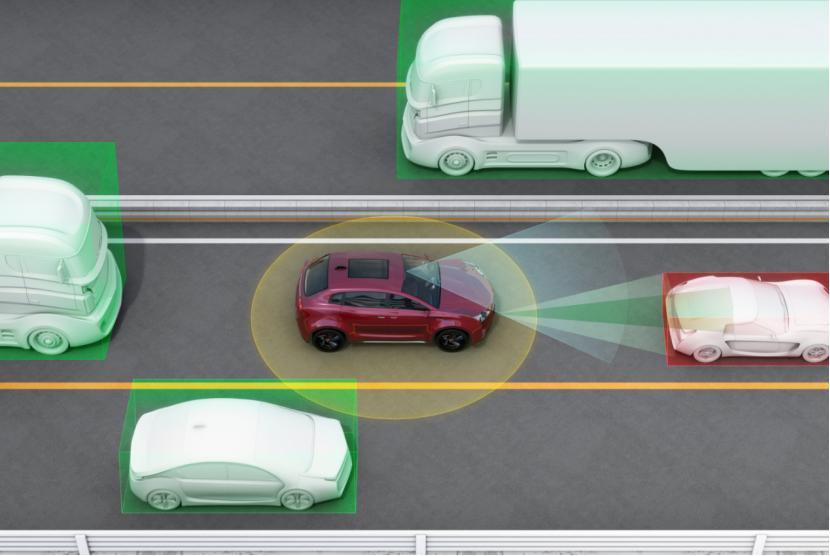
Signals from the industrial end have emerged. In the first half of this year, the overseas expansion of domestic intelligent driving entered the fast lane. High - order navigation solutions for passenger cars were mass - matched and exported to right - hand - drive models. Enterprises such as Pony.ai and WeRide have successively launched commercial operations of Robotaxi in Europe, the Middle East, and Singapore. China has gradually upgraded from exporting complete vehicles to exporting a complete set of intelligent driving technology solutions. XPeng Motors has deeply participated in the relevant discussions and standard - setting of the WP.29 Automated Driving System Working Group. He Xiaopeng, the chairman of XPeng Motors, said that the DCAS UNR 171 Series 02 approved by WP.29 will come into effect as a mandatory EU regulation in six months. "This means that from the end of 2026, automated driving can legally enter the global market."
From a more macro perspective, the implementation of this regulation marks that automated driving has entered the "compliance" stage from the "feasible" stage. The competition dimension has extended from the product level to the rule level. Whoever can establish a whole - life - cycle safety management system in line with the new regulation first will gain a first - mover advantage in the next stage. The Ministry of Industry and Information Technology stated that in the next step, it will continue to deeply participate in the formulation, revision, and coordination of international standards and regulations in the field of intelligent and connected vehicles, accelerate the release and implementation of domestic mandatory national standards, and comprehensively promote the effective connection between international regulations and domestic standards.
As of May 2026, more than 57,000 kilometers of test roads for intelligent and connected vehicles have been opened nationwide, and 237 national and industry standards have been released. From the establishment of GRVA in 2018 to the implementation of the global regulation in 2026, eight years have brought automated driving from "wild growth" back to "rule - bound". The global unified technical regulation provides a basic framework, but this is only the starting point. How countries will transform it into domestic regulations, how enterprises will complete compliance transformation, and how to build consumer trust - the answers to these questions still need more time to be verified.