Stop worrying about Doubao's paid model, Seedance is raking in massive profits at a frantic pace.
"We actually don't make money, and may even lose money, by simply selling the basic model version." A relevant business leader of Kouz, an AI agent development platform under ByteDance, told Guangzhui Intelligence.
The Token consumption generated by developers using Kouz is mainly divided into text-to-text, text-to-image, and text-to-video. Among these, "video generation consumes the most tokens."
Therefore, to encourage customers to consume more models on Kouz, Kouz has also started the business of AI video generation. According to the leader, there are currently hundreds of trial customers, dozens of customers who have actually purchased and deployed the service, and the monthly model consumption has reached the million level.
However, he also repeatedly emphasized that this is just a "scenario solution." What Kouz really wants to sell is not AI video generation itself, but the ability to enable enterprise customers to continuously consume Tokens on its platform.
This actually reflects from the side that in ByteDance's current AI landscape, it is AI video generation that truly drives Token consumption. And what supports this is Seedance.
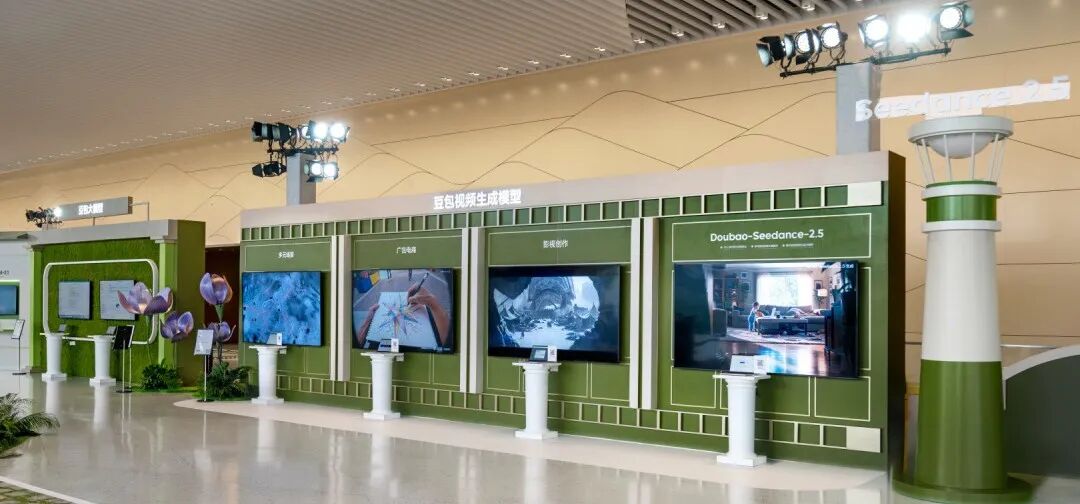
Since the release of Seedance 2.0, it has become extremely popular. ByteDance has also overtaken Kuaishou's Keling and become the leader in this field. Since then, the commercialization ability of Seedance has attracted much attention from the industry. In just half a year, it has been regarded as the first truly profitable AI business within ByteDance.
According to media reports, Seedance's current annual recurring revenue (ARR) has reached $2 billion (about 14.3 billion yuan), with monthly revenue exceeding 1 billion yuan, and the vast majority of the revenue comes from enterprise customers. However, Tan Dai, the president of Volcengine, denied these figures: "All the revenue data of Seedance circulated outside are wrong and overestimated."
However, simply selling APIs and competing on Token unit prices is indeed a tough business. When the capabilities of large AI models are embedded in the specific workflows of enterprises, the large models become "water pumps," with each call directly corresponding to the enterprise's production needs and business returns.
Previously, some media reported that two months ago, some senior ByteDance executives visited Anthropic. Soon after they returned, ByteDance began to adjust its AI resource allocation, shifting the focus from products for the general public like Doubao to products serving enterprises.
Anthropic has proven with facts that by providing paid services to enterprises, Anthropic, which has only 30 million daily users, has a valuation of $965 billion, overtaking OpenAI, which has nearly 900 million weekly consumer users.
Obviously, at this stage, providing paid B2B enterprise services is the key to closing the commercialization loop. Currently, Seedance is undergoing an evolution from "selling Tokens" to "selling productivity."
So, from its release in February to its iteration to version 2.5 in June, in which industries has an AI video generation model truly taken root? What is its commercialization path? And how exactly does Seedance conduct its B2B business?
Testing the waters in multiple tracks, not just the short drama route
When talking about Seedance, it is often associated with scenarios such as short dramas and comic dramas. Even Kouz showcased its comic drama business at the FORCE Primeval Conference. "Because the scale of the comic drama market is large now," the above-mentioned leader said.
"This track is currently the hottest and most competitive," a relevant leader of Huoshan Juchuang, a short drama platform under ByteDance, told Guangzhui Intelligence. "So different product lines are all moving in this direction."
Indeed, at the conference, there were many visitors around the booths related to Seedance and those related to short dramas and comic dramas. People also kept coming forward to discuss the usage of the relevant platforms.
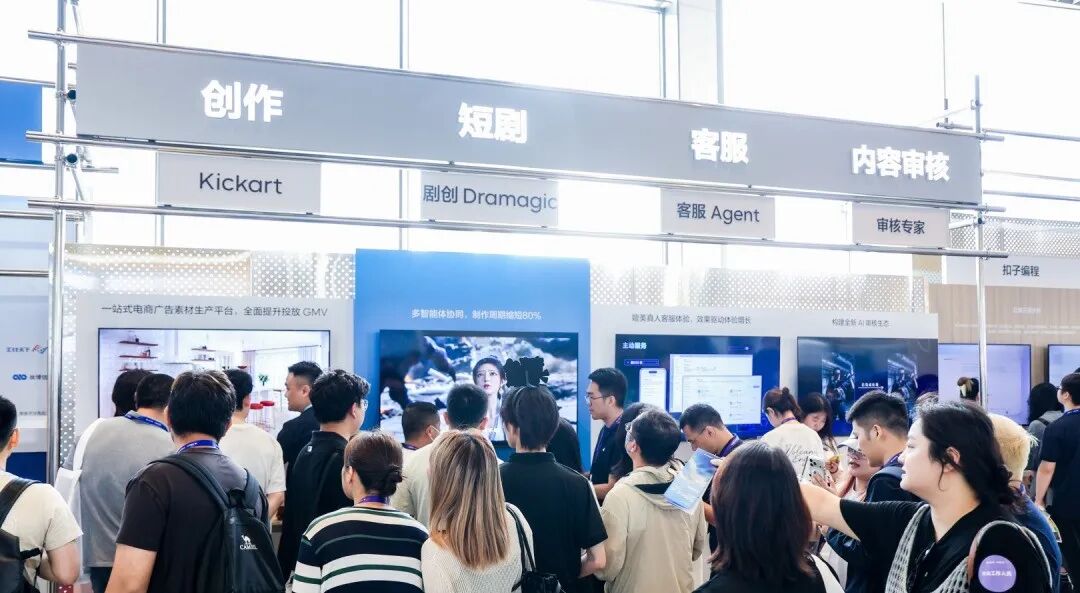
Among them, a short drama practitioner showed Guangzhui Intelligence a video he made using Seedance 2.0. The video effect was very impressive. "Now, the videos made with AI basically have no sense of being AI-generated."
He admitted that he had previously used other short drama creation platforms, but the video effects were not good. So, in the end, he mainly used the Huoshan Juchuang platform for AI short drama video creation.
In addition to Huoshan Juchuang, ByteDance also has a platform called Xiaoyunque specifically for short dramas and comic dramas. "It is a C2C product, and we are all in a competitive relationship," the above-mentioned leader said. However, in comparison, Huoshan Juchuang is more targeted at small and medium-sized B2B users.
It can be seen that whether it is for C2C or B2B, ByteDance uses Seedance, a basic model, to cover multiple product lines. Each product line targets different audiences, enabling it to achieve the largest-scale expansion in the short drama and comic drama tracks.
Previously, some media reported that the penetration rate of Seedance in the short drama industry had reached about 95%. However, Tan Dai believes that "Film and television, and short dramas are just one aspect of Seedance, and in the long run, they may only be a small scenario."
Overall, Seedance is taking root in various vertical scenarios and industries.
Take Kickart as an example. It is a one-stop marketing and e-commerce material production platform that can autonomously plan material generation through an agent, serving the material production scenarios and UGC interaction scenarios in marketing and e-commerce.
To put it simply, "We focus on creating marketing videos," a relevant product leader of Kickart told Guangzhui Intelligence. "It can be used for e-commerce product promotion, brand advertising, and also for creating videos related to local life and other types."
Its underlying capabilities are also based on the Seedance series of models, but the agent layer adds a large number of marketing scenario workflows. "Its entire production process is centered around marketing."
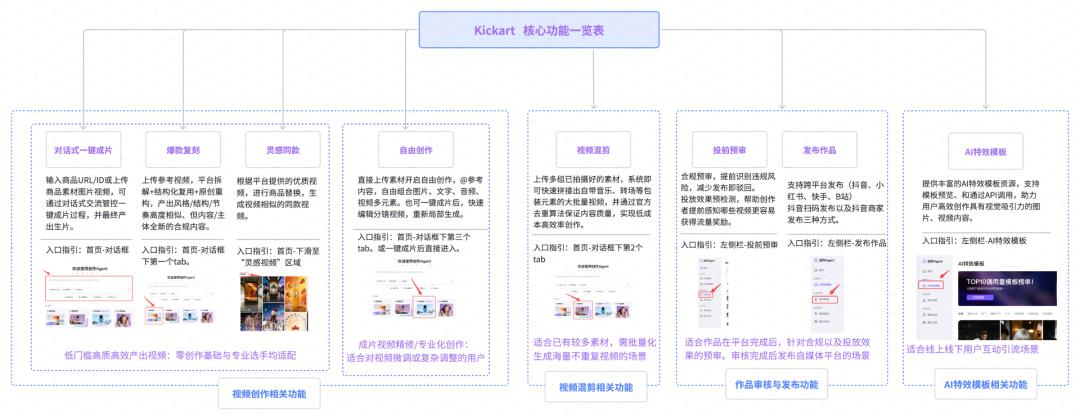
For example, in the early stage, it can help users analyze product selling points, write scripts, and formulate strategies. "Even if you only upload a product image, it will help you analyze the product's selling points and target audience."
In the middle stage, it can support a maximum video length of 60 seconds, better preserve product consistency, and support storyboard creation and multiple languages (including small languages in Southeast Asia to meet the needs of cross-border e-commerce). In the later stage, it supports cross-platform video distribution and QR code publishing.
On-site, the leader strongly recommended the popular video fission function. This function allows users to upload products and reference videos and then generate corresponding video content in batches. Simply put, 10 products × 10 reference videos = 100 videos can be generated in batches.
Currently, its customers include enterprises such as Xufuji and Meifubao. "The results are quite good." It can be seen that in the marketing scenario, this platform has obvious advantages over the direct output of Seedance 2.0.
Kickart's positioning is very clear. "We won't get involved in comic dramas or short dramas. We focus on marketing," the above-mentioned leader said. Obviously, this forms a clear distinction from Huoshan Juchuang in terms of the track.
However, this is just one route for Seedance to test the waters in vertical scenarios. In Volcengine's plan, Seedance will also be implemented in scenarios such as manufacturing, knowledge/education, embodied intelligence, and autonomous driving.
For example, in the embodied intelligence scenario, Seedance can be used for data synthesis. In the autonomous driving scenario, it can synthesize corner cases such as extreme weather and marginal road conditions.
"This method of video generation allows for large-scale unsupervised training. This solution makes the fewest assumptions about the world state, has the most natural data, and the training method is relatively mature. It is a technical solution that can be expanded on a large scale in an unsupervised manner," Tan Dai said.
It can be seen that these scenarios have one thing in common: they all require a world model, that is, an understanding and simulation of the physical world. Tan Dai believes that "Seedance is the foundation for building a world model."
In other words, short dramas and comic dramas are just the first "payable" scenario that Seedance has encountered, but not its endgame. Volcengine's imagination for Seedance in the B2B market goes far beyond content creation. It aims to evolve from a video generation tool to a world simulator.
Hierarchical business models, different "revenue extraction" logics
Within ByteDance, Seedance supports two completely different routes: the C2C creation ecosystem and the B2B enterprise service.
Among them, the C2C market mainly includes platforms such as Dreamina, Jianying, and Douyin, and the short drama market includes Xiaoyunque. Its C2C business model is straightforward, that is, selling memberships, points, and creative tools.
C2C users pay for a more fun and cooler experience and to lower the creation threshold. The peak usage times are mainly on weekends, and the usage scenarios are for entertainment and UGC content production.
However, for the B2B market, Seedance's business model is much more complex, and the selling methods are completely different.
The first method is direct API call, but an annual framework agreement needs to be signed. This strategy is mainly targeted at top large customers.
"Directly using Seedance 2.0 requires signing an annual framework agreement. It used to be 10 million yuan. Now, although there is an option at the 100,000-yuan level, it's like throwing 100,000 yuan away for nothing. It's better to use the money to buy computing power directly," the above-mentioned short drama industry practitioner told Guangzhui Intelligence.
This shows that there is a threshold for directly calling Seedance's API. Top customers need to sign a high-value framework agreement, and even the 100,000-yuan low-threshold option is still a significant investment for small and medium-sized creative teams.
So, for large customers with R & D capabilities, they can directly call the API. For small and medium-sized creative teams without R & D capabilities, platforms such as Huoshan Juchuang and Kickart provide an "intermediate layer" that doesn't require signing a framework agreement.
The second method is the intermediate layer represented by Huoshan Juchuang and Kickart, where customers pay by the second or by creative points to buy "finished product capabilities."
Among them, Huoshan Juchuang charges based on video length. "Converted to seconds, it's about 1.5 yuan per second," the platform leader said. "Of course, if the volume is large, specific discounts can be negotiated."
The above-mentioned short drama practitioner said that for a short drama he made in 1080P, the cost was about 3.7 yuan per second. For a one-minute short drama, the cost was about 2,000 - 3,000 yuan, and the cost would change with the change in picture detail.
In comparison, Kickart's business model is more complex. Its leader said, "We calculate based on creative point consumption."
To convert, a Maybelline-style marketing video with a length of about 2 - 3 minutes costs about 8 creative points, which is "less than 100 yuan" in RMB. Even if the content needs to be modified later, as long as it doesn't involve generating a new video, the cost won't increase.
It can be seen that whether it's Huoshan Juchuang or Kickart, what customers want to buy is not a direct model ability, but a complete service that can "generate usable videos." Workflows, templates, reviews, distribution, and other capabilities are added on top of the model.
The third method is free deployment, following the model consumption route, with Kouz being a typical example.
"Our main customer group is large B2B enterprise customers," the Kouz leader said. The different target customer groups obviously also determine the different business models.
(Kouz's comic drama business showcases customer cases)
The Kouz leader was very straightforward: "First of all, we are not in the comic drama track. We focus on AI video creation." Kouz doesn't sell individual products but binds them to the Kouz platform and deploys tools for free, enabling customers to consume models through these tools.
Its core advantage is that "we charge exactly the same as Volcengine, without any markup," the Kouz leader said. "At the same time, customers can directly call and consume the Seedance model on their own, without any price difference in the middle."
Moreover, Kouz has also clearly developed the batch generation ability. "Many models can't support batch creation. We can support batch creation for enterprise customer scenarios." This is crucial for large B2B customers: they can run their business in batches instead of generating videos one by one.
However, the Kouz leader also emphasized that this is just a scenario solution, not the main business. "Theoretically, based on Kouz, it can support all scenarios. What we are selling today is just a scenario solution for now."
"We hope that customers can build their own solutions based on Kouz. If they have strong planning capabilities, they can even build their own solutions with the personal version of Kouz," the Kouz leader said.
In other words, what Kouz sells is not Seedance itself, but a combination of Seedance, workflows, and batch generation capabilities.
Overall, the common point of the three vertical scenario usage models is that they don't directly sell the model but sell a combination of the model and the scenario. The value of the model can only be released through industry know - how, engineering capabilities, and data closed - loops. The difference between the three models is that Kouz earns platform traffic revenue, Huoshan Juchuang earns intermediate - layer service fees, and Kickart earns vertical scenario premiums.
In terms of the charging structure, there are at least three models. This hierarchical design allows Seedance to cover top large customers (annual framework agreements), medium - sized enterprises (platform subscriptions), and small and micro - enterprises/individuals (pay - as - you - go).
From a toy to a tool, the core is industry know - how
Since the release of Seedance 2.0, AI video generation has evolved from a toy to an enterprise's productivity.
"Before the release of Seedance 2.0, many people said that video generation was just a toy. And it was true. The number of calls on weekends was much higher than on weekdays, which shows that it was mainly used for leisure by UGC (individual users). However, after the release of Seedance 2.0, the workload and number of uses on weekdays are far greater than on weekends," Tan Dai said in an interview.
What does this mean? C2C users "play" on weekends, while B2B users "use" on weekdays. One is for entertainment consumption, and the other is for production investment. This is a fundamental shift in scenarios.
The Kouz leader also confirmed this: "Using the AI method of Kouz itself, we can only create some