Six provinces in central China are frantically building universities.
As college entrance examination results are being released across the country, the crucial stage of college application has arrived. For candidates and their parents, choosing the city to attend university has become one of the most talked - about topics at present.
In recent years, the layout of national colleges and universities has been continuously adjusted, and many provinces are accelerating the construction of new universities.
Comparing the "List of National Higher Education Institutions" released by the Ministry of Education in 2024 and 2026, a total of 84 new higher education institutions were added nationwide in two years. Among them, the number of undergraduate institutions increased by 104, while the number of vocational (junior college) institutions decreased by 20.
Looking at the situation by province, from 2024 to 2026, Shandong added 10 new colleges and universities, ranking first in the country; Hunan and Jiangxi both added 9, tied for second; Henan added 8, ranking fourth. Meanwhile, Gansu was the only province where the number of colleges and universities decreased. In 2026, the total number of colleges and universities in Gansu was 49, one less than in 2024.
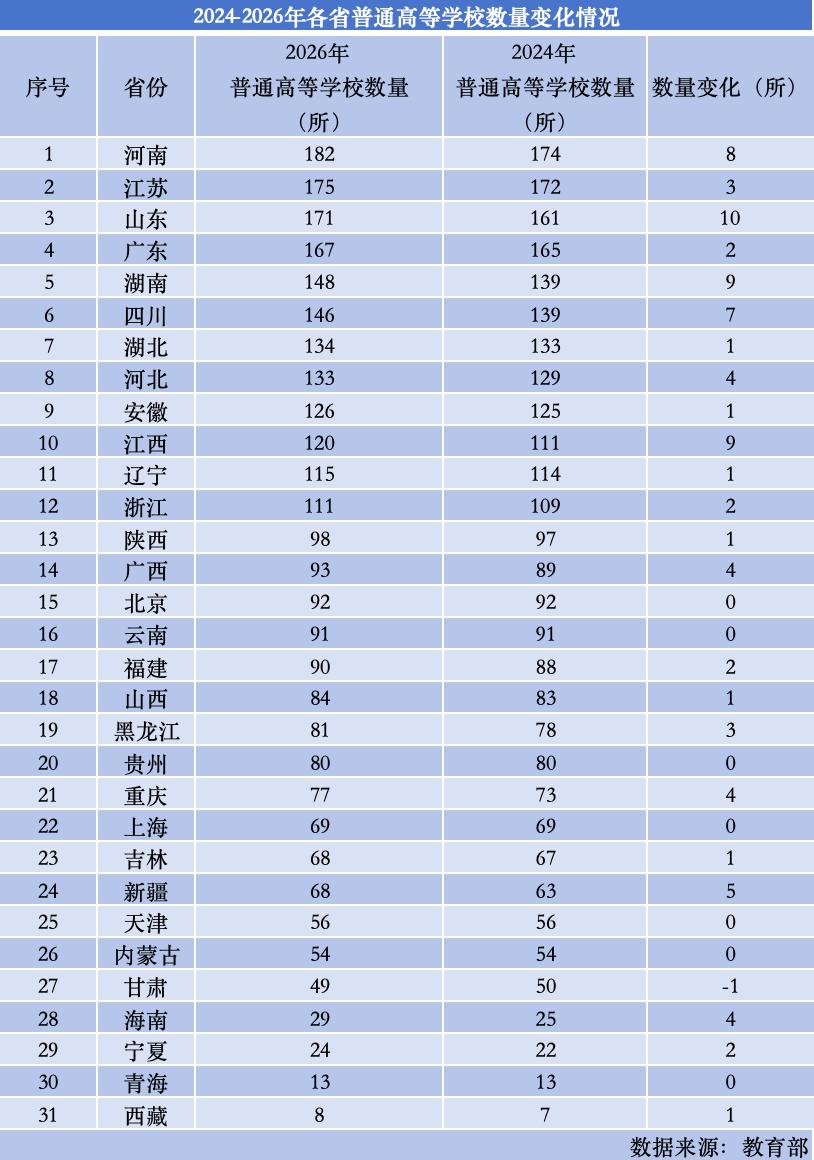
The central region has become the area with the most concentrated growth of colleges and universities. Six provinces in the central region, including Shanxi, Anhui, Jiangxi, Henan, Hubei, and Hunan, added a total of 29 colleges and universities in two years, accounting for 34.5% of the total number of new colleges and universities nationwide.
Most of the new colleges and universities are vocational institutions
In recent years, the number of colleges and universities in China has been continuously increasing.
According to the latest data released by the Ministry of Education, there are a total of 3,196 higher education institutions in the country, including 2,952 regular higher education institutions, with 1,412 undergraduate institutions and 1,540 vocational (junior college) institutions.
In terms of the ranking of the number of colleges and universities, the national higher - education resources are still mainly concentrated in provinces with large populations and well - developed education.
Henan ranks first in the country with 182 colleges and universities; Jiangsu ranks second with 175; Shandong ranks third with 171. Followed by Guangdong (167), Hunan (148), Sichuan (146), Hubei (134), Hebei (133), Anhui (126), and Jiangxi (120).
In terms of the increase, in the past two years, Shandong, Hunan, Jiangxi, and Henan have become the provinces with the fastest - growing number of colleges and universities, adding 10, 9, 9, and 8 respectively.
In this round of expansion of colleges and universities, vocational institutions have become an important source of growth.
Take Shandong as an example. The local area has continuously expanded higher - education resources through various means such as building new vocational institutions and upgrading existing vocational institutions. Among them, Zibo Vocational Institute was upgraded to a vocational undergraduate institution, and Binzhou Vocational College and Rizhao Polytechnic were also successively upgraded to Binzhou Vocational and Technical University and Rizhao Vocational and Technical University.
Meanwhile, Shandong is also accelerating the layout of new vocational institutions. Since 2025, Shandong has successively established many vocational institutions, including Binzhou Health and Technology Vocational College, Jining Health and Wellness Vocational College, Dezhou Intelligent Technology Vocational College, Qingdao Health and Technology Vocational College, and Shandong Institute of Ecology and Environment.
It is not difficult to see from the names and educational orientations of these institutions that the newly established colleges and universities generally have a distinct industrial orientation, focusing on fields such as health and wellness, intelligent manufacturing, and ecological environmental protection to meet the talent needs of local industrial transformation and upgrading and the development of emerging industries.
Similar situations have also occurred in provinces such as Hunan, Henan, and Hebei.
In the past two years, institutions such as Changsha Institute of Industry, Changsha Vocational College of Science and Technology, and Changsha Health College have been successively established in Hunan; Hebei has added schools such as Shijiazhuang Financial Vocational College, Shijiazhuang Agriculture and Forestry Vocational College, Shijiazhuang Health Care Vocational College, and Xinji Institute of Applied Technology.
From the perspective of spatial distribution, provincial capitals such as Changsha, Zhengzhou, and Shijiazhuang are still important locations for the layout of colleges and universities.
On the one hand, provincial capitals have a more complete industrial system, a larger employment market, and stronger population attraction; on the other hand, it is easier to form an agglomeration effect among colleges and universities, industries, and talents. For local governments, laying out colleges and universities in provincial capitals can not only improve the supply level of educational resources but also enhance the city's innovation ability and talent competitiveness.
It is worth noting that while the total number of colleges and universities has increased, the number of vocational (junior college) institutions nationwide has decreased.
This change reflects that the vocational education system is developing towards a higher level. In recent years, many vocational colleges have upgraded their educational levels by being promoted to vocational undergraduate institutions. Data shows that as of June 2026, the number of vocational undergraduate institutions nationwide has reached 124.
With the rapid development of industries such as advanced manufacturing, new - energy vehicles, integrated circuits, and high - end equipment manufacturing, the market's demand for high - quality technical and skilled talents has been continuously increasing. Compared with traditional academic education, vocational education is more closely connected with industrial needs, which has also become an important reason for many localities to give priority to the development of vocational education and continuously expand the supply of vocational education.
The central region has the largest increase in the number of colleges and universities
If we extend the time dimension, we will find a more obvious phenomenon: in the past decade, the region with the most new colleges and universities in the country is not the eastern coastal area but the central region.
Data shows that from 2015 to 2025, the total number of colleges and universities nationwide increased by 366. Among them, the six central provinces added 113, accounting for more than one - third of the national increase.
The relatively rapid growth of colleges and universities in the central region is closely related to the local large population size and the demand for higher education.
In terms of population, the central region is home to several populous provinces in the country. Henan has a permanent population of nearly 100 million, and the population of Hunan, Anhui, and Jiangxi all exceeds 40 million.
A large population base means a greater demand for higher education.
For a long time, there has been a common problem in the central region of "a large number of candidates and a small number of colleges and universities." Take Henan as an example. The number of college entrance examination applicants in Henan has long ranked among the top in the country every year, but the high - quality higher - education resources are relatively insufficient. As higher education enters the popularization stage, expanding the supply of colleges and universities has become an important choice for many populous provinces.
At the national level, efforts are also being made to further tilt higher - education resources towards populous provinces and the central and western regions. The National Education Work Conference in 2026 proposed to tilt new higher - education resources towards populous provinces and the central and western regions and accelerate the revitalization of higher education in the central and western regions.
In addition to educational needs, industrial development is also an important driving force for the expansion of colleges and universities.
In recent years, the central region has successively undertaken industrial transfers from the coastal areas and accelerated the development of industries such as advanced manufacturing, new - energy vehicles, new materials, and electronic information. Whether it is the integrated circuit industry in Hefei, the construction machinery industry in Changsha, or the electronic information industry in Zhengzhou, they all put forward higher requirements for local talent cultivation.
Compared with the high - cost introduction of talents, building local colleges and universities and cultivating local talents is a more stable and sustainable way.
By observing the newly established colleges and universities in recent years, it is not difficult to find that keywords such as "intelligent" and "technology" frequently appear in the names of the new schools, which reflects the direction of local industrial development.
Jiangxi has continuously increased its layout in industries such as electronic information and new energy; Hunan has cultivated professional talents around advanced manufacturing and construction machinery industries. More and more new colleges and universities are not only educational projects but also undertake the function of serving local industrial development.
From a deeper perspective, behind the new round of "building universities", there is actually a competition for talents and development resources. For local governments, a university not only means educational resources but also a research platform, innovation ability, and population attraction. The consumption, employment, entrepreneurship, and innovation resources brought by college students are becoming an important support for urban development.
This article is from the WeChat official account "Reading the City Studio", author: Li Hang. It is published by 36Kr with authorization.