At Meituan's general meeting, Wang Xing calmly "responded to everything": from the food delivery wars to the shrinking market value, and then to the "two major mistakes" made in the past five years
On June 26, Meituan's annual general meeting of shareholders was held. Previously, due to the subsidy war worth tens of billions in the food delivery and instant retail sectors, Meituan's performance turned from profit to loss in 2025, and its stock price dropped significantly. This meeting has attracted significant market attention.
At the meeting, Wang Xing responded to the slump of the stock price and stated that he had no plan to reduce his holdings. He reviewed two strategic mistakes in the past five - year strategies, namely the late start of overseas expansion and the operation of Meituan Select. He proposed that future business investments would strictly adhere to financial discipline. CFO Chen Shaohui said that the company's value was seriously underestimated and planned to restart the stock repurchase. He also disclosed that Meituan's overseas investment scale exceeded 65 billion yuan, covering various cutting - edge technology sectors. After the lock - up period expires, Meituan will cash out the listed targets at an appropriate time.
In response to concerns about the competition for platform entry in the AI era, Wang Xing believes that AI will not bring a disruptive impact in the short term, but Meituan will continue to make arrangements and follow the technological development through investment and cooperation.
At the industry level, the high - cost subsidy competition has dragged down the entire industry. However, Meituan's share of high - unit - price food delivery orders is stable, and the operation of its food delivery business has been continuously reducing losses. Coupled with the introduction of new regulatory rules on food delivery subsidies, institutions' judgments on its prospects are divided.
Overall, after the huge subsidy war, Meituan's strategy has completely shifted to a repair mode of reducing losses, repurchasing stocks, and disposing of investments. However, whether the subsidy competition has ended and whether the profit inflection point can be sustained still need to be verified by subsequent operating data.
After the subsidy war worth tens of billions and the market value falling below HK$400 billion, Meituan has reached a new strategic juncture.
On June 26, the annual general meeting of shareholders of Meituan (03690.HK) was held in Beijing. In the past year, Meituan has faced severe challenges. Its full - year performance in 2025 turned from profit to loss, with an adjusted net loss of 18.65 billion yuan, compared with a profit of 43.77 billion yuan in the same period of 2024. Behind the losses, the competition in the food delivery and instant retail sectors has become extremely fierce, and Meituan, Alibaba, and JD.com have been engaged in a continuous and costly subsidy war. In addition, Meituan's stock price has fallen by more than 37% since the beginning of the year, while the Hang Seng Index has dropped by about 9.96% during the same period.
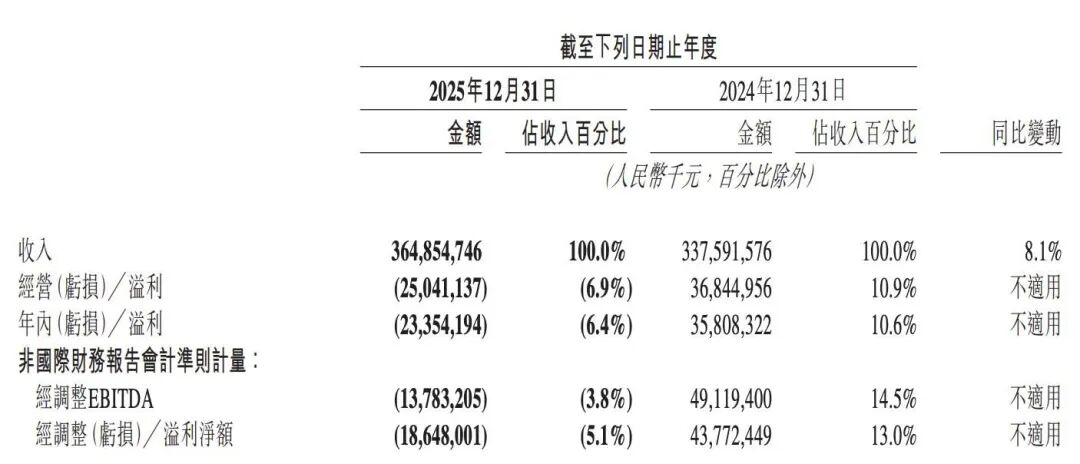
Image source: Meituan's announcement
For this reason, this general meeting of shareholders has attracted significant market attention. According to the on - site speech content compiled by participating shareholders obtained by a reporter from NBD (National Business Daily), at the general meeting of shareholders, Wang Xing, the CEO of Meituan, responded that "the stock price has been unsatisfactory in the past few years, and I feel a great sense of responsibility for this" and emphasized that "I have no plan to sell my shares." Chen Shaohui, the CFO of Meituan, said that "the current value of the company is seriously underestimated" and revealed that Meituan plans to conduct a stock repurchase.
At the general meeting of shareholders, Wang Xing also reviewed the strategic mistakes in the past five years, and the management for the first time clearly signaled to withdraw from some external investments. It is worth noting that some shareholders pointed out that Meituan's current models are products of the late stage of the mobile Internet and asked Wang Xing how Meituan could become the "brain" of consumers and influence their decisions in the AI (Artificial Intelligence) era. In response, Wang Xing said: "In the short term, the AI entry will not be the most disruptive thing, but this direction is very worthy of continuous attention and arrangement."
On one hand, there is still fierce industry competition, and on the other hand, there is a battle for the super - entry in the AI era. Where will this local - life giant, which has experienced a "tens - of - billions consumption war", go in the future?
Wang Xing "Responds to Everything": Food Delivery War, AI Changes...
In addition to responding to the stock price issue, Wang Xing also clarified the previous speculation about his shareholding reduction. He clearly stated that "I have not sold a single share since the company was founded, and I have no plan to sell my shares." Injecting 10% of his personal shares into the foundation in 2021 "was completely for public - welfare purposes and is irrevocable."
Wang Xing divided Meituan's stock price issue into two levels: "controllable" and "uncontrollable".
The uncontrollable factors are industry competition and overall market liquidity, while the controllable factor is Meituan's own operating quality. He said bluntly that the past year "has been a very crazy competition, and the irrational competition has delayed the entire industry for almost a whole year." Chen Shaohui further said that the current stock price "seriously underestimates the company's value", and Meituan plans to conduct a stock repurchase. From January 2024 to May 2025, Meituan repurchased a total of about 4% of the company's equity, with an amount close to US$3.6 billion. After suspending the repurchase last year due to the food delivery war, the restart this time aims to send a positive signal to the market.
What is more worthy of attention than the repurchase is Chen Shaohui's disclosure of Meituan's investment portfolio.
Chen Shaohui mentioned that as of March 31, 2026, Meituan held equity in Li Auto (12.73%), Zhipu AI (3.86%), and Unitree Robotics (7.61%). The value of the shares in these companies (Note: Unitree Robotics is still in the IPO stage) alone exceeds 50 billion yuan. Coupled with the shares of other non - listed companies, the total overseas investment scale exceeds 65 billion yuan.
The investment case of Unitree Robotics is quite representative. On June 1, Unitree Robotics passed the review for its IPO on the Science and Technology Innovation Board, with a valuation of about 42 billion yuan. The Meituan - affiliated entities hold a total of 9.65% of the shares, making it the largest external shareholder of Unitree. In the case of Zhipu AI, Meituan holds 3.86% of the shares. Since its listing on the Hong Kong Stock Exchange in January this year, the market value of this company has soared, rising from about HK$52.8 billion at the initial listing to a maximum of HK$650 billion within half a year.
Chen Shaohui revealed that "for listed companies, after the lock - up period expires, we will actively consider cashing out." He regarded these investments as "a very important part of the overall asset allocation" and will comprehensively consider liquidity, market environment, valuation rationality, and capital - use needs.
A reporter's review of Meituan's investment portfolio found that it has covered five major fields: large AI models, embodied intelligence (16 enterprises, 10 of which have grown into unicorns), chip semiconductors, autonomous driving, and AI intelligent hardware. It has invested in more than 28 unicorn technology companies and 7 listed enterprises.
It is reported that in terms of the synergy between investment and the main business, Meituan and Galaxy Universal have carried out cooperation in fields such as offline retail and smart warehouses. In addition, Meituan's drones have opened regular delivery services in many cities such as Beijing, Shanghai, Shenzhen, Hong Kong, and Dubai, with a cumulative number of commercial orders exceeding 900,000. This "investment + scenario" synergy model has enabled Meituan's technology layout to go beyond the scope of simple financial investment.
However, against the background of the current low stock price, the management's choice to "actively cash out" some investments means that Meituan is entering a harvest period of "meticulous accounting" from an expansion period of "scattering the net widely". How to convert the book assets of 65 billion yuan into actual shareholder returns and business investments will be the focus of observing Meituan's capital operation in the future.
It is worth noting that in addition to industry competition, since the beginning of this year, many general large models have been trying to bypass platforms like Meituan and directly complete the invocation of services such as food delivery and ticket booking through dialogue. Therefore, there are also market voices worried that once users get used to ordering food with a single sentence, the entry value of the Meituan App itself will face great challenges.
At the general meeting of shareholders, some shareholders said that Meituan's current models are products of the late stage of the mobile Internet, and the competition in the AI era depends on whether the platform can become the brain of customers or an auxiliary to the customers' brains. In response, Wang Xing said that the changes brought by AI are huge. He mentioned that currently, people mostly use AI on mobile phones, but mobile phones may not be the most natural AI devices, and in the future, it may be more voice - based or in other forms. There are many possibilities in the future, including smart homes, smart glasses, headphones, or other wearable devices.
"In this process, we keep an open mind to understand. It is impossible for us to do everything ourselves. We try our best to do well what we can do and cooperate more where we can. Part of our external investment is precisely to understand the most cutting - edge development directions and which can be better combined with us. We will continue to improve the fulfillment efficiency, product richness, and price, which already have a certain scale but still have great room for improvement. At the same time, we keep an open mind to try the new entry brought by AI. In the short term, I think (AI) will not be the most disruptive thing, but this direction is very worthy of continuous attention and arrangement." Wang Xing said.
Reviewing Two Strategic Mistakes in Five Years and Calibrating Future Investment Directions: Rational and with Financial Discipline
At the general meeting of shareholders, in response to the question from shareholders "Has Meituan taken any wrong paths in the past five years?", Wang Xing reviewed the development strategy of the past five years and publicly admitted two mistakes.
The first mistake was the late start of overseas expansion. Wang Xing said that "looking back, we should have expanded overseas earlier" and should have promoted overseas expansion at the end of 2018 or in 2019. During the two - year COVID - 19 pandemic, the penetration rate of overseas food delivery increased rapidly, and Meituan missed this window period. Currently, Keeta (Meituan's food - delivery brand in the overseas market) has entered markets such as Saudi Arabia, the United Arab Emirates, Qatar, Kuwait, Bahrain, and Brazil, and has achieved the highest order volume in Hong Kong, China, and achieved positive unit economics ahead of schedule. However, Wang Xing said that "we will not blindly and rapidly expand."
The second mistake was Meituan Select. This business started to receive a large amount of investment in 2020 but was gradually shut down last year. Wang Xing said that the direction of Meituan Select was in line with Meituan's positioning, but there were problems with the model - "non - standard products are prone to 'only choose the lowest price', falling below the bottom line." A large amount of resources were invested, but the expected results were not achieved. The lesson Meituan learned from this business is to shift from pure seller bidding to in - depth supply - chain operation for ultimate cost - effectiveness. The new business "Happy Monkey" is such an attempt.
The review of these two mistakes reveals a signal: Meituan is shifting from "unlimited expansion" to "disciplined investment". Wang Xing clearly stated at the general meeting of shareholders that for "directions where the business situation is not clear but require large - scale investment, we will invest more rationally and with financial discipline."
Image source: Photo by Kong Zesi, a reporter from NBD
Meanwhile, the competitive landscape of the food - delivery industry is also changing. When responding to shareholders' questions, Chen Shaohui mentioned that the competition has been quite crazy in the past year or so. According to his rough calculation, the entire industry may have invested 200 billion yuan. He also said that in high - value orders above 30 yuan, Meituan maintains a market share of over 70%. The unit economic efficiency of pure food - delivery business turned positive in April and May this year. Although all three companies (Meituan, Alibaba, and JD.com) are in the red, Meituan has the fastest loss - reduction speed. Its operating loss narrowed from 16.1 billion yuan in the fourth quarter of 2025 to 6.5 billion yuan, a quarter - on - quarter reduction of nearly 10 billion yuan.
It is worth noting that the regulatory changes in the food - delivery industry since the beginning of this year are also worthy of attention.
On June 17, the State Administration for Market Regulation solicited public opinions on the "Ten Rules for Regulating Subsidy Behaviors of Food - Delivery Platforms", clearly stating that long - term and large - scale subsidies should not be used to exclude or restrict market competition. Meituan, Taobao Flash Delivery, and JD.com have all stated that they "firmly support" this.
Judging from the ratings of leading institutions, the capital has both expectations and concerns about Meituan's future direction. Goldman Sachs maintained its "Buy" rating and raised the target price from HK$112 to HK$116, believing that the recovery pace of the unit economic efficiency of the food - delivery business exceeded expectations and predicting that the food - delivery segment will achieve a break - even in the second quarter of 2026. JPMorgan Chase maintained its "Neutral" rating with a target price of HK$85, believing that a judgment should be made after confirming the sustainability of the unit economic inflection point in the second and third quarters.
Overall, the signals released by this general meeting of shareholders are clear and concentrated. Meituan is switching from an offensive mode of "burning money for growth" to a repair mode of "reducing losses, repurchasing stocks, and cashing out investments". Wang Xing's self - review, Chen Shaohui's statement on cashing out, and the restart of the repurchase plan together outline a company that is recalibrating its strategic coordinates after experiencing a consumption war worth tens of billions.
However, for investors, the key questions still remain: Has the subsidy war really ended? Can the unit economic inflection point be sustained? These questions may need to be answered by Meituan's future operations and financial report data.
This article is from the WeChat public account "NBD Headlines", author: Zhao Wenqi, editors: Zhang Jinhe, Yu Tingting, Du Hengfeng, proofreader: Cheng Peng. Republished by 36Kr with authorization.