The AI hardware sector is awaiting its next "Little Genius Watch" moment.
In 2024, Silicon Valley held a small funeral for AI hardware.
Less than a month after the official shipment of the Humane AI Pin and Rabbit R1, they were severely criticized by various media outlets due to numerous defects. These two products, which were highly touted before their release, quickly became failed experimental products in the first wave of the ebb of AI hardware. The Rabbit R1 is unlikely to become a truly daily device, and the return volume of the Humane AI Pin once exceeded the sales volume. However, before their release, both products boasted the aura of "replacing mobile phones." The AI Pin was hailed as the "killer of smartphones," and Time magazine included it in the "Best Inventions of 2023" before its official shipment.
Meanwhile, on the other side of the Pacific Ocean, another hardware that doesn't seem very futuristic is quietly making money on the wrists of Chinese primary school students.
Counterpoint data shows that in Q2 of 2024, Imoo/Xiaotiancai captured 48% of the global children's smartwatch market share. According to data from LOTU Technology, in the first half of 2025, the online sales volume of children's smartwatches in China reached 4.551 million units, a year-on-year increase of 16.8%; the sales revenue reached 2.57 billion yuan, a year-on-year increase of 47.8%. Among them, Xiaotiancai ranked first with a sales volume share of 35.3% for consecutive times.
This contrast is more glaring than many industry reports.
If advanced technology alone could determine everything, a thick, child - friendly, and even somewhat rustic phone watch shouldn't have entered real life earlier than many AI hardware.
Rather than just being a more powerful tool, how can a piece of hardware pass through the three gates of purchase, use, and retention?
The path that Xiaotiancai found a decade ago may not be directly replicable, but it's worth a look back for today's AI hardware.
Hello, this is "AI in the Fray."
Looking back suddenly, "Xiaotiancai" stands in the dim light.
The latecomer secures the first ticket
People always tend to portray the victors as the pioneers.
However, looking back at the Chinese children's smartwatch market, Xiaotiancai wasn't an early entrant.
In 2013, 360 launched the "360 Children's Guardian," focusing on positioning and anti - loss; subsequently, Abating incorporated SIM cards and call functions into watches. By the time Xiaotiancai launched its first - generation phone watch in 2015, the obvious demand for positioning and calling had already been verified by predecessors.
Xiaotiancai arrived a bit late on this time scale, but it was in line with its nature.
After all, Duan Yongping, who instilled its underlying genes, favored the principle of "daring to be the latecomer."
In the context of this children's watch, it means something very specific: let others illuminate the demand first, and then focus on the most crucial aspects.
What it secured first was the first ticket that parents were willing to pay for.
For parents, a children's watch doesn't need to tell a high - tech story first. It can be thick, childish, and not look like a delicate consumer electronic product, but it must give parents peace of mind.
This concern is particularly sensitive in Chinese families.
A previous report from the China Industry Research Institute mentioned that the number of children aged 5 to 12 in China is about 170 million, and the penetration rate of the children's smartwatch market has reached 30%, even exceeding 50% among urban children. Behind these large numbers lies the instinctive fear of "losing contact" among many parents.
This fear doesn't stay as an abstract concept.
When a child enters a shopping mall, an underground garage, or a high - speed railway station, parents want to know which floor the child is on, which area the child is near, and which path the child has just taken. Xiaotiancai condenses these concerns into a positioning point on the screen. The multiple positioning system that combines GPS, Beidou, base stations, Wi - Fi, and barometers tries to turn "might be somewhere" into "right here."
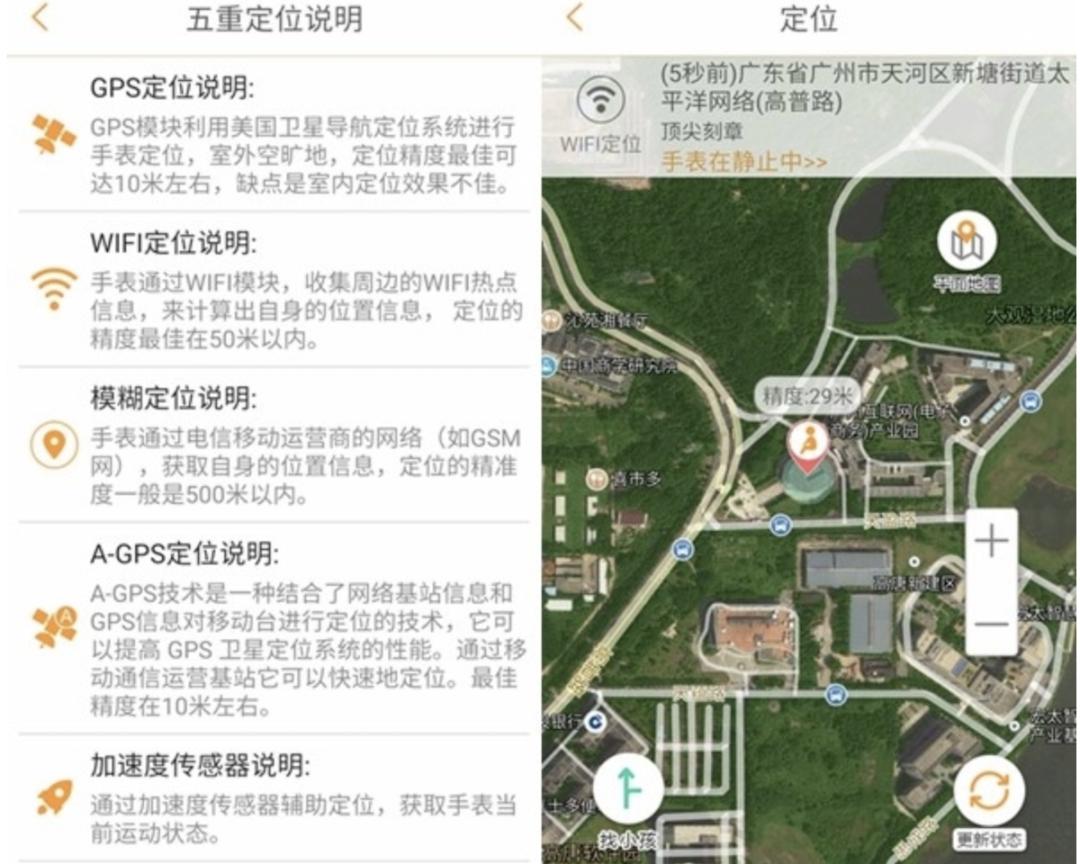
Xiaotiancai's positioning in 2015
This is the first level of certainty.
Whether the call can be made, whether the positioning is accurate, whether strangers can be blocked, whether it can be quiet during class, and whether someone can be reached when there's a problem. These features aren't flashy, but they're solid enough. Solid enough for parents to be willing to open their payment codes.
The flip - up vertical camera hits another niche for children.
The camera on adult watches often seems redundant. But in the hands of children without mobile phones, it might be the first camera of their own. It can take selfies, make video calls, recognize objects, and look up words, fulfilling the children's little desire to "record the world."
Even today, the most prominent positions on Xiaotiancai's official website still feature basic selling points such as phone - call - enabled watches, video calls, and safety guardianship. After many rounds of technological iteration, what the brand shows to parents first is still that straightforward sense of safety and certainty.
Many people, when analyzing Xiaotiancai, like to start with features such as "tap to add friends," "friend circle," and "closed - loop social networking."
Those are of course important, but the order can't be messed up. Without the previous level of certainty, it wouldn't even be considered in family decision - making.
Parents need to believe it's a safety rope first, and then children have the chance to turn it into something else.
This is also where many AI hardware products today tend to go astray.
Too many new products rush to crown themselves as soon as they appear: future entry points, next - generation terminals, second intelligent agents, connected intelligent agents. The grander the words, the more the most ordinary question is obscured: Who's anxiety does it actually relieve at which moment?
AI hardware also needs to secure the first ticket like Xiaotiancai.
Without this ticket, no matter how beautiful the form is, it's like an empty house with the lights on but no one living in it.
But one ticket is only enough to get in the door.
A red - ocean market doesn't mean that opportunities have disappeared. Sometimes it just means that the most obvious demands have been met once, and the real differences lie at the next level.
Solving safety concerns explains why parents buy the watch, but it doesn't explain why children wear it. A locator only for parents is likely to become a burden at the bottom of the schoolbag once out of the parents' sight.
Where Xiaotiancai truly advanced was to transform the watch from a safety tool for parents to a social device for children.
When a child first wears the watch, parents can see where the child is.
After wearing it for a while, the child begins to see themselves in it.
When a watch develops social connections
Any product that sells anxiety has an expiration date. Once the anxiety is relieved, users' attention will inevitably shift elsewhere.
Jin Zhijiang, the CEO of Xiaotiancai Technology, saw this step earlier than his peers. He once judged that the core demand of children's watches is communication, with positioning and safety as supplementary functions; if public security improves, the demand for anti - loss will weaken, and in the long run, its future lies in social networking.
Looking at it today, this statement is almost a spoiler for the past decade.
Safety got Xiaotiancai into the family, but social networking kept it on children's wrists.
This step was well - judged because it recognized a frequently overlooked situation. Children aged 6 - 12 are in a critical period of social identity and extremely eager for peer recognition and a sense of belonging. Most children at this age don't have their own mobile phones yet. WeChat, QQ, Douyin, group chats, and Moments don't really belong to them.
But this doesn't mean they don't have a social desire.
At school, in cram schools, in the neighborhood, and on the way home from school, their activity radius is narrow, but their social relationships are close. Who plays with whom, who is invited, who is left out, who is surrounded during breaks, and who has no one to wait for after school are all big events that happen every day.
Xiaotiancai targeted this gap.
When the first phone watch was launched in 2015, it left an entrance at the core: a closed - off social space that a primary school student without a mobile phone could enter.
The keyword here is closed.
Only Xiaotiancai watches can communicate with each other, and it's difficult for other brands to integrate. It leaves children with almost no choice: either join or stay out.
This "wall" later developed into a network effect. The more people use it, the thicker the social barrier becomes, and new users have no choice but to choose Xiaotiancai. Just like WeChat back then, when all your friends are on it, no matter how good another app is, it's hard to become your daily choice.
"Tap to add friends" is the most brilliant part of the whole design.
Adults tend to underestimate this action. Scanning a QR code to add friends on WeChat is efficient enough, and it only takes a few seconds. But in the world of ten - year - old children, social interaction can't just happen in the background. It needs to be visible, have actions, a bit of a game feel, and a bit of a show - off.
Xiaotiancai's well - known advertising slogan fits right in with this action:
"Looking for friends, looking for friends, found a good friend. You have one, I have one, we're all good friends."
It doesn't talk about technology or parameters, just repeatedly sings about one thing: finding friends.
When two watches gently tap each other, it's like a small alliance.
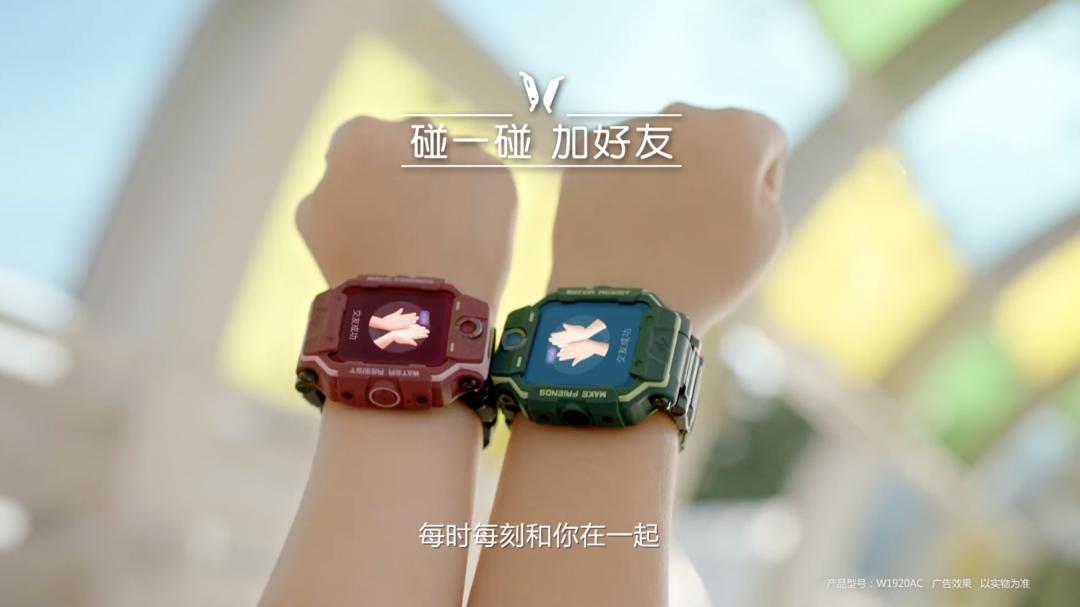
Xiaotiancai turns the abstract "we're friends" into an action that classmates can see and envy on the spot.
The second - level demand it truly tapped into is the visibility of children's social interaction.
The sociologist Erving Goffman in "The Presentation of Self in Everyday Life" understood daily interactions as a stage performance. People adjust their behavior under the gaze of others. What Xiaotiancai did was to move this stage to children's wrists.
Around 2021, the level cap of Xiaotiancai watches was raised from 26 to 60, and mechanisms such as friend circles, level medals, likes, points, and step - counting PK were continuously added. A children's watch began to become a social currency among primary school students.
It didn't turn the watch into a game console, but it created a light - weight online - game - like atmosphere for children's social interaction. Friend relationships can be deepened, likes can be accumulated, levels can be upgraded, and the home page can be decorated. How popular a child is among peers is broken down into a visible, comparable, and updatable digital system.
The number of friends is an asset, likes are prestige, levels are status, and the home page is the front door.
Some parents said bluntly: "Everyone in the class uses this brand. If you don't buy it, your child can't join the classmates' circle."
At this point, the real strength of Xiaotiancai is revealed. It not only makes children use the watch but also makes them start to manage their position in the class social network. The children's words "everyone in the class has it" often end up hitting the parents' wallets.
A watch thus becomes a coordinate in the peer world.
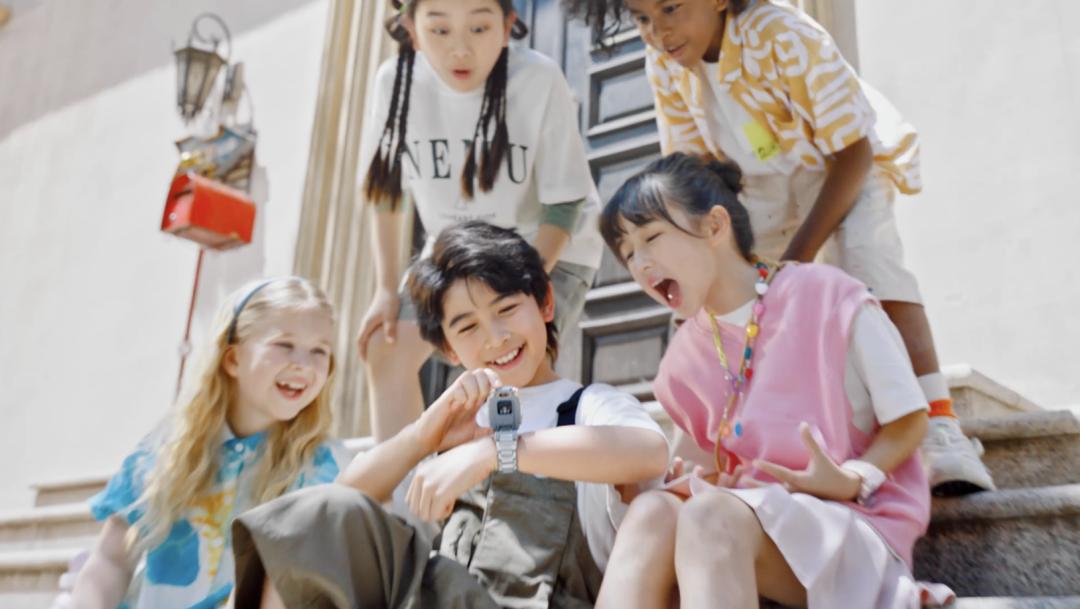
This is also the subtle difference between it and many children's AI hardware and AI toys.
A survey by Common Sense Media shows that only about 20% of parents hope that AI toys or devices can be their children's companions, and more than half of the parents don't want AI toys to act as their children's companions or followers.
Many current AI toys rush to promote "becoming children's friends" as their biggest selling point. But for parents, this selling point isn't inherently safe. An algorithmic character that can remember, respond, and simulate emotions entering a child's life sounds advanced but also makes people uneasy.
Xiaotiancai's smart move is that it doesn't immediately sell a social world to parents. It first says: "I'll help you contact your child." Then, in the hands of children, a social world gradually develops.
The social connections have been established.
What remains to be seen is how this social network can expand beyond a single class and reach more families, stores, and cities.
Three key strategies to weave an unbreakable network
When talking about Xiaotiancai, advertising and distribution channels always come to mind first.
Around 2015, "Where Are We Going, Dad?" was very popular. Xiaotiancai found the star parent - child pairs from the show to shoot advertisements and played them repeatedly during prime time on children's channels and other channels. The advertising slogan "No matter where you are, a phone call and I'll find you right away. Hey, remember, it's Xiaotiancai phone watch!" Just like BBK's "Tap where you don't understand" for its point - reading machine, quickly entered many living rooms.
Public reports show that the shipment volume of Xiaotiancai phone watches was 1.076 million units in 2015, reaching 3.604 million units in 2016, a year - on - year increase of 234.9%; as of 2020, the cumulative sales volume had exceeded 20 million units.
The outside world often attributes Duan Yongping's product - making success to advertising, employee stock ownership, dealer investment, dense distribution networks, and offline channels. But he himself doesn't agree with this view, saying that the secret is "being true to oneself + having a normal mindset."
There's no need to elaborate on this statement. Just looking at a few specific things about Xiaotiancai is enough.
The first aspect is that the product must live up to the promises made in the advertising.
Jin Zhijiang later mentioned a detail. The first - generation Xiaotiancai phone watch was originally planned to be launched on May Day in 2015, and the advertising and distribution channels were all set. But shortly before the shipment, the team discovered a software bug that would cause about 1.5‰ of the products to crash unexpectedly.
Production and shipment were halted.
The problem was that the advertising couldn't be withdrawn. From May to June, the ads were