The second-largest city in Hubei has quietly outpaced a host of provincial capitals
How many cities in the Chinese mainland have a GDP of over one trillion? As of 2025, the answer is 29, which is what people often refer to as the "Trillion - Club".
These 29 trillion - GDP cities have two obvious geographical characteristics: one is "more in the south and fewer in the north", and the other is "more in the east and fewer in the west". In particular, the Yangtze River Delta urban agglomeration accounts for 10 seats, more than one - third of the country.
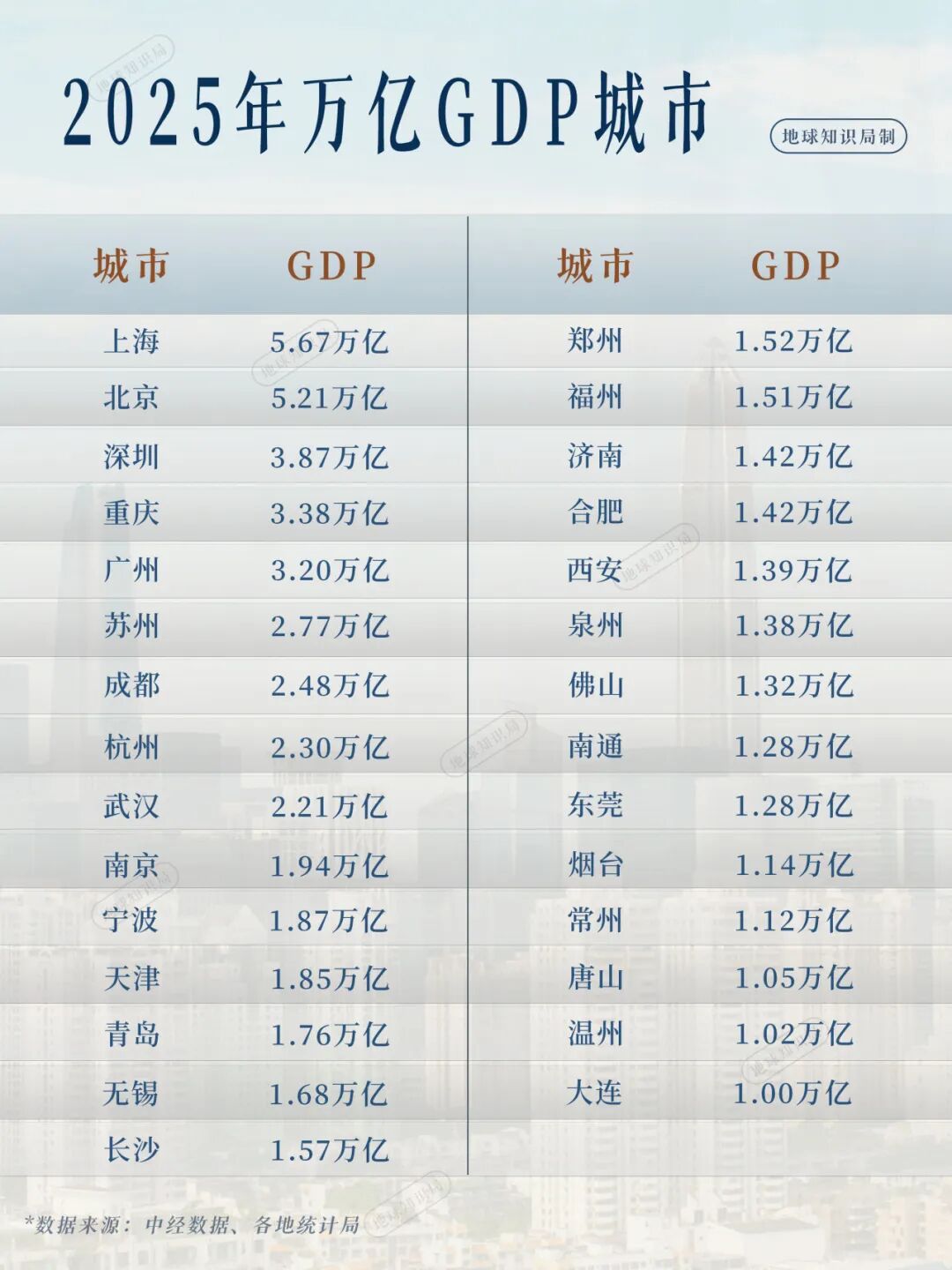
In contrast, the "Trillion - Club" members in central provinces are not only small in number, but currently only provincial capitals can "join the list": Zhengzhou, Hefei, Wuhan, and Changsha. Non - provincial - capital cities still have a certain distance to reach the "Trillion - Club".
However, the situation is changing. Xiangyang, a city that was well - known in history but a bit of an "NPC" in the past, is challenging the "Trillion - Club" as a sub - central city of the province.
So, what does Xiangyang rely on to have a chance of becoming a trillion - GDP city?
Transformers, roll out!
When it comes to the "Automobile City" in Hubei Province, many people often think of Shiyan first. In fact, Wuhan and Xiangyang are also important automobile production bases in the country. These three cities, together with Xiaogan and Suizhou, form a "trillion - level automobile industry corridor".
As early as the early 1980s, Dongfeng Motor Corporation regarded Xiangyang as an important automobile production base and formulated the "Shiyan - Xiangyang - Wuhan" three - step strategy.
In 1992, the Citroën "Fukang" sedan, one of the so - called "Three Old Models", was born in the Dongfeng Xiangyang Trial Assembly Plant. In the same year, Xiangyang established the Automobile Industry Development Zone. In just one year, the automobile industry replaced the textile industry as the leading pillar industry.
In addition to vehicle manufacturing, nearly 1,500 automobile parts enterprises have emerged in Xiangyang, covering the R & D and production of nearly 4,000 key automobile parts such as powertrain, axle assembly, car seats, automotive electronics and electrical appliances, body and interior.
Put it this way, if you want to build a car, you can almost get all the required automobile parts in Xiangyang.
Xiangyang has also caught up with the trend of the new - energy transformation of the automobile industry and has not been left behind. It has built an important national new - energy automobile parts production base.
As early as 2022, BYD laid out in Xiangyang and established a car power battery production base here, setting a record of signing the contract, starting construction, and putting into production in the same year.
Now, 16 production lines of BYD's Xiangyang power battery factory are running at full capacity. In addition to meeting domestic demand, it also supplies 500,000 battery cells to Southeast Asia every month.
Camel Battery, which was just an electrical repair shop in Gucheng County, Xiangyang City in the 1980s, has now become the largest automobile battery production enterprise in China, without a doubt.
Currently, Camel Battery mainly engages in automobile battery, recycling, and energy - storage businesses. It has a market share of up to 49% in the domestic original equipment manufacturer (OEM) supporting market and about 31% in the domestic maintenance and replacement market. Its output of automobile batteries ranks among the top in the industry, making it an "invisible champion" in this niche field.
Hangyu Seiko's automobile locks, AVIC Precision Machinery's regulators, Dongfeng Xiangyang Spinning's motor rotor shafts and engine pulleys, Sanhuan Forging's steering knuckles, Feilong Friction Sealing Materials' brake pads... Now, Xiangyang has a group of leading players in the automobile parts industry and has become one of the most important automobile parts production bases in the country.
In addition to the two "major" pillars of vehicle and parts manufacturing, Xiangyang has 12 more. Generally speaking, China's industrial system can be divided into 41 major categories, and Xiangyang alone accounts for 37 of them.
3 + 4: Xiangyang Grows the "Calabash Brothers"
There is an old saying in Xiangyang that "when the automobile industry sneezes, the whole city catches a cold", which means that although the automobile manufacturing industry here is strong, it is a bit one - sided. Now, Xiangyang is focusing on the "3 + 4" path:
"3" refers to the three traditional pillar industries of automobile, modern chemical industry, and agricultural product processing; "4" refers to emerging industries such as new energy and new materials, high - end equipment manufacturing, biomedicine, and low - altitude economy.
When it comes to the modern chemical industry, Xiangyang's inherent advantage lies in "having minerals at home". Baokang County, under its jurisdiction, has a proven phosphate ore reserve of nearly 2.4 billion tons, ranking fourth in the country in terms of both reserve and grade.
Speaking of phosphate ore, an important use is to make fertilizers. Phosphatic fertilizers such as superphosphate and ammonium phosphate can effectively promote the flowering and fruiting of crops, increase yields, and enhance drought - resistance and pest - resistance capabilities. Farmers all say they are good.
In addition to making fertilizers, phosphate ore also has a wide range of industrial uses. For example, it can be processed into yellow phosphorus and phosphates. Yellow phosphorus is the raw material for producing phosphoric acid, glyphosate, and phosphorus trichloride. The end products are pesticides, flame - retardant materials, electronic chemicals, and lithium iron phosphate batteries.
Among them, lithium iron phosphate, the cathode material of lithium iron phosphate batteries, and lithium hexafluorophosphate, the electrolyte component, both require phosphate ore. In recent years, with the great development of new - energy vehicles in China, the demand for phosphate ore has skyrocketed.
Xiangyang's chemical industry chain has currently extended upstream to phosphoric acid, yellow phosphorus, and phosphate fertilizers, and downstream to cover products such as phosphates, phosphorus - based flame retardants, and lithium iron phosphate cathode materials.
Developing the phosphate chemical industry also requires coal because the coal chemical industry is upstream of the phosphate chemical industry, and some products of the coal chemical industry are important raw materials for the phosphate chemical industry. Coincidentally, the Haoji Railway (from Ordos to Ji'an), an important channel for "transporting coal from the north to the south" in China, passes through Xiangyang. It's like God is feeding the city.
The transformation of Xiangyang's phosphate chemical industry has also extended to "cyclic regeneration" - a number of new business forms such as comprehensive utilization of phosphogypsum, recycling of retired power batteries, and low - carbon industrial parks are making up for the past shortcomings.
In the new - energy and new - materials track, projects such as Chueneng New Energy, Camel Group's low - voltage lithium batteries, BYD's blade batteries, and Ganfeng Lithium have been intensively launched, helping Xiangyang to complete the link of "battery materials - battery cells - vehicles".
There is also an advantage to developing emerging industries deeply and covering a wide range of industries, which is the ability to produce "invisible champions" in batches. To make the industry strong, it not only depends on large enterprises but also on a group of "invisible champion" small and medium - sized enterprises in various industries. Xiangyang is doing just that.
Invisible Champions Prop Up the Industrial Chain
Why should we cultivate more "invisible champions"? Because such enterprises have strong influence in extremely niche fields, higher profit margins, and stronger resilience.
A sufficient number of "invisible champions" can cover a wider range of manufacturing categories, create a large number of high - quality jobs domestically, and earn substantial profits internationally. It is beneficial to both the country and the people.
As of 2025, Xiangyang has cultivated 70 national - level specialized and sophisticated "little giants" enterprises, 142 provincial - level single - champion manufacturing enterprises, and 3,733 technology - based small and medium - sized enterprises.
For example, Huazhong Pharmaceutical has a global market share of 55% in vitamin B1 production, making it a veritable "invisible champion" in pharmaceutical manufacturing; another example is Hangyu Life - Saving Equipment and Wuerwu Pump Industry - two national - level single - champion demonstration enterprises in manufacturing. One focuses on aviation life - saving equipment, almost being a "unique" track in China; the other has broken through foreign monopolies in the field of special industrial pumps.
The rail transit maintenance equipment of Golden Eagle Heavy Industry and the intelligent electrical system of Depu Electric - these enterprises do not have the scale and glamour of automobile enterprises, but they have achieved the top in the country and the forefront in the world in their respective niche fields.
There is a key auxiliary material for lithium batteries called PVP (polyvinylpyrrolidone). This material directly affects the energy, safety, and lifespan of lithium batteries, but it was previously monopolized by foreign enterprises. Yuang Technology, a specialized and sophisticated "little giant" enterprise in Xiangyang, has successfully achieved localization, filling a crucial link in China's new - energy industrial chain.
Another "invisible champion" in Xiangyang, Longsheng Sihai, has also made great breakthroughs in the field of silicon - based new materials. In particular, the new material of interpenetrating network silicone resin has a market share of up to 70% in the domestic market, providing reliable insulation protection for the power batteries of new - energy vehicle owners.
After the end of the 15th Five - Year Plan, Xiangyang's goal is to become a trillion - GDP city, and to some extent, it's not just an empty promise. The three traditional pillar industries serve as the "basic disk" for stable growth, and the four characteristic industries provide the "acceleration". The diversified layout of Xiangyang's manufacturing industry already has the industrial depth to support a trillion - GDP.
Of course, we should also note that Xiangyang's pillar industries overlap highly with those of Wuhan. It both collaborates and competes in the "Wuhan - Xiangyang - Yichang" advanced manufacturing corridor. The balance between path dependence and differentiated breakthrough still needs to be resolved.
But for a city that has long regarded itself as the "second" but has never stopped moving forward, making the industrial matrix thicker and more solid is the steadiest step towards a trillion - GDP. (Text | Crimson Pig; Cartography | Tong)
This article is from the WeChat official account "Earth Knowledge Bureau". Author: Earth Knowledge Bureau. Republished by 36Kr with permission.