Japan can't cultivate top-tier biotech companies?
When it comes to Japanese pharmaceuticals, multinational giants like Takeda, Astellas, Ono, and Eisai are well - known. Many globally influential scientific research achievements have been born in the fields of iPS cells, regenerative medicine, and immunology. Japan's domestic pharmaceutical market ranks among the top three in the world.
However, few people can name Japanese domestic Biotech companies with global competitiveness.
This strong contrast is precisely the most intriguing dilemma in Japan's innovative drug industry. In the United States, benchmark Biotech companies such as Moderna, Vertex, and Revolution have continuously emerged. In China, a large number of innovative start - ups with global clinical and commercialization capabilities have emerged in the past decade, and the innovative pipelines have been continuously exported.
In contrast, Japan is not short of scientists or markets. Logically, it should have nurtured a prosperous start - up biotech ecosystem. However, the core players in the entire innovative drug industry have always been firmly monopolized by large pharmaceutical companies.
Japan is not completely without Biotech companies. However, under the dual environment of the squeeze from giants and the cold attitude of capital, domestic start - ups find it difficult to form core competitiveness, resulting in Japan's failure to cultivate decent Biotech companies.
The imbalanced industrial ecosystem has directly led to a continuous decline in the efficiency of new drug research and development in Japan for more than two decades, and the long - term absence of the domestic biotech start - up track.
Of course, Japan has long been aware of the industrial shortcomings. In the past two years, it has successively introduced support policies and guided capital to tilt towards start - ups. However, the ecological gap accumulated over the years cannot be bridged in the short term, and the road to catch up is long and arduous.
The Imbalanced Biotech Industrial Ecosystem
If only looking at the industrial foundation, Japan should have become one of the most active countries in the global Biotech field.
It has the world's third - largest pharmaceutical market. Basic research in life sciences has long been at the forefront of the world. World - class achievements have been constantly born in cutting - edge fields such as iPS cells, regenerative medicine, and CAR - T. It also has a group of international pharmaceutical companies such as Takeda Pharmaceutical, Astellas, and Ono Pharmaceutical.
However, beneath the glorious foundation, the strength of new drug research and development has been continuously weakening. According to OPIRS statistics, in 2008, the number of globally best - selling drugs developed in Japan was second only to that of the United States, ranking second in the world. However, by 2022, Japan had slipped to the sixth place.
The reason for this situation is closely related to the serious shortage of the number of Japanese biopharmaceutical start - ups (EBP).
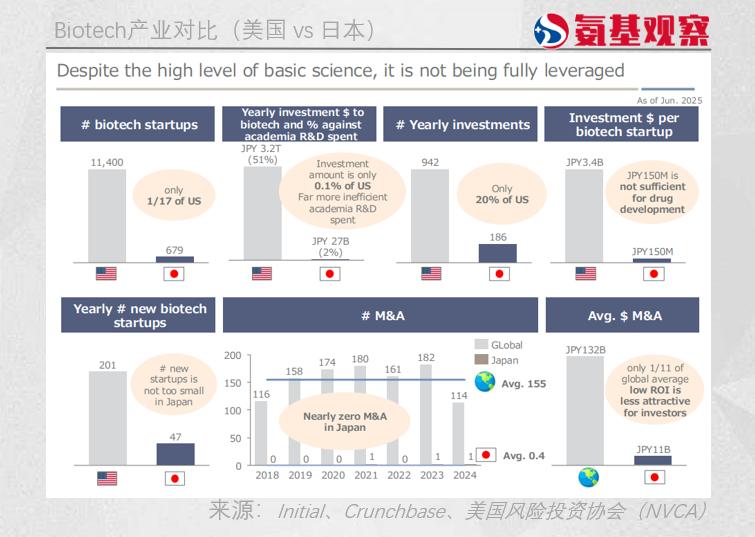
According to the statistics of INITIAL, the largest venture capital enterprise database in Japan, as of June 2025, there were a total of 679 biomedical start - ups in Japan, which is 1/17 of that in the United States. Although China's innovative drug industry started relatively late, the wave of innovative drug entrepreneurship has risen rapidly in the past decade, and the scale of enterprises has been continuously expanding. According to Biotechgate statistics, the number of biotechnology - related companies in China has reached 5,699, among which the number of Biotechnology companies is close to 2,500. There is an obvious gap between Japan and China and the United States.
What's more troublesome is that the existing Japanese Biotech companies have not really developed.
In recent years, many Biotech companies in the United States have completed financing of hundreds of millions of dollars to advance global Phase III clinical trials, or have been successfully listed or acquired at high prices by MNCs. Many Biotech companies in China have also gradually achieved the development path of financing, IPO, and global BD. In contrast, although university - derived start - ups are established in Japan every year, there are very few companies that can continuously raise funds and advance clinical development.
A survey by the Japanese Pharmaceutical Manufacturers Association in 2025 showed that among 108 emerging Biotech companies with drug R & D capabilities, only 235 clinical R & D projects could be counted, with an average of about 2.5 pipelines per company. There are almost no companies in the late - stage clinical trials with global competitiveness.
From 2013 to 2022, none of the globally approved drugs originated from Japanese domestic EBP. Nobuyuki Hanamura, the head of IQVIA's clinical development in Japan, said in an interview at that time: "EBP covers two - thirds of the drugs under research globally. Although these companies are more active in the United States, China, and South Korea, there is no growth in Japan." These words directly pointed out the embarrassing situation of Japanese Biotech.
The root cause of the weak growth of start - ups lies in the serious lack of capital supply. In 2023, the total investment of Japanese VC and CVC in Biotech was 913 million US dollars, while in the United States, it reached about 28 billion US dollars in the same period, and Japan's investment was only about 3% of that in the United States. Even though the financing environment has improved in recent years with government support, the latest results show that the average single - financing scale of Japanese Biotech companies is still less than one - twentieth of that of US companies.
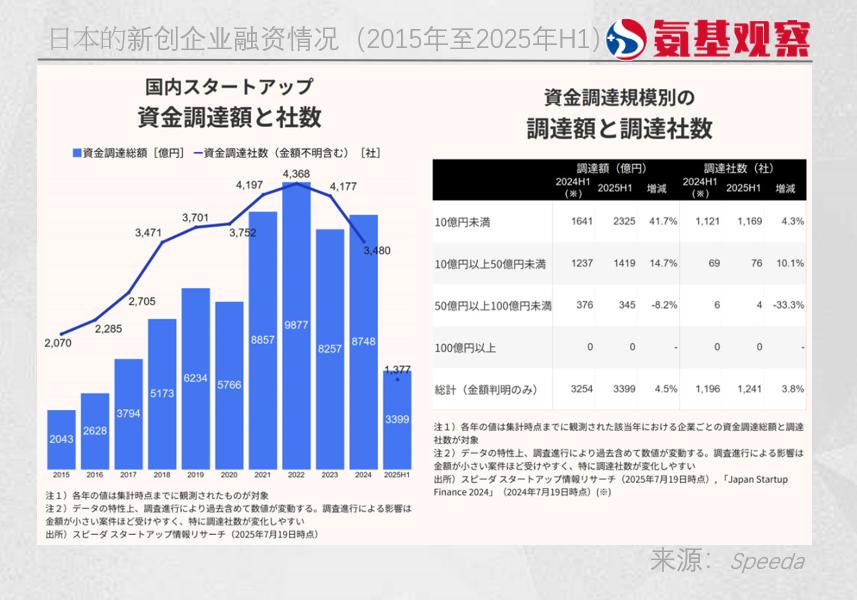
Large - scale financing is extremely rare. In the United States, as of the beginning of 2026, 12 Biotech companies have completed financing of more than 200 million US dollars. In Japan, in the past five years, only one biotech venture capital fund has just reached 200 million US dollars. The limited capital volume is doomed to be unable to support the continuous progress of high - investment, long - cycle, and high - risk innovative drug research and development.
The pipeline supplement logic of domestic giants further highlights the weakness of the domestic start - up ecosystem. Large Japanese pharmaceutical companies such as Takeda and Chugai Pharmaceutical have continuously supplemented their innovative pipelines through license - in in recent years, but the introduction targets are from China, Europe, etc., rather than domestic start - up companies in Japan.
Obviously, whether in terms of the number of start - ups, clinical R & D strength, or the scale of capital market financing, the development level of Japan's Biotech industry is seriously mismatched with its status as the world's third - largest pharmaceutical market and its world - leading basic scientific research strength.
The Best Resources Do Not Flow to Biotech
Japan has never been short of innovative technologies, high - quality talents, and social capital. However, it is always difficult for various core resources to flow to start - up biotech companies, and there are fundamental defects in the industrial distribution mechanism.
First, in terms of scientific research achievements. According to the Nature Index 2024, in the field of biological sciences, Japan ranks fifth in the world, second only to the United States, China, Germany, and the United Kingdom.
In order to promote the industrialization of these scientific research achievements, Japan has always attached great importance to the transformation of university scientific and technological achievements. Universities such as the University of Tokyo and Kyoto University in Japan have continuously incubated university - derived enterprises (Spin - off). The government has also successively improved the intellectual property system and the TLO system, and supported the commercialization of innovative achievements through institutions such as AMED.
However, after completing patent layout, technology transfer, or industrial cooperation, these scientific research achievements often enter large pharmaceutical companies through joint research, licensing, etc. in the early stage of R & D, rather than being continued by Biotech companies for subsequent clinical development and commercialization.
Second, in terms of talents. The free flow of talents is the core underlying logic for the continuous iteration of Biotech in the United States. Overseas top scientists generally hold both university teaching positions and corporate CSO positions. The cross - enterprise flow of industry executives and R & D personnel has become normal, and mature commercial R & D experience has been accumulated. China's innovation track also relies on the wave of entrepreneurship led by a large number of overseas returnees. Many practitioners start a second business after completing their first business, continuously providing fresh start - up forces.
The industry pattern in Japan is completely the opposite. Large pharmaceutical companies such as Takeda, Astellas, and Ono have gathered a large number of experienced drug R & D talents, and almost all of them are under the "lifetime employment system".
For researchers, entering a large pharmaceutical company means a stable income, a mature R & D platform, and a clear career development path. In contrast, Biotech companies not only have unstable financing but also face a higher risk of R & D failure, which further restricts the flow of talents. A Nature article also mentioned that it is still a challenge to attract entrepreneurial scientists to leave stable university or corporate positions to start a business.
Finally, in terms of capital. Capital is the core variable that determines whether a Biotech company can survive and grow, but Japanese domestic investment institutions are extremely cautious about domestic biotech start - ups. The primary market for Japanese biomedicine highly depends on domestic VC, but domestic institutions generally dislike early - stage innovative projects with long cycles and high risks. Even when investing in the life - science track, the funds are more inclined to mature late - stage assets, and rarely bet on start - up Biotech companies.
The problem of capital outflow further exacerbates the domestic capital gap. According to the joint analysis data of Dealroom and NordicNinja, from 2019 to 2025, about 33 billion euros of capital related to Japan flowed into European enterprises, and the life - science field occupied an important share. Japanese domestic funds continue to nourish overseas competitors.
What's even more unacceptable is that even Biotech companies that are successfully listed face great pressure. On December 8, 2025, the Tokyo Stock Exchange introduced new listing maintenance standards for the growth - type market. Starting from March 1, 2030, the market value of a company must reach at least 10 billion yen five years after listing. Starting from the end of March of that year, companies that fail to meet this requirement within a one - year rectification period will, in principle, face delisting. This set of rules is no less than a huge "survival" challenge for domestic listed Biotech companies.
Overall, Japan lacks an industrial distribution mechanism that guides technology, talents, and capital to tilt towards start - ups. Large pharmaceutical companies siphon off the vast majority of scientific research achievements and high - quality R & D talents, and the conservative capital market continuously compresses the survival space of start - ups. The superposition of multiple factors completely blocks the benign growth cycle of domestic Biotech.
Reform Has Begun
Japan has clearly recognized the structural shortcomings of its domestic biotech industry and has introduced multiple measures from top to bottom to systematically improve the development environment for start - ups.
The top - level policy has set the tone, listing biomedical entrepreneurship as the core development goal.
In 2022, Japan proposed the "Startup Development Five - year Plan", hoping to build a world - class entrepreneurial industrial cluster. In 2024, the Ministry of Economy, Trade and Industry of Japan released the "Bio Policy Action Plan", clearly defining four main lines of industrial development: increasing support for domestic Biotech, improving the CDMO industrial chain supporting facilities, accelerating the industrialization of regenerative medicine and gene therapy, and introducing global capital and overseas high - end talents to systematically build a domestic drug - innovation and entrepreneurship ecosystem.
Special public funds have been established to fill the gap in early - stage R & D funds.
Institutions such as the Ministry of Economy, Trade and Industry (METI), AMED, and JIC in Japan have successively launched special funds, focusing on supporting the pre - clinical and early - stage R & D phases. According to the Japanese government's plan, by the fiscal year 2040, the total public and social investment in innovative drug R & D will reach 23.4 trillion yen.
In addition to internal funds, Japan has also begun to actively introduce international capital forces. Institutions such as F - Prime, RA Capital, 4BIO, and Eight Roads have participated in the investment in Japanese start - up biomedical enterprises. It hopes to use overseas VC to bring in funds, promote global clinical development, BD, IPO, and M & A resources, and promote the integration of Japanese Biotech into the global innovative drug ecosystem.
Domestic large pharmaceutical companies have also begun to play a more active role in empowering the start - up track.
For example, Takeda Pharmaceutical has continuously expanded its cooperation with universities, start - ups, and venture capital institutions. Through its innovation center Takeda i3 and global cooperation network, it provides R & D resources and international development experience for early - stage projects. Astellas also invests in innovative Biotech through platforms such as Astellas Venture Management and actively looks for domestic innovative projects in Japan. Ono Pharmaceutical has established a corporate venture capital fund of 30 billion yen, focusing on the fields of innovative drugs, biotechnology, and digital medicine to support start - ups.
However, this round of industrial reform is still in its infancy. A mature and friendly Biotech industrial ecosystem requires long - term cultivation. It is not realistic to catch up with the industrial gap of mature markets in Europe and the United States in the short term.
Compared with Japan, the development environment for Biotech in China is obviously more friendly. In the past decade, China's Biotech has experienced rapid development. Capital has poured in rapidly, the number of innovative drug enterprises has increased rapidly, BD transactions have continuously set new records, and the pipelines of many enterprises have entered global Phase III clinical trials, and some have even achieved international commercialization. However, the industry has now entered a new adjustment stage. Homogeneous competition has intensified, the financing environment has become colder, the valuation in the secondary market has declined, and many Biotech companies are facing cash - flow pressure again.
Although there are essential differences in the industry dilemmas between China and Japan, the underlying logic for breaking the deadlock is similar: only by opening up the domestic internal circulation of technology, talents, and capital and building a sustainable innovative industrial ecosystem can the long - term and healthy development of the biomedical industry be achieved.
This article is from the WeChat official account "Amino Observation" (ID: anjiguancha), author: Sha Xiaowei, published by 36Kr with authorization.