The first "AI World Cup" has redefined the business narrative.
From Lenovo and Google to more technology companies making bets, the 2026 FIFA World Cup in the United States, Canada, and Mexico has sent a clear signal - AI is becoming the new brand language in the football market and a new business entry point.
Artificial Intelligence (AI) has made its first full - scale "invasion" of the World Cup.
After people opened the door to the AI era, the World Cup, one of the world's greatest sports and cultural events, was naturally "swept" into this wave of the times. The 2026 FIFA World Cup in the United States, Canada, and Mexico set many new records and made numerous new attempts, including the application of AI - related technologies at multiple levels.
Many football fans even seek advice from AI when participating in World Cup prediction activities. This shows that AI has penetrated every aspect related to the 2026 World Cup. This World Cup can truly be called the first "AI World Cup".
FIFA has never resisted the latest cutting - edge technologies. Instead, it has shown a positive attitude towards embracing them. Before the start of the tournament, FIFA President Gianni Infantino said that the 2026 World Cup would be an unprecedented grand show. "FIFA is fully embracing digital technology and artificial intelligence, not only to support teams and referees but also to bring a shocking new experience to fans."
In the context of the AI era, the 2026 World Cup in the United States, Canada, and Mexico is not just a global football carnival but also an excellent testing ground for AI applications. With the influx of huge amounts of capital behind AI, the football business is being re - priced.
AI Becomes the New Narrative in the Football Business Market
For football, the role of AI is not limited to making the tournament run more efficiently, training and preparation more scientific, and the viewing experience more excellent. It can also use AI as the new protagonist of market narrative to attract more business cooperation.
Each World Cup is not only filled with the noise of football and the cheers of fans but also a stage for the iteration of technology and innovation. In the early days, fans could only hear the excitement of the World Cup through the radio. Now, major broadcasting platforms have long used a wide variety of AI technologies to continuously improve the viewing experience of fans.
The widespread use of AI tools has made the World Cup, which seemed distant to many fans, more tangible. One of the most impressive AI scenarios of this World Cup for the sports business community is that many fans used AI tools to generate photos of themselves with Cristiano Ronaldo.
On social media platforms, many fans posted their "fancy group photos" with Cristiano Ronaldo or Lionel Messi, sharing the joy of connecting with their idols. This is another concrete scenario where AI intersects with the World Cup, or rather, football players.
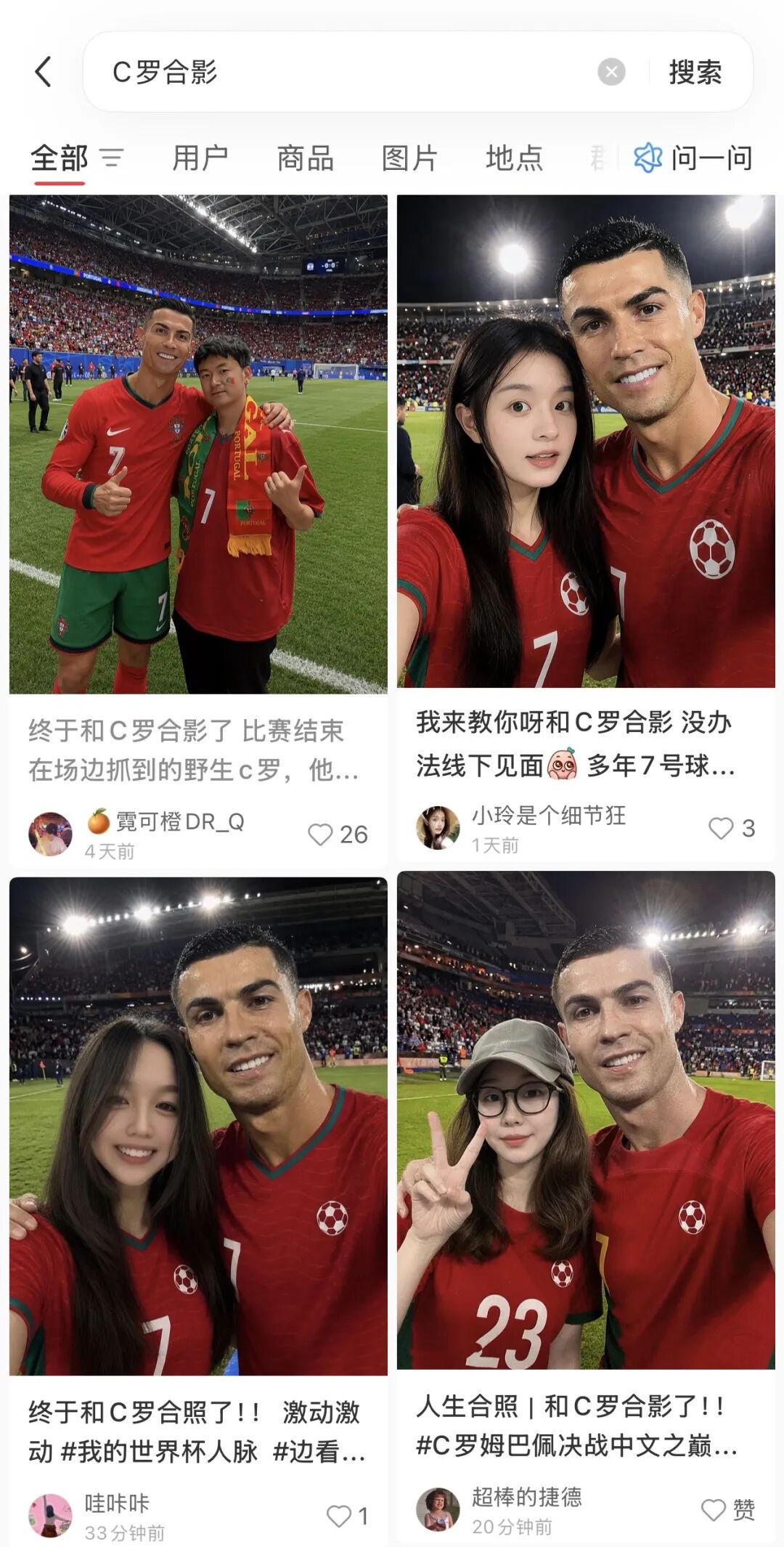
A "group photo with Cristiano Ronaldo" posted by a user on Xiaohongshu. Source: Screenshot of Xiaohongshu APP
For fans, AI is just one of the tools to enhance their sense of participation. However, for FIFA, AI has become one of the new "money - attracting" narratives.
In October 2024, FIFA reached a cooperation with Lenovo, which became an official technology partner of FIFA. "Lenovo Group will provide FIFA with technologies including AI innovation, smart devices, and data center infrastructure to enhance the fan experience and the quality of global tournament broadcasts." Lenovo emphasized in its official press release that AI innovation would play an important role in this cooperation.
According to foreign media reports, Lenovo paid approximately $150 million in sponsorship fees. Thus, Lenovo became the first Chinese technology - field partner to cooperate with FIFA. However, from a deeper perspective, the reason why FIFA chose to cooperate with Lenovo is not just because of the higher amount of money it paid but also Lenovo's in - depth layout in the AI field.
From the hardware end to the software end, Lenovo's business covers all aspects of the AI industry chain. Lenovo has also benefited greatly from the AI wave, which can be seen from the reaction of the capital market. From the beginning of the year to the close on June 26, the stock price of Lenovo Group listed on the Hong Kong Stock Exchange has risen by 153.13%.
In the view of the sports business community, the cooperation between FIFA and Lenovo is a win - win situation. The 2026 World Cup in the United States, Canada, and Mexico has become a natural marketing scenario for Lenovo to showcase its AI layout, while FIFA has not only received a substantial sponsorship fee but also benefited from the positive effects brought by Lenovo's technological innovation, making the tournament run more intelligently and efficiently.
For example, during the World Cup, Lenovo launched Football AI Pro, a generative AI knowledge assistant and analysis tool for 48 teams, to help them better prepare for and review the games.
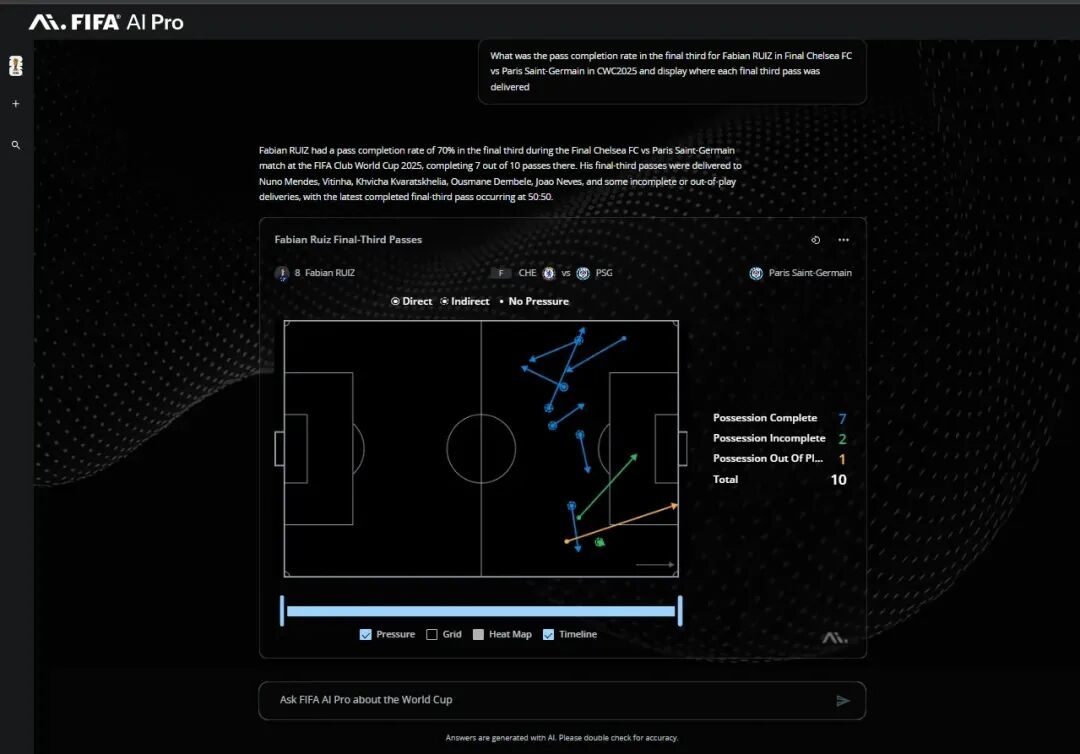
An example of Football AI Pro. Source: FIFA official website
In addition, the enhanced semi - automatic offside technology used in this World Cup also applies AI - related technologies. In some ambiguous penalty decisions, AI can make "millimeter - level" judgments.
In fact, the cooperation between FIFA and Lenovo is not the only case where AI has become the new protagonist of market narrative during this year's World Cup. In March this year, Gemini, an AI brand under Google, became the global sponsor of the Argentine national team. Gemini's logo appeared on the front of the Argentine team's training uniforms.
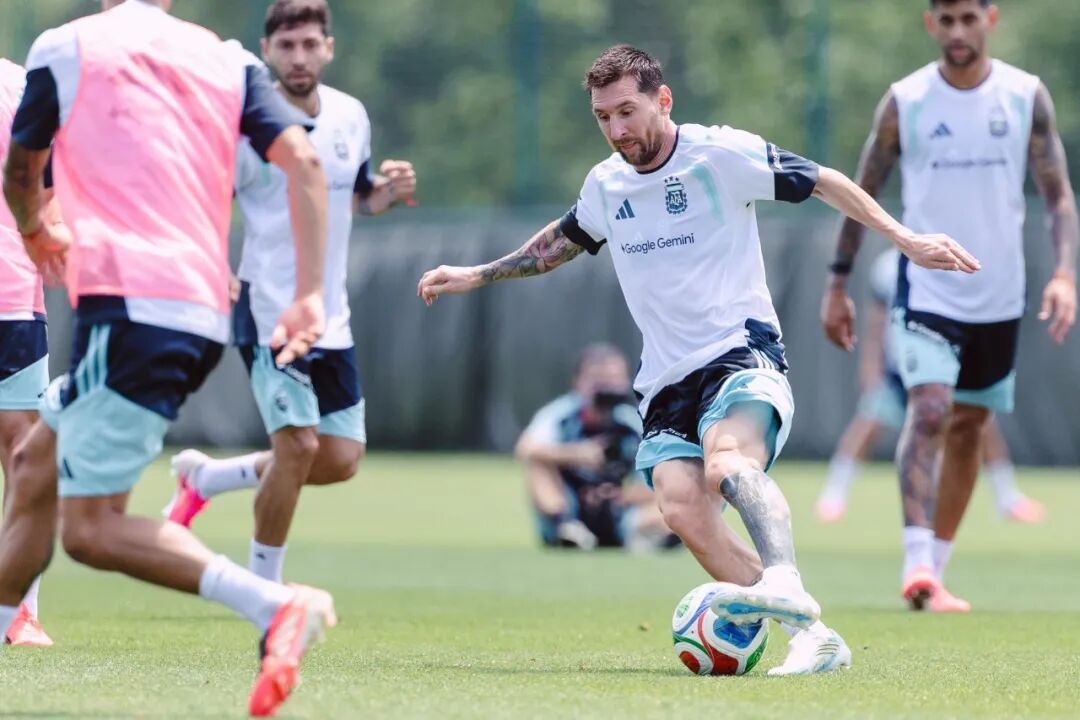
The Gemini logo on the front of the Argentine team's training uniform. Source: Social media of the Argentine Football Association
The Argentine team stated in its press release announcing the cooperation that it would explore the potential application of artificial intelligence in training, analysis, and player development through the Gemini platform to inject more technological strength into the national team. Using AI tools to improve players' skills and athletic performance is exactly the common ground for many technology giants to cooperate with football associations around the world.
According to statistics from the sports business community, in addition to the Argentine team, Google and its sub - brands have also signed contracts with the French, Brazilian, Moroccan, Turkish, Spanish, Iraqi, and English teams, forming a powerful brand lineup in this World Cup.
From Lenovo to Google and many other technology giants, they have all focused their marketing narratives on AI, using the World Cup stage to showcase their strength and layout in the AI field and quickly establish brand awareness. In the future, the marketing war in the football market may evolve into a narrative war among AI giants.
From Watching to Interacting, AI Brings Fans "Closer" to the World Cup
Compared with the previous World Cup, another major change in the football market regarding AI is the significant improvement in fans' interaction and viewing experience.
During the World Cup, many fans go to lottery stations to place entertainment bets to enhance their sense of participation in the event. However, the most obvious change this year is that many casual fans seek advice from AI. For example, a friend of mine always asks AI for corresponding betting plans before placing a bet.
Some fans may ask AI tools which team has a higher winning probability, which team has the highest goal - scoring efficiency in the group stage, which team has fewer goals conceded, and the historical data of head - to - head matches between the two teams. Through AI tools, a series of previously complex data can be presented to fans intuitively and in a short time.
Regardless of the accuracy rate, this behavior itself has extended the chain of fans' participation in the World Cup. Before the games, fans can simply understand the general situation of each match through the answers provided by AI tools and quickly select the matches they want to watch.
Therefore, to some extent, the emergence and iteration of AI tools allow fans to "customize" or "personalize" the World Cup content or information they want to see.
Providing betting plans is just one of the functions of AI tools. As mentioned before, one of the popular social media topics of this World Cup is that fans posted various generated pictures of football stars on social media. The group photos of fans with Cristiano Ronaldo are just one example.
If we have to name the most popular "dark - horse" star of this World Cup, it can only be Erling Haaland. On social media, various funny pictures of Haaland have become the focus of fans' discussions. Various spoof "blonde beauty" photos have even been made into emojis by fans.

A promotional photo of Haaland made by netizens using AI. Source: Xiaohongshu platform
With the help of AI tools, many fans have shown their wild imagination on Haaland. Some fans used AI tools to turn Haaland into the protagonist of a "dating simulation game" (a nickname for girl - oriented games). After the World Cup, we wonder if a domestic game company will sign Haaland to help the Norwegian "debut".
From the perspective of fans, the widespread application of AI technology and tools has not only lowered the threshold for fans to access and understand football but also become a means to continuously create memes inside and outside the football field, providing a steady stream of materials for fans' discussions.
While fans are using AI tools for interaction, major broadcasting platforms are also using AI technology and tools to help fans have a better viewing experience.
Take Migu, the rights - holding broadcaster of this World Cup, as an example. As one of the first domestic broadcasting platforms to use AI technology in live sports events, Migu's AI technology has been upgraded again. Migu innovatively launched AI - zone, which integrates 9 viewing black technologies on the small - screen end.
Each World Cup attracts many casual fans. How to help fans "understand" the game tests the comprehensive ability of broadcasting platforms. With the help of Migu's AI - zone, fans can perceive the changes in the viewing experience brought by AI tools from multiple dimensions such as listening, watching, and chatting.
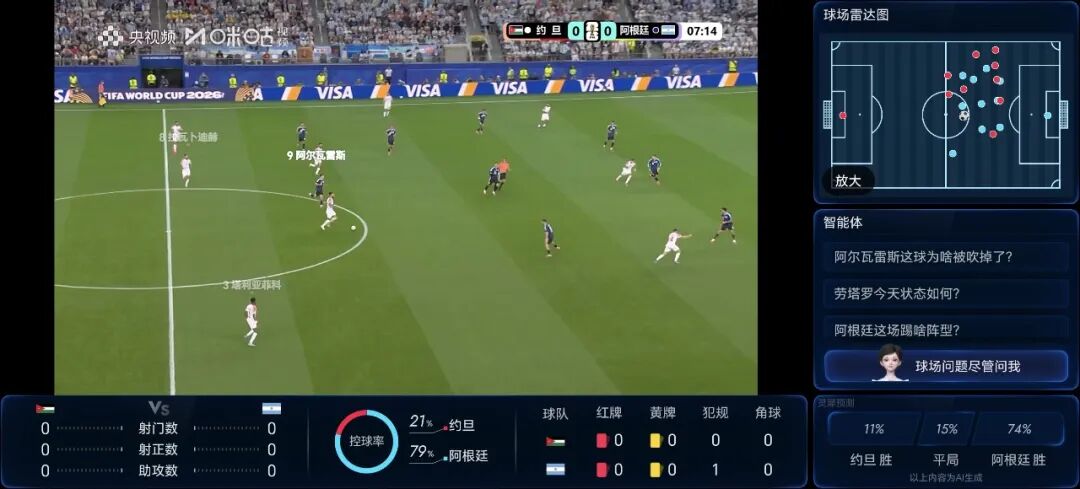
An example of Migu's AI - zone. Source: Migu
For example, fans can watch the game and ask questions to the AI agent at the same time. They can easily and quickly get the answers they want, from the rules of the game to the history of the teams. More importantly, the AI agent Lingxi can remember the context, which means that the more questions fans ask, the better the AI agent will understand what fans need.
For technical - minded fans, Migu's intelligent field - viewing function provides multi - scenario intelligent special - effect services such as tactical visualization, formation display, and real - time data stream projection, helping fans more easily and intuitively understand the real - time situation changes on the football field and enhancing their understanding and immersion in football games.
From the C - end interaction of fans spontaneously using AI tools to take "cross - time group photos" with their idols, to the hard - core technological empowerment of broadcasting platforms integrating tactical visualization and real - time data streams, AI is completely reshaping the way the public participates in the World Cup. In the AI era, the traditional one - way communication chain of the World Cup has been completely broken, replaced by a highly customized and personalized viewing and experience.
After the World Cup, the Football Industry May Formally Enter the Intelligent Era
The 2026 World Cup in the United States, Canada, and Mexico only lasts for one month, but the impact of AI on the football industry will not end with the birth of the champion.
In the past few years, AI in the sports industry has mostly remained at the single - point application level: some are used for data analysis, some for video editing, and some for content generation.
The biggest change in this World Cup is that AI tools have penetrated the entire chain of tournament operation, team training, business marketing, and media communication for the first time. This means that AI is gradually evolving from an auxiliary tool to the "new infrastructure" of the football industry.
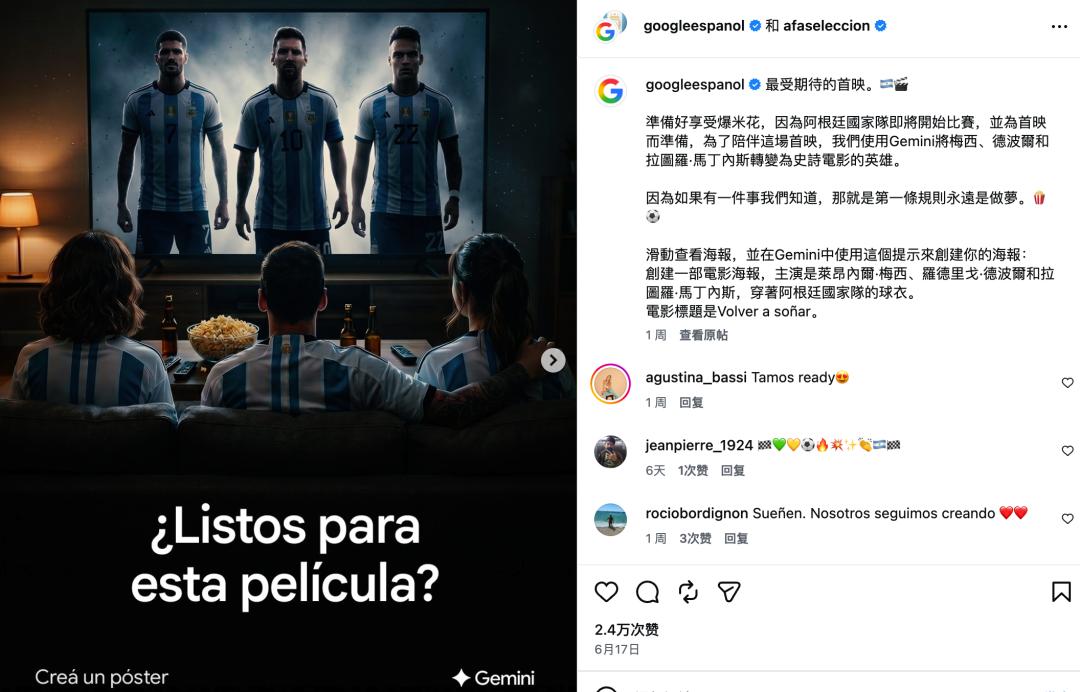
Gemini invited Argentine fans to generate posters. Source: Social media of the Argentine Football Association
For professional football, this change will become more and more obvious. As AI tools are continuously trained and iterated, AI can not only help teams with technical and tactical analysis, injury risk prediction, and player development but also be transformed into the club's own knowledge base and decision - making system, allowing the coaching team, scouting department, and even the management to share the same set of intelligent capabilities.
The traditional football management model driven by experience is also expected to gradually enter a new stage driven by both data and AI.
At the same time, the football business will also enter a new competitive dimension. In the past, major brands competed for World Cup sponsorship seats. In the future, the competition will be about who can become the AI infrastructure provider behind the football industry.
From Lenovo and Google to more technology companies making bets, the 2026 FIFA World Cup in the United States, Canada, and Mexico has sent a clear signal - AI is becoming the new brand language in the football market and a new business entry point. In the future, the competition around football will not only be about equipment, advertising, and copyright but also about digital capabilities such as large - scale models, intelligent agents, and data platforms.
Perhaps many years later, when people look back, they will remember the 2026 World Cup not only for the expansion to 48 teams or the final destination of the FIFA World Cup Trophy but also for it being the watershed for the football industry to enter the intelligent era.
For the history of the World Cup, AI is just an innovative technological upgrade. However, for the global football industry, it is more like an update of the underlying operating system. And AI has become the fulcrum of this operating system.