A post-90s entrepreneur raised 3 billion yuan to teach AI to play games
Can watching game recordings of "Fortnite" train AI?
Yes, General Intuition, a company that trains AI with a vast amount of game recordings, has just completed a $320 million (approximately RMB 2.177 billion) financing round.
This round was led by Khosla Ventures, with participation from General Catalyst, former Google Chairman Eric Schmidt, and Amazon founder Jeff Bezos.
The total disclosed financing of General Intuition has reached $454 million, and its valuation is $2.3 billion.
Game data is very valuable
There is a vivid scene in the New York office of General Intuition:
On the screen, an AI agent runs continuously in a game environment similar to "Fortnite". Next to it, a quadruped robot walks around the office. And the same "brain" drives both the game agent and the robot.
This "brain" is not learned bit by bit from the real world, but first learned from game recordings.
This is also the core reason why General Intuition was able to secure a large - scale financing. Behind it is a data entry that is difficult for others to replicate: the game editing platform Medal.
Medal was originally a platform for players to upload and share their game highlights. Players' actions such as jumping, turning, shooting, dodging, climbing, hitting the wall, failing, and counter - attacking in the game are all recorded.
There are a large number of game videos on YouTube and X. What General Intuition values is another aspect: action tags.

General Intuition Source: Public information
That is to say, it not only knows what is happening in the picture, but also knows which key the player pressed, how the mouse was moved, and what operations were performed at that moment. With both the picture and the action, the AI can learn a problem closer to real - world actions: in an environment, seeing what is in front, what should be done next.
This is somewhat similar to the training of large language models on text.
Large language models learn language rules from Internet text. After seeing many sentences, they know what words might follow a certain word. What General Intuition wants to do is to let AI learn action rules from game actions. When it sees a character facing walls, stairs, enemies, obstacles, and shadow changes, it has to learn which actions are effective and which are not.
Why did General Intuition think of using game recordings to train AI?
It has to start with the founder.
OpenAI attempted to acquire it for $500 million
Pim de Witte, the founder of General Intuition, was born in the Netherlands in 1994 and has had a deep relationship with games since an early age.
When he was a teenager, he earned $1.5 million by building and operating a private Rune Scape server. Later, he founded Medal. The function of this platform is very simple: to allow players to record, upload, and share exciting game clips.
Initially, this seemed to be a game community business. Players wanted to show off their skills, the platform needed to distribute content, and game companies needed traffic. However, in the era of AI, these game clips suddenly gained new value.
Because the AI industry is facing a new problem: text data has been widely used, but what robots, drones, autonomous driving, and game agents need is not text, but action data.
A robot cannot just rely on reading a few instruction manuals to navigate around shelves in a warehouse. A drone cannot just rely on looking at static pictures to enter a disaster site for search and rescue. A game NPC cannot just rely on preset scripts to act like a real - life player.
They all need to understand space, time, and causality.
For example, if there is a wall in front, one cannot continue to rush forward; one can go up the stairs; shadow changes mean that the light source and time are changing; if an opponent suddenly appears from the right, the player should turn, dodge, or counter - attack. Human players make countless such judgments in the game every day. What Medal records are these continuous judgments.
This is the data barrier of General Intuition.
Medal can generate billions of video uploads in a year, covering a large number of game environments. More importantly, these data are not from a single scenario, but span different games, different maps, different perspectives, and different operation methods. This diversity is crucial for training AI.
If an AI is only trained in a simulated environment, it is easy to learn to "pass the exam". It knows how to move in a certain room and the rules of a certain map, but may not be able to transfer to a new environment. General Intuition wants to use the diversity of the game world to let the model learn more fundamental spatial and action rules.
OpenAI noticed Medal and once attempted to acquire it for $500 million.
The game behavior data in Medal records how humans act in a virtual environment. For the next - generation AI, this may be more valuable for training than ordinary videos.
Raised over $3 billion in less than a year
General Intuition was founded based on this judgment.
In October 2025, it announced the completion of a $133.7 million seed - round financing. Less than a year later, it completed a $320 million Series A financing. In such a short period, it raised funds equivalent to over RMB 3 billion.
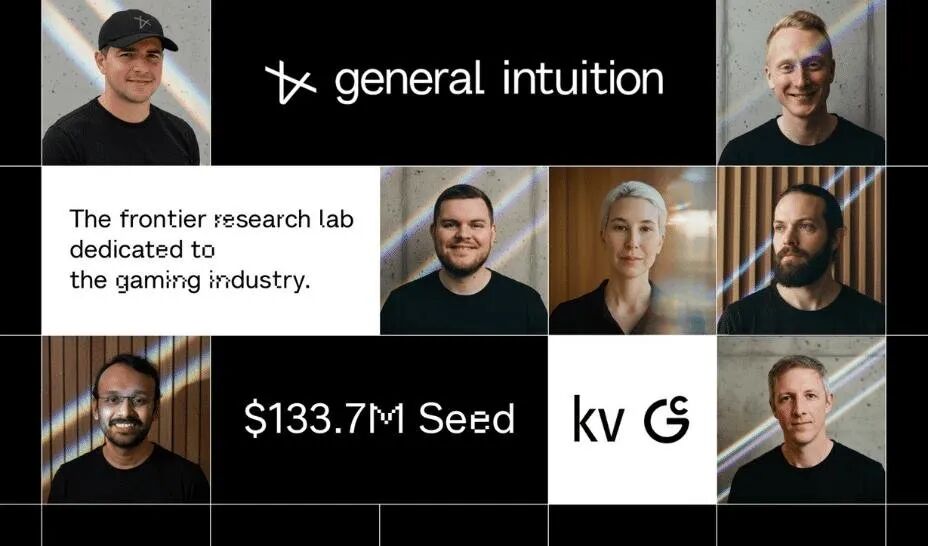
The founding team of General Intuition Source: Public information
Currently, the General Intuition team has about 25 people, and Medal has about 65 people.
A small AI laboratory was able to raise funds continuously in a short period. It is not because of its revenue scale, but because investors believe that it holds a scarce training resource.
General Intuition's AI will first serve the game industry. For example, many robot players and NPCs in today's games are still driven by scripts. They seem smart, but in fact, they just act according to the rules. After players get familiar with them, it is easy to spot the flaws.
What General Intuition wants to do is to let game characters act under the same information conditions. It only sees what an ordinary player can see on the screen, and its action mode is similar to that of a player. The AI trained in this way does not simply know the background data of the map, but makes judgments based on the screen image like a human. More realistic NPCs, more natural training partners, and a more dynamic game world may all enhance the game experience.
However, what General Intuition really wants to do is not just limited to games.
It focuses on "spatial - temporal reasoning", that is, spatial - temporal reasoning. AI needs to understand how objects, people, and the environment change over time.
This is exactly the shortcoming of many AI systems today.
A model can describe that there are tables, doors, and chairs in a picture, but may not know that walking forward will hit the table, turning left can get around it, and the doorknob needs to be turned first to open it.
For robots, this difference is very crucial. To make robots more reliable, they need to have the ability to predict environmental changes.
Humanoid robots, drones, and autonomous driving simulation systems can essentially be abstracted into a process of "observation - judgment - action". The same is true for games. Players observe the environment through the screen and issue actions through the keyboard, mouse, and gamepad. Although their forms are different, their underlying structures are similar.
General Intuition has also begun to attempt commercialization. Public reports mention that the company already has some customers from the game, simulation, and robot fields and plans to expand the availability of its API.
General Intuition wants to be a provider of underlying models. Just as OpenAI and Anthropic provide large - language - model capabilities for others to develop applications based on them, General Intuition hopes to provide action - model capabilities for game companies, robot companies, and simulation companies to develop products based on it.
Three new trends in the AI industry
This round of financing of General Intuition reflects the new competitive logic of AI startups.
First, data has become a core asset again.
In the era of large language models, Internet text, code, pictures, and videos have been widely used. As time goes on, public data is becoming increasingly insufficient, and high - quality, private, and labeled data is getting more and more expensive. The special thing about General Intuition is that its data is not just "watchable", but "action - learnable".
Every key press by a player is an action tag. Every success or failure of a player is a training signal. For the model, this is more valuable than a video with only pictures.
Second, computing power remains the biggest cost.
GamesBeat reported that when Pim de Witte talked about the use of the financing, he directly said that GPUs are very expensive. General Intuition plans to use a large amount of funds to expand its computing power and has a cooperation arrangement with CoreWeave. For cutting - edge model companies, financing is often not for slow spending, but for locking in the computing - power window.
Third, AI is starting to extend into the physical world.
If ChatGPT represents AI's entry into knowledge - based work, then companies like General Intuition represent AI's attempt to enter the world of action.
Although the technology demonstration of General Intuition is eye - catching, it cannot be simply regarded as a sign that commercialization is mature.
The large - scale migration from games to simulation and then to the real world has not been fully proven. The slow acquisition, high cost, and high risk of real - world data are still problems for the entire industry. General Intuition's bet is to use game data as a cheaper and more scalable pre - training entry, and then use a small amount of real - world data for adaptation.
Whether this judgment can hold true still needs time to verify.
General Intuition is also trying to deal with another sensitive issue: the relationship between AI and the game industry, labor, and military applications.
The game industry has always been vigilant about AI. Many developers are worried that AI will replace positions in art, design, writing, and programming. General Intuition publicly stated that it will not develop technologies to replace game developers, designers, or artists.
It also launched the Nerve platform, allowing players to earn income through tasks such as data annotation and remote operation. This arrangement is both a data flywheel and a way to appease the game community.
In terms of military applications, Pim de Witte also set boundaries. He said that he does not want the company's agents to be used to harm humans, but is willing to use them for search and rescue.
This is not entirely in line with the increasingly positive attitude towards defense technology in Silicon Valley in recent years, which also gives General Intuition a more distinct corporate character.
*This article does not constitute any investment advice.
*Cover image created by ChatGPT
This article is from the WeChat official account "Pencil News" (ID: pencilnews), author: Huang Xiaogui, editor: Zhu Zhishan. Republished by 36Kr with authorization.