Doubao was forced to charge fees to support its operations, which in turn raised the visibility of "DAA"
Doubao has finally started charging fees officially.
On June 24th, Doubao officially launched its professional version, which can also be called the paid version. In the past month, discussions about when and how Doubao would start charging fees have hardly stopped.
This AI application produced on the assembly line of ByteDance's App factory, like its "siblings" such as Hongguo Short Dramas, doesn't lack traffic. Its daily active users have exceeded 200 million, making it one of the most successful domestic AI products in China.
However, having traffic doesn't mean it has the ability to support itself. Doubao still needs continuous input of resources such as computing power, bandwidth, and R & D, just like an insatiable "money - gobbling beast". Even ByteDance is almost unable to support it.
Interestingly, I found that Doubao's forced move to charge fees to support itself has inadvertently increased the industry visibility of the DAA indicator, the metric for the AI era proposed by Robin Li, the founder of Baidu.
If ByteDance uses this metric as the standard for Doubao's charging, its commercialization story might be more coherent.
It's time for Doubao to support itself
Public reports show that ByteDance has raised its AI infrastructure expenditure for 2026 from 160 billion yuan to 200 billion yuan, an increase of at least 25%. Some media also reported that ByteDance is discussing an annual AI capital expenditure as high as 70 billion US dollars.
This level of money - burning can only be rivaled by Alibaba and Tencent among domestic AI giants.
However, their AI investment strategies are different. Behind Qianwen, there is a huge business ecosystem such as Alibaba Cloud and Taotian e - commerce. Whether Qianwen itself can make money is just one part of Alibaba's AI strategy. Its positioning is to be Alibaba's entrance in the AI era, leveraging the entire Alibaba business ecosystem through its "problem - solving ability".
Tencent is similar. Although it still adopts a horse - racing strategy, focusing on Yuanbao and WeChat AI simultaneously. Even if Yuanbao isn't performing well, it has WeChat, almost the only super - app in China. WeChat AI (AI Xiaowei) will form a commercial closed - loop within the WeChat ecosystem, and whether it can make a profit isn't very important.
Doubao is different. The more users it has, the more it depends on the group's cash flow, and the larger its loss scale becomes. Under ByteDance's current AI strategy, this isn't allowed.
At the Volcengine FORCE Primitive Power Conference on the 23rd, Liang Rubo, the CEO of ByteDance, made a rare appearance. He emphasized in a video speech that ByteDance has been narrowing its business scope in recent years. To ensure strategic focus, it has been tilting resources towards the AI field; within the AI track, it has further focused on improving the core model capabilities.
Under this layout, Volcengine's MaaS business has been upgraded from an innovative business to a basic business of ByteDance. The company will make long - term and firm investments in this sector.
In other words, AI is no longer an innovative trial - and - error business, but a basic business that must make money. Doubao needs to integrate into Volcengine's MaaS business and start independently undertaking commercialization tasks. If it can't prove that it can make money to support itself, ByteDance's AI story will be hard to justify.
However, Doubao's current revenue return far lags behind its money - burning speed. After Liang Rubo, Tan Dai, the president of Volcengine, made a rare "public cry of poverty". He revealed that the daily average token calls of the Doubao large - model have reached 180 trillion, more than 1500 times the number at the time of its release. Correspondingly, Doubao's daily active users exceed 200 million (the latest data shows about 345 million), the daily average computing power consumption reaches tens of millions of yuan, but the daily revenue is less than one million yuan.

Picture | Doubao large - model, reference picture
A research report by Guolian Minsheng Securities in May estimated that if calculated based on the cheapest Doubao model, the cost of providing one - day free AI services by Doubao is between 132 million yuan and 240 million yuan.
Even if ByteDance has optimized the technology. For example, the inference efficiency of Doubao 2.0 has increased by 43%, the first - packet delay in long - context scenarios is more than 25% lower than the industry mainstream, and the inference cost per 10,000 tokens is 38% of that of the compliance link of overseas leading models.
It's difficult to fill this huge loss pit in a short time.
Facing the high costs, ByteDance, which doesn't lack traffic, has to adopt the original "basic free + high - level subscription" SaaS model to let Doubao generate revenue. In essence, this uses price anchors for domestic AI paid education and achieves cost diversion through hierarchical subscriptions.
Doubao is pricing the productivity of Agents
Overall, the key to Doubao's success in charging fees to support itself lies in extreme cost - effectiveness and a qualitative change in productivity.
In terms of pricing, Doubao's professional version offers three levels of paid subscription services, consistent with the standards in the product description document in May: the standard version costs 68 yuan per month, the enhanced version costs 200 yuan per month, and the advanced version costs 500 yuan per month.
The new change is that it has added an education discount plan of 38 yuan per month for college students and will launch a discount plan for the video - call needs of visually impaired people.
This charging standard is quite "competitive" among similar products at home and abroad. For example, ChatGPT offers package options ranging from 8 US dollars per month (about 54 yuan) to 200 US dollars per month. Among them, the annual fee for ChatGPT Pro is about 16,295 yuan, while the annual cost of the highest - level advanced package of Doubao's professional version is 5088 yuan, which is relatively more moderate compared to the former. Domestically, Kimi was an early adopter of the paid model, setting up four levels of subscription services, from the entry - level version at 49 yuan per month to the premium version at 699 yuan per month.
However, in the domestic market where users are used to "free packages", charging fees will filter out the majority of users. Moreover, price isn't the decisive factor affecting users' willingness to pay.
Whether Doubao's professional version can make money depends mainly on whether its productivity effects can make users feel it's worth the price.
Tan Dai said at this conference that only when the model's capabilities cross the "qualitative change point" can it truly meet the needs of enterprises and individuals in production scenarios. According to official disclosures, Doubao 2.1 Pro has achieved a leap in capabilities in three core directions: Coding, Agent, and VLM (Visual Language Model). Its performance in multiple evaluations is better than that of Claude Opus 4.6, officially crossing the production - level qualitative change point.
This is also regarded as Doubao's first Agent version. Compared with previous general AI products mainly focused on dialogue, search, image understanding, and document Q & A, Doubao's professional version focuses on "work - capable" work and productivity scenarios.
From personal use and tests by multiple AI media, the office task mode and expert mode that Doubao's professional version features have some highlights but also many deficiencies, and it hasn't distanced itself from its competitors.
For example, during a practical test, AIX Finance found that when making PPTs, reading reports, and developing applications, the efficiency was high but there were hallucinations. Regarding the hallucination problem, it would provide some answers that don't conform to common sense, fabricate some information, and some content didn't match the official website.
It concluded that it can help you prepare materials, but you still need to make the final judgment and review, which is on a par with similar products.
The expert mode is the same. It can think and analyze, but it lacks accuracy.
Doubao has no other choice. It still chooses to make money by "helping people work and improving efficiency" in the dimension of the Token economy. This is also ByteDance's pricing for AI productivity in the Agent era.
From the perspective of positioning and service scenarios, Doubao's professional version could be spun off into a new product, but Doubao has only made a distinction in name. There may be a lack of confidence in charging fees within the company.
ByteDance can use a different metric
For Doubao, if it changes its charging logic and makes it work, becoming a new value coordinate for ByteDance to persuade users to pay, its commercialization story might be told more smoothly.
This reference logic is the metric for the AI era proposed by Robin Li - DAA, Daily Active Agents, which refers to the number of daily active intelligent agents.
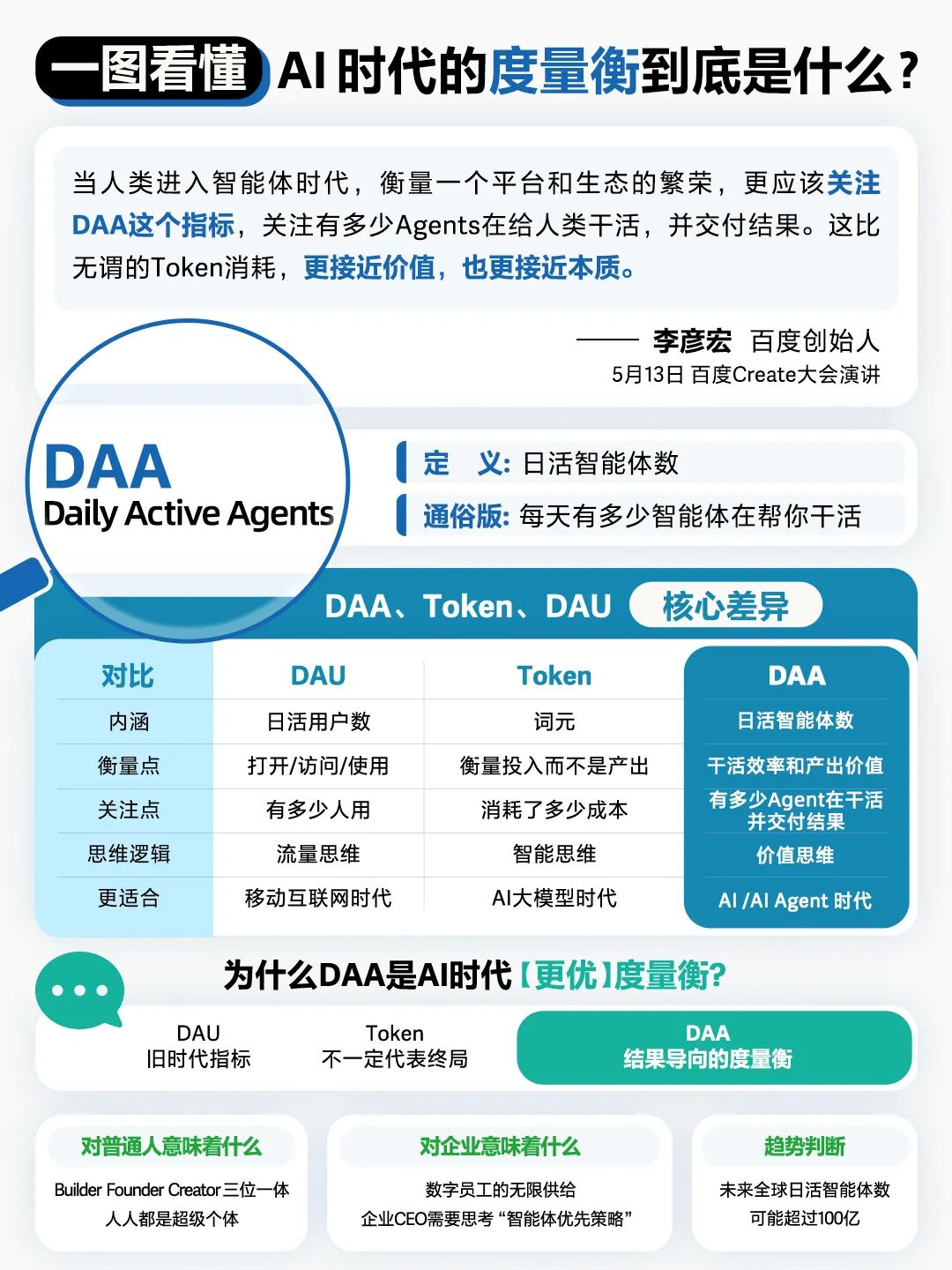
Picture | Understand what DAA is at a glance
He proposed at the Baidu Create 2026 Conference that tokens don't necessarily represent the end - game. They only represent costs, not benefits, and measure inputs rather than outputs. As AI enters the Agent era, to measure the prosperity of a platform and ecosystem, we should focus more on the DAA indicator, paying attention to how many Agents are working for humans and delivering results. This is closer to value and essence than meaningless token consumption.
Before he proposed the DAA concept, the AI industry, including ByteDance, mostly used DAU and tokens as metrics.
DAU (Daily Active User) follows the traffic logic and network effect of the Internet era. The larger the user scale, the higher the growth and commercialization efficiency.
This indicator system once supported the development of the Internet for decades, but it may be contrary to the underlying logic of AI. On the one hand, the popularization of AI has lowered the technical threshold and eliminated the scarcity of traffic. The focus of product competition has shifted from user scale to execution ability and user experience. On the other hand, the computing power cost of AI products has broken the law of decreasing marginal cost in the Internet. The larger the user scale, the higher the cost.
A typical example is that the total DAU of all products under Anthropic, a star in the AI field, is only 2% of that of ChatGPT, the flagship application of its competitor OpenAI. However, in April this year, Anthropic announced that its annual recurring revenue (ARR) in 2026 exceeded 30 billion US dollars. This scale has exceeded that of OpenAI, whose disclosed annual recurring revenue is about 25 billion US dollars.
This change in status is actually a divergence in the underlying business logic. OpenAI follows the old Internet logic, first using free products to attract users and expand DAU, and then realizing monetization later. Anthropic directly aims at value realization. It first looks for corporate customers willing to pay and achieves profitability through high - value task delivery.
The signal it sends is that in the Agent era, the classic path of the consumer Internet doesn't work. "Creating high - value task delivery" is more important than "user scale". In other words, the value of task delivery takes precedence over the scale of user traffic.
After DAU is no longer applicable, tokens have become the current mainstream statistical unit in the industry. Jensen Huang's view on tokens is quite representative. He believes that data centers are changing from places for training models to factories for producing tokens. Tokens will be the most core and valuable commodities in the future digital world.
Jensen Huang almost directly said that the future of AI is tokens. Many people regard this as an extreme statement, but he accurately pointed out the essential positioning of tokens. That is, as the basic unit of AI inference and decision - making costs, tokens are the "fuel" in the AI era. Their value is determined by production speed, power consumption efficiency, and application scenarios.
This shows that tokens may only be a basic cost indicator, recording only inputs and not accounting for outputs. It can measure the "power consumption" of AI and the consumption of computing power resources, but it can't reflect efficiency and benefits, can't evaluate output value, and can't confirm real commercial value. It's somewhat "distorted".
High token consumption doesn't mean high - value results, just like a programmer writing a lot of code doesn't mean the software quality is higher. Because there are still a large number of invalid calls and redundant operations, which are typical extensive growth indicators.
During the ISC.AI 2026 (the 14th Internet Security Conference), Zhou Hongyi also exposed the deficiencies of tokens. He said that before using Longxia, he had no concept of token consumption and thought that one had to be willing to spend money on AI.
However, after working on Longxia for six months, two problems made him desperate, and he decided to abandon using Longxia in a new product. "One is the core security uncertainty. A lot of work needs to be done to solve security problems. And Longxia's token consumption is really wasteful. It's really an unreasonable consumption. Basically, making a PPT would consume hundreds of millions of tokens. If using the most expensive model, this cost would be equivalent to thousands of yuan."
In my opinion, DAA is a better "metric" provided by Baidu for the industry in the Agent era after DAU and tokens. Compared with DAU and tokens, DAA breaks out of the single dimension of traffic and cost and redefines the value measurement logic in the Agent era.
This actually fills the gap in the value dimension of tokens. If tokens determine the lower limit of AI costs, then DAA determines the upper limit of AI value. In the future, they will jointly form the basic coordinate system for the metric in the AI era.
Looking back, the entire industry this year has been gradually downplaying the token economy, trying to end the endless token consumption. MiniMax, Zhipu, Kimi, and Alibaba Cloud have all adjusted their prices, collectively bidding farewell to the extensive money - burning competition.
The value of DAA has become even more prominent. Doubao's "nest - style" charging has inadvertently thrown the "bait" into the core value circle of DAA. Its paying group will mainly be professional users, who put forward higher requirements for the ability of Agents to perform tasks on the ground, which is the core of DAA.
This also makes the entire industry pay attention again to Robin Li's judgment: in the Agent era, DAA, which can measure actual productivity, is likely to become the ruler for measuring AI value.
At the same time, Doubao's charging is also a proof question for its peers such as WeChat AI, Qianwen, and Wenxin: Can AI assistants achieve commercialization through the most primitive paid method based on productivity and cost - effectiveness?
In the process of solving this problem, DAA can be used as a supplementary condition and idea to help ByteDance find the answer quickly. The question is, will Doubao take this advice?
Reference materials:
AIX Finance, "Is the 68 - yuan professional version of Doubao worth it? A practical test"
Doubao, "Today, Doubao officially launched its professional version"
Tang Chen, "「DAA × Self - evolution」, Baidu initiates a revolution in the metric for the Agent era"
This article is from the WeChat public account "Tang Chen", author: Tang Chen, published by 36Kr with authorization.